From programmer to industry leader, as one of Australia’s only Chief Information Officers in technology, Andrea Walsh has shattered the glass ceiling. And she’s championing other women, while she’s at it.
So, is she a game changer? Let’s find out. I’m Sarah Harris. Welcome to Game Changers.
Sarah: Andrea, welcome to Game Changers, now you are one of Australia’s only female CIOs of a technology company. You must see yourself as a bit of a role model?
Andrea: I never thought I was, but having been in the role now for number of years I look around and I do think where are all the other women, where are all the females.
Sarah: And, where are they?
Andrea: There is just a real shortage of women in I.T and technology, which is a real shame.
Sarah: So, tell us a little bit about Isentia and what it actually does.
Andrea: So, Isentia is a media monitoring company. And basically what that means is we take information and news from across varying countries, about 18 countries, multiple languages, and we filter that and disseminate it to what is important to our clients and what are the leading issues that they need to focus on. An average day, there’s about 7 million news items that we’re processing.
Sarah: That is a big job, lots of information to get through. So, what does your role as CIO involve?
Andrea: So, I lead the technology team. We are responsible for all the systems and the technology that processes those 7 million items a day. And we also provide all the services for our clients and tools for them to be able to do their job each day.
Sarah: Why do you think there’s a lack of women in IT roles?
Andrea: I think through education. I don’t think that girls are encouraged to take up sciences and engineering when they’re younger. It’s very much seen as, ‘it’s for the boys’. I think it starts really early on. And then I also think women don’t put themselves forward necessarily for opportunities, and roles to re-train. And maybe say, I might be interested but unless I’m absolutely sure I not going to give it a go.
Sarah: You are quoted as saying, “we’re on the cusp of a technological revolution”. What are you most excited about?
Andrea: There is so much. I think that’s what’s exciting. I think with cloud technology, it’s enabled a lot of organisations to be able to experiment with technologies. And things like artificial intelligence, so looking at machine learning. And I think that will really shape future roles and jobs.
Sarah: You really passionate, which I love, about women moving up in the industry. In particular, girls learning how to code. For someone who is not as technologically advanced as you, perhaps, explain to me what coding actually is.
Andrea: It’s basically creating something using computer and technology. Sometimes, yes, it has to be, or can be, detailed lines of programming. But some of the tools that are available, especially to young children who are interested in coding, enables kids to build stories, cartoons and make videos.
Sarah: The number of girls studying, as you said before, STEM, which is science, technology, engineering and mathematics, it is slowly increasing. Which is brilliant. But it’s not at a rate of ‘the boys’ just yet.
Andrea: No. Certainly not. And I think that it is great that it is slowly increasing. But it’s got a considerable way to go.
Sarah: Well, how do we change that?
Andrea: I think again, it goes back to the education. It’s encouraging girls and young children to get involved in these subjects. And I also think that they have maybe a brand, or an image, issue with engineering and IT often see as ‘it’s for the boys’. I think it’s also about the parents and the carers. So often we teach our children when they come home about doing their homework, reading, writing, maths. But what about the children who want to learn technology, and they want to learn to code? And if the parents aren’t IT, how do they support them. So I think it’s really about, as I say, the education, but then also then about the parents and finding these great programs that are out there to give the kids opportunity.
Sarah: Your daughter is eight and she’s already taken an interest.
Andrea: When I first showed her the iPad, she just took it instantly. It was quite amazing to experience. We certainly encourage here to use it. There’s s o many educational programs for children that you can use on the iPad. So I’m a big advocate of it.
Sarah: It does bring up that other thing as well, because I have a little boy who’s 18 months, and he’s very savvy when it comes to technology. You know, he’s coming up to the television and trying to swipe it like an Ipad. But I do kind of worry that (you know) we’re introducing technology to these kids too early, because there’s been research that show that it’s actually changing the chemistry of the brain. When should we be introducing this sort of stuff to our kids? Because as a parent you sort of think to yourself, I don’t want my kids to have their head in technology all the time. But at the same time, you don’t want to hold them back, because that’s the future.
Andrea: I think its each individual parent’s choice. For our daughter’s, Charlotte, we introduced it quite early on, so it was before kindergarten. But we’re very strict with her, both from what she can do on there and so content she can see. And also how long she spends on there, because the last thing we want is to build a relationship and the communication is with the back of an Ipad all of the time.
Sarah: IT is a well-paying field, but there id still a gender pay gap when it comes to technology, isn’t there?
Andrea: Where I work at Isentia, we pay the market rate and we pay on skills regardless of gender. But it is a known issue within many industries and with many organisations and that’s something we need to address.
Sarah: What advice you want to give to women that you mentor?
Andrea: I would say, seek every opportunity. Just go for it – what can you lose at the end of the day? I think work with other areas of the business as well; get to know the business and the industry in which you work. Do things that are potentially outside your remit so you can learn and grow from them.
Sarah: You are a trailblazer and a Game Changer. Thank you for joining us today.
Loren is an experienced marketing professional who translates data and insights using Isentia solutions into trends and research, bringing clients closer to the benefits of audience intelligence. Loren thrives on introducing the groundbreaking ways in which data and insights can help a brand or organisation, enabling them to exceed their strategic objectives and goals.
This is not a list of what to do to be more successful. Or a list about the highly successful morning habits of CEOs and CIOs.
Instead, it’s a call-out to others who read the titles of articles like these on a Monday and sometimes feel exhausted by the amount of additional ‘work’ that is actually recommended to be more productive or successful.
This is, however, a question as to whether our push for productively has blurred into so many areas of life that we’ve forgotten why we strive to be increasingly efficient in the first place. Are we now too focused on volume, rather than value?
For example, in the last week alone we’ve seen the launch of a five-minute workout video series, been served an ad for an app which gives you the world’s best nonfiction books in bite-sized formats and scrolled past a ‘mindfulness in microseconds’ Instagram post.
While squeezing more into everyday life is a common challenge (and arguably a goal) for many professionals, it does present an interesting behavioural shift where we start to use smart technology to speed up activities that perhaps we shouldn’t.
Working in the always-on media Industry, we work with some of the most pressed-for-time people on a daily basis.
These communications and marketing professionals are dealing with huge amounts of fragmented media across channels that sometimes need urgent attenuation or action, particularly in times of crisis. However, this is where our technology thrives – it puts in the hard yards for them. Crunching huge volumes of data, providing the tools to report, alert, shred and more, and helping to give back time that should be spent on the more important strategic tasks, away from a computer.
From a professional standpoint this could mean more time for pitching ideas, benchmarking results against business strategy or presenting to the board. This is where value is achieved – with time spent on activities that need extra thinking space and deserve focus. From a personal standpoint, this may mean taking time back to pick up the kids from school, getting to yoga or simply enjoying a cup of tea in silence.
It’s not a case about fitting more into the day, but about filling your day with more valuable activities. Smart technology holds so much power in helping us spend less time on task-based needs like emails, to-do lists and life admin to free up the time for (hopefully) more than a ‘mindfulness in microseconds’ quick fix.
Remember, effort is not the same as impact.
"
["post_title"]=>
string(30) "The push to be ‘on’ by 6am"
["post_excerpt"]=>
string(126) "This is not a list of what to do to be more successful. Or a list about the highly successful morning habits of CEOs and CIOs."
["post_status"]=>
string(7) "publish"
["comment_status"]=>
string(4) "open"
["ping_status"]=>
string(4) "open"
["post_password"]=>
string(0) ""
["post_name"]=>
string(24) "the-push-to-be-on-by-6am"
["to_ping"]=>
string(0) ""
["pinged"]=>
string(0) ""
["post_modified"]=>
string(19) "2019-06-25 08:16:04"
["post_modified_gmt"]=>
string(19) "2019-06-25 08:16:04"
["post_content_filtered"]=>
string(0) ""
["post_parent"]=>
int(0)
["guid"]=>
string(36) "https://isentia.wpengine.com/?p=1975"
["menu_order"]=>
int(0)
["post_type"]=>
string(4) "post"
["post_mime_type"]=>
string(0) ""
["comment_count"]=>
string(1) "0"
["filter"]=>
string(3) "raw"
}
Blog
The push to be ‘on’ by 6am
This is not a list of what to do to be more successful. Or a list about the highly successful morning habits of CEOs and CIOs.
What can you learn from 750,000 social media posts in China each day? Sean Smith of Isentia explores how technology is disrupting market research.
No Facebook. No Twitter. No YouTube. With stifling regulations around social media use, how can New Zealand businesses’ use social media to enter Chinese markets?
The basic premise remains the same – the way in which Chinese consumers engage with social media platforms is not dissimilar to here, nor is their decision-making journey. Needless to say, understanding the landscape is paramount for any company aspiring to capitalise on the booming Chinese economy. It’s certainly an opportunity worth pursuing – this year China’s GDP is estimated to exceed US $12.1 trillion (NZ $16.44 trillion).
An obvious difference from the outset is the sheer volume of online conversations that happen within China’s firewalls.
This is not surprising given the 740 million-odd internet users, and is exacerbated by the fact that social media is a much larger phenomenon in Chinese culture than it is here in New Zealand.
In today’s digital world, this level of activity offers businesses unprecedented access to millions of organic conversations unfolding in the alluring Chinese market – in real time. The million-dollar question is, how can this information be used to help businesses make important decisions about when to launch a product in the market and drive sales?
Givenchy and Mr Bags
A great example of the power of social media in China is the partnership between Givenchy and blogger Tao Liang, better known as Mr Bags.
He uses his encyclopaedic fashion knowledge to retain over 2.7 million Weibo readers and a further 600,000 WeChat followers; keen to be ‘in the know’ on the latest handbag trends and the current “it” bag.
In an act of extreme commercial nous, in 2017 Mr Bags called for his followers to nominate a potential collaborator for the blogger. When Givenchy emerged as the overwhelming favourite, the brand took the opportunity to launch a limited-edition handbag on Valentine’s Day via Mr Bags’ social channels. What followed the announcement was a 12-minute frenzy seeing Givenchy part with 1.2 million RMB’s (NZ$247,000) worth of handbags – a complete sell-out. Needless to say, the campaign was deemed a success.
Listen to many, speak to a few
By now it’s no secret that social media isn’t just a broadcast platform. In fact, true to the proverb “we have two ears and one mouth, so we should listen more than we say”, there’s far greater power in using social media to understand a potential customer’s motivations.
In today’s world, social media provides market research on an unprecedented scale.
Once upon a time, businesses invested heavily in market research groups to understand consumer insight.
Test groups were enticed with gift vouchers or free products to partake in a fishbowl-style exercise, where they were asked to provide honest and open feedback as eager marketers and communicators looked on.
Despite questions being developed using the latest, tested methodology and astute moderators, the quality and authenticity of the data was often in question.
Let me be clear – this has less to do with the methodology and more a reflection that as consumers, we find it much easier to speak the whole truth when we think we’re not being watched.
With such a high level of human involvement, it is also incredibly difficult to collect data consistently and without bias.
Technology: the market research disruptor
Why might technology make consumers more honest and open with their feedback? The truth is people are more honest in a casual setting. Therefore, dialogue about a product or service that’s exchanged in the comfort of someone’s home (behind a screen) will often be more candid than their responses to a survey.
At Isentia, Mediaportal’s cloud-based technology trawls video, audio and digital content across more than 4,400 print items, 1750 broadcast items, 62,500 online news sites, 6 million blogs and 300,000 forums. Processing seven million news items each day a rate of 234 stories per second, it presents summaries to clients in real-time.
For China enthusiasts, the technology mines over 750,000 WeChat and Weibo posts daily and uses this information to unearth the Mr Bags’ opportunities – the people or issues relevant to specific industries – so that businesses can make informed decisions based on both data and sentiment in foreign markets.
What’s more, the nature of social media means the survey technically never ends. Social media listening provides continued real-time pulse checking and the perfect new product incubator. It’s more than watching @mentions and comments pour in via your social profiles, mobile apps or blogs.
“If you’re only paying attention to notifications, you’re missing a huge group of people that are talking about you, your brand and your product.”
The true value is in tracking conversations around specific topics, keywords, phrases, brands or industries, and leveraging these insights to discover opportunities or create content for those audience.
Data – a modern marketing and communications must-have
It is now hard to imagine a marketing and communications industry that doesn’t rely on data to inform strategy, new product development and campaigns.
Much of what took place in marketing and communications teams, even as recently as a decade or so back, was based on assumption. We *think* that this product would be of interest to this audience, so we *figured* the best way to tell them about it would be mostly via a TV ad campaign.
“But data is now essential for any smart and savvy marketer or communicator and presents the opportunity to tap into foreign markets with a level of insight that has never been more accurate or accessible.”
When you combine and embrace the use of technology, social media, and analyse the data that it provides – you can not only quickly test and learn new products, but also give the fans what they want.
Givenchy were clever and reaped the rewards of listening, embracing and reacting to their consumers’ want, making it big in China. Now it is your time to get onboard and reap the results.
"
["post_title"]=>
string(30) "Listen to many, speak to a few"
["post_excerpt"]=>
string(164) "No Facebook. No Twitter. No YouTube. With stifling regulations around social media use, how can New Zealand businesses’ use social media to enter Chinese markets?"
["post_status"]=>
string(7) "publish"
["comment_status"]=>
string(4) "open"
["ping_status"]=>
string(4) "open"
["post_password"]=>
string(0) ""
["post_name"]=>
string(29) "listen-to-many-speak-to-a-few"
["to_ping"]=>
string(0) ""
["pinged"]=>
string(0) ""
["post_modified"]=>
string(19) "2019-06-25 08:14:24"
["post_modified_gmt"]=>
string(19) "2019-06-25 08:14:24"
["post_content_filtered"]=>
string(0) ""
["post_parent"]=>
int(0)
["guid"]=>
string(36) "https://isentia.wpengine.com/?p=1973"
["menu_order"]=>
int(0)
["post_type"]=>
string(4) "post"
["post_mime_type"]=>
string(0) ""
["comment_count"]=>
string(1) "0"
["filter"]=>
string(3) "raw"
}
Blog
Listen to many, speak to a few
No Facebook. No Twitter. No YouTube. With stifling regulations around social media use, how can New Zealand businesses’ use social media to enter Chinese markets?
Isentia’s analysis of stakeholder reactions to the NSW Budget across 11 key sectors.
The 60-second summary
In his fourth budget, handed down on Tuesday, Treasurer Daniel Mookhey prioritised cost-of-living assistance for New South Wales residents.
In response to rising fuel prices and three interest rate increases, the government announced a $100 discount on car registration, a reduced toll cap, and frozen Opal fares. The budget also includes a record $10.3 billion commitment to health and a significant increase in funding for domestic violence services.
In reaction to the announcements, stakeholders responded with caution rather than celebration. Economic growth forecasts have been revised down to 1%. The budget has returned to deficit, and property tax revenue is declining.
Industry groups broadly described the budget as careful and responsible, while advocates for renters, farmers, the homeless and people with disabilities criticised the limited support. Groups representing the almost 3 million people who live in regional New South Wales - almost one-third of the state’s population - felt the budget fell short for the regions.
And with a state election approaching in early 2027, many stakeholders indicated they will continue to advocate for additional measures from the Minns government.
The numbers at a glance
Key figures highlighted by stakeholders:
$10.3 billion Health funding increase (4 yrs)
$561.4 million Transport Affordability Package
$100 Off private car registration
$50 Weekly toll cap (down from $60)
$184.1 million Domestic & family violence boost
$9.2 billion New & upgraded schools
$6.5 billion Electric buses (10 yrs)
$116.7 billion Total infrastructure pipeline
$2.3 billion 2026-27 deficit
1.0% Growth forecast (down from 2.5%)
Sector scorecards
Cost of living relief [Mixed]
The budget’s headline announcement is a 12-month, $561.4 million Transport Affordability Package, offering $100 off private car registration, a reduced weekly toll cap from $60 to $50, Opal fares frozen at 2025 prices, and the removal of toll administration fees.
Additionally, $557.1 million was committed to the Home Energy Saver scheme, continuing the interest-free loans for households to install energy-saving upgrades.
The New South Wales public sector is the largest employer in Australia, so a $1,000 bonus for 120,000 government workers was well received by the Public Service Association and for public servants living in Sydney. The bonus comes off the back of the announcement that Sydney’s CPI had exceeded 4 per cent since this time last year.
Australia’s peak industry association, the Australian Industry Group, described the cost-of-living measures as a sensible response, acknowledging current economic challenges, noting that the relief is intended to be temporary.
"Today's NSW Budget treads carefully, given the challenging economic times ahead for the State's economy."
— Helen Waldron, NSW State Head, Australian Industry Group
Leading community services organisation Social Futures welcomed the support but cautioned that it is limited, noting that lower public transport fares and tolls primarily benefit urban areas, and that low-income households remain at risk.
And the Insurance Council of Australia expressed concern that the Emergency Services Levy continues to rise, with NSW households and businesses carrying the load, set to pay $1.5 billion this year.
Health and mental health [Mixed]
The NSW health sector received the largest commitments in this year’s budget, with a $10.3 billion increase over four years. This increase includes 9,000 additional health workers, and an $11.9 billion building program for 32 hospitals and 2,500 extra beds.
The industry group representing NSW general practitioners welcomed support for patient transitions out of hospital, funding for rural travel, and the Thriving Kids and ADHD initiatives.
"GPs can help to cure a healthcare system struggling under the burdens of an ageing population, an epidemic of chronic disease, and a growing need for mental health care."
— Dr Rebekah Hoffman, RACGP NSW & ACT Chair
The doctors’ union was more guarded in its response, with the Australian Salaried Medical Officers Federation (ASMOF) welcoming the funding but stating it does not address the core issue of recruiting and retaining staff, as NSW continues to offer the lowest doctor salaries in Australia.
"Doctors, nurses and other health professionals have kept the public health system functioning under enormous pressure, but dedication is not a workforce plan."
— Dr Nicholas Spooner, President, ASMOF NSW
The NSW branch of the Australian Medical Association took the criticism further, with NSW AMA claiming the government’s health funding has gone backwards in real terms, due to health inflation rising at 4.9 per cent.
"The NSW Government has promised 9,000 additional health workers, including paramedics, nurses and allied health staff, but there is no mention of doctors. That is a serious gap in today’s Budget."
—Dr Fred Betros. President, AMA NSW
Mental health groups expressed concerns about their stakeholders being overlooked in this year’s budget. The Mental Health Coordinating Council welcomed crisis funding, but stated the budget relies too heavily on hospitals to deliver services.
"Mental health reform cannot rely primarily on hospitals and crisis responses."
— Dr Evelyne Tadros, CEO, Mental Health Coordinating Council
NSW’s Network of Alcohol and Other Drugs Agencies (NADA) also criticised the government for not addressing priorities from the 2024 Drug Summit, leaving over 100,000 people waiting for treatment.
Housing, property and homelessness [Negative]
Housing was the most challenged area in the budget announcement. The government highlighted planning reforms, an expanded Pre-Sale Finance Guarantee, and funding for Modern Methods of Construction.
Community housing group, Faith Housing and the Planning Institute of Australia viewed these as positive steps. However, the Urban Development Institute raised concern over an $8 billion reduction in property tax revenue.
"The lack of direct investments in supply-side initiatives in this Budget will make it harder for us to turn around the housing crisis."
— Stuart Ayres, CEO, UDIA NSW
The peak body for property developers in Australia, Urban Taskforce described the budget as a missed opportunity to increase housing supply, and the Property Council warned that additional federal tax changes could further reduce the number of new homes.
Homelessness and tenant advocates were more critical. Homelessness NSW described the housing package as insufficient, and the Tenants' Union noted that the government holds $2.5 billion in renters' bonds, forgoing up to $200 million annually in interest.
"We should not let the pursuit of budget savings punish the state's most vulnerable people by putting off meaningful investment in housing and homelessness."
— Amy Hains, A/CEO, Homelessness NSW
The Retirement Living Council welcomed the removal of foreign surcharge duty on large retirement village projects, describing retirement living as essential infrastructure.
Domestic violence and social services [Positive]
A $184.1 million increase put forward by the government would raise funding by 50% across six frontline domestic and family violence programs, marking the largest core funding boost for the sector in over a decade.
The Male Family Violence Prevention Association, or “No to Violence”, had advocated for this change, and welcomed the recognition of programs directly addressing men who use violence.
"Men's Behaviour Change Programs play a vital role in stopping violence at the source."
— Phillip Ripper, CEO, No to Violence
The NSW Council of Social Service (NCOSS), NSW’s peak social services body, responded to the announcements positively. They welcomed funding for award wage increases for community workers and enhanced patient travel support, while advocating for increased investment in preventative measures.
"This Budget lays the groundwork for deeper investment in people and communities."
— Cara Varian, CEO, NCOSS
Community groups like Uniting NSW.ACT and Social Futures agreed, stating the budget missed an opportunity to invest in early support to prevent families from reaching crisis.
Infrastructure and construction [Mixed]
While the government highlighted a $116.7 billion infrastructure pipeline, industry stakeholders pointed to a downward trend. Infrastructure Partnerships Australia reported a $1.1 billion reduction in infrastructure funding, but characterised this as a deliberate measure, rather than neglect.
"The Budget isn't flash, it doesn't hand out treats like confetti, but it does deliver a sizeable serving of sensible government."
— Adrian Dwyer, CEO, Infrastructure Partnerships Australia
Construction industry groups expressed concern, with the NSW Civil Contractors Federation (CCF NSW) warning that without a consistent pipeline, skilled workers may relocate interstate and become costly to attract back.
"This State Budget reflects an underwhelming level of infrastructure investment relative to the scale of NSW's growth needs."
— Kylie Yates, CEO, CCF NSW
The NSW Master Builders Association and the Housing Industry Association were more optimistic, noting increased housing approvals and welcoming the emphasis on prefabrication and materials supply.
Business and industry [Mixed]
Business groups acknowledged the Treasurer’s fiscal discipline but noted a lack of direct support.
Business NSW welcomed the $4.1 billion workers’ compensation premium freeze for employers but highlighted the absence of a payroll tax cut and no changes to the Emergency Services Levy.
"The Government is expecting to collect an additional $1 billion in payroll tax – or about $25,000 per eligible business – pushing more of the tax burden onto employers at a time they can least afford it."
— Daniel Hunter, CEO, Business NSW
Unions NSW viewed the budget differently, describing the end of the wage cap and the return of hospitals and prisons to public management as positive outcomes for workers.
"We are seeing the dividend of a government that understands the value of essential workers."
— Mark Morey, Secretary, Unions NSW
Regional NSW and agriculture [Negative]
Perhaps the strongest criticism on budget night came from regional stakeholders across the state. The Country Women’s Association of NSW stated the budget prioritised those living in Sydney, with significant funding for Western Sydney hospitals, schools, and transport, while regional roads, maternity services, and mobile coverage were not addressed.
"Billions for Western Sydney. Crumbs for the bush. The Budget does not lie."
— Tanya Jolly, State President, CWA of NSW
NSW Farmers also criticised the budget, stating it was repeating previous announcements and not in support of the sector’s goal of reaching a $30 billion industry by 2030. Both groups indicated they will make regional NSW a key campaign platform ahead of the 2027election.
"Producers are facing generational challenges and what we've seen today is a recycled response that does nothing to address the issues that matter most."
— Xavier Martin, President, NSW Farmers
Education and early learning [Mixed]
The budget included education commitments of $9.2 billion, including over 260 new and upgraded schools, with a quarter of the funding to be directed to regional areas.
Education workers unions welcomed the move to make tens of thousands of teaching positions permanent. However, the early learning sector received no immediate funding boost, noted by the Independent Education Union. They cited the absence of promised support for community preschools, although an announcement is expected soon.
"It's time for wages that properly value the work of community preschool staff."
— Carol Matthews, Branch Secretary, IEUA NSW/ACT
Energy, environment and transport [Positive]
The budget outlined $6.5 billion over ten years to build electric buses and depots in NSW, a measure supported by unions for supporting local manufacturing.
The continuation of funding to households looking to make energy savings was mostly well received, with $557.1 million promised for the Home Energy Saver program.
Further to this, the budget looks to unlock up to $77 billion in private investment through the Electricity Infrastructure Roadmap. Master Builders of NSW emphasised the benefits of the funding, creating regional construction jobs with the rollout of renewable energy projects.
Legal and justice [Negative]
The NSW Police were promised funding across a range of initiatives in a challenging period for law and order in the state. In reaction to the funding announcements, the Police Association of NSW (PANSW) welcomed the $108.8 million investment targeting digital infrastructure and crime-fighting technology. However, the union pushed for more workplace reform and funding for front-line resources.
To the contrary, the legal sector expressed dismay about being excluded from infrastructure spending. The Law Society of NSW stated the legal profession was overlooked in the budget’s building program, with no funding for key asks such as safe rooms for victims or digital court upgrades.
"Our members will be disappointed that the court system was allocated a meagre share of the $116.7 billion in state infrastructure investments through to 2030."
— Ronan MacSweeney, President, Law Society of NSW
Community Legal Centres NSW further noted that $3.5 million promised under a national agreement for community legal practice a year ago remains unfunded.
"People cannot pay their rent with promises, and community legal centres cannot deliver services with funding that has never arrived."
— Sarah Marland, Executive Director, Community Legal Centres NSW
Mining and resources [Positive]
The resources sector responded positively, highlighting in statements that mining royalties are projected to reach $3.4 billion next year. The Association of Mining and Exploration Companies (AMEC) welcomed the continuation of the Critical Minerals Royalty Deferral Scheme and progress on land access reform, while emphasising the need for faster project approvals.
"There's no better way to improve productivity than approving projects quicker."
— Warren Pearce, CEO, AMEC
The NSW Minerals Council had a similar sentiment but took the opportunity to criticise the federal government for recent inflation and interest rate hikes and proposed changes to capital gains tax and negative gearing. They pointed to the claim that the NSW budget will now lose at least $8.4 billion in foregone property-related taxation revenues, and that mining royalties will need to help cover that gap.
The winners and losers
Stakeholders point to the positives and negatives out of this year’s Budget.
WINNERS
LOSERS
Nurses, midwives and essential public workers — the wage cap is gone, with pay rises of 16–28% over three years and a $1,000 cost-of-living payment for 120,000 staff.
Drivers and commuters — $100 off rego, a $50 weekly toll cap, frozen Opal fares and scrapped toll admin fees.
Women and children escaping violence — a 50% funding lift across six frontline domestic violence programs.
First home buyers — average savings of $20,400, with about 30,000 more expected to benefit next year.
Hospital patients — $11.9 billion to build 32 new and upgraded hospitals and 2,500 extra beds.
Older people downsizing — foreign surcharge duty waived on large retirement village and build-to-rent projects.
Local bus manufacturing — $6.5 billion to build electric buses and depots in NSW.
Renters — the government forgoes up to $200 million a year in interest on $2.5 billion of held bonds.
People sleeping rough — homelessness advocates call the $224 million housing package “crumbs”.
Young people without a home — no new investment in specialist homelessness services since 2012.
Farmers and the bush — no new transformational funding; “billions for Western Sydney, crumbs for the bush.”
Businesses — no payroll tax or Emergency Services Levy relief, with payroll taking up about $1 billion.
Insurance holders — the Emergency Services Levy is forecast to raise $1.5 billion, up 66% over five years.
Drug and alcohol services — the 2024 Drug Summit priorities go unfunded as 100,000 people wait for treatment.
Community legal centres — $3–3.5 million promised a year ago, still undistributed.
What this means for communicators
This budget is defensive in nature, presented as a relief budget to the people of New South Wales. With growth slowing, inflation continuing to rise, and an election approaching in March 2027, the government is prioritising measures that directly impact voters, such as everyday costs for fuel, tolls, fares, and power bills, over large new projects.
Cost-of-living measures, health funding, and domestic violence spending are expected to be central to the government’s messaging in the coming days and weeks.
A clear pattern in stakeholder reactions is the divide between metropolitan and regional interests. Regional groups, including the CWA, NSW Farmers, and rural health and legal groups have consistently expressed concerns about being overlooked, and have noted Sydney projects receiving significant funding. This regional grievance is likely to become a prominent narrative in the lead-up to the election.
Housing remains another hot issue for the government. Industry representatives warn that housing supply is stagnating and the tax base is shrinking, while homelessness and tenant advocates argue that vulnerable groups are being overlooked.
With both ends of the spectrum - from developers to welfare organisations - claiming ongoing dissatisfaction, housing will be a persistent challenge for the Minns government.
The opposition has characterised the budget as evidence that NSW is regressing, suggesting that housing, regional services, and business costs will shape the election debate as we head into 2027. A clear understanding of audience groups and what drives them will be key to success for any government in such uncertain times.
For real-time monitoring of the budget reactions and the journey to the 2027 state election, register here and we'll reach out to you.
"
["post_title"]=>
string(101) "NSW Budget 2026: Cost of living relief ahead, but regions, renters, and businesses remain unconvinced"
["post_excerpt"]=>
string(135) "NSW Budget 2026: a sector breakdown of who gained and who didn't, with stakeholder reactions across housing, health, business and more."
["post_status"]=>
string(7) "publish"
["comment_status"]=>
string(4) "open"
["ping_status"]=>
string(4) "open"
["post_password"]=>
string(0) ""
["post_name"]=>
string(25) "nsw-budget-2026-reactions"
["to_ping"]=>
string(0) ""
["pinged"]=>
string(0) ""
["post_modified"]=>
string(19) "2026-06-26 03:13:41"
["post_modified_gmt"]=>
string(19) "2026-06-26 03:13:41"
["post_content_filtered"]=>
string(0) ""
["post_parent"]=>
int(0)
["guid"]=>
string(32) "https://www.isentia.com/?p=48311"
["menu_order"]=>
int(0)
["post_type"]=>
string(4) "post"
["post_mime_type"]=>
string(0) ""
["comment_count"]=>
string(1) "0"
["filter"]=>
string(3) "raw"
}
Blog
NSW Budget 2026: Cost of living relief ahead, but regions, renters, and businesses remain unconvinced
NSW Budget 2026: a sector breakdown of who gained and who didn’t, with stakeholder reactions across housing, health, business and more.
There is a new frontier where public perception is shaped: Large Language Models. Right now, LLMs are answering critical questions about your organisation. What are they saying? And more importantly, which sources are shaping those answers?
To navigate this landscape, public relations professionals don't need generic tools, but rather technology that speaks their language, and addresses the realities of a changed media and informational landscape.
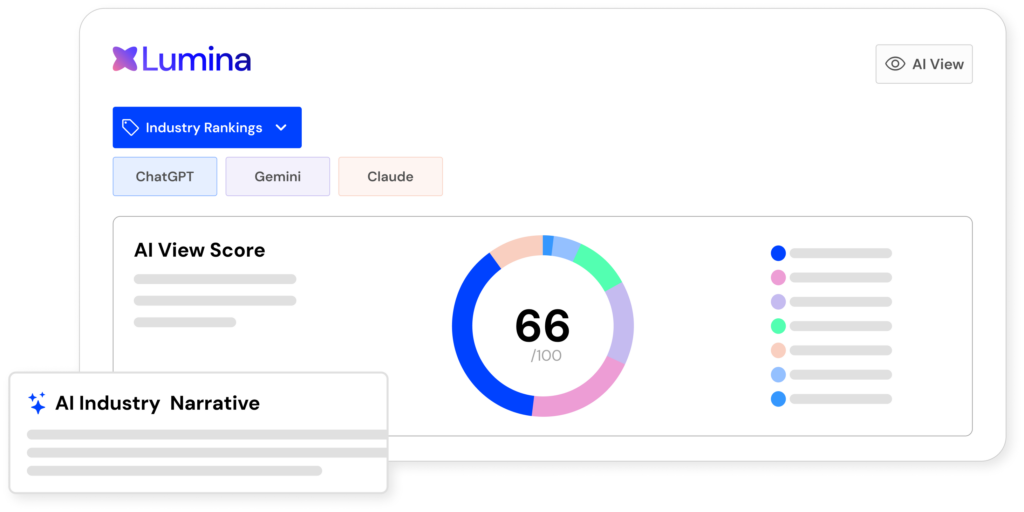
That is why we're unveiling Lumina AI View, the latest addition to our intelligent suite of AI tools from Isentia. Trained specifically on the workflows and challenges of modern PR & communications, Lumina AI View helps you understand exactly what AI knows about you, and how it learned it.
A new standard for AI visibility
AI View tracks your citation strength and source quality alongside those of your competitors, giving you a clear view of where you hold authority and where you have gaps.
Lumina AI View maps your AI reputation from the ground up, allowing you to:
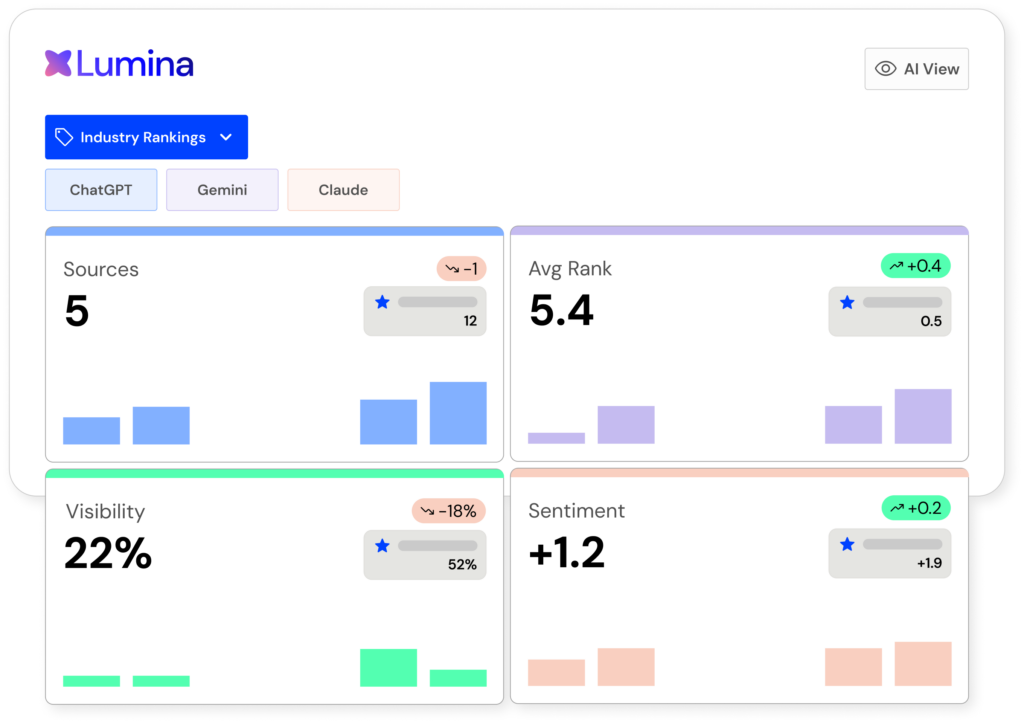
See which sources matter: When tools such as ChatGPT or Gemini discuss your organisation, which outlets do they cite? Track your source footprint over time and view the impact of key target media on how you’re discussed. We measure your citation strength and source quality alongside those of competitors, giving you a clear view of where you have authority and where you have gaps.
Gain industry-specific insight: Your competitors get cited from Financial Times and Bloomberg. You get cited on Reddit. Each brings opportunity – and risk. Discover how you measure up against industry standards, and target the sources that actually influence how AI represents you.
Catch narrative shifts early: AI responses change when new sources appear, sentiment shifts, or old controversies resurface. Get alerts when citation patterns change suddenly, before they impact the way you’re perceived by stakeholders.
Measure your progress: From media monitoring to full media intelligence
Lumina AI View is built on the principle that insights get stronger with repeated measurement. To help you maintain a clear view of your reputation, our proprietary scoring system provides regular updates that show you:
Evolving trends in how sources cite your organisation
Competitive standing and benchmark metrics
Where models differ in information presented, and sources cited
Whether you run it weekly, on-demand, or whenever you need a check-in, patterns will emerge, trends will become clear, and you will build a baseline that makes any sudden narrative changes both comprehensible and the prerequisite to action.
Lumina AI View is part of Lumina AI, a comprehensive suite of AI tools built specifically for communicators. Our Lumina suite evolves traditional media monitoring into narrative intelligence, enabling you to truly understand how perceptions form, evolve, and impact your reputation.
Get in touch to register your interest and see what Lumina AI View can do for you.
"
["post_title"]=>
string(66) "Introducing Lumina AI View: AI Visibility Built for PR & Comms"
["post_excerpt"]=>
string(158) "Lumina AI View, the latest in Isentia's AI suite, is trained on PR & comms workflows to help you understand what AI knows about you — and how it learned it."
["post_status"]=>
string(7) "publish"
["comment_status"]=>
string(4) "open"
["ping_status"]=>
string(4) "open"
["post_password"]=>
string(0) ""
["post_name"]=>
string(59) "introducing-lumina-ai-view-ai-visibility-built-for-pr-comms"
["to_ping"]=>
string(0) ""
["pinged"]=>
string(0) ""
["post_modified"]=>
string(19) "2026-06-04 04:13:37"
["post_modified_gmt"]=>
string(19) "2026-06-04 04:13:37"
["post_content_filtered"]=>
string(0) ""
["post_parent"]=>
int(0)
["guid"]=>
string(32) "https://www.isentia.com/?p=47963"
["menu_order"]=>
int(0)
["post_type"]=>
string(4) "post"
["post_mime_type"]=>
string(0) ""
["comment_count"]=>
string(1) "0"
["filter"]=>
string(3) "raw"
}
Blog
Introducing Lumina AI View: AI Visibility Built for PR & Comms
Lumina AI View, the latest in Isentia’s AI suite, is trained on PR & comms workflows to help you understand what AI knows about you — and how it learned it.