3 minutes with Brendan McGreevy, Country Manager, Australia
We sat down with Brendan McGreevy, recently appointed Country Manager for Australia (2017) and discussed his viewpoints on leading the Australian team and the latest release of Custom Reports on Mediaportal.
Tell us who you are and how you came along with your Isentia journey
My name is Brendan McGreevy and I am the Country Manager for Australia [here at] Isentia. I joined the company in January 2004 as a tele-sales consultant, selling media intelligence services and data distribution. I’ve managed the tele-sales team and the Slice products over a number of years before we brought that back into the [Isentia] family, I’ve been a BDM, a Service Consultant, a Sales Manager and now I’m Country Manager. I have done many, many jobs and have always been in client facing, which is what I like, and I hope to continue my career throughout the company in a client-facing role.
What job haven’t you had at Isentia?
I haven’t been Chief Executive yet, so maybe at some point in the future! I am keeping my options open though.
What are you 100% passionate about and what gets you going every day?
Probably two things – one being the media and how it rapidly changes, the different forms and the different platforms that are popping out pretty much every month or every year. The other is clients – dealing with communicators – people in PR and Corp Comms.
It’s fast paced, and every day is a new and different day. If one client is on the news on a Monday, it’s going to be someone different on a Wednesday. [It’s] that kind of variety that keeps you getting up in the morning and keeps you coming into work.
What are you most proud of, a moment of time of your life at Isentia?
I can’t think of one defining moment. I suppose each year when you see the achievements of the team, achievements of the clients, and you are hitting those targets – seeing the client growing every year and seeing that we’re doing all those things right that keeps the clients coming back for more and more. I would say that is probably the proudest achievement.
Can you talk about what makes the Australian customer base unique and what is different about them?
I think what makes it unique from the rest of the company is that there are clients that have used us for many, many years. We’ve been through the evolution of their businesses and their careers and they’ve been through the evolution of our business.
From the hard copy clipping agency in the 80’s and 90’s through to the digitally media intelligence company we are now. Personally, I’ve worked with a lot of them [the clients], since the early 2000’s and it does create a bit of uniqueness within our business. We do find that a lot of people in the Account Management team and the Sales team have been here for 20 to 30 years, and they tend to stick around because they know the people that they’re working with. Whether they move from government to private sector [or elsewhere], they always move back again, so you tend to meet the same people over and over again – it gives that sense of familiarity with all of the clients.
Looking at the new Custom Reports feature, what do you think would excite them most about it?
Probably the levels of customisation that we can now offer – like adding in the client’s logo and customising the look and feel of it.
Even though it is our content that we’re sending to the clients, it is their work. Allowing them to personalise their work and distribute that internally in a format that actually gives them the kudos and credit for what they’ve done and what they’ve achieved. I think that is going to get on pretty well.
What do you think makes Isentia brilliant?
What makes us brilliant is the people that are here.
I think the people that works here takes a very specific breed of person – you’ve got to love the media, you’ve got to love communications, you’ve got to love PR, you’ve got to love marketing, and you’ve got to love what we do, you’ve got to love the industry.
I think that is everybody that is here – evident in the high tenure of service across the business. People love what they do, they love that it is fast-paced, and they love that it is continually changing. And at the same time there is a level of familiarity at what we do as well. So yeah, it is definitely the people.
What is your favorite feature within the latest Custom Reports release and why?
To be honest, that is my favourite feature – the customisable view of it. In previous reports you could only use the PDF and that was very much a standard, static document. This is the client’s document, and it is important that when we build our products and services that they are all about the client and not about us. It’s not about the media, it is not about the content, it is actually about that client and their business and what they need to use the information for, and how they can customise it for different stakeholders, and different audiences internally. So, the more it looks like their document and the more they can customise it, the better it is.
Given your recent promotion to Country Manager, what excites you about the year ahead?
What we just completed in Australia is a slight restructure of the sales and services team. Previously we had an account management structure. We’ve [since] taken client success out and created a new division for Client Success and a new division for Sales.
These changes excite me because now we’ve got a dedicated focus on service for our clients and trying to understand what our client wants from us and how we can make that service better, and that is the dedication of that team. They don’t have to sell, or have find a new revenue stream, their job is purely to service our clients. Going back to that value and Isentia being client obsessed, this structure allows us to actually be client obsessed – to focus on our clients and their needs on a day-to-day basis, but to also have consultants from a different team to help clients with different services when the need arises.
Loren is an experienced marketing professional who translates data and insights using Isentia solutions into trends and research, bringing clients closer to the benefits of audience intelligence. Loren thrives on introducing the groundbreaking ways in which data and insights can help a brand or organisation, enabling them to exceed their strategic objectives and goals.
Next week’s Federal Budget has many Australians wondering how they will be affected.
The government has strongly advocated for building a more resilient economy than their predecessors, yet in recent months, the economy is suffering due to a rapid rise in inflation. This has pushed up interest rates and is squeezing the cost of living with both consumers and businesses feeling the pressure.
Following groceries, the leading financial stressors for Australians are petrol, rent, mortgage payments and energy bills. And just to make ends meet, Aussies are making more considered purchases, seeking higher paying employment or working multiple jobs. Australians are already anxious about inflation with growing concern there’s no end in sight.
Will the government restore their trust in Australians and keep their pre Federal Budget promises?
Cost of living crisis
Latest data from CHOICE’s Consumer Pulse survey, revealed that cost of living pressures are a major concern, with 90% of Australians seeing an increase in their household bills and expenses over the past year.
Inflation pressures are intensifying and the Reserve Bank of Australia (RBA) continues to drive up interest rates - their highest level in 7 years. The government has promised a long-term and sustainable approach to cost of living support in the form of a relief package.
Concerned about their mortgage payments, up to a third of mortgage holders could struggle to keep up with future repayments, with younger generations particularly concerned about surging interest rates.
Using Isentia data, during an eight week period from early August to early October 2022, 18% of Australia’s front pages featured cost of living stories. Even in a time of large local and international news such as the war on Ukraine and the Optus security breach, the cost of living crisis was still making front page news.
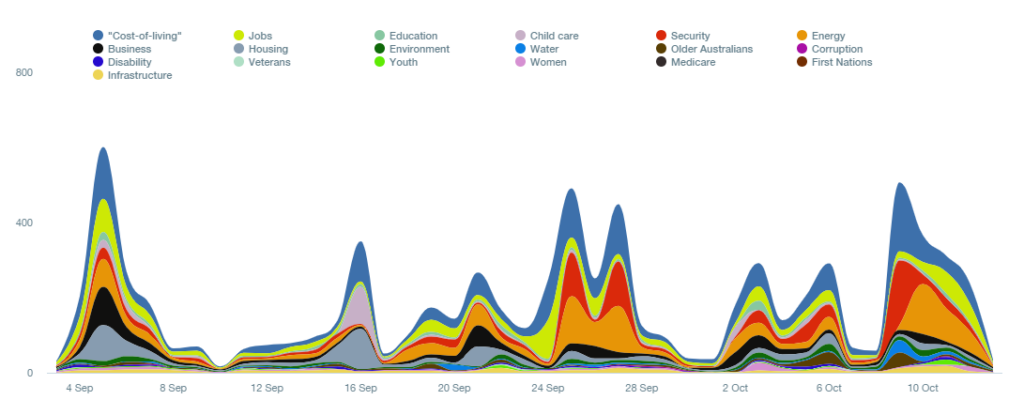
According to Pulsar data, anxieties around the cost of living, peaked following the RBA's interest rate announcements on 4 September and 4 October. For the sixth consecutive month, Australians have had to tighten an already lean household budget.
Apprehensions around security increased on 24 September as a result of the Optus security breach and again on 10 October when the government announced changes to the country's defence projects. Also on 10 October, cost of living concerns spiked after growing speculation surrounding the Stage 3 tax cuts being recalibrated. Australians also felt a heightened sense of unease after the announcement of a future surge in energy costs, following a recent 35% rise.
Anxieties surrounding topics mentioned by the government. Source: Pulsar
Childcare fees are at their highest in 8 years, with child care subsidies failing to keep out of pocket costs to a minimum. On 16 September, conversation around child care spiked, as Treasurer Jim Chalmers promised to reduce the cost of childcare, yet pledged to keep spending restrained in light of budgetary constraints.
As part of the cost of living relief package, this reduction won't come into play until mid 2023. Can Australian families wait this long?
Problematic climate conditions such as excessive rain and floods are leading to localised food price increases and diminished food quality. Even in the same area, poorer households are faring far worse than affluent counterparts. Across the board, there has been a surge in the cost of fruit and vegetable prices (7.3%) and meat, seafood and bread rising by 6.3%.
On top of these climate issues, labour shortages in both warehousing and transportation have resulted in added disruption to the supply chain. Freight costs are on the rise, putting intense pressure on importers and exporters.
Are Aussie consumers looking at a continued supply chain that is more disruptive than the 2020 toilet paper shortage? The rise in the cost of living weighs on households' spending, and Australians are seeking alternate ways to make extra cash.
The thrifty shopper
As the cost of living rises, many Australians are seeking alternate ways to make or save cash; trimming budgets where they can; cancelling home entertainment subscriptions, and reducing insurance coverage for lower fees to name a few. Purchases at all levels are becoming more involved and highly considered, with discounts heavily sought after.
As Millennials and Gen Z shoppers are gaining more buying power, their passion for sustainable commerce is stronger than ever. Selling personal items to make extra cash has been on the rise with retail e-commerce platforms such as Facebook Marketplace and ‘Recommerce’ platforms like AirRobe, are booming. Not only are Australians becoming more financially savvy, they are conscious of the need to ‘reduce, reuse and recycle’ - a criteria these platforms adopt.
Following the money
There’s no doubt that inflation is changing salary expectations. And for those in industries where movement and remote working is possible, many Australians are following the money.
Data from the Reserve Bank of Australia, shows organisations have reported higher rates of employees leaving to achieve higher pay packets as a way to provide temporary relief for the rise in cost of living. Interestingly, this higher voluntary turnover was especially concentrated in professional services.
In response to labour shortages, organisations are implementing a range of non-base wage strategies - e.g bonuses, flexible work practices, more internal training and hiring staff with less experience, as opposed to increasing base wages.
Australian Bureau of Statistics (ABS) figures also show Australians are taking on multiple jobs, as full-time work forces employees to juggle several roles to make ends meet. Although multiple job holding is more common in low-paid industries, a record high of 900,000 people held multiple jobs in the June quarter of 2022.
This is an increase of 4.3 per cent from the previous quarter and is a reflection of wages growth stagnating and nominal wages barely keeping up with consumer prices. The result; people needing to work more hours to make ends meet.
Using data insights from Pulsar, wages is one of the ‘most anticipated’ topics in this year’s Budget. The Wage Price Index (WPI) rose 0.7 per cent in the June quarter and 2.6 per cent over the year, which represented a substantial fall in real wages given inflation rose 6.1 per cent last quarter.
Social media conversation around wages is evolving with other indicators suggesting wages are still climbing alongside extreme uncertainty surrounding global growth and rampant inflation.
Will Australians see more dollars in their pocket after the Budget is handed down?
The "most anticipated" topics in this year's Federal Budget. This is a visual representation of the conversation frequency of topics over time. Source: Pulsar
Australians taking action
With Australians taking a greater interest in living a sustainable lifestyle, the government and organisations are prompted to influence the lever of positive change and create actionable outcomes.
Despite a great deal of politicians pledging change, governments are often swayed by the media and public opinion which can derail policies wanting to address complex, longer-term challenges. Millennials and Gen Zs have long pushed to see societal and economic change.
Results from the 10th Annual Deloitte Global 2022 Gen Z and Millennial Survey shows they are increasingly becoming more politically involved. These influential cohorts are progressively showing interest in political issues, and turning to social media to discuss their opinions. Moreover, they are consciously making calculated career decisions and spending their money with organisations who share the same values.
The top keywords used by key communities discussing the Federal Budget online.Source: Pulsar
Social engagement shows left wing millennials are showing concern over the budget and economic issues, with Treasurer, Jim Chalmers gaining the most chatter. Similarly, baby boomers are equally vocal, using the same keywords as millennials but they also seek strong leadership and a strong economy.
For younger demographics, their interactions or relationships with organisations is dependent on the organisation's treatment of the environment, their policies on data privacy and their position on social and political issues.
For governments, tackling environmental, economic and social issues and their impact requires a huge transformation across all sectors. Market forces alone will not solve the problem, and the onus is on governments to take a lead to meet the sustainability challenge.
The October Federal Budget is an opportunity for the government to show they are the lever of change by creating actionable outcomes and a positive impact. Australians are concerned for the welfare of the country and previous governments have fallen short.
The government promises to back clean energy and build new renewable infrastructure across the country, will they succeed or disappoint?
The Federal Budget can be an overwhelming time, with an abundance of promises and policies, it can be hard to stay on top of the latest news. We have a comprehensive range of political news services available to help you navigate the political media coverage at this October Federal Budget. Want to learn what’s being said at this Federal Budget?
Click hereto start navigating the announcements that may impact your organisation.
"
["post_title"]=>
string(55) "How concerned are Australians about the Federal Budget?"
["post_excerpt"]=>
string(95) "The upcoming October Federal Budget has many Australians wondering how they will be affected. "
["post_status"]=>
string(7) "publish"
["comment_status"]=>
string(4) "open"
["ping_status"]=>
string(4) "open"
["post_password"]=>
string(0) ""
["post_name"]=>
string(46) "australians-concerned-about-the-federal-budget"
["to_ping"]=>
string(0) ""
["pinged"]=>
string(87) "
https://www.smartcompany.com.au/industries/retail/recommerce-can-help-save-the-planet/"
["post_modified"]=>
string(19) "2024-11-14 04:29:01"
["post_modified_gmt"]=>
string(19) "2024-11-14 04:29:01"
["post_content_filtered"]=>
string(0) ""
["post_parent"]=>
int(0)
["guid"]=>
string(32) "https://www.isentia.com/?p=20160"
["menu_order"]=>
int(0)
["post_type"]=>
string(4) "post"
["post_mime_type"]=>
string(0) ""
["comment_count"]=>
string(1) "0"
["filter"]=>
string(3) "raw"
}
Blog
How concerned are Australians about the Federal Budget?
The upcoming October Federal Budget has many Australians wondering how they will be affected.
As we countdown the days to the Gold Coast 2018 Commonwealth Games, Australia’s biggest sporting events this decade – there’s an incredible relay happening that celebrates diversity, inspires communities and creates opportunities for some to experience something quite special.
The Queens Baton has a proud history, with batonbearers chosen from thousands to represent the spirit of the games and #SHARETHEDREAM.
One runner in particular will be cheered on by all at Isentia – a girl who has certainly inspired us, and many around her. Meet 13-year-old Nayeli Gajardo.
Daughter of long-time Isentia Press Readers, Oscar and Patricia Gajardo, Nayeli has quite a remarkable story for such a young girl.
At the age of 6 months, Nayeli was diagnosed with acute dermatitis, and by the time she was 8 years old her illness became chronic – requiring her to spend much of the next 4 years in and out of St George Hospital. As her condition continued to deteriorate over time, she spent extensive periods in and out of hospital – missing almost the full first term of school in 2016. It was at this point that doctors concluded Nayeli would have this condition for the rest of her life.
"It was very stressful to see our daughter in pain and discomfort. Not only the physical part, but also mentally. She was growing – and to see her skin in that state was very confronting. With no hope from the doctors, we decide to take action and find alternative medicines to help our daughter,” Nayeli’s mother, Patricia Gajardo said.
She tried different medications until she was stable including Methotrexate – a chemo pill that people with transplant organs take, and after endless treatments and procedures Nayeli was sent to France for treatment at the Avene Hydrotherapy Centre.
“The Gajardo’s have contributed over 25 years’ combined service to our [Isentia] team here, so when Oscar and Patricia asked for our help with getting treatment for Nayeli, people from right across the business wanted to pitch in and help Nayeli get better,” Isentia’s Press Manager, Peter Coy said.
With the help and financial support of the community, friends, family and Isentia staff via the family’s GoFundMe page, Nayeli has now been to France twice for treatments, and plans a third trip in the coming year.
“Isentia helped us to take time off to go to France and our co-workers did a money collection to help us with the trip,” Patricia said.
Now, Nayeli’s condition has improved to a point where she is able to able to control her illness and live a healthier life, only experiencing discomfort when days have high content of pollen or she has an allergic reaction.
“It was really cool to see all that generosity and, of course, to also see it pay off when Nayeli’s condition improved. Seeing Nayeli now get the chance to carry the Queen’s Baton is a great bit of icing on the cake for a family who’ve been though some bloody tough times.” Peter said.
We can't wait to see Nayeli take the baton, enjoy the moment and inspire others with her story!
Isentia is proud to be delivering powerful media intelligence and insights for GC2018 all the way to the finish line. To keep up-to-date with the Queen’s Baton Relay and all the excitement of the Games, visit www.gc2018.com/qbr
"
["post_title"]=>
string(38) "A champion well before the finish line"
["post_excerpt"]=>
string(132) "Daughter of long-time Isentia Press Readers, Oscar and Patricia Gajardo, Nayeli has quite a remarkable story for such a young girl. "
["post_status"]=>
string(7) "publish"
["comment_status"]=>
string(4) "open"
["ping_status"]=>
string(4) "open"
["post_password"]=>
string(0) ""
["post_name"]=>
string(38) "a-champion-well-before-the-finish-line"
["to_ping"]=>
string(0) ""
["pinged"]=>
string(0) ""
["post_modified"]=>
string(19) "2019-06-26 04:03:43"
["post_modified_gmt"]=>
string(19) "2019-06-26 04:03:43"
["post_content_filtered"]=>
string(0) ""
["post_parent"]=>
int(0)
["guid"]=>
string(36) "https://isentia.wpengine.com/?p=1645"
["menu_order"]=>
int(0)
["post_type"]=>
string(4) "post"
["post_mime_type"]=>
string(0) ""
["comment_count"]=>
string(1) "0"
["filter"]=>
string(3) "raw"
}
Blog
A champion well before the finish line
Daughter of long-time Isentia Press Readers, Oscar and Patricia Gajardo, Nayeli has quite a remarkable story for such a young girl.
Would you trust a brand more if an AI model recommended it? For many, the answer is yes – and it’s changing the very nature of PR & Comms.
Our latest report digs into the changing nature of trust, as audiences turn to AI models for quick answers instead of going to organisations or media outlets directly, with AI fast becoming the final stop in the comms cycle.
This report unpacks:
Why trust has shifted, and where audiences are having these conversations
Why AI has become the last stop in the comms cycle
Methods for staying on top of your brand trust and reputation
To access the full report, fill in the form below:
If you ask ChatGPT or Gemini about your organisation today, the answer won't come straight from your website. Instead, it uses sources the model already trusts, which are often months or years old. So if your last big mention was a crisis or a controversy from 2023, that's probably still how AI describes you.
This is the tough reality for anyone working in PR and communications today. More people are getting their first—and sometimes only—impression of your organisation from an AI-generated summary, not from search results or the homepage. And these summaries often rely on outdated information.
What does freshness actually mean?
Content freshness refers to how recent the sources are that an AI model uses when it talks about you. It might seem like a minor technical point, but it's actually very important.
Search engines have always valued fresh content, and they let you update information quickly. If you change a page, Google recrawls it, and rankings can shift in days. Large language models don't work like this. As Lisa Main, Director at Main Bureau, said on Isentia's "AI as a Stakeholder" panel, "large language models are not databases of verified facts." These models are trained on a snapshot of the internet, updated only from time to time, and they rely on sources that were already prominent when they were trained. This means a past crisis or a controversy that is already resolved can keep showing up in AI answers long after it's no longer relevant.
She shared the example of how a day and a half after a notorious terror attack, she asked ChatGPT if the area had ever experienced a tragedy of that type. It replied that it had not." The model wasn't being careless, but it just hadn't updated to include the latest news. This gap between what reality is and what AI still believes is true sums up the content freshness problem.
Dr Nici Sweaney, founder of AI Her Way, explained on the same panel why this gap matters. She calls AI "an accidental narrator" — it shapes what people believe about your organisation just by repeating the latest information it received. The system simply uses what's available and is not trying to be harmful, so it's important to make sure that information is up to date.
How does this change the way organisations show up?
For PR and communications teams, this changes what "reputation management" means. Put simply, messaging that an LLM cites will remain relevant, no matter when it dates from. Messaging that has not been factored into the LLM’s answers, meanwhile, will have no discernible impact on an increasingly vital - even central - channel, regardless of how many other metrics it might win out on.
This leads to two important things to consider:
First, the conditions that surround recent earned media, statements, and announcements determine whether an AI model updates its picture of the brand, or keeps running on an outdated one. Catherine Arrow of the PR Knowledge Hub made a related point on the "Inside the AI Shift" webinar: LLMs and the agents built on them are "often forbidden from going behind paywalls, from scraping particular sites," which she said creates a kind of "news vacuum." The same logic applies to the brand’s own newsroom or press page. If it isn't feeding the model something current, the model has nothing current to draw from.
Second, owned content—like blog posts, media releases, and website pages — are strategically important because they’re something the organisation in question can control , but only if they are updated. If a page hasn't changed in eighteen months, it's much more likely to disappear from AI results, making any reputation built on it unstable. If something is published once and not updated, the brand risks letting older, less positive stories take its place.
For public sector and government communicators, the stakes are more immediate again. When a government agency's guidance changes, whether that's eligibility criteria, compliance requirements, or a service update, and the fresh version doesn't make it into what AI models are citing, people will still get fed old information, with potentially devastating real-world implications.
The evidence is already there
This is not just in theory. It's playing out in global research and in the day-to-day data right now.
AI is quietly replacing the front door to your content
The Reuters Institute's Digital News Report Australia 2026 confirms that many PR teams have noticed that Google organic search traffic to news sites dropped by a third worldwide between November 2024 and November 2025, and by 38% in the US, as AI Overviews and AI Mode launched. Publishers expect this traffic to nearly halve again in the next three years. Some now call this trend a move towards "Google Zero." For communications teams, this means people are increasingly less likely to click through to your website to check if information is current. More often, they're trusting what the AI says: hence why it’s so important to monitor content freshness.
AI models are now web-enabled and they might not actually guarantee source accuracy
One challenge is that most major chatbots are now web-enabled. For example, ChatGPT can browse the internet, Gemini uses Google Search, and Perplexity has its own live index. This makes it easy to assume that AI always knows the latest information. However, this does not mean that they are always accurate when it comes to citations. A study from Columbia's Tow Center for Digital Journalism tested eight AI search tools with 1,600 queries. They found that these tools failed to correctly identify or cite the source article more than 60% of the time. Some tools were wrong on most tests and rarely showed any uncertainty. New information has not had time to be checked or confirmed like older stories have. This is the real risk of relying on the newest updates — a story that is fast moving and poorly sourced about your organisation might end up in an AI answer before it’s even verified or fact-checked.
People are turning to AI chatbots specifically for what's new
The same report found that 35% of people who use AI chatbots for news do so to get the latest media updates. Dr Sora Park from the University of Canberra's News and Media Research Centre explained on the "Digital News Report Australia 2026" webinar that the main reason people use AI chatbots for news is that "AI collates stories from different news sources into a single response." People expect these tools to provide current information. If your organisation's newest content isn't included (and you have something current or novel to communicate) you miss the chance to reach audiences when they're most interested.
Fresh content doesn’t always equate to ‘new’ content
A notable example of creating freshness that LLMs reward and prioritise comes from updating existing pages, rather from creating brand-new content. Republishing and refreshing current material is more effective than many communications teams realise, as long as one actually updates the content, not just the date.
Evergreen pages are the first casualties when AI overviews roll in
The DNR Australia 2026 report also notes that once someone is inside an AI chatbot conversation, they rarely leave it to check the source — only 4% of AI chatbot users say they always or often click through to the original article, compared with 19% for search and 17% for social media. The pages that used to earn traffic just by sitting there, permanent and useful, are now the ones most likely to lose visibility, because AI models favour what's recent over what's merely correct.
One fresh statement doesn't automatically undo a stale narrative
If an executive online, especially one who has a lot of weight to what they post online, says something controversial and it quickly spreads across media articles, social media and search — it will definitely be picked up by AI as well. There is a golden window of opportunity that they need to capitalise on to clarify what they said. If they don’t, the negative story that was already built into the data AI models use, will not be affected much by the executive’s clarification statement, which wasn’t that timely anyway. As Catherine Arrow of the PR Knowledge Hub said on the "Inside the AI Shift" webinar: "public relations and media relations are not the same thing," and relying on a single release misses the point. The real lesson is not to publish faster after a crisis, but to build a strong, up-to-date presence before you need it. In our latest report, “How can leaders communicate in an age of scrutiny”, we’ve outlined exactly how comms leaders can communicate by adapting their content to audiences exposed to the “AI way” of news dissemination.
What PR & Comms teams should actually do?
The challenge is that organisations can't make an AI model update its answers whenever they want. What they can do is track whether recent work is actually being noticed, which is what Lumina AI View can help with.
Lumina AI View monitors which sources AI models use when talking about your organisation, how strong and recent those sources are, and how you compare to competitors. Freshness is one of five key factors in the overall score. If your freshness score drops, it's an early warning that your latest campaign or announcement hasn't reached the AI ecosystem yet, and older stories are still dominating.
What’s important to note is that the tool provides a list of source citations, paired with reputation pillars like direction, integrity, performance and innovation — giving a comms professional a fully-rounded understanding of what they need to do. It’s not just the case of knowing source citations, but also of understanding your own AI perception and performance to make informed decisions — whether that’s for a brand,a government agency, a NFP or elsewhere.
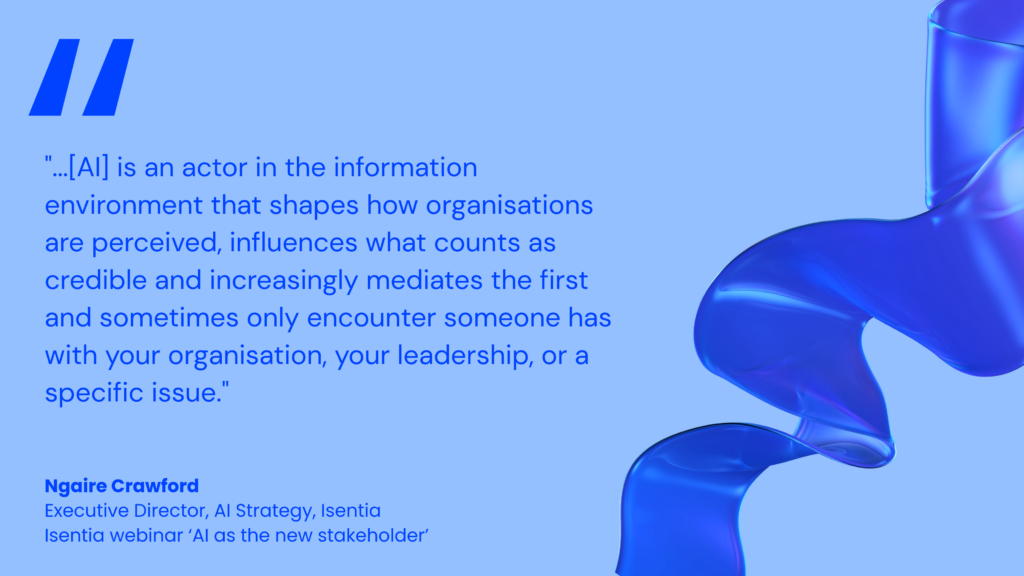
This kind of tracking is even more important because it shifts by industry and by market, so "AI visibility" doesn't mean the same monitoring job for every organisation. AI answers for healthcare might draw from the smallest, highest-trust pool of sources (mostly clinical and government), but SaaS and fintech answers lean heavily on editorial reviews and comparison sites. Ngaire Crawford made a similar point regionally on the "AI as a Stakeholder" panel. For the APAC region specifically, she pushed back on the assumption that editorial media dominates AI citations — "there are a lot of really massive claims about the impact of editorial media... some as high as 85, 88%. That's not what we're seeing." Instead, she found "a fairly even split between (editorial media) and company content," alongside a real presence for review sites, forums, and academic sources. For a comms team, that means the freshness strategy that works for a media-heavy consumer brand might not work for a government agency whose AI visibility is really riding on review sites, .gov pages, or industry forums instead.
By tracking regularly — weekly or as a routine check— you turn the vague concern of "what is AI saying about us" into something that is super clear. You can see if recent coverage changed your list of citations, or if your owned content is still being found, or where there are gaps that need to be filled because old stories still exist and are causing problems.
The opportunity in staying current
There's a real advantage here too. If old content keeps you tied to an outdated story, fresh content is a direct way for PR and communications teams to influence how AI presents them. Publishing regularly, keeping your own pages updated, and getting recent, credible coverage is not just for human audiences. It's how PR professionals can make sure the systems shaping first impressions have the right information.
Teams that make it an ongoing habit of checking in regularly, watching for changes, and keeping fresh, credible content flowing, will have more control over how AI describes their organisation.
If you would like to know more about our Lumina suite, please reach out here and our team will get in touch with for you a quick demo.
"
["post_title"]=>
string(60) "Why is content freshness the new currency for AI visibility?"
["post_excerpt"]=>
string(172) "AI summaries are replacing websites as your organisation's first impression. Here’s why content freshness—and the sources feeding these models—matters more than ever."
["post_status"]=>
string(7) "publish"
["comment_status"]=>
string(4) "open"
["ping_status"]=>
string(4) "open"
["post_password"]=>
string(0) ""
["post_name"]=>
string(59) "why-is-content-freshness-the-new-currency-for-ai-visibility"
["to_ping"]=>
string(0) ""
["pinged"]=>
string(0) ""
["post_modified"]=>
string(19) "2026-08-20 02:44:18"
["post_modified_gmt"]=>
string(19) "2026-08-20 02:44:18"
["post_content_filtered"]=>
string(0) ""
["post_parent"]=>
int(0)
["guid"]=>
string(32) "https://www.isentia.com/?p=49408"
["menu_order"]=>
int(0)
["post_type"]=>
string(4) "post"
["post_mime_type"]=>
string(0) ""
["comment_count"]=>
string(1) "0"
["filter"]=>
string(3) "raw"
}
Blog
Why is content freshness the new currency for AI visibility?
AI summaries are replacing websites as your organisation’s first impression. Here’s why content freshness—and the sources feeding these models—matters more than ever.