The 2019 Wellbeing Budget is set to broaden New Zealand’s focus beyond economic and fiscal policy
“We need to address the societal wellbeing of our nation, not just the economic wellbeing” Jacinda Ardern, Prime Minister of New Zealand
The 2019 Wellbeing Budget is hailed by many as a landmark of its time for its undeterred focus on the social sector. [1] The intent for this budget, which is set to be handed down May 30 2019, is to go beyond GDP per capita and debt to GDP ratios to analyse the wider effects on people’s wellbeing and the state of the environment in an intergenerational way.[2] Although New Zealand have GDP growth rates that many countries would envy, for many New Zealanders it has been thought this GDP growth (and previous years budgets) have not translated into higher living standards or better opportunities.[3]
New Zealand is the first western country to design and implement its entire budget around wellbeing initiatives and also instruct its ministries to propose policies to enhance wellbeing for the country. This year’s Budget winner’s are set to be education, health and environmental industries. The top five priorities of the budget are outlined as follows:
1. Creating opportunities for productive businesses, regions, iwi and others to transition to a sustainable and low-emissions economy
2. Supporting a thriving nation in the digital age through innovation, social and economic opportunities
3. Lifting Māori and Pacific incomes, skills and opportunities
4. Reducing child poverty and improving child wellbeing, including addressing family violence
5. Supporting mental wellbeing for all New Zealanders, with a special focus on under 24-year-olds
The wellbeing approach
The nation enjoys being the third freest economy in the world, and as such, ranks first globally for ease of doing business. The Wellbeing Budget will broaden the focus beyond economic and fiscal policy by using the Treasury’s Living Standards Framework to inform the governments’ investment priorities and funding decisions [4] on complicated issues including climate change, inequality and child poverty. Through effective planning and decision making to combat these issues, it will enable the best choices for current and future generations beyond economic growth and successfully embed wellbeing into the public policy.
While it has been rumoured government agencies have been siloed when seeking budget funding, the Ardern government have introduced a new framework to combat this rumour and encourage a collaborative funding process. This process involves ministers submitting joint proposals with their colleagues for funding requests and enables social issues such as Domestic Violence to receive dedicated and well-rounded funding.
Interestingly, since the Wellbeing Budget was first announced 13 December 2018, there have been 600+ mentions across broadcast and print. Unsurprisingly, Minister of Finance, Grant Robertson has been leading the conversations with 43 per cent alongside Prime Minister, Jacinda Ardern with her share of voice being 29 per cent. The wellbeing budget is surely getting a lot of airtime with 34 per cent of all mentions being across broadcast channels.
At the heart of the Wellbeing Budget is the Living Standards Framework (LSF) – a new dashboard of indicators to be used to advise successive governments’ how their policy choices affect New Zealanders over time and by using this framework, it will effectively embed wellbeing in New Zealand’s public policy. In addition, the Ardern government is being guided by other indicators, including the new Child Poverty Reduction Act which obliges the Minister of Finance to report at each budget how the country is tracking on a set of child wellbeing and poverty measures. The current Minister of Finance Grant Robertson will be the first finance minister to do so.
Beyond GDP
Historically, GDP was never intended as a measure of societal progress and it’s only quite recently that alternative measures of societal progress have been developed and a global “beyond GDP” has emerged.
Internationally, this has led to the UN Sustainable Development Goals, the OECD Better Life Index and the Canadian Index of Wellbeing. Having these goals allow countries to track their progress towards aspirational goals including good health, superior education and wellbeing.
For a country that is socially progressive, it has taken a long time for the NZ political system to discuss wellbeing and the roles of values. Other taxpayers’ interests such as tourism, housing, immigration and education are also high on the list and the government has a great opportunity to reframe its budgets around the anticipated effect of the policies they’ve announced.
So, is the wellbeing budget a new way to measure the success as a country or is it just the introduction of another ‘first’ to keep the momentum going as a forward-thinking country?
If you would like to learn more about how you can stay across the wellbeing budget or any other topic, get in touch with us today
Loren is an experienced marketing professional who translates data and insights using Isentia solutions into trends and research, bringing clients closer to the benefits of audience intelligence. Loren thrives on introducing the groundbreaking ways in which data and insights can help a brand or organisation, enabling them to exceed their strategic objectives and goals.
Next week’s Federal Budget has many Australians wondering how they will be affected.
The government has strongly advocated for building a more resilient economy than their predecessors, yet in recent months, the economy is suffering due to a rapid rise in inflation. This has pushed up interest rates and is squeezing the cost of living with both consumers and businesses feeling the pressure.
Following groceries, the leading financial stressors for Australians are petrol, rent, mortgage payments and energy bills. And just to make ends meet, Aussies are making more considered purchases, seeking higher paying employment or working multiple jobs. Australians are already anxious about inflation with growing concern there’s no end in sight.
Will the government restore their trust in Australians and keep their pre Federal Budget promises?
Cost of living crisis
Latest data from CHOICE’s Consumer Pulse survey, revealed that cost of living pressures are a major concern, with 90% of Australians seeing an increase in their household bills and expenses over the past year.
Inflation pressures are intensifying and the Reserve Bank of Australia (RBA) continues to drive up interest rates - their highest level in 7 years. The government has promised a long-term and sustainable approach to cost of living support in the form of a relief package.
Concerned about their mortgage payments, up to a third of mortgage holders could struggle to keep up with future repayments, with younger generations particularly concerned about surging interest rates.
Using Isentia data, during an eight week period from early August to early October 2022, 18% of Australia’s front pages featured cost of living stories. Even in a time of large local and international news such as the war on Ukraine and the Optus security breach, the cost of living crisis was still making front page news.
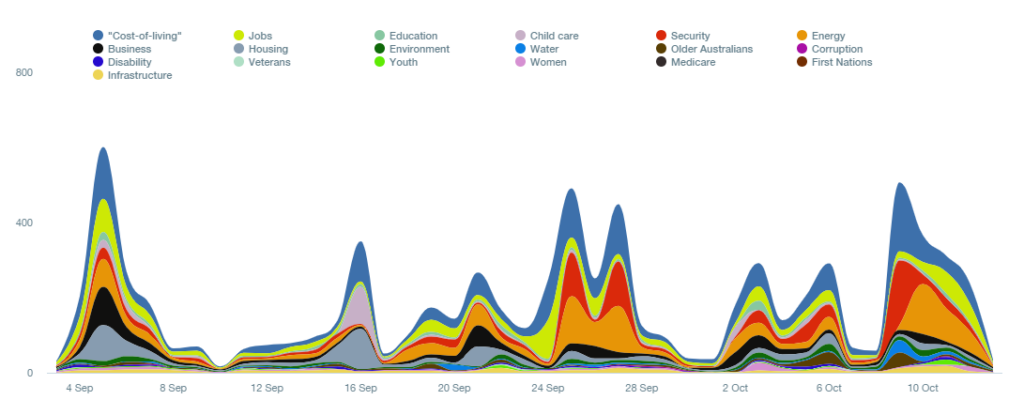
According to Pulsar data, anxieties around the cost of living, peaked following the RBA's interest rate announcements on 4 September and 4 October. For the sixth consecutive month, Australians have had to tighten an already lean household budget.
Apprehensions around security increased on 24 September as a result of the Optus security breach and again on 10 October when the government announced changes to the country's defence projects. Also on 10 October, cost of living concerns spiked after growing speculation surrounding the Stage 3 tax cuts being recalibrated. Australians also felt a heightened sense of unease after the announcement of a future surge in energy costs, following a recent 35% rise.
Anxieties surrounding topics mentioned by the government. Source: Pulsar
Childcare fees are at their highest in 8 years, with child care subsidies failing to keep out of pocket costs to a minimum. On 16 September, conversation around child care spiked, as Treasurer Jim Chalmers promised to reduce the cost of childcare, yet pledged to keep spending restrained in light of budgetary constraints.
As part of the cost of living relief package, this reduction won't come into play until mid 2023. Can Australian families wait this long?
Problematic climate conditions such as excessive rain and floods are leading to localised food price increases and diminished food quality. Even in the same area, poorer households are faring far worse than affluent counterparts. Across the board, there has been a surge in the cost of fruit and vegetable prices (7.3%) and meat, seafood and bread rising by 6.3%.
On top of these climate issues, labour shortages in both warehousing and transportation have resulted in added disruption to the supply chain. Freight costs are on the rise, putting intense pressure on importers and exporters.
Are Aussie consumers looking at a continued supply chain that is more disruptive than the 2020 toilet paper shortage? The rise in the cost of living weighs on households' spending, and Australians are seeking alternate ways to make extra cash.
The thrifty shopper
As the cost of living rises, many Australians are seeking alternate ways to make or save cash; trimming budgets where they can; cancelling home entertainment subscriptions, and reducing insurance coverage for lower fees to name a few. Purchases at all levels are becoming more involved and highly considered, with discounts heavily sought after.
As Millennials and Gen Z shoppers are gaining more buying power, their passion for sustainable commerce is stronger than ever. Selling personal items to make extra cash has been on the rise with retail e-commerce platforms such as Facebook Marketplace and ‘Recommerce’ platforms like AirRobe, are booming. Not only are Australians becoming more financially savvy, they are conscious of the need to ‘reduce, reuse and recycle’ - a criteria these platforms adopt.
Following the money
There’s no doubt that inflation is changing salary expectations. And for those in industries where movement and remote working is possible, many Australians are following the money.
Data from the Reserve Bank of Australia, shows organisations have reported higher rates of employees leaving to achieve higher pay packets as a way to provide temporary relief for the rise in cost of living. Interestingly, this higher voluntary turnover was especially concentrated in professional services.
In response to labour shortages, organisations are implementing a range of non-base wage strategies - e.g bonuses, flexible work practices, more internal training and hiring staff with less experience, as opposed to increasing base wages.
Australian Bureau of Statistics (ABS) figures also show Australians are taking on multiple jobs, as full-time work forces employees to juggle several roles to make ends meet. Although multiple job holding is more common in low-paid industries, a record high of 900,000 people held multiple jobs in the June quarter of 2022.
This is an increase of 4.3 per cent from the previous quarter and is a reflection of wages growth stagnating and nominal wages barely keeping up with consumer prices. The result; people needing to work more hours to make ends meet.
Using data insights from Pulsar, wages is one of the ‘most anticipated’ topics in this year’s Budget. The Wage Price Index (WPI) rose 0.7 per cent in the June quarter and 2.6 per cent over the year, which represented a substantial fall in real wages given inflation rose 6.1 per cent last quarter.
Social media conversation around wages is evolving with other indicators suggesting wages are still climbing alongside extreme uncertainty surrounding global growth and rampant inflation.
Will Australians see more dollars in their pocket after the Budget is handed down?
The "most anticipated" topics in this year's Federal Budget. This is a visual representation of the conversation frequency of topics over time. Source: Pulsar
Australians taking action
With Australians taking a greater interest in living a sustainable lifestyle, the government and organisations are prompted to influence the lever of positive change and create actionable outcomes.
Despite a great deal of politicians pledging change, governments are often swayed by the media and public opinion which can derail policies wanting to address complex, longer-term challenges. Millennials and Gen Zs have long pushed to see societal and economic change.
Results from the 10th Annual Deloitte Global 2022 Gen Z and Millennial Survey shows they are increasingly becoming more politically involved. These influential cohorts are progressively showing interest in political issues, and turning to social media to discuss their opinions. Moreover, they are consciously making calculated career decisions and spending their money with organisations who share the same values.
The top keywords used by key communities discussing the Federal Budget online.Source: Pulsar
Social engagement shows left wing millennials are showing concern over the budget and economic issues, with Treasurer, Jim Chalmers gaining the most chatter. Similarly, baby boomers are equally vocal, using the same keywords as millennials but they also seek strong leadership and a strong economy.
For younger demographics, their interactions or relationships with organisations is dependent on the organisation's treatment of the environment, their policies on data privacy and their position on social and political issues.
For governments, tackling environmental, economic and social issues and their impact requires a huge transformation across all sectors. Market forces alone will not solve the problem, and the onus is on governments to take a lead to meet the sustainability challenge.
The October Federal Budget is an opportunity for the government to show they are the lever of change by creating actionable outcomes and a positive impact. Australians are concerned for the welfare of the country and previous governments have fallen short.
The government promises to back clean energy and build new renewable infrastructure across the country, will they succeed or disappoint?
The Federal Budget can be an overwhelming time, with an abundance of promises and policies, it can be hard to stay on top of the latest news. We have a comprehensive range of political news services available to help you navigate the political media coverage at this October Federal Budget. Want to learn what’s being said at this Federal Budget?
Click hereto start navigating the announcements that may impact your organisation.
"
["post_title"]=>
string(55) "How concerned are Australians about the Federal Budget?"
["post_excerpt"]=>
string(95) "The upcoming October Federal Budget has many Australians wondering how they will be affected. "
["post_status"]=>
string(7) "publish"
["comment_status"]=>
string(4) "open"
["ping_status"]=>
string(4) "open"
["post_password"]=>
string(0) ""
["post_name"]=>
string(46) "australians-concerned-about-the-federal-budget"
["to_ping"]=>
string(0) ""
["pinged"]=>
string(87) "
https://www.smartcompany.com.au/industries/retail/recommerce-can-help-save-the-planet/"
["post_modified"]=>
string(19) "2024-11-14 04:29:01"
["post_modified_gmt"]=>
string(19) "2024-11-14 04:29:01"
["post_content_filtered"]=>
string(0) ""
["post_parent"]=>
int(0)
["guid"]=>
string(32) "https://www.isentia.com/?p=20160"
["menu_order"]=>
int(0)
["post_type"]=>
string(4) "post"
["post_mime_type"]=>
string(0) ""
["comment_count"]=>
string(1) "0"
["filter"]=>
string(3) "raw"
}
Blog
How concerned are Australians about the Federal Budget?
The upcoming October Federal Budget has many Australians wondering how they will be affected.
The end of the financial year is drawing closer, budgets have been forecast and approved – how will you target your spending in FY20?
A new financial year provides a great opportunity to review your results and reflect on your approach with some concrete performance data that can both prove value delivered and help you make the case for more.
While performance is a critical measure, it’s also a great time to address any internal processes and procedures that may be working against you or impacting other departments and staff. From operating systems and day-to-day workflow to crisis plans and business ready-ness protocols, the opportunity to communicate better throughout your business as well as outside of it can be extremely valuable.
So, when it comes time to evaluate what worked well and what didn’t in FY19 and plan for a successful FY20, here’s some first steps to help you get started:
Set your intentions
Set an intention to celebrate the wins and identify the opportunities to pivot where necessary. Even if you had a great FY19, you want it to grow and have even more success in FY20. If you have a business strategy already for the new financial years, are there areas that you could focus on to have greater impact on the bottom line?
Make a list of questions
Being intentional about your process sparks creativity and prevents the business from overlooking important pieces of information.
What are your overall achievements?
How did they impact business growth?
What were the key learnings from FY19?
What were the biggest disappointments?
Did you implement a strategy to pivot or constructively address the disappointments?
What products/services will be launched in FY20?
Did your messaging cut through, and if so, was the audience right?
How did your audience feel about your products, services and people – and what insights can you tell other departments like R&D, sales or the C-Suite that could help course correct some of the sentiment?
Did you have unexpected expenditures due to a PR crisis, and can you better prepare if this something else happens in FY20?
How sustainable are you as a business and are there long-term strategies you could start now that would put you in better shape?
Do you need to revisit some of your relationships with key conte Identify your metricsnt publishers, journalists and influences?
Are there areas that could benefit from expenditure over others?
What do you need to pull together to demonstrate what was achieved, and what could be achieved if your new FY20 plan is supported by leadership?
Identify your metrics
What will you use to measure your professional performance? Alongside your business statements and PnL, other measures like online traffic, media reach, customer sentiment and , sales figures, new subscribers and event attendees.
Carefully review your metrics and ascertain what contributed to your growth, as well as best practices for further growth. Assess the reasons for churn and identify areas for improvement. Are there any other tools and resources you can add to your metrics dashboard?
Review your FY19 goals
Identify which goals are worth keeping, which are to be eliminated and where energy will be most effective. This list of goals should be SMART (specific, measurable, achievable, relevant and timely) and include short- and long-term timeframes. Goals or priorities for the coming year may be different from the previous year, whether it be hitting a certain new audience, building a certain leader’s profile, a successful new product launch or just staying ‘out’ of certain conversations and stories, these goals are key for your business’ success.
Time for innovation
It can be said that growth invariably comes from innovation. With so much pressure to perform well and report on performance, a different approach to communications tactics and tools can promote greater levels of innovation and encourage a more collaborative environment that welcomes new ideas while ensuring the business keeps up with modern changes. It doesn’t have to be world changing, it could be looking at new audiences, automation, the use of video or updating onboarding programs with all staff media training. The goal here is to think differently, challenge ideas and stay competitive.
Use technology to your advantage
Understand what is being said about your business, how your audiences respond to or feel, and how you fare against your competitors. Our Mediaportal platform provides a full range of reporting and analytics allowing you to identify the most relevant audiences, the hot topics that need attention and what issues may be impacting your business, as well as additional insights born from your media coverage. This information is useful in planning your future tactics, leverage existing pools of success and continue to stand apart from the competition. Along with these always-on metrics in Mediaportal, our insights reports can provide the quantitative analysis needed to reflect on the year past with a comprehensive overview of share of voice, audiences and reach as well as month-on-month trends, media influence and positioning against competitors. Such reports provide a greater snapshot of your efforts and will assist with setting your benchmarks, goals and budgets for the year ahead.
By gaining a better understanding of what has been achieved and the potential areas for improvement, you will be able to establish an appropriate budget based on your objectives and provide a successful FY20 for your business.
Want to learn more about how to measure the effectiveness of your business and how to plan for your FY20? Let our team show you how,get in touch today.
"
["post_title"]=>
string(68) "How to plan for your FY20 budget and show off your hard-earned media"
["post_excerpt"]=>
string(135) "The end of the financial year is drawing closer, budgets have been forecast and approved – how will you target your spending in FY20?"
["post_status"]=>
string(7) "publish"
["comment_status"]=>
string(4) "open"
["ping_status"]=>
string(4) "open"
["post_password"]=>
string(0) ""
["post_name"]=>
string(68) "how-to-plan-for-your-fy20-budget-and-show-off-your-hard-earned-media"
["to_ping"]=>
string(0) ""
["pinged"]=>
string(0) ""
["post_modified"]=>
string(19) "2019-06-25 07:24:51"
["post_modified_gmt"]=>
string(19) "2019-06-25 07:24:51"
["post_content_filtered"]=>
string(0) ""
["post_parent"]=>
int(0)
["guid"]=>
string(36) "https://isentia.wpengine.com/?p=1790"
["menu_order"]=>
int(0)
["post_type"]=>
string(4) "post"
["post_mime_type"]=>
string(0) ""
["comment_count"]=>
string(1) "0"
["filter"]=>
string(3) "raw"
}
Blog
How to plan for your FY20 budget and show off your hard-earned media
The end of the financial year is drawing closer, budgets have been forecast and approved – how will you target your spending in FY20?
The HKSAR Government announced the Hong Kong Budget 2019 on late February 2019. Looking ahead on 2019, Hong Kong should endeavour to diversity its economy and sustain growth in economic performance. In this whitepaper, we will look into the key takeaways of this year’s budget and what society concerns about this budget.
"
["post_title"]=>
string(62) "What are the societal concerns with the 2019 Hong Kong budget?"
["post_excerpt"]=>
string(244) "Looking ahead on 2019, Hong Kong should endeavour to diversity its economy and sustain growth in economic performance. In this whitepaper, we will look into the key takeaways of this year’s budget and what society concerns about this budget. "
["post_status"]=>
string(7) "publish"
["comment_status"]=>
string(4) "open"
["ping_status"]=>
string(4) "open"
["post_password"]=>
string(0) ""
["post_name"]=>
string(61) "what-are-the-societal-concerns-with-the-2019-hong-kong-budget"
["to_ping"]=>
string(0) ""
["pinged"]=>
string(0) ""
["post_modified"]=>
string(19) "2019-06-26 09:47:46"
["post_modified_gmt"]=>
string(19) "2019-06-26 09:47:46"
["post_content_filtered"]=>
string(0) ""
["post_parent"]=>
int(0)
["guid"]=>
string(35) "https://isentia.wpengine.com/?p=985"
["menu_order"]=>
int(0)
["post_type"]=>
string(4) "post"
["post_mime_type"]=>
string(0) ""
["comment_count"]=>
string(1) "0"
["filter"]=>
string(3) "raw"
}
Whitepaper
What are the societal concerns with the 2019 Hong Kong budget?
Looking ahead on 2019, Hong Kong should endeavour to diversity its economy and sustain growth in economic performance. In this whitepaper, we will look into the key takeaways of this year’s budget and what society concerns about this budget.
A weekly tracker tracing the stories, figures and policies driving media and social coverage in the 2026 New Zealand General Election across Online News, TV, Radio, Newspaper, Magazine, X, Facebook, Instagram, TikTok, Threads and Forums. This edition covers conversations and coverage from 1st – 8th October, highlighting what’s shaping the election conversation.
1. Election Conversation
21,637
total mentions this week
4,360 media17,277 social
2. Media Issue of the Week
National Proposes Drug Testing and Benefit Cuts for Jobseekers
National29 media items
National announced a five-point welfare policy: random drug testing for JobSeeker recipients (with sanctions for repeat failures), reduced payments for long-term beneficiaries, and a doubled stand-down period for repeatedly leaving jobs without good reason. Labour and the Greens called it "punching down" and "cruel"; ACT proposed going even further; Luxon defended it as "fairness" for taxpayers.
The single largest media cluster this week (183 of 600 sampled items) was generic "campaigning intensifies as election day nears" coverage. This welfare policy, while smaller by volume (29 items), is a genuine flashpoint: a specific, controversial announcement that sharply divided every major party and will likely keep generating reaction into next week.
3. What's happening across media and social?
4,360 media items · 17,277 social items · share of each channel's own conversation, so the two bars are directly comparable
MediaSocial
Issues
Cost of Living
Media
15.8%
Social
24.5%
Economy & Jobs
Media
19.4%
Social
13.4%
Housing
Media
10.5%
Social
7.7%
Health
Media
8.5%
Social
9.3%
Infrastructure & Transport
Media
9.8%
Social
7.1%
Education
Media
8.2%
Social
8%
Parties
National
Media
25.5%
Social
31.3%
Labour
Media
18.9%
Social
25.9%
NZ First
Media
18.3%
Social
17.2%
Greens
Media
10.3%
Social
20.8%
ACT
Media
11%
Social
3.9%
The Greens get more than twice the relative attention on social media as in the news. On social, the Greens are 20.8% of party conversation; in the news, they're 10.3%.
Health is a top-four issue on social but not in the news this week - Infrastructure takes its place in media's top four instead. Social conversation is tilting toward the health system while media coverage stays on economy, cost of living and infrastructure announcements.
4. Party Share of Conversation
1. National33.7%
2. Labour26.7%
3. NZ First20.7%
4. Greens18.9%
Share of conversation measures attention and mentions only - it is not polling and should not be read as an indication of electoral success.
5. Top candidates this week
1. Christopher Luxon2,301
2. Chris Hipkins2,058
3. Winston Peters1,446
4. David Seymour757
5. Chloe Swarbrick609
Luxon and Hipkins remain close at the top as the campaign enters its final stretch. Peters follows, still driven by coalition speculation. Seymour moves up to fourth on the back of ACT's economic-reform push (including floating a higher superannuation age), overtaking Swarbrick, whose fifth-place mentions continue to track the Greens' polling strength.
6. Election Issues
Top 4 themes this week
Cost of Living3,584
Economy & Jobs3,359
Housing1,846
Infrastructure & Transport1,709
How are policies landing for each party?
Each major party's most prominent specific policy, and how social conversation reacted to it
NegativeNeutralPositive
National
Infrastructure investment · 53 items
Neg 42.3%Neu 36.5%Pos 21.2%
Labour
Capital gains tax (incl. farms) · 70 items
Neg 85.5%Neu 14.5%Pos 0%
Greens
Wealth tax · 67 items
Neg 17.9%Neu 65.7%Pos 16.4%
ACT
KiwiSaver tax removal · 23 items
Neg 4.3%Neu 4.3%Pos 91.3%
Volume and sentiment above are based on social media data only.
7. Issues to Watch
National's welfare drug-testing policy is a fresh, sharply divisive flashpoint - the "punching down" framing from Labour and the Greens, and ACT signalling it wants to go further still, both point to more reaction next week.
Labour's capital gains tax remains the week's clearest negative outlier (85.5% negative on social). National's own infrastructure pledge is also net-negative this week (42.3% vs 21.2% positive), despite infrastructure announcements usually landing on safer ground than tax policy. ACT's KiwiSaver policy, by contrast, remains clearly positive (91.3%).
On social, discussion of the Greens is mostly about polling results and tactical voting rather than their own policy: 14% of their social conversation is coalition/tactical-voting framing (which bloc to "party vote" for), versus just 2% specifically about their wealth tax policy - their polling surge is driving attention more than their platform is.
If you want to find out more about how Isentia can help you understand the NZ media landscape, please reach out to us here.
"
["post_title"]=>
string(71) "NZ Election 2026: Welfare, Greens and the policies driving conversation"
["post_excerpt"]=>
string(152) "What’s shaping New Zealand’s 2026 election conversation? Explore the key policies, parties and issues driving media and social discussion this week."
["post_status"]=>
string(7) "publish"
["comment_status"]=>
string(4) "open"
["ping_status"]=>
string(4) "open"
["post_password"]=>
string(0) ""
["post_name"]=>
string(69) "nz-election-2026-welfare-greens-and-the-policies-driving-conversation"
["to_ping"]=>
string(0) ""
["pinged"]=>
string(0) ""
["post_modified"]=>
string(19) "2026-10-08 12:06:35"
["post_modified_gmt"]=>
string(19) "2026-10-08 12:06:35"
["post_content_filtered"]=>
string(0) ""
["post_parent"]=>
int(0)
["guid"]=>
string(32) "https://www.isentia.com/?p=50341"
["menu_order"]=>
int(0)
["post_type"]=>
string(4) "post"
["post_mime_type"]=>
string(0) ""
["comment_count"]=>
string(1) "0"
["filter"]=>
string(3) "raw"
}
Blog
NZ Election 2026: Welfare, Greens and the policies driving conversation
What’s shaping New Zealand’s 2026 election conversation? Explore the key policies, parties and issues driving media and social discussion this week.