Indonesia’s PDP law and social listening: what buyers need to know in 2026
Indonesia’s Personal Data Protection Law (Law No. 27/2022) finished its two-year transition period in October 2024. Every organisation that processes personal data in Indonesia is now expected to comply. Yet the landscape remains unusually uncertain: the supervisory PDP Agency has not been established, the implementing regulation is still undergoing harmonisation, and a January 2026 omnibus law on criminal provisions (Law No. 1/2026) revised penalty clauses across multiple statutes, including the PDP Law. For social listening buyers, this creates a compliance environment where the obligations are clear but the enforcement infrastructure — and some of the finer regulatory detail — is still taking shape.
What the PDP law requires
The PDP Law establishes comprehensive data protection requirements modelled on GDPR principles but adapted for Indonesia’s context. Key provisions affecting social listening include purpose limitation (data can only be processed for stated purposes), storage limitation (data cannot be retained beyond the period necessary), data subject rights (including access, correction, and deletion), cross-border transfer requirements, and data breach notification.
The consent framework is thorough. Data controllers must provide clear information about the purpose of processing, the type of personal data collected, and the retention period before obtaining consent. For social listening, this means organisations cannot simply begin monitoring Indonesian social media without establishing a documented legal basis.
A notable feature of the PDP Law is that it does not appear to provide an explicit exemption for publicly available data — a distinction from Singapore’s PDPA, which does include such a carve-out. Many legal commentators have interpreted this to mean that even public posts on platforms like Facebook, TikTok, and X are considered personal data when they can be linked to identifiable individuals, bringing aggregation, analysis, and storage of such data under PDP Law obligations. However, the implementing regulation has not been finalised, and no supervisory authority exists yet to issue authoritative guidance on this point. Organisations should work with local legal counsel to assess how this provision applies to their specific social listening activities, as the regulatory position may become clearer once the PDP Agency is operational.
The absence of the supervisory agency creates practical uncertainty more broadly. Organisations are expected to comply with the law’s requirements, but there is no regulatory body to issue guidance, respond to queries, or enforce compliance. This vacuum has led many organisations to adopt a wait-and-see posture — a strategy that carries real risk when the agency becomes operational and begins reviewing existing data processing practices.
The enforcement horizon
The PDP Agency is expected to become operational in 2026–2027. The draft Presidential Regulation establishing the Agency has gone through multiple harmonisation rounds. Legal experts anticipate the Agency will prioritise establishing its organisational structure, issuing implementing guidelines, and building enforcement capacity before pursuing widespread enforcement actions.
When enforcement begins, the Agency will likely focus initially on high-profile cases involving large-scale data processing, cross-border transfers, and sector-specific complaints. Social listening — which involves processing volumes of personal data from public and semi-public sources — is the type of activity that could attract regulatory attention.
It is worth understanding the penalty structure clearly. The PDP Law sets criminal fines for individuals at up to IDR 4–6 billion depending on the offence, with corporate penalties multiplied by up to ten times the individual amount. The highest corporate criminal fine — IDR 60 billion (approximately USD 3.68 million) — applies specifically to the offence of creating false or fake personal data. Other violations carry lower but still substantial corporate maximums: up to IDR 50 billion for unlawful collection or use of personal data, and up to IDR 40 billion for unlawful disclosure. Administrative fines of up to 2% of annual revenue apply separately. Beyond monetary penalties, courts can order confiscation of profits, suspension of business operations, licence revocation, or even corporate dissolution.
Separately, Law No. 1/2026 — an omnibus law on criminal provisions dated 2 January 2026 — adjusted criminal sanction clauses across several Indonesian statutes, including the PDP Law. This is part of a broader legislative programme on criminal law reform rather than a targeted amendment to data protection specifically, but it reflects ongoing legislative attention to the penalties framework.
For social listening buyers, the compliance imperative is clear: build governance frameworks now, while there is time to implement them properly, rather than scrambling to comply once enforcement begins.
Practical compliance steps for social listening
The compliance approach should address four areas specific to social listening operations. The guidance below reflects Isentia’s interpretation of the current regulatory landscape and should not be treated as legal advice. We strongly recommend engaging qualified Indonesian legal counsel to develop a compliance strategy tailored to your organisation.
Document your lawful basis for processing: Given the apparent absence of a publicly available data exemption, many legal practitioners point to legitimate interest as a potentially viable basis — that the organisational benefit of social listening outweighs the potential adverse effect on data subjects. This would require a documented legitimate interest assessment for each monitoring programme. However, as the PDP Agency has not yet issued guidance on how lawful bases should be applied in practice, this approach should be validated with local counsel and revisited as regulatory guidance emerges.
Implement retention policies: Social listening platforms that store historical data indefinitely create compliance risk. Define retention periods based on actual analytical needs and configure your platform to enforce them.
Establish access controls: Restrict access to social listening data to personnel who have a documented need. Maintain audit trails for data access and use.
Prepare for cross-border transfers: If your social listening vendor stores or processes data outside Indonesia, document the transfer arrangements and ensure adequate protection in recipient jurisdictions.
How Isentia supports PDP law readiness
Pulsar Group — Isentia’s parent company — holds ISO/IEC 27001:2022 certification for information security management and ISO 9001 certification for quality management, covering its portfolio of brands including Isentia. These independently audited certifications provide a compliance foundation for buyers who need to demonstrate that their vendors meet recognised international standards for data security and operational quality.
The Pulsar platform offers configurable retention periods, role-based access controls, and audit trails that support the kind of documentation the PDP Law requires. While no platform can guarantee regulatory compliance on its own — compliance is ultimately an organisational responsibility — these capabilities give social listening buyers the technical controls needed to implement a defensible governance framework.
Frequently asked questions
Does Indonesia’s PDP Law exempt publicly available social media data?
The PDP Law does not contain an explicit exemption for publicly available data, unlike Singapore’s PDPA. Most legal commentators interpret this to mean that public social media posts linked to identifiable individuals are considered personal data. The implementing regulation and future PDP Agency guidance may provide further clarity.
When will the PDP Agency begin enforcement?
The PDP Agency is expected to become operational in 2026–2027. The implementing regulation is undergoing harmonisation, and the Agency will need to establish its structure and issue guidelines before widespread enforcement begins.
What are the maximum penalties under the PDP Law?
Corporate criminal fines range from IDR 40 billion to IDR 60 billion depending on the offence, with the highest figure applying to the creation of false personal data. Administrative fines of up to 2% of annual revenue apply separately. Additional sanctions can include asset confiscation, business suspension, and corporate dissolution.
*Disclaimer: This blog is for informational purposes only and does not constitute legal advice. Indonesia’s PDP Law regulatory environment is evolving, and organisations should consult qualified Indonesian legal counsel for guidance specific to their circumstances.
Nikita Gundala manages brand marketing and thought leadership for Pulsar Group across the SEA and ANZ markets. With over three years of first-hand experience in the influencer marketing and PR industries, she specializes in translating real-time insights and audience intelligence into actionable content. Nikita holds a master’s in Marketing and Digital from ESSEC Business School, Singapore. She has contributed to the wider industry conversation by co-authoring articles and reports for The Business Times Marketing Interactive.
A weekly tracker tracing the stories, figures and policies driving media and social coverage in the 2026 New Zealand General Election across Online News, TV, Radio, Newspaper, Magazine, X, Facebook, Instagram, TikTok, Threads and Forums. This edition covers conversations and coverage from 1st – 8th October, highlighting what’s shaping the election conversation.
1. Election Conversation
21,637
total mentions this week
4,360 media17,277 social
2. Media Issue of the Week
National Proposes Drug Testing and Benefit Cuts for Jobseekers
National29 media items
National announced a five-point welfare policy: random drug testing for JobSeeker recipients (with sanctions for repeat failures), reduced payments for long-term beneficiaries, and a doubled stand-down period for repeatedly leaving jobs without good reason. Labour and the Greens called it "punching down" and "cruel"; ACT proposed going even further; Luxon defended it as "fairness" for taxpayers.
The single largest media cluster this week (183 of 600 sampled items) was generic "campaigning intensifies as election day nears" coverage. This welfare policy, while smaller by volume (29 items), is a genuine flashpoint: a specific, controversial announcement that sharply divided every major party and will likely keep generating reaction into next week.
3. What's happening across media and social?
4,360 media items · 17,277 social items · share of each channel's own conversation, so the two bars are directly comparable
MediaSocial
Issues
Cost of Living
Media
15.8%
Social
24.5%
Economy & Jobs
Media
19.4%
Social
13.4%
Housing
Media
10.5%
Social
7.7%
Health
Media
8.5%
Social
9.3%
Infrastructure & Transport
Media
9.8%
Social
7.1%
Education
Media
8.2%
Social
8%
Parties
National
Media
25.5%
Social
31.3%
Labour
Media
18.9%
Social
25.9%
NZ First
Media
18.3%
Social
17.2%
Greens
Media
10.3%
Social
20.8%
ACT
Media
11%
Social
3.9%
The Greens get more than twice the relative attention on social media as in the news. On social, the Greens are 20.8% of party conversation; in the news, they're 10.3%.
Health is a top-four issue on social but not in the news this week - Infrastructure takes its place in media's top four instead. Social conversation is tilting toward the health system while media coverage stays on economy, cost of living and infrastructure announcements.
4. Party Share of Conversation
1. National33.7%
2. Labour26.7%
3. NZ First20.7%
4. Greens18.9%
Share of conversation measures attention and mentions only - it is not polling and should not be read as an indication of electoral success.
5. Top candidates this week
1. Christopher Luxon2,301
2. Chris Hipkins2,058
3. Winston Peters1,446
4. David Seymour757
5. Chloe Swarbrick609
Luxon and Hipkins remain close at the top as the campaign enters its final stretch. Peters follows, still driven by coalition speculation. Seymour moves up to fourth on the back of ACT's economic-reform push (including floating a higher superannuation age), overtaking Swarbrick, whose fifth-place mentions continue to track the Greens' polling strength.
6. Election Issues
Top 4 themes this week
Cost of Living3,584
Economy & Jobs3,359
Housing1,846
Infrastructure & Transport1,709
How are policies landing for each party?
Each major party's most prominent specific policy, and how social conversation reacted to it
NegativeNeutralPositive
National
Infrastructure investment · 53 items
Neg 42.3%Neu 36.5%Pos 21.2%
Labour
Capital gains tax (incl. farms) · 70 items
Neg 85.5%Neu 14.5%Pos 0%
Greens
Wealth tax · 67 items
Neg 17.9%Neu 65.7%Pos 16.4%
ACT
KiwiSaver tax removal · 23 items
Neg 4.3%Neu 4.3%Pos 91.3%
Volume and sentiment above are based on social media data only.
7. Issues to Watch
National's welfare drug-testing policy is a fresh, sharply divisive flashpoint - the "punching down" framing from Labour and the Greens, and ACT signalling it wants to go further still, both point to more reaction next week.
Labour's capital gains tax remains the week's clearest negative outlier (85.5% negative on social). National's own infrastructure pledge is also net-negative this week (42.3% vs 21.2% positive), despite infrastructure announcements usually landing on safer ground than tax policy. ACT's KiwiSaver policy, by contrast, remains clearly positive (91.3%).
On social, discussion of the Greens is mostly about polling results and tactical voting rather than their own policy: 14% of their social conversation is coalition/tactical-voting framing (which bloc to "party vote" for), versus just 2% specifically about their wealth tax policy - their polling surge is driving attention more than their platform is.
If you want to find out more about how Isentia can help you understand the NZ media landscape, please reach out to us here.
"
["post_title"]=>
string(71) "NZ Election 2026: Welfare, Greens and the policies driving conversation"
["post_excerpt"]=>
string(152) "What’s shaping New Zealand’s 2026 election conversation? Explore the key policies, parties and issues driving media and social discussion this week."
["post_status"]=>
string(7) "publish"
["comment_status"]=>
string(4) "open"
["ping_status"]=>
string(4) "open"
["post_password"]=>
string(0) ""
["post_name"]=>
string(69) "nz-election-2026-welfare-greens-and-the-policies-driving-conversation"
["to_ping"]=>
string(0) ""
["pinged"]=>
string(0) ""
["post_modified"]=>
string(19) "2026-10-08 12:06:35"
["post_modified_gmt"]=>
string(19) "2026-10-08 12:06:35"
["post_content_filtered"]=>
string(0) ""
["post_parent"]=>
int(0)
["guid"]=>
string(32) "https://www.isentia.com/?p=50341"
["menu_order"]=>
int(0)
["post_type"]=>
string(4) "post"
["post_mime_type"]=>
string(0) ""
["comment_count"]=>
string(1) "0"
["filter"]=>
string(3) "raw"
}
Blog
NZ Election 2026: Welfare, Greens and the policies driving conversation
What’s shaping New Zealand’s 2026 election conversation? Explore the key policies, parties and issues driving media and social discussion this week.
A customer evaluating a brand, a journalist researching a CEO, and a policymaker looking up a public agency are all doing the same thing — discovering organisations through AI. The difference is that they may each receive a different description, supporting evidence, and overall impression.
This shift represents a major change in modern communications.
Large language models (LLMs) now interpret information for audiences, rather than just helping them find it. Instead of listing search results, they retrieve content, select authoritative sources, and generate a single synthesised answer that many users accept without reviewing the original articles.
For PR, communications, and marketing professionals, this presents a new reputation challenge. Your organisation now has multiple AI-generated reputations, each shaped by the model your stakeholders use. Understanding these differences is becoming as important as understanding media coverage – in fact, the two are often closely linked.
There isn't one AI version of your organisation
A common misconception is that ChatGPT, Gemini, Claude, and Perplexity all access the same information. In reality, they don’t.
At a high level, all leading LLMs are built on similar foundations. They're trained on vast collections of books, websites, news articles, public documents and licensed datasets that help them understand language and generate human-like responses. Increasingly, they're also capable of retrieving live web information, allowing answers to incorporate recent events rather than relying solely on historical training data.
However, their similarities end there.
Each LLM uses a unique combination of training data, retrieval architecture, and ranking logic. As a result, each model answers three key questions differently before generating a response:
What information should I retrieve?
Which sources should I trust most?
What deserves emphasis in the final answer?
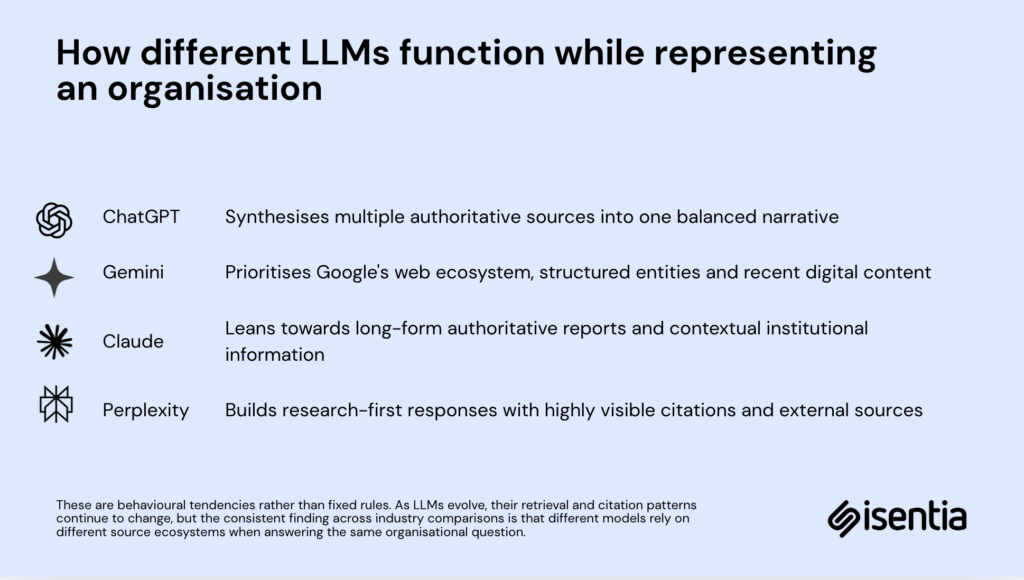
These decisions fundamentally shape how organisations are represented. To explain this better, we summarise how different AI models consult different publications and finally cite them in AI answers:
LLMs are not impartial, but come with their own weights and balances. In a sense, it reflects dynamics we already see at play across PR & Comms.
If four experienced journalists had to write a profile of the same CEO after attending the same press conference and have access to the same reports, one may write about leadership, another financial performance, another governance and another might frame the story around innovation. None are necessarily wrong—they're simply viewing the event through a lens of individual expertise, and therefore, making different editorial decisions.
LLMs behave in similar ways. As a result, organisations are now represented by multiple AI-generated narratives, rather than a single authoritative digital narrative.
The same prompt can produce four different narratives
These differences are most apparent when users ask AI questions that require judgment rather than simple factual recall.
Consider a prompt like: "Which are the leading banks in Southeast Asia?" Across ChatGPT, Gemini, Claude, and Perplexity, you will likely see many of the same names — DBS, UOB, OCBC, and Maybank. This overlap occurs because all four models recognise these institutions as major regional banks.
However, the models differ in their explanations of why these banks are considered leaders.
ChatGPT may highlight DBS's digital banking leadership and customer experience. Claude is potentially more likely to discuss governance, regional strategy, and long-term institutional strength. Gemini may emphasise recent awards and publicly available web information, while Perplexity often presents answers as research comparisons supported by multiple citations. These changes are not necessarily so big as to be immediately noticeable, but over time the results accumulate.
An organisation may not meaningfully change between two users asking two different LLMs , but the reputation narrative shifts accordingly. This distinction matters because stakeholders rarely ask AI for isolated facts. They ask questions like:
Should I work with this company?
Which university is most innovative?
Has this government agency delivered on its commitments?
Who are the market leaders in this sector?
AI responds by interpreting credibility, authority, and context, rather than simply retrieving documents.
For communications teams, this means your organisation is increasingly evaluated through comparative prompts, where competitors, industry peers, and institutional benchmarks appear alongside your organisation by default.
Every LLM has its own citation fingerprint
When ChatGPT, Gemini, Claude, or Perplexity answer a question, they first retrieve documents from distinct information ecosystems. A recent study analysed 17.2 million AI citations across ChatGPT, Gemini, Claude and Perplexity and found that each model retrieves from substantially different source ecosystems rather than a shared pool of webpages. Two LLMs can answer the same question accurately while relying on entirely different publications.
Instead of viewing these as technical differences, it is more useful to consider them as citation behaviours. Each model consistently references different types of publications when explaining organisations.
ChatGPT – Building consensus from multiple sources
ChatGPT functions more like an executive briefing writer than a traditional search engine.
Rather than listing multiple links, ChatGPT typically combines information from several credible publications into a coherent narrative. If mainstream media, company information, and industry commentary consistently describe an organisation as a market leader, ChatGPT is likely to reinforce that positioning, regardless of the original source.
For a prompt like "Tell me about Singapore Airlines”, a typical ChatGPT response integrates its history, customer experience, awards it has won over time, its financial performance, etc., into a cohesive description. Individual articles become almost invisible, as the model prioritises a coherent narrative in its answer over transparently showcasing all citations.
For brands, this means consistency across publications is very valuable. ChatGPT values credible signals that repeat across multiple publications over one off news moments.
Gemini – Reading the living web
Gemini approaches organisations differently, as its retrieval is closely linked to Google's broader information ecosystem.
When we ask "What has Enterprise Singapore done to support AI businesses?", Gemini is more likely to include recent programme announcements, official government webpages, and newer online reporting. Its responses often feel more current because they draw from a web ecosystem designed to reflect continuously updated information.
For government agencies, this has practical implications. Official announcements and well-structured public information become machine-readable assets that help AI explain policy more accurately. These become important information touchpoints into how audiences understand government through AI.
Claude — explains the ‘why’, in addition to the ‘what’
Claude's defining feature is its emphasis on context.
Other models often prioritise concise answers but Claude frequently elaborates on why an organisation is respected. Questions about leadership, governance, ethics, and institutional reputation tend to produce more detailed explanations rather than brief summaries.
For a prompt like "Why is DBS considered one of Asia's leading banks?", Claude is more likely to discuss how the bank has regionally expanded, its digital transformation, what’s unique about its leadership etc. Its responses resemble analyst reports more than search summaries, as it favours high-authority editorial and institutional content.
For executive communications, this makes Claude particularly influential. Leadership narratives and corporate values often receive more contextual treatment than with other models.
Perplexity — makes your media strategy visible
Perplexity changes the experience by treating citations as a central feature rather than a supporting detail.
A question comparing two sustainability leaders, for example, typically returns numerous linked sources from business media and research publications. Users can immediately review the origin of each claim.
For PR teams, this creates greater transparency. Publication quality becomes visible within the user experience and is not hidden behind an AI summary. This means media strategy influences the evidence presented alongside the perception of the organisation.
How commercial brands and government agencies are represented differently
Although LLMs behave similarly across sectors, the questions users ask differ fundamentally.
For brands, AI compares before customers get the chance
Consumers rarely ask AI what a brand does. They definitely do ask which brand is better.
Questions like:
1. Which airline has the best customer experience? 2. Is Salesforce better than HubSpot? 3. Which bank is most innovative? 4. Who are the leaders in cloud computing?
These questions are inherently comparative.
As a result, your organisation is often introduced alongside competitors before stakeholders visit your website.
During a recent Isentia webinar on Measuring your brand’s visibility in AI answers, we analysed airlines across multiple LLMs with Lumina AI View. Using identical prompts, different models highlighted different airlines and emphasised varying strengths, such as premium service, operational performance, innovation, and customer experience. Competitive positioning shifted depending on the model, even though the underlying organisations remained unchanged.
For commercial communicators, competitor association is becoming as important as share of voice. AI evaluates brands in context, not in isolation.
AI becomes the interpreter of policy for government agencies
Public sector organisations encounter a different reputational challenge. Audiences increasingly ask questions that begin with how, why and can I trust:
1. What support does this agency provide? 2. Has this ministry achieved its policy goals? 3. What AI initiatives has this department introduced? 4. Has this programme faced criticism?
LLMs then synthesise official publications and institutional information into a single accessible explanation. This changes the role of public communications. The objective is not to ensure AI models have sufficient credible, authoritative context to explain complex policy accurately.
As AI becomes the primary interpreter of government information, communications teams are responsible for managing both visibility and understanding.
Measuring AI reputation with Lumina AI View
Reputation has been shaped across three familiar environments: media, search and social. AI introduces a fourth environment.
LLMs condense dozens of publications into a single response, reducing the traditional discovery process between a question and an opinion.
During the recent webinar, Prashant Saxena, VP of Revenue and Insights says, “We used to Google it. Now we're ChatGPT-ing it.”
This behavioural shift is significant. Reuters Institute research found that only a small proportion of AI chatbot users regularly click through to original articles.
Practically, every piece of earned coverage now has two audiences:
The people reading it.
The AI models learning from it.
Both shape reputation.
This is the challenge Lumina AI View was designed to solve.
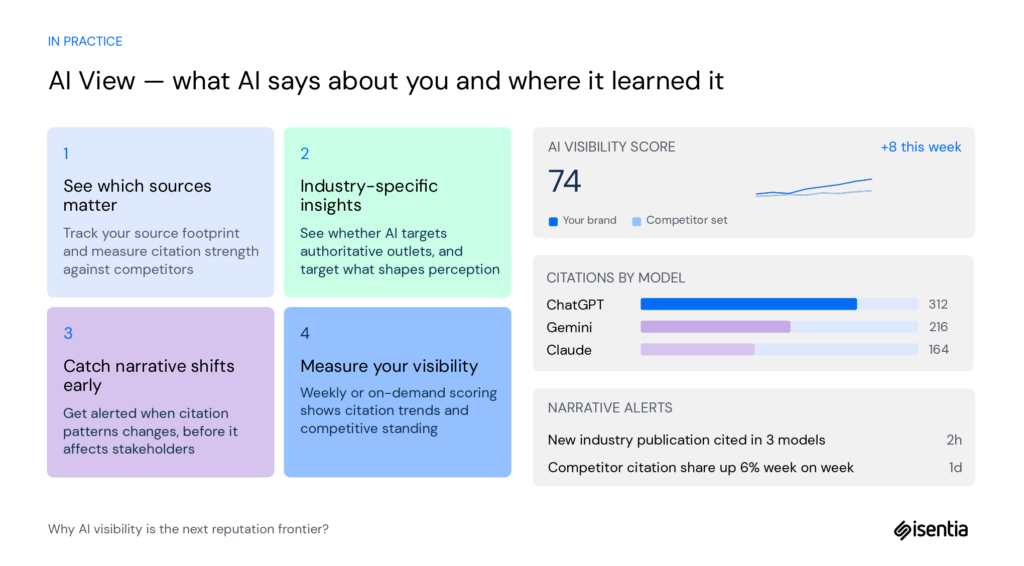
Instead of measuring whether an organisation appears in ChatGPT, AI View measures how different LLMs represent the organisation. Using consistent question sets across ChatGPT, Gemini, Claude, Perplexity, Grok, and Google AI Overviews, it compares narratives, citations, and competitive positioning through a unified reputation methodology.
The framework is built around four familiar dimensions: Direction, Performance, Integrity, and Innovation. Rather than tracking keywords alone, AI View identifies which reputation pillars dominate AI responses, which publications influence those narratives, and how representation differs across models. It also gives the organisation an AI score based on all the above factors.
The tool also shows organisations which publications are covered by different AI models. If the organisation’s AI score on the tool is high for ChatGPT, but struggles with or is a lower score on Gemini or Perplexity, the tool allows you to see where you’re underperforming. If there are publications that are covering the wrong information, or the important ones just don’t show up, then that’s an indication to why the AI score is low on that platform.
What this means for PR and communications professionals
The communications profession has always adapted to new discovery channels, from newspapers to search engines, and from social media to digital news.
AI is different because it does not simply help audiences find information, but it increasingly determines how organisations are introduced.
For communications leaders, this changes media strategy in three key ways.
First, publication quality becomes more important than quantity, as different LLMs repeatedly reference authoritative sources when constructing narratives around your organisation.
Second, visibility for the organisation’s spokespeople now extends beyond interviews and articles. The expertise attributed to leaders increasingly shapes how AI explains an organisation's direction and credibility.
Finally, competitor positioning is now continuous rather than campaign-based, as AI naturally compares organisations whenever users ask for recommendations or leadership insights.
Organisations that succeed in this new environment are those that have leadership, performance, integrity, and innovation represented consistently across every major AI model, regardless of where audiences and stakeholders begin their search.