Here at Isentia, wellness is a focus and working in an environment where everyone feels comfortable to speak openly about troubling issues without fear or stigma is important to our culture of inclusivity and respect. We believe being part of an organisation that are advocates for diverse employment and fair treatment are important values and having a healthy mindset is just as important. We also love to lend a hand to local and national fundraising organisations wherever we can and support social issues that resonate with us.
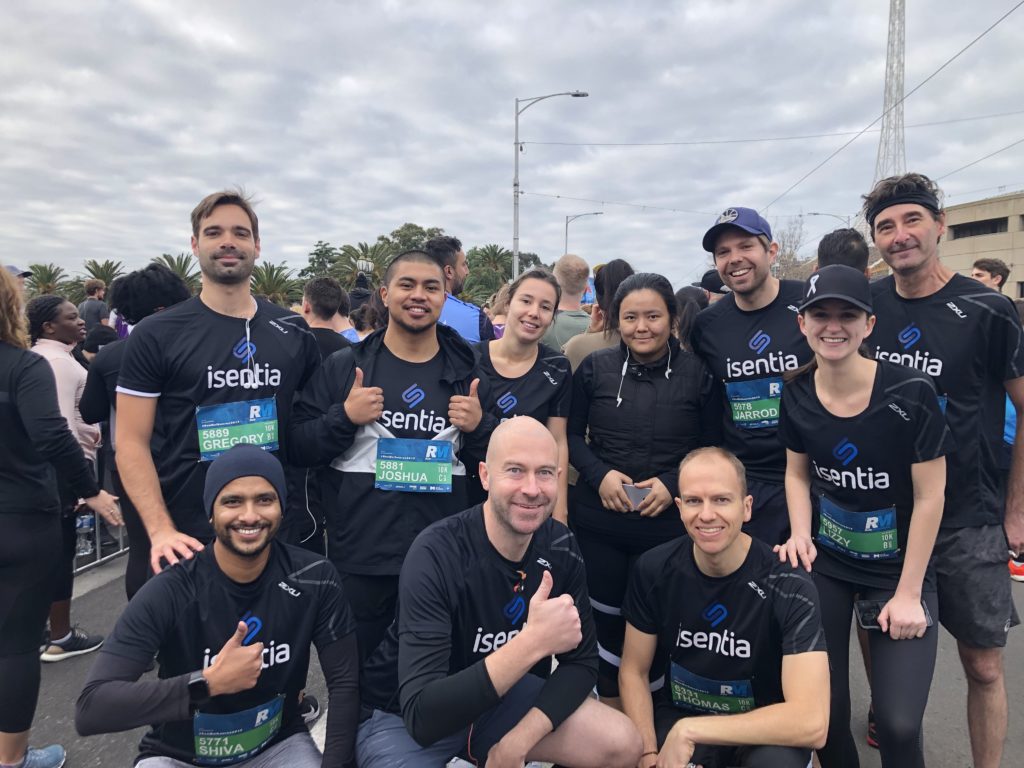
With this in mind, it sparked an idea to combine health and wellness whilst also participating in a charitable activity. We wanted to raise funds for a great cause, get fit and have fun at the same time and so 11 Melbourne Isentians formed a running club and participated in the Run Melbourne 10km. Our charity of choice was White Ribbon.
We trained hard and with the help of Strava, we were able to stay accountable with our training and also track our progress. Running through the Melbourne winter was a challenge in itself, but slowly and surely our fitness and running pace increased week by week and we were feeling confident about the 10km run. Many of us achieved our fastest times, motivating us to continue training and recruit more people into our running club.
Over a three-week campaign, our team collectively raised $1,375 for White Ribbon, it was great so many of our colleagues, friends and family were supportive of us participating in the event as well as supporting this great cause.
Where are we running off to next? Watch this space…
Loren is an experienced marketing professional who translates data and insights using Isentia solutions into trends and research, bringing clients closer to the benefits of audience intelligence. Loren thrives on introducing the groundbreaking ways in which data and insights can help a brand or organisation, enabling them to exceed their strategic objectives and goals.
In our third edition of Isentia Conversations: Communicating through Change, we chat with Rochelle Courtenay, the Founder and Managing Director of Share the Dignity. Rochelle talks to us about how she stays connected with over 6,000 volunteers across Australia and how she motivates those teams to work to end period poverty.
Isentia’s Insights Director, Ngaire Crawford also shares some of the trends seen across social and traditional media about home not always being the safest place for some people, and how social communities can help combat this.
Because many of us are working from home, we saw this webinar series as an opportunity to connect with each other, learn from subject matter experts and hear their stories, as we adapt to a new way of working.
Ngaire Crawford from Isentia talks feeling safe and secure at home
4:55 - Although most of us are now working from home,home isn’t always the safest placefor everybody.
5:25 - The main topics currently reported on mainstream media:
The increase in family violence - a topic that has been present since the lockdowns in Australia and New Zealand.
Connectivity and education - there is concern about people not having access to the right equipment or not having good enough internet connectivity for homeschooling.
Poverty during lockdown - there are restrictions in place to stay at home and access to food more controlled than ever before. Food specials are a thing of the past and fresh food may be more difficult to get.
8:55 - Within ANZ, data shows people are searching online about the rules for lockdown. What are they? Are they doing the right thing? What are the policies?
9:10 - On social media, people are reaching out and using their social channels to create connection, to remind everyone to check in on people and be a source of safety. During March, references to being scared and feeling unsafe more than doubled across ANZ.
Cluster topics driven by COVID-19 for feeling unsafe included: Rates, self-isolation, stress and mental health.
Cluster topics driven by COVID-19 for feeling scared included: Government, kids, workers, rent, supermarket, police, trust and social media.
10:15 - It’s important to see the good in social media right now - it’s the greatest facilitator of social connection. Not only can people reach out to others directly, toxic people and unhelpful communication can be called out very quickly. Always use your common sense when using social media, check your sources and investigate claims before relying on them.
13:13 - The importance of community.
Communicating with your social media audiences and communities is valuable during this time.
See the good that people are doing as well as the innovation.
Listen to your audience and ask for feedback. We’re all in our homes and more conversational than ever.
Be genuine and authentic when talking to your audience, if you look as though you are doing the right thing, then people will be on board.
Follow on social media those affected most from lockdown and watch what they are doing and how they’ve adapted their businesses.
Watch cancel culture on Twitter, understand what’s driving people to call out brands and public figures on social media.
Rochelle Courtenay from Share the Dignity talks staying connected and keeping your teams motivated
15:45 - For the past five years, Rochelle has also been known as the ‘Pad Lady’. Share the Dignity was created after Rochelle read about the high number of Australian homeless women who didn’t have access to essential sanitary items.
Twice a year, she drives two collections for sanitary items and runs the ‘It’s in the bag’ campaign each December. For this initiative, every day Australians are asked to fill a bag with essential items including toothbrushes, toothpaste, sanitary items, shampoo, conditioner, deodorant and soap. For a woman who is fleeing domestic violence, it may have been weeks since she has brushed her teeth, so these basic items are essential for these women in need.
16:56 - Communicating online to her ‘Shero’ and ‘Hero’ volunteers has been the norm for Rochelle since she founded Share the Dignity. Using ‘Workplace’ for their intranet, internal communications via announcements to all 5,783 volunteers is easy and effective.
17:45 - The most important thing when communicating is to be authentic and genuine.We ensure the most important people (Sheroes and Heroes) within our charity are kept informed and are at the forefront of everything that’s done. We ensure our communication comes from the heart first and our heads second.
19:03 - Reinforce the message you are trying to communicate. With charities, it’s important to remind volunteers (and staff members) why they are doing the work they are doing. Often, different types of communication are developed to cater for different communication preferences. Videos are recorded and also written up to deliver the same message.
19:58 - Since COVID-19, Share the Dignity has adopted new engagement initiatives on social media. The most recent; a Mother’s Day campaign where the community was asked to share their favourite photo with their mum. The campaign encouraged people to connect and engage with one another, to share stories, smiles, tears and laughter. It was a great way to create a community within a community. It’s important to help people within your community through difficult times.
24:30 - A key part of running a charity is to sustain volunteers’ passion. We do this by sharing stories about the women they have helped and continue to help. We make sure they know how much of a difference they are making to someone else’s life.
If you would like to view other Webinar Isentia Conversations: Communicating through Change:
"
["post_title"]=>
string(69) "Isentia Conversations: with Rochelle Courtenay from Share the Dignity"
["post_excerpt"]=>
string(209) "Because many of us are working from home, we saw this webinar series as an opportunity to connect with each other, learn from subject matter experts and hear their stories, as we adapt to a new way of working."
["post_status"]=>
string(7) "publish"
["comment_status"]=>
string(4) "open"
["ping_status"]=>
string(4) "open"
["post_password"]=>
string(0) ""
["post_name"]=>
string(68) "isentia-conversations-with-rochelle-courtenay-from-share-the-dignity"
["to_ping"]=>
string(0) ""
["pinged"]=>
string(90) "
https://www.isentia.com/latest-reads/isentia-conversations-with-katherine-newton-at-ruok/"
["post_modified"]=>
string(19) "2023-05-02 00:50:51"
["post_modified_gmt"]=>
string(19) "2023-05-02 00:50:51"
["post_content_filtered"]=>
string(0) ""
["post_parent"]=>
int(0)
["guid"]=>
string(31) "https://www.isentia.com/?p=6772"
["menu_order"]=>
int(0)
["post_type"]=>
string(4) "post"
["post_mime_type"]=>
string(0) ""
["comment_count"]=>
string(1) "0"
["filter"]=>
string(3) "raw"
}
Blog
Isentia Conversations: with Rochelle Courtenay from Share the Dignity
Because many of us are working from home, we saw this webinar series as an opportunity to connect with each other, learn from subject matter experts and hear their stories, as we adapt to a new way of working.
object(WP_Post)#8965 (24) {
["ID"]=>
int(1744)
["post_author"]=>
string(2) "36"
["post_date"]=>
string(19) "2019-06-24 09:01:34"
["post_date_gmt"]=>
string(19) "2019-06-24 09:01:34"
["post_content"]=>
string(0) ""
["post_title"]=>
string(18) "RUOK? Day Campaign"
["post_excerpt"]=>
string(168) "R U OK? uses the insights Isentia provides to plan and evaluate its campaigns. Revealing the messages that get attention and how different audiences engage each year."
["post_status"]=>
string(7) "publish"
["comment_status"]=>
string(4) "open"
["ping_status"]=>
string(4) "open"
["post_password"]=>
string(0) ""
["post_name"]=>
string(17) "ruok-day-campaign"
["to_ping"]=>
string(0) ""
["pinged"]=>
string(0) ""
["post_modified"]=>
string(19) "2023-07-03 01:08:31"
["post_modified_gmt"]=>
string(19) "2023-07-03 01:08:31"
["post_content_filtered"]=>
string(0) ""
["post_parent"]=>
int(0)
["guid"]=>
string(36) "https://isentia.wpengine.com/?p=1744"
["menu_order"]=>
int(0)
["post_type"]=>
string(4) "post"
["post_mime_type"]=>
string(0) ""
["comment_count"]=>
string(1) "0"
["filter"]=>
string(3) "raw"
}
Case Study
RUOK? Day Campaign
R U OK? uses the insights Isentia provides to plan and evaluate its campaigns. Revealing the messages that get attention and how different audiences engage each year.
The Australian public’s reaction to government reforms and leaders was especially eventful. Debates about campus safety by the Royal Commission, a tax deal between Labor and the Greens unsettling the finance and property sectors, and a speech on “monoculture” by Pauline Hanson shifting opinion polls in an unexpected way; were three complex stories that saw audiences taking different sides, leading to many perspectives and angles.
We used Isentia's Lumina to track the different viewpoints, key people, and stories with the largest volume and audience. Over four weeks (22 June to 17 July), we found 62 unique perspectives and nearly 900 media items across these three stories.
Key Stories, Key Drivers
Here’s a quick overview:
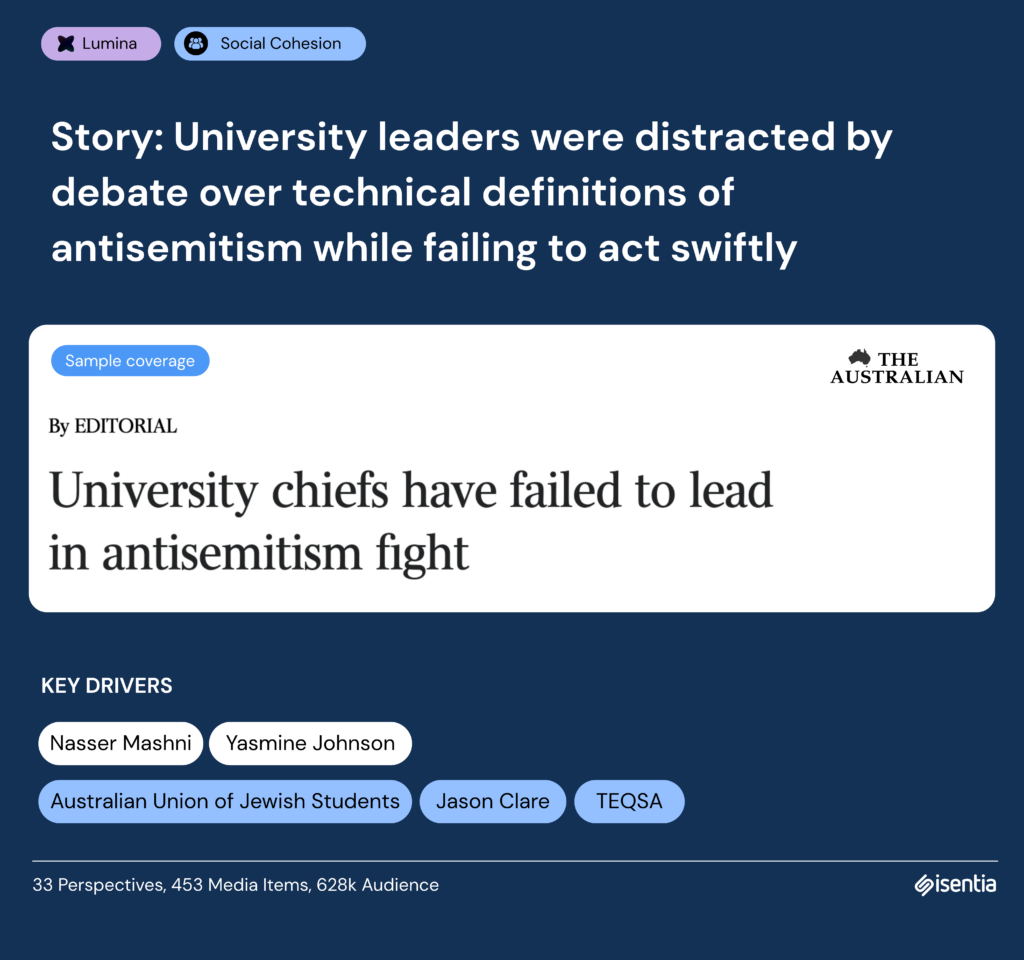
▸ Campus Antisemitism at the Royal Commission — Pro-Palestinian groups, Jewish advocacy groups, and the federal government each put a different framing on the same hearings. Key drivers: Nasser Mashni, Yasmine Johnson, the Australian Union of Jewish Students, Jason Clare, TEQSA.
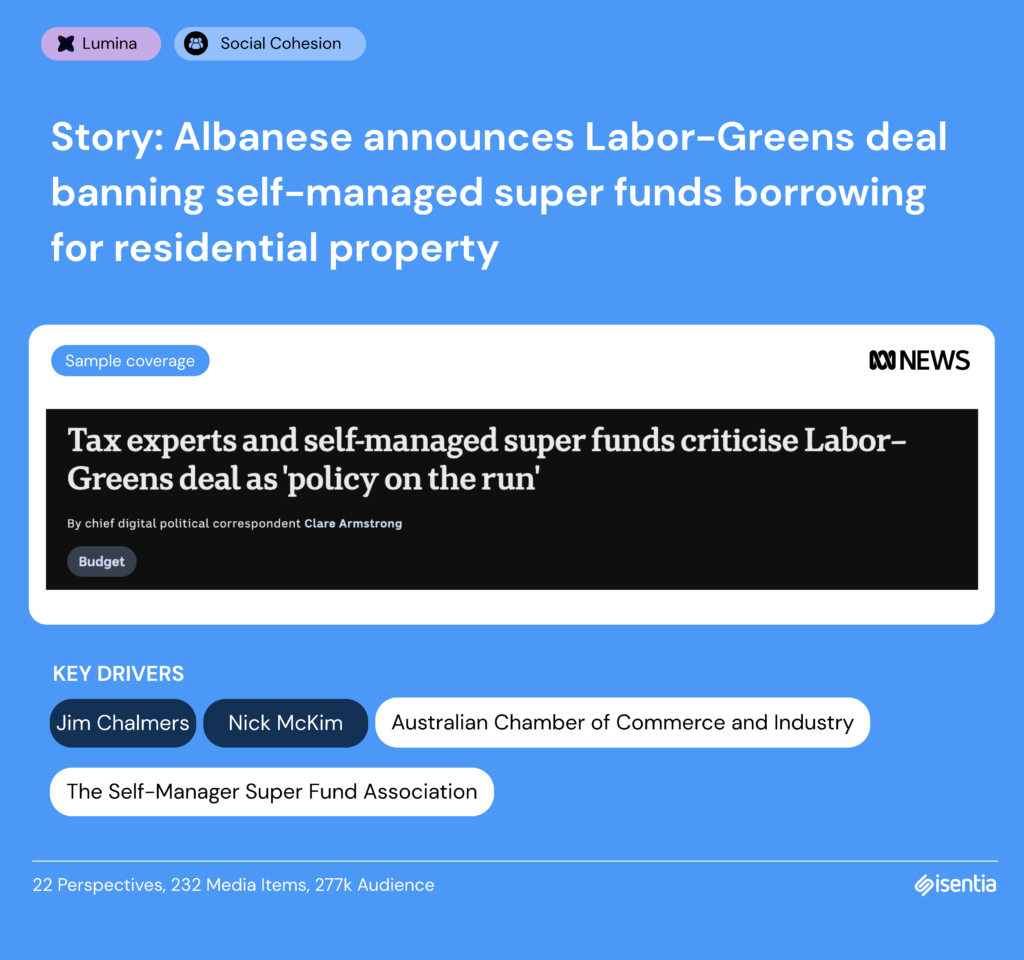
▸ The Labor–Greens Tax Deal — Government and Greens call it fairness for first-home buyers; finance and business groups call it policy on the run. Key drivers: Jim Chalmers, Nick McKim, the Self-Managed Super Fund Association, the Australian Chamber of Commerce and Industry.
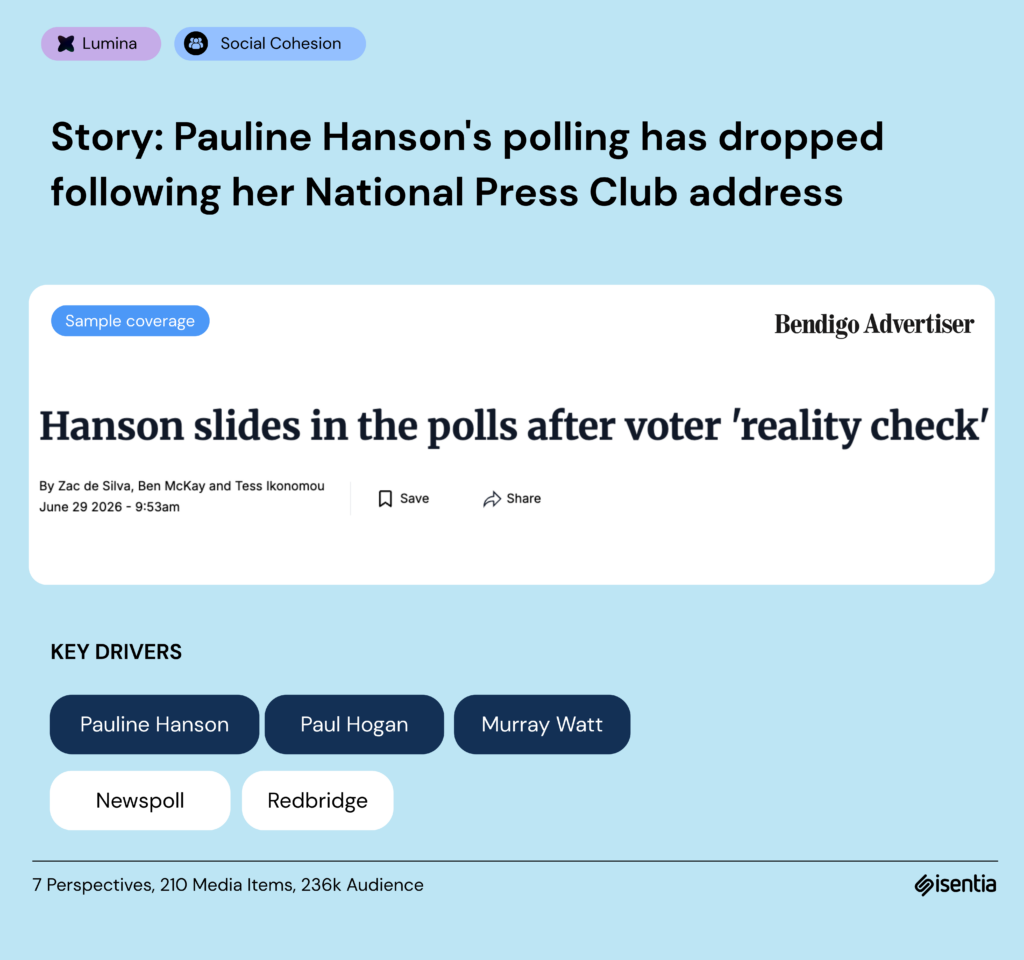
▸ Pauline Hanson's Monoculture Speech — A push for cultural unity that critics called divisive, followed by a real slide in the polls. Key drivers: Pauline Hanson, Paul Hogan, Murray Watt, Newspoll, Redbridge.
The Royal Commission on campus anti-semitism
The Royal Commission on Antisemitism and Social Cohesion’s hearings on university campuses was the biggest story by far. In less than a week, it drew 33 perspectives and 453 media items, reaching over 628k audiences. The story’s size came from the many institutions involved—student groups, representative bodies, and the federal government—each offering their own view on the same testimony.
Pro-Palestinian advocacy groups had the widest reach, making up about a third of all coverage. Spokespeople like Yasmine Johnson from Students for Palestine and Nasser Mashni from the Australia Palestine Advocacy Network told the commission their campus protests are a legitimate justice movement. They also raised concerns that criticism of government policy is being confused with antisemitism, which they say limits open debate.
Jewish student and staff groups also received significant coverage, making up about a fifth of the total. The Australian Union of Jewish Students described campuses where some students feel hesitant to attend and highlighted gaps in how universities handle complaints and support those affected. Most of this coverage came from wire services and was widely shared across news outlets like The Australian or the Midwest Times.
The federal government provided a third perspective, with similar coverage. Education Minister Jason Clare said universities had been slow to act and announced plans to tighten governance standards. This includes clearer anti-racism policies covering both antisemitism and Islamophobia. Reports also noted that TEQSA, the regulator, warned universities about outside groups joining campus protests, and the government’s antisemitism envoy suggested universities could face funding cuts if they do not do enough.
The Labor-Greens Tax Deal
The second-biggest story was more focused but still managed to stir strong reactions. Labor’s deal with the Greens to close a borrowing loophole for self-managed super funds, in return for Greens support on capital gains tax and negative gearing changes, led to 22 perspectives and 232 media items, reaching nearly 177k audiences.
The government, supported by the Greens, presented the deal simply — it closed a loophole that allowed wealthy investors to use their super funds to compete with first-home buyers at auctions. Treasurer Jim Chalmers cited a 2014 recommendation to support the change, and Greens treasury spokesman Nick McKim called it a win against "wealthy property investors."
The Greens, however, took a tougher stance and received similar coverage for saying the deal was only a partial win. They argued that allowing existing arrangements to continue would let Labour protect wealthy investors rather than renters, and said the housing crisis would now be "squarely of Labor's design." This shows that support from a governing partner does not always mean they are satisfied, as Country News highlighted.
Finance and business groups pushed back with nearly as much coverage. The Self-Managed Super Fund Association and the Australian Finance Industry Association said the borrowing rules did not pose a systemic risk and argued that regulators should focus on "aggressive marketing" and property spruiking, not legitimate investors. The Australian Chamber of Commerce and Industry warned that the wider capital gains tax changes could hurt business investment. ABC News gave the most detailed account of this perspective, noting the sector was "surprised" by how the deal was made.
Pauline Hanson’s monoculture speech
This story had the fewest perspectives (just seven) but still reached nearly 236k people through 210 media items. That’s a bigger audience than the tax story, which had three times as many viewpoints.
The story began when Pauline Hanson used a National Press Club speech to argue that Australia should replace multiculturalism with a single "monoculture." She cited Paul Hogan and the Socceroos as examples. The backlash was quick and unexpected and Hogan himself called her a "pelican" and said her views were racist. His response ended up shaping the story more than her monoculture speech.
What makes this story notable is what happened afterward. Two polls, Newspoll and Redbridge, showed One Nation’s primary vote dropping by about two points (Dairy News Australia) and Hanson’s personal approval falling ten points into negative territory. Labor regained a narrow lead and Labor minister Murray Watt quickly described the numbers as a "reality check,". This framing spread almost as widely as the original speech, as the Bendigo Advertiser reported.
The speech and the poll results are really one story seen from three sides — Hanson’s message, her critics’ reactions, and Labor’s use of the polling. Each angle received similar coverage, showing that the speech missed its mark and gave the government a useful talking point.
How does this inform PR & Comms Strategy?
First, the number of perspectives in a story is important. A story with many viewpoints, like the antisemitism hearings, needs a different monitoring approach than one with just a few, because the loudest voices might not always be the most important.
Second, pay attention when several perspectives are about the same size, as in the tax deal. If no single viewpoint stands out, the issue is likely still being debated. It’s a good idea to check back after some time instead of treating the first coverage as the final answer.
Third, compare any polarising message to the Hanson example before recommending it to a client. The numbers show that a divisive message can get attention but still turn public opinion against the speaker.
Conclusion
What links these stories is how much is lost when they are reduced to just two sides. The antisemitism hearings, the tax deal, and Hanson’s polling drop were all more complex than their main headlines suggested.
That’s why it’s valuable to track a story by its different perspectives and key drivers. See what Lumina can reveal for your industry or clients, and check out more analysis like this on the Isentia blog.
"
["post_title"]=>
string(61) "Who really shaped Australia's latest social cohesion debates?"
["post_excerpt"]=>
string(170) "See how Isentia's Lumina tracked 62 perspectives across 3 major Australian stories, revealing how media coverage really spreads and who ends up controlling the narrative."
["post_status"]=>
string(7) "publish"
["comment_status"]=>
string(4) "open"
["ping_status"]=>
string(4) "open"
["post_password"]=>
string(0) ""
["post_name"]=>
string(59) "who-really-shaped-australias-latest-social-cohesion-debates"
["to_ping"]=>
string(0) ""
["pinged"]=>
string(0) ""
["post_modified"]=>
string(19) "2026-07-23 02:35:20"
["post_modified_gmt"]=>
string(19) "2026-07-23 02:35:20"
["post_content_filtered"]=>
string(0) ""
["post_parent"]=>
int(0)
["guid"]=>
string(32) "https://www.isentia.com/?p=48739"
["menu_order"]=>
int(0)
["post_type"]=>
string(4) "post"
["post_mime_type"]=>
string(0) ""
["comment_count"]=>
string(1) "0"
["filter"]=>
string(3) "raw"
}
Blog
Who really shaped Australia’s latest social cohesion debates?
See how Isentia’s Lumina tracked 62 perspectives across 3 major Australian stories, revealing how media coverage really spreads and who ends up controlling the narrative.
There is a new frontier where public perception is shaped: Large Language Models. Right now, LLMs are answering critical questions about your organisation. What are they saying? And more importantly, which sources are shaping those answers?
To navigate this landscape, public relations professionals don't need generic tools, but rather technology that speaks their language, and addresses the realities of a changed media and informational landscape.
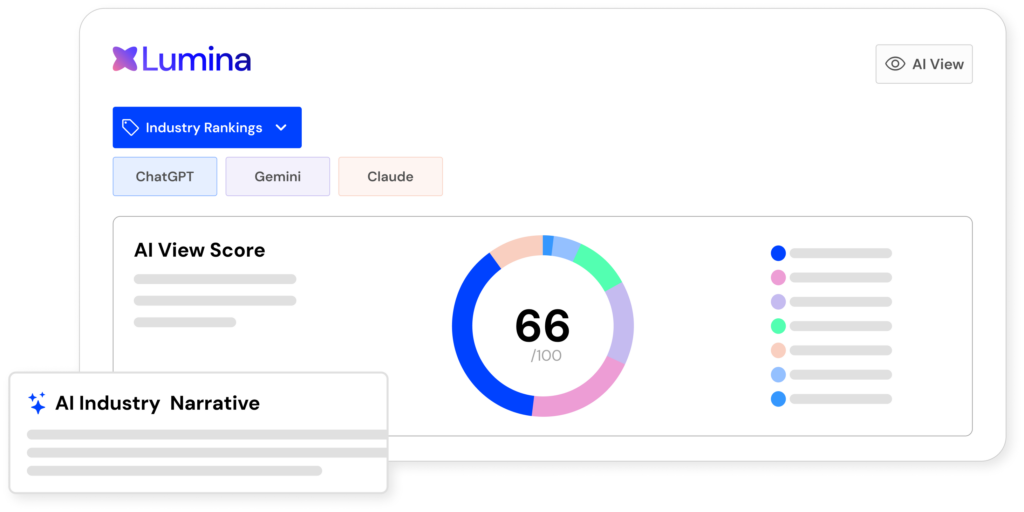
That is why we're unveiling Lumina AI View, the latest addition to our intelligent suite of AI tools from Isentia. Trained specifically on the workflows and challenges of modern PR & communications, Lumina AI View helps you understand exactly what AI knows about you, and how it learned it.
A new standard for AI visibility
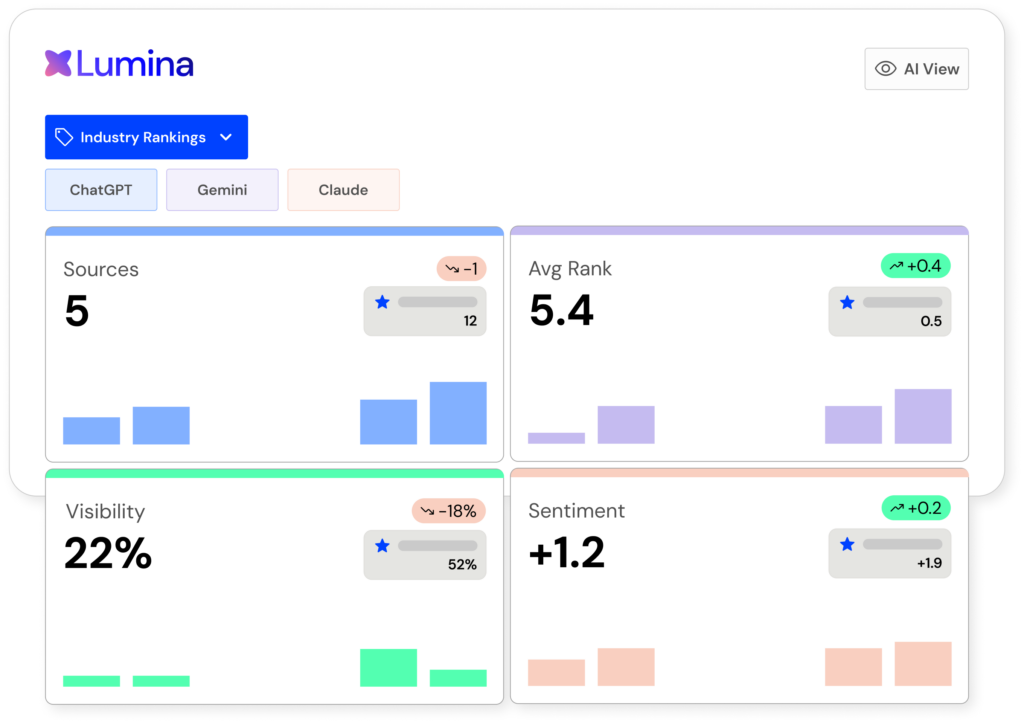
AI View tracks your citation strength and source quality alongside those of your competitors, giving you a clear view of where you hold authority and where you have gaps.
Lumina AI View maps your AI reputation from the ground up, allowing you to:
See which sources matter: When tools such as ChatGPT or Gemini discuss your organisation, which outlets do they cite? Track your source footprint over time and view the impact of key target media on how you’re discussed. We measure your citation strength and source quality alongside those of competitors, giving you a clear view of where you have authority and where you have gaps.
Gain industry-specific insight: Your competitors get cited from Financial Times and Bloomberg. You get cited on Reddit. Each brings opportunity – and risk. Discover how you measure up against industry standards, and target the sources that actually influence how AI represents you.
Catch narrative shifts early: AI responses change when new sources appear, sentiment shifts, or old controversies resurface. Get alerts when citation patterns change suddenly, before they impact the way you’re perceived by stakeholders.
Measure your progress: From media monitoring to full media intelligence
Lumina AI View is built on the principle that insights get stronger with repeated measurement. To help you maintain a clear view of your reputation, our proprietary scoring system provides regular updates that show you:
Evolving trends in how sources cite your organisation
Competitive standing and benchmark metrics
Where models differ in information presented, and sources cited
Whether you run it weekly, on-demand, or whenever you need a check-in, patterns will emerge, trends will become clear, and you will build a baseline that makes any sudden narrative changes both comprehensible and the prerequisite to action.
Lumina AI View is part of Lumina AI, a comprehensive suite of AI tools built specifically for communicators. Our Lumina suite evolves traditional media monitoring into narrative intelligence, enabling you to truly understand how perceptions form, evolve, and impact your reputation.
Get in touch to register your interest and see what Lumina AI View can do for you.
"
["post_title"]=>
string(66) "Introducing Lumina AI View: AI Visibility Built for PR & Comms"
["post_excerpt"]=>
string(158) "Lumina AI View, the latest in Isentia's AI suite, is trained on PR & comms workflows to help you understand what AI knows about you — and how it learned it."
["post_status"]=>
string(7) "publish"
["comment_status"]=>
string(4) "open"
["ping_status"]=>
string(4) "open"
["post_password"]=>
string(0) ""
["post_name"]=>
string(59) "introducing-lumina-ai-view-ai-visibility-built-for-pr-comms"
["to_ping"]=>
string(0) ""
["pinged"]=>
string(0) ""
["post_modified"]=>
string(19) "2026-07-15 03:12:57"
["post_modified_gmt"]=>
string(19) "2026-07-15 03:12:57"
["post_content_filtered"]=>
string(0) ""
["post_parent"]=>
int(0)
["guid"]=>
string(32) "https://www.isentia.com/?p=47963"
["menu_order"]=>
int(0)
["post_type"]=>
string(4) "post"
["post_mime_type"]=>
string(0) ""
["comment_count"]=>
string(1) "0"
["filter"]=>
string(3) "raw"
}
Blog
Introducing Lumina AI View: AI Visibility Built for PR & Comms
Lumina AI View, the latest in Isentia’s AI suite, is trained on PR & comms workflows to help you understand what AI knows about you — and how it learned it.