What can you learn from 750,000 social media posts in China each day? Sean Smith of Isentia explores how technology is disrupting market research.
No Facebook. No Twitter. No YouTube. With stifling regulations around social media use, how can New Zealand businesses’ use social media to enter Chinese markets?
The basic premise remains the same – the way in which Chinese consumers engage with social media platforms is not dissimilar to here, nor is their decision-making journey. Needless to say, understanding the landscape is paramount for any company aspiring to capitalise on the booming Chinese economy. It’s certainly an opportunity worth pursuing – this year China’s GDP is estimated to exceed US $12.1 trillion (NZ $16.44 trillion).
An obvious difference from the outset is the sheer volume of online conversations that happen within China’s firewalls.
This is not surprising given the 740 million-odd internet users, and is exacerbated by the fact that social media is a much larger phenomenon in Chinese culture than it is here in New Zealand.
In today’s digital world, this level of activity offers businesses unprecedented access to millions of organic conversations unfolding in the alluring Chinese market – in real time. The million-dollar question is, how can this information be used to help businesses make important decisions about when to launch a product in the market and drive sales?
Givenchy and Mr Bags
A great example of the power of social media in China is the partnership between Givenchy and blogger Tao Liang, better known as Mr Bags.
He uses his encyclopaedic fashion knowledge to retain over 2.7 million Weibo readers and a further 600,000 WeChat followers; keen to be ‘in the know’ on the latest handbag trends and the current “it” bag.
In an act of extreme commercial nous, in 2017 Mr Bags called for his followers to nominate a potential collaborator for the blogger. When Givenchy emerged as the overwhelming favourite, the brand took the opportunity to launch a limited-edition handbag on Valentine’s Day via Mr Bags’ social channels. What followed the announcement was a 12-minute frenzy seeing Givenchy part with 1.2 million RMB’s (NZ$247,000) worth of handbags – a complete sell-out. Needless to say, the campaign was deemed a success.
Listen to many, speak to a few
By now it’s no secret that social media isn’t just a broadcast platform. In fact, true to the proverb “we have two ears and one mouth, so we should listen more than we say”, there’s far greater power in using social media to understand a potential customer’s motivations.
In today’s world, social media provides market research on an unprecedented scale.
Once upon a time, businesses invested heavily in market research groups to understand consumer insight.
Test groups were enticed with gift vouchers or free products to partake in a fishbowl-style exercise, where they were asked to provide honest and open feedback as eager marketers and communicators looked on.
Despite questions being developed using the latest, tested methodology and astute moderators, the quality and authenticity of the data was often in question.
Let me be clear – this has less to do with the methodology and more a reflection that as consumers, we find it much easier to speak the whole truth when we think we’re not being watched.
With such a high level of human involvement, it is also incredibly difficult to collect data consistently and without bias.
Technology: the market research disruptor
Why might technology make consumers more honest and open with their feedback? The truth is people are more honest in a casual setting. Therefore, dialogue about a product or service that’s exchanged in the comfort of someone’s home (behind a screen) will often be more candid than their responses to a survey.
At Isentia, Mediaportal’s cloud-based technology trawls video, audio and digital content across more than 4,400 print items, 1750 broadcast items, 62,500 online news sites, 6 million blogs and 300,000 forums. Processing seven million news items each day a rate of 234 stories per second, it presents summaries to clients in real-time.
For China enthusiasts, the technology mines over 750,000 WeChat and Weibo posts daily and uses this information to unearth the Mr Bags’ opportunities – the people or issues relevant to specific industries – so that businesses can make informed decisions based on both data and sentiment in foreign markets.
What’s more, the nature of social media means the survey technically never ends. Social media listening provides continued real-time pulse checking and the perfect new product incubator. It’s more than watching @mentions and comments pour in via your social profiles, mobile apps or blogs.
“If you’re only paying attention to notifications, you’re missing a huge group of people that are talking about you, your brand and your product.”
The true value is in tracking conversations around specific topics, keywords, phrases, brands or industries, and leveraging these insights to discover opportunities or create content for those audience.
Data – a modern marketing and communications must-have
It is now hard to imagine a marketing and communications industry that doesn’t rely on data to inform strategy, new product development and campaigns.
Much of what took place in marketing and communications teams, even as recently as a decade or so back, was based on assumption. We *think* that this product would be of interest to this audience, so we *figured* the best way to tell them about it would be mostly via a TV ad campaign.
“But data is now essential for any smart and savvy marketer or communicator and presents the opportunity to tap into foreign markets with a level of insight that has never been more accurate or accessible.”
When you combine and embrace the use of technology, social media, and analyse the data that it provides – you can not only quickly test and learn new products, but also give the fans what they want.
Givenchy were clever and reaped the rewards of listening, embracing and reacting to their consumers’ want, making it big in China. Now it is your time to get onboard and reap the results.
Loren is an experienced marketing professional who translates data and insights using Isentia solutions into trends and research, bringing clients closer to the benefits of audience intelligence. Loren thrives on introducing the groundbreaking ways in which data and insights can help a brand or organisation, enabling them to exceed their strategic objectives and goals.
This is not a list of what to do to be more successful. Or a list about the highly successful morning habits of CEOs and CIOs.
Instead, it’s a call-out to others who read the titles of articles like these on a Monday and sometimes feel exhausted by the amount of additional ‘work’ that is actually recommended to be more productive or successful.
This is, however, a question as to whether our push for productively has blurred into so many areas of life that we’ve forgotten why we strive to be increasingly efficient in the first place. Are we now too focused on volume, rather than value?
For example, in the last week alone we’ve seen the launch of a five-minute workout video series, been served an ad for an app which gives you the world’s best nonfiction books in bite-sized formats and scrolled past a ‘mindfulness in microseconds’ Instagram post.
While squeezing more into everyday life is a common challenge (and arguably a goal) for many professionals, it does present an interesting behavioural shift where we start to use smart technology to speed up activities that perhaps we shouldn’t.
Working in the always-on media Industry, we work with some of the most pressed-for-time people on a daily basis.
These communications and marketing professionals are dealing with huge amounts of fragmented media across channels that sometimes need urgent attenuation or action, particularly in times of crisis. However, this is where our technology thrives – it puts in the hard yards for them. Crunching huge volumes of data, providing the tools to report, alert, shred and more, and helping to give back time that should be spent on the more important strategic tasks, away from a computer.
From a professional standpoint this could mean more time for pitching ideas, benchmarking results against business strategy or presenting to the board. This is where value is achieved – with time spent on activities that need extra thinking space and deserve focus. From a personal standpoint, this may mean taking time back to pick up the kids from school, getting to yoga or simply enjoying a cup of tea in silence.
It’s not a case about fitting more into the day, but about filling your day with more valuable activities. Smart technology holds so much power in helping us spend less time on task-based needs like emails, to-do lists and life admin to free up the time for (hopefully) more than a ‘mindfulness in microseconds’ quick fix.
Remember, effort is not the same as impact.
"
["post_title"]=>
string(30) "The push to be ‘on’ by 6am"
["post_excerpt"]=>
string(126) "This is not a list of what to do to be more successful. Or a list about the highly successful morning habits of CEOs and CIOs."
["post_status"]=>
string(7) "publish"
["comment_status"]=>
string(4) "open"
["ping_status"]=>
string(4) "open"
["post_password"]=>
string(0) ""
["post_name"]=>
string(24) "the-push-to-be-on-by-6am"
["to_ping"]=>
string(0) ""
["pinged"]=>
string(0) ""
["post_modified"]=>
string(19) "2019-06-25 08:16:04"
["post_modified_gmt"]=>
string(19) "2019-06-25 08:16:04"
["post_content_filtered"]=>
string(0) ""
["post_parent"]=>
int(0)
["guid"]=>
string(36) "https://isentia.wpengine.com/?p=1975"
["menu_order"]=>
int(0)
["post_type"]=>
string(4) "post"
["post_mime_type"]=>
string(0) ""
["comment_count"]=>
string(1) "0"
["filter"]=>
string(3) "raw"
}
Blog
The push to be ‘on’ by 6am
This is not a list of what to do to be more successful. Or a list about the highly successful morning habits of CEOs and CIOs.
From programmer to industry leader, as one of Australia’s only Chief Information Officers in technology, Andrea Walsh has shattered the glass ceiling. And she’s championing other women, while she’s at it.
So, is she a game changer? Let’s find out. I’m Sarah Harris. Welcome to Game Changers.
Sarah: Andrea, welcome to Game Changers, now you are one of Australia’s only female CIOs of a technology company. You must see yourself as a bit of a role model?
Andrea: I never thought I was, but having been in the role now for number of years I look around and I do think where are all the other women, where are all the females.
Sarah: And, where are they?
Andrea: There is just a real shortage of women in I.T and technology, which is a real shame.
Sarah: So, tell us a little bit about Isentia and what it actually does.
Andrea: So, Isentia is a media monitoring company. And basically what that means is we take information and news from across varying countries, about 18 countries, multiple languages, and we filter that and disseminate it to what is important to our clients and what are the leading issues that they need to focus on. An average day, there’s about 7 million news items that we’re processing.
Sarah: That is a big job, lots of information to get through. So, what does your role as CIO involve?
Andrea: So, I lead the technology team. We are responsible for all the systems and the technology that processes those 7 million items a day. And we also provide all the services for our clients and tools for them to be able to do their job each day.
Sarah: Why do you think there’s a lack of women in IT roles?
Andrea: I think through education. I don’t think that girls are encouraged to take up sciences and engineering when they’re younger. It’s very much seen as, ‘it’s for the boys’. I think it starts really early on. And then I also think women don’t put themselves forward necessarily for opportunities, and roles to re-train. And maybe say, I might be interested but unless I’m absolutely sure I not going to give it a go.
Sarah: You are quoted as saying, “we’re on the cusp of a technological revolution”. What are you most excited about?
Andrea: There is so much. I think that’s what’s exciting. I think with cloud technology, it’s enabled a lot of organisations to be able to experiment with technologies. And things like artificial intelligence, so looking at machine learning. And I think that will really shape future roles and jobs.
Sarah: You really passionate, which I love, about women moving up in the industry. In particular, girls learning how to code. For someone who is not as technologically advanced as you, perhaps, explain to me what coding actually is.
Andrea: It’s basically creating something using computer and technology. Sometimes, yes, it has to be, or can be, detailed lines of programming. But some of the tools that are available, especially to young children who are interested in coding, enables kids to build stories, cartoons and make videos.
Sarah: The number of girls studying, as you said before, STEM, which is science, technology, engineering and mathematics, it is slowly increasing. Which is brilliant. But it’s not at a rate of ‘the boys’ just yet.
Andrea: No. Certainly not. And I think that it is great that it is slowly increasing. But it’s got a considerable way to go.
Sarah: Well, how do we change that?
Andrea: I think again, it goes back to the education. It’s encouraging girls and young children to get involved in these subjects. And I also think that they have maybe a brand, or an image, issue with engineering and IT often see as ‘it’s for the boys’. I think it’s also about the parents and the carers. So often we teach our children when they come home about doing their homework, reading, writing, maths. But what about the children who want to learn technology, and they want to learn to code? And if the parents aren’t IT, how do they support them. So I think it’s really about, as I say, the education, but then also then about the parents and finding these great programs that are out there to give the kids opportunity.
Sarah: Your daughter is eight and she’s already taken an interest.
Andrea: When I first showed her the iPad, she just took it instantly. It was quite amazing to experience. We certainly encourage here to use it. There’s s o many educational programs for children that you can use on the iPad. So I’m a big advocate of it.
Sarah: It does bring up that other thing as well, because I have a little boy who’s 18 months, and he’s very savvy when it comes to technology. You know, he’s coming up to the television and trying to swipe it like an Ipad. But I do kind of worry that (you know) we’re introducing technology to these kids too early, because there’s been research that show that it’s actually changing the chemistry of the brain. When should we be introducing this sort of stuff to our kids? Because as a parent you sort of think to yourself, I don’t want my kids to have their head in technology all the time. But at the same time, you don’t want to hold them back, because that’s the future.
Andrea: I think its each individual parent’s choice. For our daughter’s, Charlotte, we introduced it quite early on, so it was before kindergarten. But we’re very strict with her, both from what she can do on there and so content she can see. And also how long she spends on there, because the last thing we want is to build a relationship and the communication is with the back of an Ipad all of the time.
Sarah: IT is a well-paying field, but there id still a gender pay gap when it comes to technology, isn’t there?
Andrea: Where I work at Isentia, we pay the market rate and we pay on skills regardless of gender. But it is a known issue within many industries and with many organisations and that’s something we need to address.
Sarah: What advice you want to give to women that you mentor?
Andrea: I would say, seek every opportunity. Just go for it – what can you lose at the end of the day? I think work with other areas of the business as well; get to know the business and the industry in which you work. Do things that are potentially outside your remit so you can learn and grow from them.
Sarah: You are a trailblazer and a Game Changer. Thank you for joining us today.
"
["post_title"]=>
string(46) "Isentia’s CIO, Andrea Walsh on Game Changers"
["post_excerpt"]=>
string(210) "From programmer to industry leader, as one of Australia’s only Chief Information Officers in technology, Andrea Walsh has shattered the glass ceiling. And she’s championing other women, while she’s at it."
["post_status"]=>
string(7) "publish"
["comment_status"]=>
string(4) "open"
["ping_status"]=>
string(4) "open"
["post_password"]=>
string(0) ""
["post_name"]=>
string(42) "isentias-cio-andrea-walsh-on-game-changers"
["to_ping"]=>
string(0) ""
["pinged"]=>
string(0) ""
["post_modified"]=>
string(19) "2019-06-26 00:51:46"
["post_modified_gmt"]=>
string(19) "2019-06-26 00:51:46"
["post_content_filtered"]=>
string(0) ""
["post_parent"]=>
int(0)
["guid"]=>
string(43) "https://isentiastaging.wpengine.com/?p=1844"
["menu_order"]=>
int(0)
["post_type"]=>
string(4) "post"
["post_mime_type"]=>
string(0) ""
["comment_count"]=>
string(1) "0"
["filter"]=>
string(3) "raw"
}
Blog
Isentia’s CIO, Andrea Walsh on Game Changers
From programmer to industry leader, as one of Australia’s only Chief Information Officers in technology, Andrea Walsh has shattered the glass ceiling. And she’s championing other women, while she’s at it.
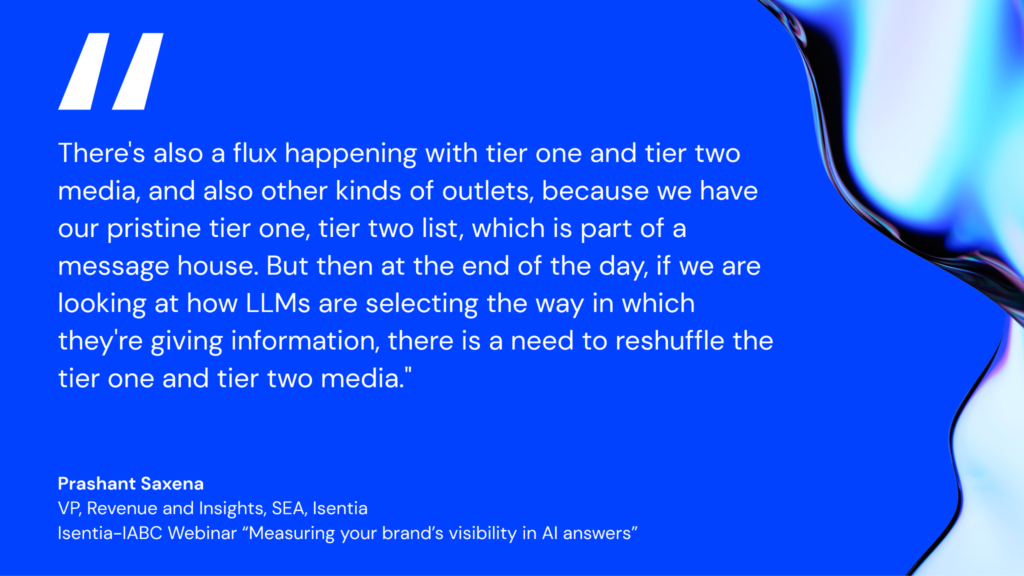
Audiences are no longer finding information through traditional search engines that favour established news outlets. AI models now highlight highly relevant and contextual information to audiences to often include niche and regional publications alongside major news media. This change challenges the old media hierarchy around tiered publications and pushes organisations to reconsider how and where they need to show up to stay visible in an AI-first world.
Yes, organisations must focus on optimising their own content for LLMs, but will that always drastically increase the chances of AI models picking up your page? Probably not always. Smart strategy means targeting the specific publications your actual target audience reads — because those are the sources AI models retrieve when answering niche questions.
It’s closer to digital PR than SEO
Generative Engine Optimization (GEO) is changing how brands approach online visibility. For years, traditional SEO meant focusing on your own site—optimising keywords, building backlinks, and improving on-page content. But AI models work differently. Instead of just using your website, these AI engines rely on trusted third-party sources to answer questions. This shift is taking place gradually, of course. LLMs increasingly source from earned media (where it is accessible) and even offsite links from trusted sites. Owned media is still where the organisation has maximum control of how it’s own content travels, but a pivotal strategy shift is needed to match what AI models are picking up and citing.
To succeed with AI search, comms professionals need to think more like a digital PR strategist than a SEO expert. The best way to stand out is by earning mentions, quotes, and citations in the external publications your audience—and the AI systems they use—trust most. This does not make a distinction between Tier 1 or Tier 2 media. If AI models are crawling sites that mention an organisation, but the organisation does not acknowledge or even know those sites are being prioritised by LLMs, they risk falling behind in being the right kind of visible.
To make this strategy work, looking beyond common metrics like traffic to the site or domain authority is not enough. Even a respected industry site will probably not influence AI answers as much if its content is behind a paywall or blocked from search engines. For AI visibility, accessibility to the site or page, structured data that can be crawled, and strong audience alignment are important. Since AI systems use both slow training cycles and fast real-time web searches (RAG), being featured on accessible, relevant niche sites helps an organisation show up accurately when models learn and when they search the web in real time.
Why is Tier 2 media punching at Tier 1 weight?
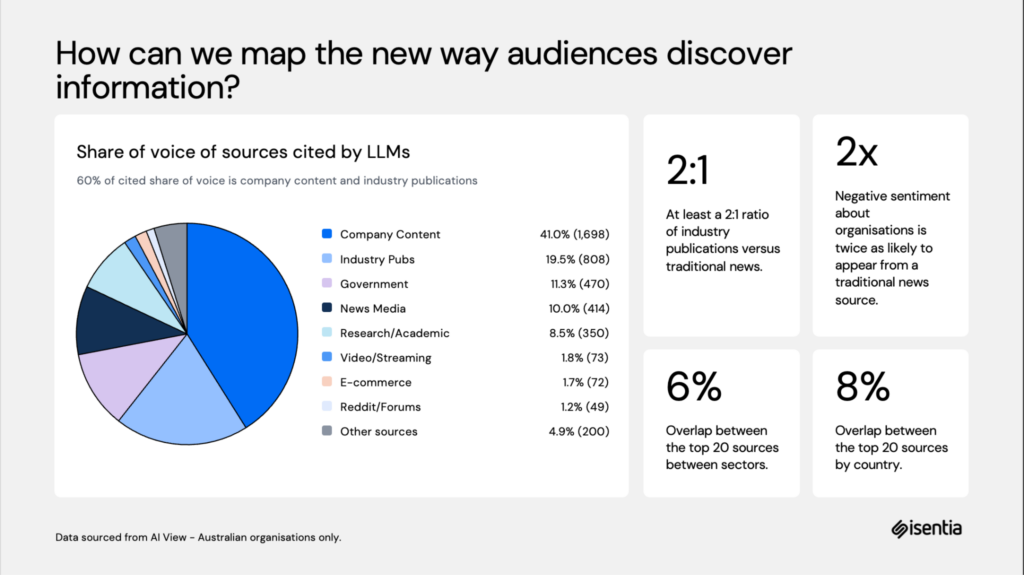
According to Isentia's report How AI is destabilising trust and reputation amongst audiences, LLMs cite industry and trade publications about twice as often as traditional news sources. Company content and industry press make up over 60% of the share of voice LLMs use, while traditional news is twice as likely to generate negative sentiment. Thus, tier 1 outlets no longer automatically dominate AI-generated responses and may sometimes have the opposite effect.
Two main factors are driving this shift in which media is picked up by LLMs:
The paywalled problem was further expanded on by Dr Momoko Fujita during the Digital News Report: Australia webinar that news organisations must figure out how to make paywalled content easily readable by LLMs. By bridging this gap, these organisations can ensure that AI tools deliver accurate, high-quality reporting rather than missing out on premium content. If not, high-quality coverage may never reach the model. Isentia’s Prashant Saxena, VP of Revenue and Insights, SEA, during a recent partner event with IABC APAC on Why AI Visibility is the next reputation frontier illustrated a paywalled Bloomberg story, for example, that was accurately summarised details it could read at the top level, but fabricated details about raised guidance, even though guidance had been cut. This is because it could not read the rest of the article and tried its best to assume what it can with the information that’s accessible.
Specificity outweighs prestige. Tier 2, trade, and specialist publications are often more accessible, focused, and likely to provide the concrete, citable facts models need. Amy Chappell, Vuelio's Head of Insights Strategy, found a similar trend across sectors in her report on the visibility of supermarkets in the UK “ The role of AI, LLMs, and earned media in shaping reputation” and noted that supermarkets were most often cited by trade publications like The Grocer and Grocery Gazette, not national newspapers. Trade press stories, being more focused and well-sourced, provide models with clearer, more citable facts than broader national articles. This doesn’t mean that Tier 1 coverage does not matter — CEOs value front-page exposure because it remains highly influential. However, relying only on tier 1 hits now means missing significant AI visibility opportunities.
Cited vs consulted: LLMs read a hundred sources, but cite only a few
Which type of media gets cited relies upon how AI models scan different pages. If these models are citing much more niche media outlets, we can assume that a lot of these pages that are consulted could be a part of very relevant Tier 2 media that ends up actually getting cited, and that we’re seeing more and more examples of in AI answers. At the IABC APAC and Isentia webinar on measuring brand visibility in AI answers, Prashant Saxena, Isentia's VP of Revenue and Insights for SEA, stated that in the search era "we would get sources on our page one, page two, mostly page one", and people would click through to form their own opinions. The combined click-through rate in that era was 35 to 40 per cent. Nowadays, he says, "it's just four to five per cent" — since LLMs provide a smooth, ready-made answer and "most of us aren't really checking the citations".
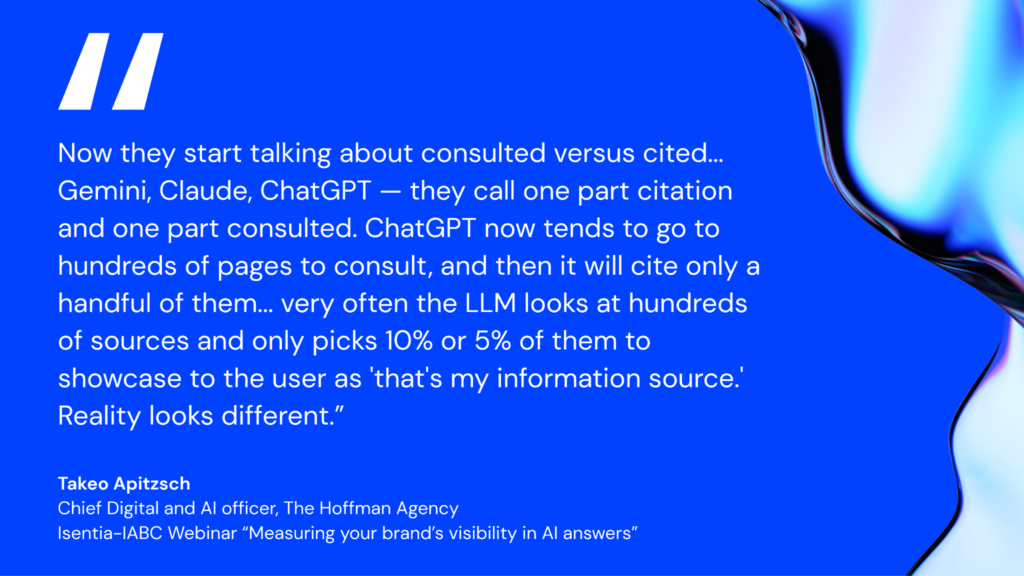
Communications teams now face a new consideration: the distinction between sources that are consulted and those that are cited. At the IABC APAC and Isentia webinar, Takeo Apitzsch, Hoffman Agency’s Chief Digital and AI Officer, explained that AI models scan hundreds of pages to generate an answer but cite only a select few to users. This means that the audience sees only a small, curated portion of the sources that actually influenced the AI's response and a lot of what actually shapes the AI answer doesn’t get visible credit. Therefore, organisations need to make sure they reach out to those publications that AI models can actually crawl and audiences trust the most.
What does this mean for communications professionals?
We are seeing four practical shifts:
Rebuild your tier list based on what LLMs actually cite, not on internal assumptions. A so-called “low-priority” trade publication or niche forum may contribute more to your AI visibility than a national outlet you have long targeted.
Keep your reshuffled tier list fresh, not just correctly ranked. InWhy is content freshness the new currency for AI visibility? we discuss that a page that hasn't been updated in eighteen months is far more likely to drop out of AI answers altogether, no matter how well it once performed. Getting the right tier 2 outlets on side is only half the job done. Feeding them (and your own owned channels) on an ongoing basis is the other half.
Treat consistency as an essential. The largest gap between an organisation’s claims and what an LLM will confidently state is often due to inconsistencies between owned content and third-party coverage. When this occurs, the model may stop providing factual answers altogether.
Shift your focus from share of voice to share of mind. It is now less about how much you are discussed and more about whether the systems mediating the most have got the correct information about your organisation.If the system holds the wrong version, your audience may never access the right one.
Structurally, as Ashley Knapp, Head of Brand and Corporate Affairs, East Asia at Schneider Electric noted during the webinar, these efforts can no longer remain siloed. Owned, earned, shared, and paid media have traditionally been managed by separate teams. Now, because of AI visibility, this required a unified approach, as models do not distinguish between departments but are first to detect inconsistencies.
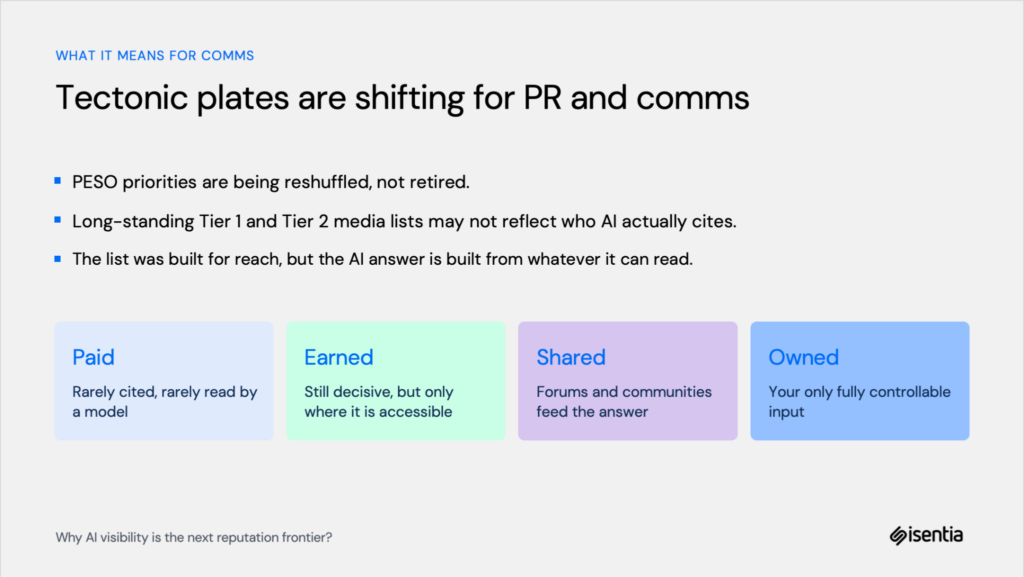
This also means reconsidering the PESO (paid, earned, shared and owned) strategy deployed by organisations since the way that LLMs access and prioritise them has changed. They prioritise brevity in content due to the high costs of GPUs and data centres. As a result, the shortest, clearest, and most trusted answers are favoured which benefits brands with strong reputations. Earned media remains important, but its influence now depends more on the credibility of the analyst than the platform. Shared content amplifies messages more than ever but is also where misinformation spreads fastest. Paid media is becoming more prominent in some models, though brands are still learning how this impacts visibility.
Media monitoring companies are becoming strategic AI visibility consultants
This shift requires media monitoring companies to evolve. Tracking mentions and sentiment across media channels has been central to media intelligence, but AI visibility has added a new dimension to this. This means monitoring not only what is said about an organisation, but also which sources AI models use when answering questions about that organisation, and assessing how current, authoritative, and consistent those sources are. This gives media monitoring organisations an opportunity to own what they’ve developed and also be thought leaders in this space. Stakeholders value the “so what” advice much more than just knowing “this is what is being said about you in the media”.
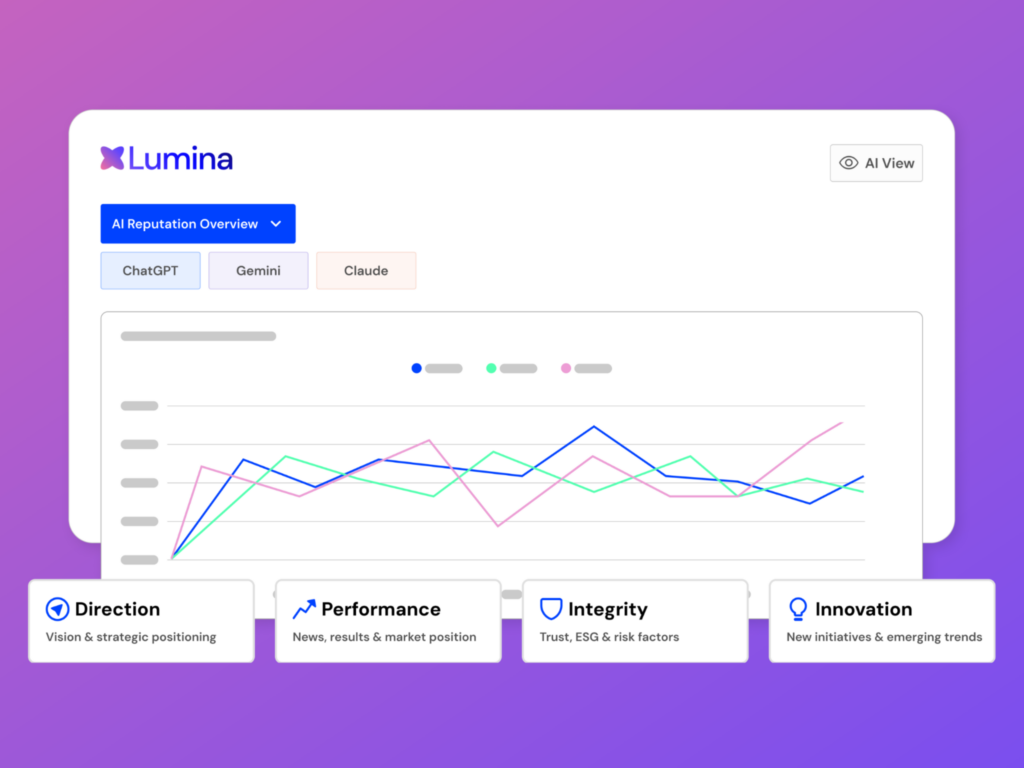
Lumina AI View addresses this by tracking which sources ChatGPT, Gemini, Claude, and other models cite when representing an organisation, benchmarks citations against competitors, identifies narrative shifts before they reach stakeholders, and regularly scores AI visibility against four reputation pillars: Direction, Performance, Integrity, and Innovation, These pillars have always supported reputation management, now applied to a largely unseen audience.
If you're weighing up where a tool like this sits alongside the rest of your stack, our own comparison,Best AI Tools for PR & Comms Teams (2026), breaks down how AI-assisted coverage, measurement, crisis response and reporting tools stack up, Lumina included.
Because that’s really the mindset shift comms teams, and the firms advising them both need to make. As Takeo put it on the IABC APAC and Isentia webinar: “I fear that this is the mindset shift communications teams and their advisors must adopt. I fear that AIs will be your secondary, and if not, at least equal… audience in the future.” Beyond human visibility, reputation is about being accurately represented by the systems that mediate access to your audience, which is an additional layer that cannot be trivialised anymore.
"
["post_title"]=>
string(97) "How relevant is Tier 1 and Tier 2 media hierarchy in impacting how organisations show up in LLMs?"
["post_excerpt"]=>
string(243) "The hierarchy that exists between Tier 1 & 2 publications today is being challenged. AI models are the new way audiences discover information requiring organisations to rethink how they show up to remain visible in an AI-mediated environment. "
["post_status"]=>
string(7) "publish"
["comment_status"]=>
string(4) "open"
["ping_status"]=>
string(4) "open"
["post_password"]=>
string(0) ""
["post_name"]=>
string(96) "how-relevant-is-tier-1-and-tier-2-media-hierarchy-in-impacting-how-organisations-show-up-in-llms"
["to_ping"]=>
string(0) ""
["pinged"]=>
string(0) ""
["post_modified"]=>
string(19) "2026-09-09 02:24:17"
["post_modified_gmt"]=>
string(19) "2026-09-09 02:24:17"
["post_content_filtered"]=>
string(0) ""
["post_parent"]=>
int(0)
["guid"]=>
string(32) "https://www.isentia.com/?p=49871"
["menu_order"]=>
int(0)
["post_type"]=>
string(4) "post"
["post_mime_type"]=>
string(0) ""
["comment_count"]=>
string(1) "0"
["filter"]=>
string(3) "raw"
}
Blog
How relevant is Tier 1 and Tier 2 media hierarchy in impacting how organisations show up in LLMs?
The hierarchy that exists between Tier 1 & 2 publications today is being challenged. AI models are the new way audiences discover information requiring organisations to rethink how they show up to remain visible in an AI-mediated environment.
Would you trust a brand more if an AI model recommended it? For many, the answer is yes – and it’s changing the very nature of PR & Comms.
Our latest report digs into the changing nature of trust, as audiences turn to AI models for quick answers instead of going to organisations or media outlets directly, with AI fast becoming the final stop in the comms cycle.
This report unpacks:
Why trust has shifted, and where audiences are having these conversations
Why AI has become the last stop in the comms cycle
Methods for staying on top of your brand trust and reputation
To access the full report, fill in the form below: