Open Letter To Every Girl: Please, Learn How To Code
Andrea Walsh, the CIO of Isentia, has 20 years experience in tech. Here, she write an open letter to women asking them to learn code:
At last count there was more than 6,500 languages spoken in the
world, yet there is one that unites us all: code. If there is a single
piece of career advice I would give to any young girl (or woman for that
matter) it would be, unequivocally, to learn how to code.
I am fortunate enough to be one of the few female CIO’s in Australia
and I would love to be surrounded by more women. The problem is, the
pipeline is a little thin. This is not only disappointing for the
industry, it is a travesty for those women who are missing out on being a
part of one of the most exciting, challenging and exhilarating
industries there is to work in.
Technology is the great accelerator the 21st century.
Cloud computing, tablets and smartphones have already transformed how we live and work, but the best is yet to come.
We are on the cusp of a technological revolution.
Soon eye-tracking technology will allow us to control tablet devices
with a simple eye movement. We will arrive at work in driverless cars.
Smartphones will evolve from mobile computers to revolutionary devices
with integrated laser that will turn flat surfaces into touchscreens and
with built-in GPS systems so accurate they will measure to the closest
centimetre. Before long every family will have their own 3D printing
with the ability to custom design everything from iPhone cases to
ornaments.
At a time when the tech industry is exploding, sadly there are
virtually no women coming through the ranks. Each year IT advisory firm
Gartner conducts the world’s largest CIO survey to track senior IT
leaders around the globe. Disappointingly, the percentage of women CIO’s
recorded in the survey has remained largely static since 2004.
This is more than just a little distressing. It is bad for the industry, and even worse for the economy.
We know intuitively that diversity matters and research has affirmed
this thinking time and time again. For example, in 2015 McKinsey
published the Diversity dividend highlighting that gender-diverse companies are 15% more likely to
outperform others. Perhaps even more interesting to note is that half of
the companies listed in the Fortune 10 are women. With technology now
an integral of any businesses’ success, surely this healthy
representation of women in leadership and obvious return is no
coincidence?
As a woman passionate about the contribution females make to the
industry, I am heartened by this promise of progress with the big
players. But we still have a long way to go. If the industry as a whole
does not change, it won’t reach it’s full potential
Firstly, we need to start engaging future female CIO’s now. My daughter is eight and she is already learning to code.
So should every other 8 year old girl in the country. Digital
literacy should be as important as any other form of literacy. We need
to generate a movement like Michelle Obama’s #builtbygirls campaign in
the US, where all young girls are encouraged to engage with technology
early and stay ‘hooked’. We need to make sure coding is no longer
relegated to the domain of boys.
We also need to ensure that women in the industry are remunerated appropriately.
The good news is, as far as other industries go the tech sector is faring considerably well. A 2016 report showed
that women in technology are paid 8% less than their male counterparts.
While parity is still yet to be achieved this is a significant
milestone for the industry when across all sectors the national gender pay gap sits at around 16%.
If the industry can see the value women bring and we are bridging the
gap in payscales at a much faster rate than other sector, why are we
attracting so few women into the field? Campaigner for women in tech,
Melinda Gates, has defined the problem as a ‘the leaky pipehole’ that
sees females veer away from a technology career pathway as they move
through primary school, high school, University and then into the
industry. In the US, 57% of professional occupations are held by women,
however females are represented in just 25% of computing jobs. In Australia it’s a similar story. A study from Professionals Australia reported 28% female representation in all science, technology, engineering and mathematics-related professions.
Although it is clear that we have a problem on our hands, we have
many reasons to remain optimistic. Women like Gates and her comrades –
Sheryl Sandberg, Marissa Meyer and Diane Green – are all working to
encourage more women into the field. Then there are groups like FITT,
a tremendous not-for-profit organisation solely focused on inspiring
more women to achieve their career aspirations in technology through
strong peer networking programs to guide young women coming through the
ranks. I am also buoyed the growing number of girls opting to study STEM
at school. Here in NSW for by example, the girls studying either maths or science increased from 5.4% in 2001 to 14.6% in 2014, while the level for boys
has only risen from 2.1% to 5.9%. But there’s still work to do.
As a woman who has been fortunate enough to enjoy an enduring,
challenging and meaningful career in tech despite the unfavourable odds,
I am extremely passionate about seeing other women benefit from the
technology explosion and embark on a career in what I can only describe
as one of the most exciting, well-paid and sustainable sectors there is.
If you are lucky enough to work in this exciting industry, please
share your stories of success with our girls and inspire them. Keeping
them engaged will help us achieve the diversity in thinking needed to
use technology to solve some of the greatest problems.
Next time a girl asks you for career advice, please share that the secret to future success is simple: learn to code.
Loren is an experienced marketing professional who translates data and insights using Isentia solutions into trends and research, bringing clients closer to the benefits of audience intelligence. Loren thrives on introducing the groundbreaking ways in which data and insights can help a brand or organisation, enabling them to exceed their strategic objectives and goals.
The role of communications professionals is evolving rapidly. AI is now actively shaping how organisations build trust, manage reputation, and engage key audiences, moving beyond theoretical discussions.
Gartner’s latest forecasts for Chief Communications Officers (CCOs) highlight a growing profession under increased scrutiny. Traditional methods such as press releases and media relationships are no longer sufficient. Communication is now central to business, and supporting tools must evolve accordingly.
Isentia’s platform combines AI-driven media intelligence, real-time narrative tracking, and expert human analysis. These capabilities address several urgent needs identified by Gartner. Below, we outline key predictions and how Isentia’s tools help meet these challenges.
AI is transforming how brands are discovered and evaluated
Gartner predicts that, as large language models replace traditional search, PR, and earned media, PR and earned media budgets will double by 2027. Stakeholders will increasingly view organisations through AI-generated summaries. The quality, authority, and timeliness of earned media will directly influence how AI systems represent your organisation.
Gartner emphasises that this is a communications challenge, not a marketing or SEO issue. Search engine optimisation requires PR and communications expertise to build trust, secure media coverage, and maintain consistent messaging across stakeholders.
Isentia’s Lumina AI suite and Narratives AI tools address these needs. Narratives AI identifies, summarises, and ranks stories from billions of news articles and social media posts in real time and historically. It reveals how stories develop and spread, enabling communications teams to understand both the content and its influence on AI-generated perceptions.
Isentia’s upcoming Lumina AI View feature enables organisations to see how their brand appears across AI platforms and understand the information shaping those results. Intelligence is no longer a luxury.
Gartner’s second forecast was that by 2029, 45% of CCOs will use narrative intelligence technologies to monitor reputation amid rising disinformation. Traditional monitoring tools often miss early signs of harmful stories because they focus on keywords rather than story development and spread.
Isentia has addressed this challenge. Our crisis monitoring teams provide 24/7 coverage and real-time alerts via email, mobile app, and WhatsApp, delivering the intelligence-driven support Gartner recommends.
Our Media Impact Score (MIS) supports this approach. It evaluates not only the volume of coverage but also its reception, combining tone, importance, and audience reach into a single human-coded score that reflects true reputational impact.
The growth of AI-powered internal communications
Gartner predicts that by 2028, 75% of employees will use chatbots for internal information instead of intranets, newsletters, or manager updates. This shift from push-based to pull-based, conversational access raises important governance considerations.
Isentia’s GenAI-powered Insights Chatbot addresses this need. It allows users to query past reports and data, providing clear, evidence-based answers from the organisation’s media intelligence archive. Teams can interact with their data, compare trends, identify patterns, and access insights efficiently.
As Dr Nici Sweaney, Founder and Director at Ai Her Way, observed at Isentia's recent webinar on AI as a new stakeholder: "What will set people apart — and what AI cannot replicate — is the human lens. The judgment, the relationships, the institutional knowledge, the strategic read of a room. The organisations that lean into supporting their people to harness these tools, rather than just deploying the tools, will be the ones best placed."
This principle guides Isentia’s approach. Our platform combines AI with over 100 local analysts across Southeast Asia (SEA) who review AI-generated data for cultural context, slang, and sarcasm. This model achieves up to 95% sentiment accuracy, ensuring reliable results through human expertise.
Analytics must move from retrospective to predictive
Gartner’s last key prediction is that analytics must shift from retrospective to predictive, much on data, and Gartner’s final key prediction is that by 2029, communications teams will double their spending on data and analytics to 6% of budgets. This reflects increased pressure to demonstrate business impact. Nearly half of CCOs struggle to prove their value, and a third report their teams are viewed as cost centres.
RepID and interactive dashboards go far beyond simple metrics. For example, RepID measures an organisation’s reputation by analysing stories and posts across areas such as leadership, ethics, and quality. This gives a clear, evidence-based view of how reputation is really changing, not just how much coverage there is.
Our interactive insights reports enable clients to track share of voice, narrative sentiment, and influencer impact in one platform. This real-time, results-focused measurement aligns with Gartner’s recommendations for credibility in communications.
Implications for communications leaders
Communications teams must achieve more, operate with greater precision, move faster, and deliver measurable business results. AI is both the driver and enabler of this change, but success depends on investing in the right intelligence systems.
Isentia’s platform already provides the essential tools Gartner recommends, including Narratives AI, real-time risk alerts, AI-powered chatbots, human-verified insights, and advanced measurement systems. For PR & Comms leaders in Asia-Pacific and beyond, the key question is how quickly they can implement this intelligence.
Join the conversation
We invite you to attend our upcoming webinar, Inside the AI Shift: How Communications Leaders Are Adapting, on Tuesday, 28 April 2026 at 11am SGT / 1pm AEST / 3pm NZST via Zoom.
Isentia’s VP of Revenue and Insights for SEA, Prashant Saxena, and ANZ’s Director of Insights, Ngaire Crawford, will discuss how communications teams are meeting increasing demands for speed, insight, and measurement, while adapting to evolving executive expectations as AI becomes a new stakeholder.
The session will explore how communications leaders discuss AI with executives and boards amid increased pressure on risk, measurement, and strategy. It will also examine how teams are adapting workflows and decision-making, the challenges communicators face, and emerging opportunities.
Register below to secure your place.
Please fill up this form if you're in the ANZ region
Please fill up this form if you're in the SEA region
"
["post_title"]=>
string(68) "How is Isentia responding to AI reshaping communications leadership?"
["post_excerpt"]=>
string(138) "Taking from the recent PR & Comms predictions for 2026 by Gartner, we observe how Isentia leads in creating a robust AI-powered workspace."
["post_status"]=>
string(7) "publish"
["comment_status"]=>
string(4) "open"
["ping_status"]=>
string(4) "open"
["post_password"]=>
string(0) ""
["post_name"]=>
string(67) "how-is-isentia-responding-to-ai-reshaping-communications-leadership"
["to_ping"]=>
string(0) ""
["pinged"]=>
string(0) ""
["post_modified"]=>
string(19) "2026-04-13 04:30:35"
["post_modified_gmt"]=>
string(19) "2026-04-13 04:30:35"
["post_content_filtered"]=>
string(0) ""
["post_parent"]=>
int(0)
["guid"]=>
string(32) "https://www.isentia.com/?p=45571"
["menu_order"]=>
int(0)
["post_type"]=>
string(4) "post"
["post_mime_type"]=>
string(0) ""
["comment_count"]=>
string(1) "0"
["filter"]=>
string(3) "raw"
}
Blog
How is Isentia responding to AI reshaping communications leadership?
Taking from the recent PR & Comms predictions for 2026 by Gartner, we observe how Isentia leads in creating a robust AI-powered workspace.
The media landscape is accelerating. In an era where influence is ephemeral and every angle demands instant comprehension, PR and communications professionals require more than generic technology—they need intelligence engineered for their specific challenges.
Isentia is proud to introduce Lumina, a groundbreaking suite of intelligent AI tools. Lumina has been trained from the ground up on the complex workflows and realities of modern communications and public affairs. It is explicitly designed to shift professionals from passive media monitoring back into the role of strategic leaders and pacesetters.
“The PR, Comms and Public Affairs sectors have been experimenting with AI, but most tools have not been built with their real challenges in mind.” said Joanna Arnold, CEO of Pulsar Group.
“Lumina is different; it is the first intelligence suite designed around how narratives actually form today, combining human credibility signals with machine-level analysis. It helps teams understand how stories evolve, filter out noise and respond with context and confidence to crises and opportunities.”
Setting a new standard for PR intelligence
Lumina is centered on empowering, not replacing, the human element of communications strategy. This suite is purpose-built to help PR, Comms, and Public Affairs professionals significantly improve productivity, enhance message clarity, and facilitate early risk detection.
Lumina enables communicators to:
Understand & Interpret: Move beyond basic alerts to strategically map the trajectory and spread of narrative evolution.
Focus & Personalise: Achieve the clarity necessary to execute strategic action before critical moments pass.
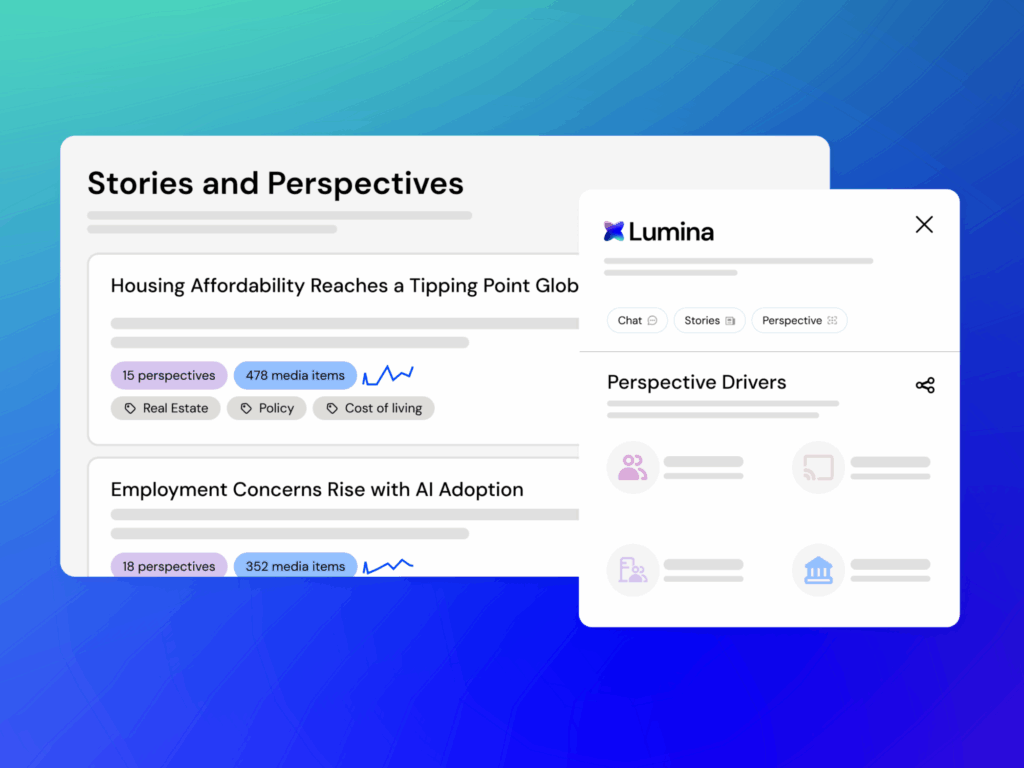
We are launching the Lumina suite by making our first module immediately available: Stories & Perspectives.
In the current fragmented, multi-channel media environment, communications professionals need to be able to instantly perceive not just how a story is growing, but also how it is being perceived across different stakeholder groups.
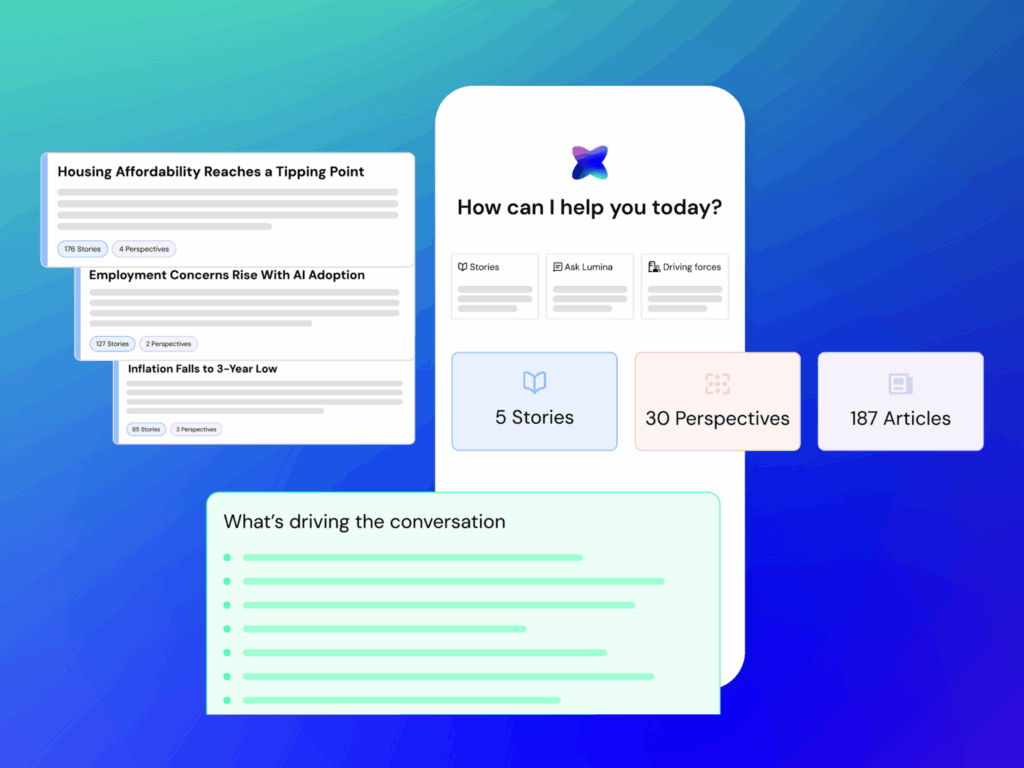
Stories & Perspectives organizes raw media mentions into clustered, cohesive Stories, and the Perspectives that exist within each, reflecting distinct media, audience, and public affairs angles. This unique functionality allows users to:
Rise above the noise: Instantly identify which high-level topics are gaining momentum or fading from attention.
Get to the detail, fast: Uncover the influential voices, niche communities, and specific channels actively shaping the narrative.
Catch the pivot point: Precisely identify the moment a story shifts—from a strategic opportunity to a reputation risk—or when a new key opinion former begins guiding the conversation.
"Media isn’t a stream of mentions," said Kyle Lindsay, Head of Product at Pulsar Group. "But rather a living system of stories shaped by competing perspectives. When you can see those structures clearly, you gain the ability to understand issues as they form, anticipate how they’ll evolve, and act with precision. That’s what we mean when we talk about AI built for communicators, and that's what an off-the-shelf LLM can't give you."
The Lumina Roadmap: AI tools for the future of comms
The launch of Stories & Perspectives is the first release of many. Over the upcoming months, we will systematically roll out the full Lumina roadmap, introducing a comprehensive set of AI tools engineered to handle every phase of the communications lifecycle.
The full Lumina suite will soon incorporate:
Curated media summaries: AI-driven daily summaries customized specifically to the priorities of senior leadership, highlighting only the most relevant stories.
Reputation analysis: Advanced measurement tracking how critical themes like ethics, innovation, and leadership are statistically shaping corporate perception.
Press release & media relations assistant: Tools designed to accelerate content creation and craft hyper-focused, personalized pitches that reach the precise contacts faster.
Predictive intelligence layer: Technology engineered to track and anticipate story momentum and strategic change before the window of opportunity closes.
Intelligent agents: Background agents continuously scanning all media channels for emerging key spokespeople and previously undetected reputation risks.
Enhanced audio, broadcast & crisis detection: Complete, real-time oversight of all channels—including audio and broadcast—enabling rapid context building and optimal crisis response delivery.
Want to harness the power of Lumina AI for your PR, Comms, or Public Affairs team? .
Complete the form below to register your interest.
"
["post_title"]=>
string(79) "Announcing Lumina: The purpose-built AI suite for PR, Comms, and Public Affairs"
["post_excerpt"]=>
string(129) "An intelligent suite of AI tools trained on the language, workflows, and realities of modern public relations and communications."
["post_status"]=>
string(7) "publish"
["comment_status"]=>
string(4) "open"
["ping_status"]=>
string(4) "open"
["post_password"]=>
string(0) ""
["post_name"]=>
string(76) "announcing-lumina-the-purpose-built-ai-suite-for-pr-comms-and-public-affairs"
["to_ping"]=>
string(0) ""
["pinged"]=>
string(0) ""
["post_modified"]=>
string(19) "2025-12-09 09:39:52"
["post_modified_gmt"]=>
string(19) "2025-12-09 09:39:52"
["post_content_filtered"]=>
string(0) ""
["post_parent"]=>
int(0)
["guid"]=>
string(32) "https://www.isentia.com/?p=43742"
["menu_order"]=>
int(0)
["post_type"]=>
string(4) "post"
["post_mime_type"]=>
string(0) ""
["comment_count"]=>
string(1) "0"
["filter"]=>
string(3) "raw"
}
Blog
Announcing Lumina: The purpose-built AI suite for PR, Comms, and Public Affairs
An intelligent suite of AI tools trained on the language, workflows, and realities of modern public relations and communications.