Blog post
April 13, 2026

How is Isentia responding to AI reshaping communications leadership?

The role of communications professionals is evolving rapidly. AI is now actively shaping how organisations build trust, manage reputation, and engage key audiences, moving beyond theoretical discussions.

Gartner’s latest forecasts for Chief Communications Officers (CCOs) highlight a growing profession under increased scrutiny. Traditional methods such as press releases and media relationships are no longer sufficient. Communication is now central to business, and supporting tools must evolve accordingly.

Isentia’s platform combines AI-driven media intelligence, real-time narrative tracking, and expert human analysis. These capabilities address several urgent needs identified by Gartner. Below, we outline key predictions and how Isentia’s tools help meet these challenges.

AI is transforming how brands are discovered and evaluated

Gartner predicts that, as large language models replace traditional search, PR, and earned media, PR and earned media budgets will double by 2027. Stakeholders will increasingly view organisations through AI-generated summaries. The quality, authority, and timeliness of earned media will directly influence how AI systems represent your organisation.

Gartner emphasises that this is a communications challenge, not a marketing or SEO issue. Search engine optimisation requires PR and communications expertise to build trust, secure media coverage, and maintain consistent messaging across stakeholders.

Isentia’s Lumina AI suite and Narratives AI tools address these needs. Narratives AI identifies, summarises, and ranks stories from billions of news articles and social media posts in real time and historically. It reveals how stories develop and spread, enabling communications teams to understand both the content and its influence on AI-generated perceptions.
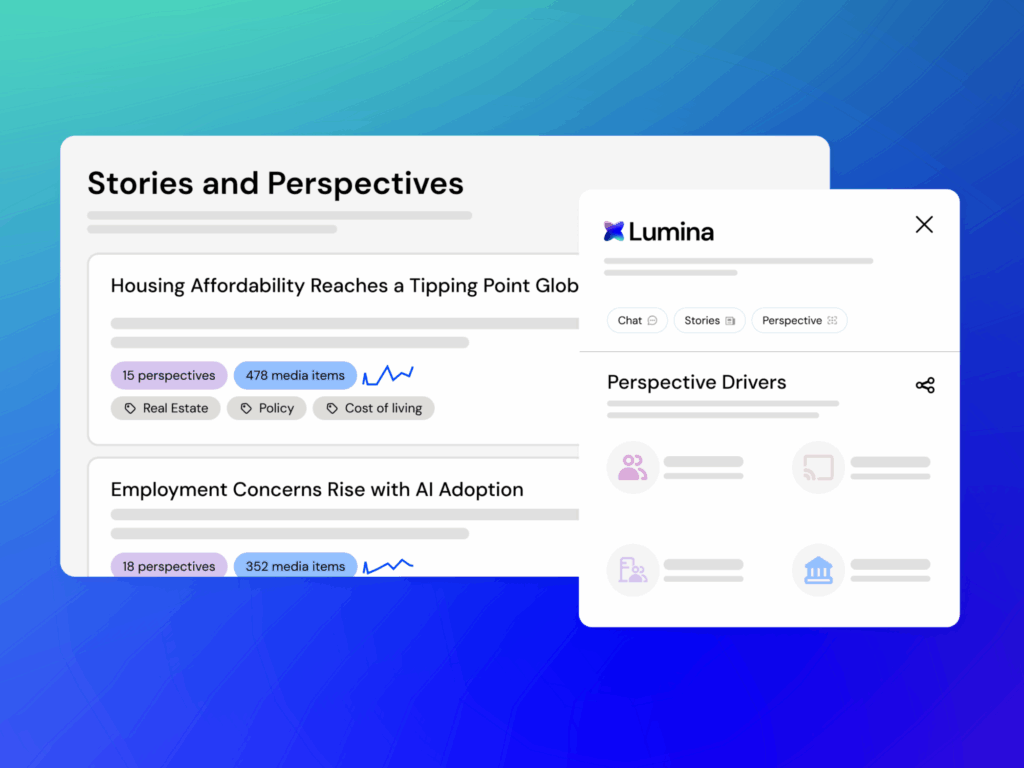
Isentia’s upcoming Lumina AI View feature enables organisations to see how their brand appears across AI platforms and understand the information shaping those results. Intelligence is no longer a luxury.

Gartner’s second forecast was that by 2029, 45% of CCOs will use narrative intelligence technologies to monitor reputation amid rising disinformation. Traditional monitoring tools often miss early signs of harmful stories because they focus on keywords rather than story development and spread.

Isentia has addressed this challenge. Our crisis monitoring teams provide 24/7 coverage and real-time alerts via email, mobile app, and WhatsApp, delivering the intelligence-driven support Gartner recommends. 

Our Media Impact Score (MIS) supports this approach. It evaluates not only the volume of coverage but also its reception, combining tone, importance, and audience reach into a single human-coded score that reflects true reputational impact.


The growth of AI-powered internal communications

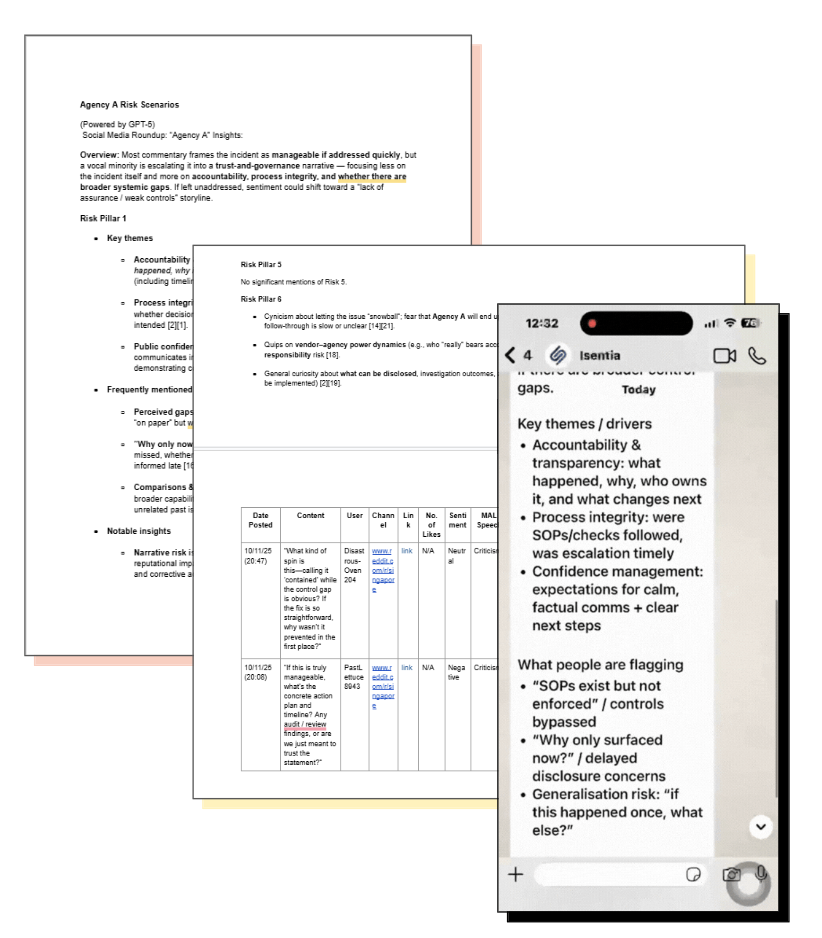
Gartner predicts that by 2028, 75% of employees will use chatbots for internal information instead of intranets, newsletters, or manager updates. This shift from push-based to pull-based, conversational access raises important governance considerations.

Isentia’s GenAI-powered Insights Chatbot addresses this need. It allows users to query past reports and data, providing clear, evidence-based answers from the organisation’s media intelligence archive. Teams can interact with their data, compare trends, identify patterns, and access insights efficiently.

This principle guides Isentia’s approach. Our platform combines AI with over 100 local analysts across Southeast Asia (SEA) who review AI-generated data for cultural context, slang, and sarcasm. This model achieves up to 95% sentiment accuracy, ensuring reliable results through human expertise.

Analytics must move from retrospective to predictive

Gartner’s last key prediction is that analytics must shift from retrospective to predictive, much on data, and Gartner’s final key prediction is that by 2029, communications teams will double their spending on data and analytics to 6% of budgets. This reflects increased pressure to demonstrate business impact. Nearly half of CCOs struggle to prove their value, and a third report their teams are viewed as cost centres. 

RepID and interactive dashboards go far beyond simple metrics. For example, RepID measures an organisation’s reputation by analysing stories and posts across areas such as leadership, ethics, and quality. This gives a clear, evidence-based view of how reputation is really changing, not just how much coverage there is.

Our interactive insights reports enable clients to track share of voice, narrative sentiment, and influencer impact in one platform. This real-time, results-focused measurement aligns with Gartner’s recommendations for credibility in communications.

Implications for communications leaders

Communications teams must achieve more, operate with greater precision, move faster, and deliver measurable business results. AI is both the driver and enabler of this change, but success depends on investing in the right intelligence systems.

Isentia’s platform already provides the essential tools Gartner recommends, including Narratives AI, real-time risk alerts, AI-powered chatbots, human-verified insights, and advanced measurement systems. For PR & Comms leaders in Asia-Pacific and beyond, the key question is how quickly they can implement this intelligence.

Join the conversation

We invite you to attend our upcoming webinar, Inside the AI Shift: How Communications Leaders Are Adapting, on Tuesday, 5 May 2026 at 11:30am SGT / 1:30pm AEST / 3:30pm NZST via Zoom. 
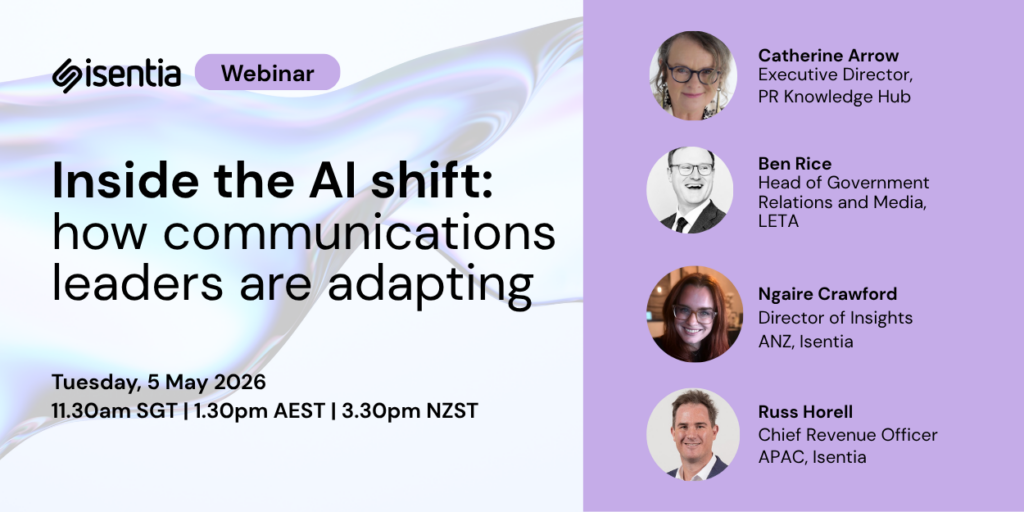
The conversation has shifted from what AI could do to what it’s already doing in the workplace. Comms leaders are now responsible for shaping how their organisations navigate this landscape

That means managing executive expectations, rethinking strategies and workflows, and staying ahead of emerging reputational risks as they unfold. The session will include top comms leaders like Catherine Arrow (Executive Director, PR Knowledge Hub), Ben Rice (Head of Government Relations and Media, Low Emission Technology Australia), Russ Horell (Isentia APAC’s Chief Revenue Officer) and Ngaire Crawford (Director of Insights, Isentia ANZ) as they explore how this new reality should be addressed and what it would take comms leaders to reset and adapt within this AI shift.

Please fill up the form below to register:

Share

Similar articles

object(WP_Post)#9066 (24) { ["ID"]=> int(45983) ["post_author"]=> string(2) "75" ["post_date"]=> string(19) "2026-04-28 11:19:20" ["post_date_gmt"]=> string(19) "2026-04-28 11:19:20" ["post_content"]=> string(18518) "[et_pb_section fb_built="1" _builder_version="4.27.4" _module_preset="default" min_height="7184px" custom_padding="0px|||||" global_colors_info="{}"][et_pb_row _builder_version="4.27.4" _module_preset="default" custom_padding="0px|||||" global_colors_info="{}"][et_pb_column type="4_4" _builder_version="4.27.4" _module_preset="default" global_colors_info="{}"][et_pb_text _builder_version="4.27.4" _module_preset="default" text_font="DM Sans|700|||||||" text_text_color="#000000" text_line_height="2.4em" link_font="DM Sans|700|on||||||" header_font="DM Sans|700|||||||" header_text_align="left" header_3_font="DM Sans|700|||||||" header_3_text_align="left" hover_enabled="0" global_colors_info="{}" sticky_enabled="0"]

If there’s one topic Australians never tire of debating, it’s housing. Whether it’s at the pub, around the dinner table, or dominating headlines, property prices, rent hikes and the “can I ever afford a home?” questions are constant fixtures of the national conversation.

But let’s be honest—rising house prices aren’t new. What is changing is how the conversation is evolving, who’s shaping it, and which narratives are starting to stick.

 Using Lumina’s Stories and Perspectives, we analysed 19 stories and over 50 perspectives across a 30-day period from 15 March to 14 April 2026 to understand what’s actually driving the housing narrative in Australia right now—and why it matters. 


Which are the stories shaping conversation and who's driving it?


Housing Supply and Affordability Divide — Analysts and economists link supply shortages directly to soaring prices. Cities that built more homes saw far less price growth. 

Key drivers: Gerard Burg (Cotality), Peter Tulip (Centre for Independent Studies), Australian Associated Press

Tax Reform Debates Heat Up Ahead of Budget — 14 competing perspectives. Advocates say reforms are essential for fairness; the property industry warns they’ll push rents up 30%. 

Key drivers: Anthony Albanese, Jim Chalmers, Angus Taylor, Housing Industry Association, Saul Eslake

Grattan Institute Connects Housing to Democratic Trust — A major report argues that the housing crisis is eroding public confidence in democracy itself. 

Key drivers: Aruna Sathanapally, Grattan Institute


Australians make housing supply the biggest story


This perspective was
100% of the coverage of this story and generated 85 media items, making it the most widely covered story of the entire period. The main insight is the public drawing a direct line between housing supply levels and property prices across Australia’s capital cities. 

Perth and Brisbane, where home construction has lagged well behind population growth since the pandemic, have seen property values surge massively. Meanwhile, Victoria — which built a proportionally higher number of new homes — saw less growth, compared to the national average.

It ran everywhere from PerthNow to regional papers across NSW and Victoria. The fact that the Australian Associated Press syndicated the data meant it hit dozens of outlets simultaneously.


[/et_pb_text][et_pb_image src="https://www.isentia.com/wp-content/uploads/2026/04/2-1-scaled.png" title_text="2" _builder_version="4.27.4" _module_preset="default" width="68%" max_width="68%" module_alignment="center" custom_margin="||60px|||" global_colors_info="{}"][/et_pb_image][et_pb_text _builder_version="4.27.4" _module_preset="default" text_font="DM Sans||||||||" header_font="DM Sans||||||||" header_3_font="DM Sans|700|||||||" global_colors_info="{}"]

The key drivers are property analysts Gerard Burg from Cotality and Peter Tulip from the Centre for Independent Studies. Both are pushing the same message. If you want to fix affordability, you have to fix supply. Their proposed solution is liberalising zoning laws, particularly in NSW and Victoria, to allow more homes to be built faster. 


Why does this matter for communicators?

This story had the widest media footprint of the entire period, reaching outlets from The West Australian to regional mastheads across the country. If your organisation operates in housing, property, or urban planning, the “supply-equals-affordability” narrative is now firmly established in public discourse, and therefore, your messaging needs to account for it. Audiences know of the supply argument before, and with experts aligned on the issue, it’s harder for policymakers to dismiss it easily. 

It’s also worth noting how the analysis around who the key drivers are adds a layer traditional media monitoring might miss. The AAP’s role as the primary distribution channel meant this story reached dozens of the bigger mastheads like PerthNow and The West Australian  and  hyperlocal outlets like the Cobram Courier and Benalla Ensign, simultaneously. For communicators, this distribution pattern indicates that a story has penetrated both metropolitan and regional audiences, making it impossible to dismiss as just a capital-city concern.  


Tax reform rebates are the most contested story of the month

The housing tax reform debate was the most contested generating 14 distinct perspectives across 23 media items becoming by far the most multi-sided story of the month. However, the top three perspectives were the most interesting to look at considering how disputed the opinions of either side are and sit at the highest level in the government. 

At the centre of it is the Albanese Government’s consideration of reducing the capital gains tax discount and limiting negative gearing ahead of the May budget. The country is essentially split down the middle on this one. 

Perspective 1: This made up for 34.8% of the story coverage. Prime Minister Anthony Albanese, Treasurer Jim Chalmers, and housing advocacy group Everybody’s Home are arguing that the current system unfairly benefits wealthy investors while locking out first-home buyers. Economist Saul Eslake backs this view. Together, they account for about a third of the story’s total coverage.

Perspective 2: This had an equal share in coverage at 34.8% of the story. Opposition figures Angus Taylor, the Housing Industry Association, and Victorian Libertarian Party Leader David Limbrick are warning that scrapping these tax incentives will scare off investors, shrink rental supply, and push rents up by as much as 30%. They command an equal share of the conversation (Herald Sun)

[/et_pb_text][et_pb_image src="https://www.isentia.com/wp-content/uploads/2026/04/image-11.png" title_text="image" _builder_version="4.27.4" _module_preset="default" width="60%" max_width="60%" module_alignment="center" custom_margin="||72px|||" global_colors_info="{}"][/et_pb_image][et_pb_text _builder_version="4.27.4" _module_preset="default" text_font="DM Sans||||||||" header_font="DM Sans|700|||||||" header_3_font="DM Sans|700|||||||" global_colors_info="{}"]

What’s interesting is what sits beneath these two dominant perspectives. A third angle that was 17.4% of the story coverage  was driven by Chalmers and Greens Senator Nick McKim, frames the whole debate as a question of intergenerational fairness. And then there are the young “rentvestors” who rent where they live but own an investment property elsewhere. They’re worried about getting caught in the crossfire of changes that weren’t designed with them in mind (Australian Financial Review)

Trust is eroding in the Australian democracy — and housing is the problem

The Grattan Institute released a report warning that trust in Australian democracy is under pressure, and housing is one of the reasons why. This soon became the second biggest story, generating 58 media items. 

Led by Grattan CEO Aruna Sathanapally, the report argues that persistent inequality, including the housing affordability gap, is eroding the social contract between citizens and government. The report explicitly names the housing crisis as one of the major unresolved challenges fuelling public disillusionment. Sathanapally is the key driver of this story, commanding over 93% of its coverage. Her influence matters because she’s reframing housing as something bigger than an economic problem. She’s positioning it as a threat to democratic stability. That’s a powerful narrative shift, and one that gives housing advocates a new way to make their case. 

For anyone in public affairs or government communications, this connection between housing and democratic trust is worth watching. It’s the kind of framing that can reshape how policymakers prioritise the issue. 

[/et_pb_text][et_pb_image src="https://www.isentia.com/wp-content/uploads/2026/04/image-9.png" title_text="image" _builder_version="4.27.4" _module_preset="default" width="60%" max_width="60%" module_alignment="center" custom_margin="||92px|||" global_colors_info="{}"][/et_pb_image][et_pb_text _builder_version="4.27.4" _module_preset="default" text_font="DM Sans||||||||" header_font="DM Sans|700|||||||" header_3_font="DM Sans|700|||||||" min_height="763px" global_colors_info="{}"]

How does this inform PR & Comms strategy?

  1. Know which side of the debate your audience sits on: The tax reform story alone has 14 perspectives. If you’re crafting messaging around housing policy, understand which perspective your stakeholders identify with and who they consider a credible voice. A one-size-fits all approach might not work.
  2. Follow the key drivers, not just the headlines: The unexpected pairing of Greens Senator Nick McKim with Treasurer Chalmers on intergenerational fairness suggests this issue is cutting across traditional party lines in ways that could reshape coalition dynamics. Meanwhile, the "rentvestor" audience represents a politically orphaned group that neither side of the debate is referencing or considering, making them a potential swing audience whose concerns could quietly shape how any reform actually lands.
  3. Watch the emerging narratives: One Nation’s growing support, the “rentvestor” demographic, and the connection between housing and democratic trust are all stories that could become dominant in the months ahead. 


What does this tell us about the Australian housing conversation?

It’s not a new crisis anymore. It’s a nationally entrenched issue that is now being addressed by the public by way of debates along with policymakers and experts at the highest government level. These debates are on solutions, trade-offs and fairness. The conversation is much more sophisticated where audiences are not just talking about “prices being too high”, but discussing supply, investments, short term relief vs long term reform. What’s also essential is to look at the key drivers or the key voices driving the top narratives.  From economists to policymakers to advocacy groups, the voices gaining traction are influencing how the issue is understood and what solutions feel viable.

Understanding not just what’s being said, but who is driving the conversation and why it’s resonating, is becoming critical for organisations looking to engage credibly. That’s where Lumina’s Stories and Perspectives comes in, helping you move beyond headlines to uncover the narratives and voices shaping the issues that matter most. 

[/et_pb_text][et_pb_divider color="#000000" divider_position="bottom" _builder_version="4.27.4" _module_preset="default" global_colors_info="{}"][/et_pb_divider][et_pb_text _builder_version="4.27.4" _module_preset="default" global_colors_info="{}"]

Want to see these insights for your own industry or brand? Discover what Lumina Stories and Perspectives can surface for you.

[/et_pb_text][et_pb_sidebar _builder_version="4.27.4" _module_preset="default" global_colors_info="{}"][/et_pb_sidebar][/et_pb_column][/et_pb_row][/et_pb_section][et_pb_section fb_built="1" _builder_version="4.27.4" _module_preset="default" global_colors_info="{}"][/et_pb_section]" ["post_title"]=> string(65) "What's really driving Australia's housing conversation right now?" ["post_excerpt"]=> string(155) "Explore how housing in Australia has become a nationally entrenched issue where audiences participate in shaping conversation as much as the policymakers. " ["post_status"]=> string(7) "publish" ["comment_status"]=> string(4) "open" ["ping_status"]=> string(4) "open" ["post_password"]=> string(0) "" ["post_name"]=> string(62) "whats-really-driving-australias-housing-conversation-right-now" ["to_ping"]=> string(0) "" ["pinged"]=> string(0) "" ["post_modified"]=> string(19) "2026-04-29 06:09:55" ["post_modified_gmt"]=> string(19) "2026-04-29 06:09:55" ["post_content_filtered"]=> string(0) "" ["post_parent"]=> int(0) ["guid"]=> string(32) "https://www.isentia.com/?p=45983" ["menu_order"]=> int(0) ["post_type"]=> string(4) "post" ["post_mime_type"]=> string(0) "" ["comment_count"]=> string(1) "0" ["filter"]=> string(3) "raw" }
Blog
What’s really driving Australia’s housing conversation right now?

Explore how housing in Australia has become a nationally entrenched issue where audiences participate in shaping conversation as much as the policymakers.

Ready to get started?

Get in touch or request a demo.