The circular economy of Australia’s soft plastics recycling system
You’ve probably heard of REDcycle by now – the initiative started by a passionate mum, providing Australian’s with the opportunity to recycle their soft plastics. Its operation helped reduce the amount of landfill in Australia and its sudden halt in operation sent the community into a frenzy.
The pause in the popular REDcycle program presented an opportunity to rethink the model for soft plastics recycling in Australia and find end markets for recycled package content. It also prompted Australians to rethink the way they consume products, rather than just the way they recycle them.
Social media conversations show Australians continue to encourage retailers and large corporations to use their influential power to create impactful change. These conversations are heightened where regression (or progression) is made towards sustainability.
Soft plastic recycling to the kerb
As Australians become more conscience about their soft plastic usage, it raises the question of whether the collapse of the REDcycle program was a blessing in disguise or more of a curse on sustainability?
From the end of October 2022 to the end of March 2023, Australians have consistently felt negative sentiment towards REDcycle’s collapse with spikes when key announcements were made by the organisation. Overall, close to 45% of Aussies felt negatively compared to 18.5% positive.
Source: Pulsar TRAC. Sentiment across online and social media between 29 October 2022 – 23 March 2023
A Twitter user sharing their frustration about soft plastic recycling.
The collection of coverage
As people learned the news about REDcycle, there was heightened concern about how soft plastics were going to be recycled. With over 12,000 mainstream media items about REDcycle or soft plastic recycling, it supports the idea that Australia’s broken plastic recycling system is distressing for many and more needs to be done.
The halt in operation brought on more concern for the environment and ignited feelings of anger and distrust after thousands of tonnes of plastic had been stockpiled instead of being recycled.
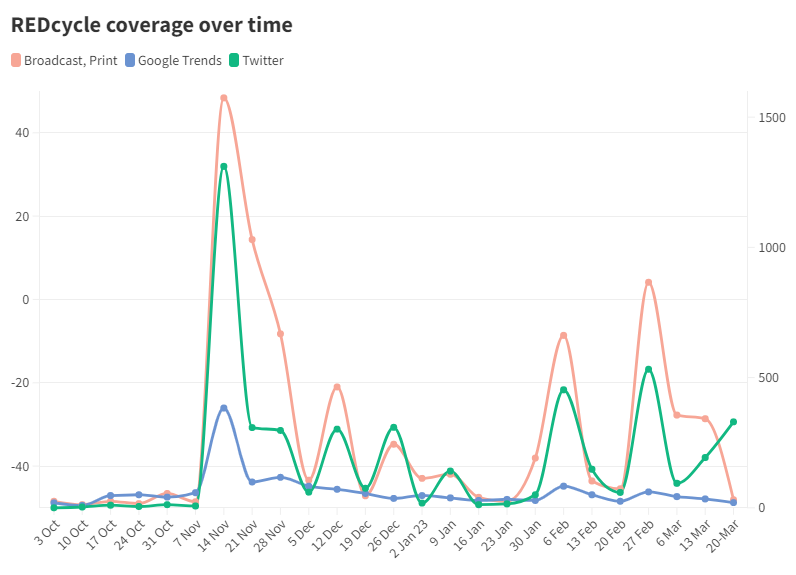
Source: Isentia, REDcycle coverage across broadcast, print. Source Pulsar Trends, Twitter coverage. Source: Google Trends, search coverage ( 1 October 2022 – 20 March 2023)
Media coverage across different channels (social media, search, broadcast and print) shows spikes of coverage on the same days (9 November, 7 February, 27 February) but at varying levels;
9 November – REDcycle announced it would pause its operations indefinitely. This shock announcement caused an influx of conversations on social media platforms which then caused people to search ‘where to recycle soft plastics’.
7 February – additional stockpiles of plastic were discovered in warehouses. People felt disappointed and let down by REDcycle.
23 February – supermarket giants announced they would take responsibility for the 12,400 tonnes of soft plastic stored by REDcycle in warehouses around the country, ahead of REDcycle declaring their insolvency. This announcement gained more chatter across social media in comparison to other channels.
Conversations on Twitter represent social media as the preferred option for users in comparison to broadcast, print and search.
Closing the loop
As political leaders have the power to influence their supporters on sustainability development, sustainability advocates are pushing Australian leaders to accelerate plastic waste regulations.
Conversations on Reddit rapidly grew on 9 November – the day the REDcycle program paused. Overall sentiment was anger and sadness with many expressing their feelings of disappointment after learning their donated soft plastics were not ending up where promised. Others felt frustrated or angry towards large organisations who were not holding up their end of the deal, especially after taking the time to correctly separate their recyclable waste.
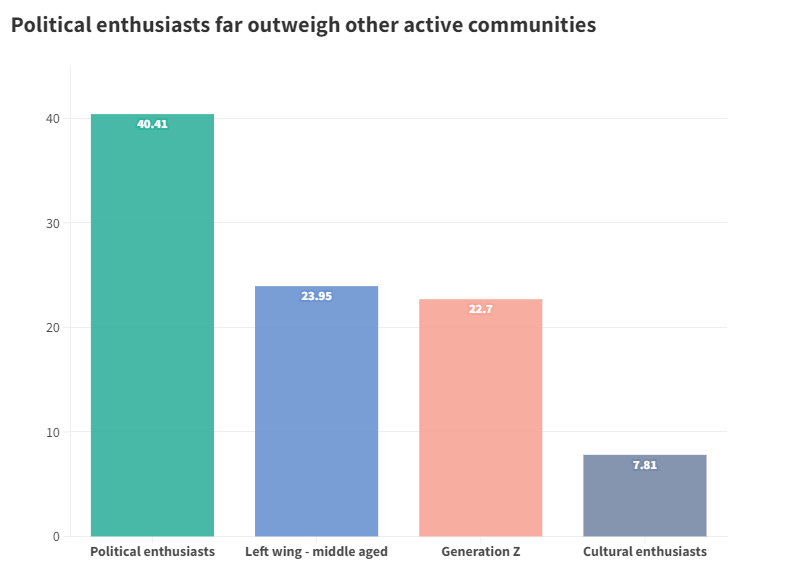
At 40%, political enthusiasts far outweigh any other active community on social media and forums. Their ‘passion’ for Australia can be overshadowed, as they share their beliefs towards the government – ranging from incompetence to over governing. Generation Z are true digital natives and make up 22% of active online communities. This cohort is motivated to make more sustainable choices, if it means it will benefit the environment for the long term.
Active communities on social media and forums discussing REDcycle and soft plastic recycling. (October 2022 – March 2023)
The REDcycle program illustrated the complexity of soft plastics recycling and the need to build robust systems to close the loop on this common household waste. For years there have been stockpiling issues, dumping, toxic fires and lax regulations, making it challenging to operate.
Australia’s largest supermarkets continue to work towards reducing unnecessary plastics in their stores, and support the development of circular economies through the use of recycled material.
Supermarket chains have moved quickly to find an alternative solution, teaming up with the National Plastics Recycling Scheme (NPRS) with financing from the Federal Government and top food and grocery producers to establish the Roadmap to Restart Taskforce.
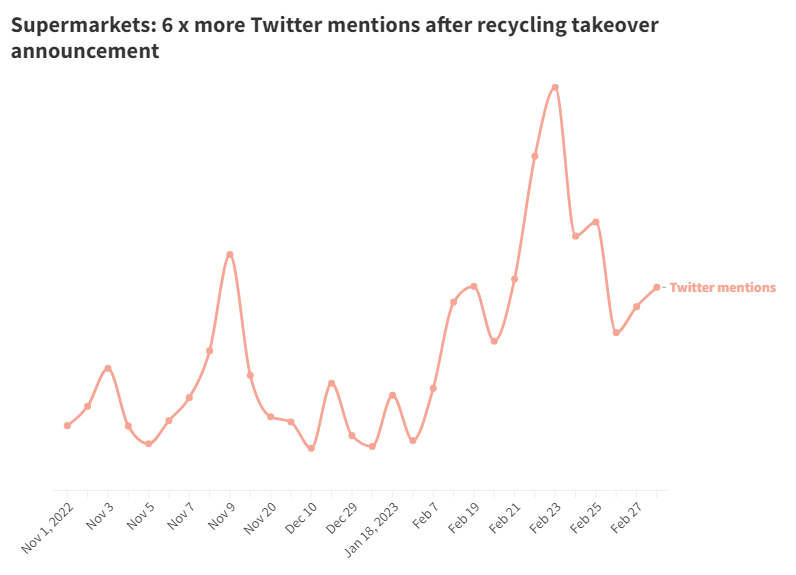
23 February 2023, supermarket giants announced the return of soft plastics recycling by late 2023, despite the lack of recyclers. This announcement generated 6 x the amount of ‘supermarket’ Twitter mentions compared to 1 Nov 2022.
Source: Pulsar TRENDS. Supermarkets and soft plastic recycling conversations on Twitter.
Although it’s a promising development, announcements like these are what drive the conversations and force change. This rings true as sustainability advocates push for more substantial action to address soft plastic waste in Australia.
Large organisations are being challenged to rethink how they package their products and how they can be more sustainable, what about the government?
A RED hot go
Minister for Environment and Water, Tanya Plibersek, has been vocal in her response to the soft plastics recycling crisis. Initially, the program’s failure was met with calls for urgent action with Ms Plibersek weighing in on the news, saying it was “really concerning” and put the pressure on major supermarkets to come up with an alternative recycling program.
Although it is acknowledged that the government plays a role, it has been made clear the responsibility also lies with manufacturers and packagers.
We’ve set a goal of making packaging 100% reusable, recyclable or compostable by 2025.
Australia needs to be better at recycling. That takes both industry and government action – and I’m ready to crackdown on those not doing enough.https://t.co/8vqoB0C9cI
Today, Coles and Woolies have outlined a path forward to resume soft plastics collection. I’ll be honest, this isn’t an easy task. pic.twitter.com/SjATWm1YMB
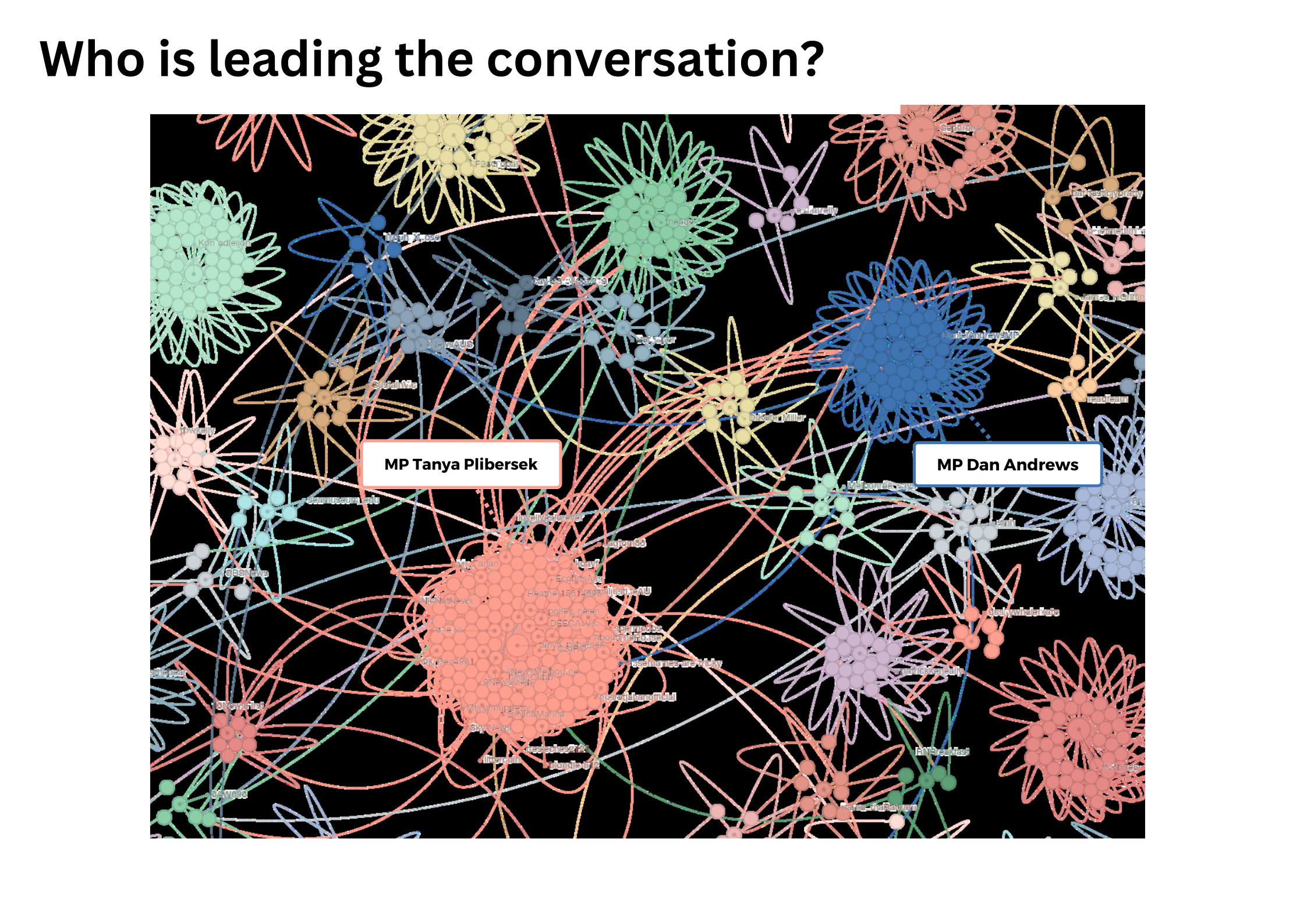
State and Federal Ministers are actively sharing their opinions and policies online in an effort to make change faster and positively influence their audience. Victorian Premier, Dan Andrews and the Victorian Government are leading the way, banning the selling and supply of single-use plastics in the state.
Commonwealth, State and Territory governments have jointly invested considerable funds into developing local capabilities to recover the challenging recycling stream and have committed to turning around Australia’s lack of progress on its recycling targets, setting new targets for 2025.
Source: Pulsar TRAC. Influential federal and state leaders driving conversations about recycling and soft plastic usage.
Adding another interesting layer of insights on social media from our sister company Pulsar, is that reddit is playing a major role in disseminating sentiment surrounding the REDcycle program. The below chart shows the most recurring keywords grouped by channel. The larger the tile, the more times the topic has appeared in that channel. Conversations involving scientists were notable and finding a solution to plastic pollution was a key narrative.
Top keywords by channel. (October 2022 – March 2023)
Trust was also a recurring keyword across all channels, indicating trust needs to be rebuilt. is something that needs to be rebuilt. Australians have begun to lose faith in the recycling industry as there is a lack of transparency into how much actually gets recycled.
The introduction of a new taskforce – the Road to Restart – will work towards rebuilding the public trust in soft plastic recycling. The taskforce also endeavours to ensure supermarkets and the packaging sector will get it right on their own accord.
The way forward
Conversations through online forums show Australians deeply care about sustainability, stating that ‘unless it can be recycled, it shouldn’t be produced.’
Social media platforms are especially fueled by sustainability advocates who need to share a broader awareness of recycling initiatives and earn potential audiences – conversations are widespread and emotions are elevated. Whereas broadcast and print channels are sharing the facts and the need to know information, directing audiences to use the information they have and to search where they can take their soft plastics. In addition to sustainability advocates, everyday Australians are learning how to pivot, seeking out support and ideas from fellow supporters on Twitter and other social media platforms.
If organisations can work together and policymakers can set clear legislative frameworks, it’s possible to implement necessary changes in both manufacturer and consumer behaviour to create a thriving circular plastics economy.
The pause of REDcycle is certainly on its way to being a good thing for the environment.
Loren is an experienced marketing professional who translates data and insights using Isentia solutions into trends and research, bringing clients closer to the benefits of audience intelligence. Loren thrives on introducing the groundbreaking ways in which data and insights can help a brand or organisation, enabling them to exceed their strategic objectives and goals.
A weekly tracker tracing the stories, figures and policies driving media and social coverage in the 2026 New Zealand General Election across Online News, TV, Radio, Newspaper, Magazine, X, Facebook, Instagram, TikTok, Threads and Forums. This edition covers conversations and coverage from 15th - 21st October, highlighting what’s shaping the election conversation.
1. Election Conversation
10,572
total mentions this week
2,842 media7,730 social
Media = news coverage. Social = all public posts across X, Facebook, Instagram, TikTok and Threads - everyone posting, not just media outlets.
2. Media Issue of the Week
Opportunity Party Puts the Kingmaker Question at the Centre of the Campaign
Opportunity (TOP)271 media items · 325 social posts
The Opportunity Party, led by Qiulae Wong, was the most covered new story in the news this week. It polled 8% in the 1News Verian poll on 13 October and 5.4% in the Post/Freshwater poll on 19 October, just above the 5% needed to enter Parliament. With National and Labour close together, outlets described it as a possible kingmaker. Christopher Luxon ruled out working with the party at the Herald leaders' debate, then told West Coast voters he would work with "whoever I have to", and campaign chair Simeon Brown ruled it out again. David Seymour said ACT would consider a four-party arrangement that includes Opportunity. Later in the week the focus turned to the party itself, with former board members describing internal problems and Wong saying the party's rules need another look.
News outlets ran 271 items on the party or the kingmaker question in the headline or summary (9.5% of the 2,842 election items), and it was mentioned somewhere in 724 (25.5%). Coverage was highest on 15 October, after Luxon's West Coast comments, Brown's response and Seymour's remarks, and again on 20 and 21 October, with new poll results, the former board members' claims and Wong's comments on coalition deals.
It matters because it affects who can form a government. The Post projected that Opportunity's seven MPs could give either a Labour-led bloc a narrow 61-seat majority or a National-led bloc 66 seats, so every party has had to say whether it would work with Opportunity. On social media it was a smaller conversation, with 325 posts (4.2%), and those posts were less negative than average (44.4% negative against 53.0% overall). The story is about coalition options rather than a policy position, so it is not linked to a party issue below.
3. What's happening across media and social?
2,842 media items · 7,730 social items · share of each channel's own conversation, so the two bars are directly comparable
"Social" is all public posts across X, Facebook, Instagram, TikTok and Threads - not just media organisations' own accounts.
MediaSocial
Issues
Cost of Living
Media
13.9%
Social
18%
Law & Order
Media
9.1%
Social
22.1%
Economy & Jobs
Media
16.5%
Social
12.5%
Health
Media
11.8%
Social
11.9%
Infrastructure & Transport
Media
10.1%
Social
4.1%
Parties
National
Media
25.8%
Social
21%
Labour
Media
23.5%
Social
17.8%
NZ First
Media
12.7%
Social
19.6%
Greens
Media
13.7%
Social
18.2%
ACT
Media
9.9%
Social
14.1%
Most frequent bylines and presenters: The most frequent bylines and presenters this week were Sean Plunket (The Platform), Ryan Bridge (Three), Henry Cooke (Waikato Times) and John MacDonald (Newstalk ZB).
Widest-reach accounts: The accounts with the widest reach among election posts were news outlets: the New Zealand Herald, 1News, Radio Tarana, RNZ and Stuff, along with the New Zealand Labour Party account. Party leaders' own accounts posted often but have smaller followings.
Law and order made up 22.1% of the issues discussed on social media but 9.1% in the news, about 2.4 times as much. Part of the gap is the continuing reaction to the Greens' and Te Pāti Māori's visit to a Mongrel Mob event, last week's Media Issue of the Week: 137 of the 791 law and order posts mention it. Across all social posts the visit came up in 291 (3.8%), 70.5% of them negative, and in 257 news items (9.0%).
The Opportunity Party shows the gap the other way round. It was in the headline or summary of 9.5% of news items but only 4.2% of social posts, about 2.3 times as much attention in the news. Among the parties, NZ First, the Greens and ACT had a bigger share of social mentions than news mentions (NZ First 19.6% against 12.7%, Greens 18.2% against 13.7%, ACT 14.1% against 9.9%), while National and Labour had a bigger share in the news (National 25.8% against 21.0%, Labour 23.5% against 17.8%).
4. Party Share of Conversation
1. National23.2%
2. Labour20.4%
3. NZ First16.5%
4. Greens16.2%
5. ACT12.2%
6. Te Pāti Māori6.5%
7. Opportunity (TOP)5%
Shown for seven parties, including Te Pāti Māori and the Opportunity Party (TOP), which is this week's Media Issue of the Week. Shares add up to 100% of the seven shown. Share of conversation measures attention, not polling, and is not a sign of electoral success.
5. Top candidates this week
1. Christopher Luxon1,614
2. Chris Hipkins1,611
3. Winston Peters1,133
4. David Seymour840
5. Chloe Swarbrick412
Christopher Luxon (1,614 mentions) and Chris Hipkins (1,611) were level at the top. Both were at the centre of the final leaders' debate on 20 October and the questions about working with Opportunity, and each party announced new policy during the week.
Winston Peters (1,133) was third and was mentioned far more on social media (726) than in the news (407). The most shared posts about him covered his comments on diversity, his message to David Seymour on strategic voting and his public meetings. David Seymour (840) drew attention for saying ACT could work with Opportunity.
Chloe Swarbrick (412) was in the news more than on social media (227 against 185), with coverage of the Greens' plan to reverse public service cuts and the Mongrel Mob visit. Mentions measure how much someone is being talked about, not how they are polling.
6. Election Issues
Top 4 themes this week
Cost of Living1,621
Economy & Jobs1,605
Law & Order1,430
Health1,252
What's driving conversation about each party?
Each party's top issues this week in social conversation, ranked by how much they were discussed
National
1Health
2Jobs
3Cost of living
Labour
1Health
2Education
3Cost of living
Greens
1Cost of living
2Law and order
3Training wage
ACT
1GP access
2Cost of living
Issues are ranked from social posts. Counts are not shown because the numbers for a single party and issue are small.
7. Issues to Watch
The coalition question around the Opportunity Party is likely to stay in the news until election day. Luxon has given two different answers on working with the party, and polls this month have put it between 4.8% and 8%, so a small shift in support could change which parties can form a government. The party's internal problems are also now in the spotlight.
Voter enrolment is becoming a political issue ahead of the 25 October deadline. New rules mean people cannot enrol at the polling booth, and 112 news items this week covered enrolment or the electoral roll, many focused on young and first-time voters. The number enrolled when the roll closes will show whether these concerns made a difference.
Social conversation leaned negative this week: 53.0% of posts with a clear tone were negative, 32.6% neutral and 14.4% positive. Cost of living is a top issue for four parties (National, Labour, Greens and ACT). Health is a top issue for two parties (National and Labour). Issues that matter to several parties are the ones most likely to keep shaping the campaign.
If you want to find out more about how Isentia can help you understand the NZ media landscape, please reach out to us here.
"
["post_title"]=>
string(97) "NZ Election 2026: TOP as Kingmaker, Law & Order Surge on Social, and Minor Parties Gaining Ground"
["post_excerpt"]=>
string(152) "Analysis of the latest NZ Election 2026 media tracker: The Opportunity Party's kingmaker potential, Law & Order social trends, and minor party momentum."
["post_status"]=>
string(7) "publish"
["comment_status"]=>
string(4) "open"
["ping_status"]=>
string(4) "open"
["post_password"]=>
string(0) ""
["post_name"]=>
string(92) "nz-election-2026-top-as-kingmaker-law-order-surge-on-social-and-minor-parties-gaining-ground"
["to_ping"]=>
string(0) ""
["pinged"]=>
string(0) ""
["post_modified"]=>
string(19) "2026-10-23 01:20:50"
["post_modified_gmt"]=>
string(19) "2026-10-23 01:20:50"
["post_content_filtered"]=>
string(0) ""
["post_parent"]=>
int(0)
["guid"]=>
string(32) "https://www.isentia.com/?p=50575"
["menu_order"]=>
int(0)
["post_type"]=>
string(4) "post"
["post_mime_type"]=>
string(0) ""
["comment_count"]=>
string(1) "0"
["filter"]=>
string(3) "raw"
}
Blog
NZ Election 2026: TOP as Kingmaker, Law & Order Surge on Social, and Minor Parties Gaining Ground
Analysis of the latest NZ Election 2026 media tracker: The Opportunity Party’s kingmaker potential, Law & Order social trends, and minor party momentum.
A weekly tracker tracing the stories, figures and policies driving media and social coverage in the 2026 New Zealand General Election across Online News, TV, Radio, Newspaper, Magazine, X, Facebook, Instagram, TikTok, Threads and Forums. This edition covers conversations and coverage from 8th - 15th October, highlighting what’s shaping the election conversation.
1. Election Conversation
18,417
total mentions this week
4,479 media13,938 social
Media = news coverage. Social = all public posts across X, Facebook, Instagram, TikTok, Threads and Forums - everyone posting, not just media outlets.
2. Media Issue of the Week
Green and Te Pāti Māori MPs Draw Criticism Over Meeting With Mongrel Mob Members
Greens / Te Pāti Māori112 media items · 116 social posts
Candidates and sitting MPs from the Green Party and Te Pāti Māori attended a meeting with Mongrel Mob members at a gang address. When photographs from the meeting were shared on social media, the response from commentators and rival parties was swift and largely critical.
This was not the week's highest-volume story, accounting for only 112 of 4,479 media items (2.5%, after filtering out unrelated international content) and 116 of 13,938 unique social posts (0.8%, after collapsing retweet/repost duplicates down to one count per message), well below the volume generated by ongoing leaders' debate coverage, which totalled 1,125 media items. Two independent methods nonetheless support treating it as a genuine, separable story: an exact keyword count aligns closely with an unsupervised clustering analysis of the entire media population, which identified it as a distinct 47-item cluster - smaller than general campaign coverage and several specific policy announcements, but clearly distinguishable from them. What sets the story apart is the intensity of the reaction rather than its scale: 72% of social commentary on the topic was negative, the most one-sided sentiment recorded for any subject this week, and the average post attracted roughly 5.7 times the typical level of engagement. Taken together, these figures point to a genuine public reaction concentrated on social platforms, and the episode provides National and ACT with a law-and-order narrative that may continue into coming weeks. It has not been linked to a tracked party policy below, as it reflects a matter of conduct rather than a policy position.
3. What's happening across media and social?
4,479 media items · 13,938 social items · share of each channel's own conversation, so the two bars are directly comparable
"Social" is all public posts across X, Facebook, Instagram, TikTok, Threads and Forums - not just media organisations' own accounts.
MediaSocial
Issues
Cost of Living
Media
15.8%
Social
22.7%
Economy & Jobs
Media
19.4%
Social
17.5%
Health
Media
11.7%
Social
9.9%
Infrastructure & Transport
Media
11.4%
Social
5.2%
Law & Order
Media
5.3%
Social
10.6%
Parties
National
Media
30.9%
Social
27.5%
Labour
Media
25.3%
Social
21.6%
NZ First
Media
14.7%
Social
21.5%
Greens
Media
14.1%
Social
20.4%
ACT
Media
6.8%
Social
6.4%
The most active commentary this week came from Sean Plunket, the Chris Chang and Tova O'Brien pairing, and John MacDonald.
By follower reach, the most prominent social accounts posting about the election this week were major outlets' own accounts - the New Zealand Herald, 1News, RNZ, Stuff and Radio Tarana - alongside the official Labour Party account. Individual leaders' personal accounts posted actively but with smaller followings than these outlet and party accounts.
The Greens continue to receive disproportionately greater attention on social media relative to traditional news coverage, accounting for 20.4% of social party conversation compared with 14.1% in media coverage - roughly 1.4 times the media share.
Law and order shows a similarly pronounced gap between channels this week, accounting for 10.6% of social conversation compared with 5.3% in the news. This is consistent with the public reaction to the Mongrel Mob meeting, which appears to have generated considerably sharper engagement on social platforms than mainstream coverage volume alone would suggest.
4. Party Share of Conversation
1. National33.1%
2. Labour26.6%
3. NZ First20.6%
4. Greens19.7%
Shown for the four largest parliamentary parties (National, Labour, Greens, NZ First); ACT, Te Pāti Māori and TOP are tracked elsewhere in this report but not included in this chart, so these shares sum to 100% of the four shown, not of all tracked parties. Share of conversation measures attention and mentions only - it is not polling and should not be read as an indication of electoral success.
5. Top candidates this week
1. Winston Peters1,931
2. Christopher Luxon1,631
3. Chris Hipkins1,466
4. David Seymour916
5. Chloe Swarbrick561
Winston Peters leads the rankings this week, a shift driven primarily by a widely circulated moment in the minor-party leaders' debate in which he described diversity as "a weakness rather than a strength" while delivering a pointed critique of the left-leaning bloc. Christopher Luxon and Chris Hipkins follow closely behind as the campaign moves into its final weeks, while David Seymour and Chloe Swarbrick complete the top five, each drawing attention largely through their parties' own policy announcements this week.
6. Election Issues
Top 4 themes this week
Economy & Jobs3,014
Cost of Living2,901
Health1,789
Infrastructure & Transport1,508
What's driving conversation about each party?
Each major party's top-ranked issues this week, by real topic volume in their social conversation (after excluding other parties' names, individual people, and procedural or horse-race chatter), with how that conversation leaned
NegativeNeutralPositive
National
Cost of living · 86 items
Neg 46.5%Neu 31.4%Pos 22.1%
Tax reform · 34 items
Neg 44.1%Neu 52.9%Pos 2.9%
Fiscal plan · 42 items
Neg 38.1%Neu 57.1%Pos 4.8%
Labour
Cost of living · 88 items
Neg 30.7%Neu 36.4%Pos 33%
Fiscal plan · 47 items
Neg 55.3%Neu 34%Pos 10.6%
Economy · 70 items
Neg 34.3%Neu 48.6%Pos 17.1%
Greens
Wealth tax · 41 items
Neg 53.7%Neu 34.1%Pos 12.2%
Cost of living · 43 items
Neg 27.9%Neu 41.9%Pos 30.2%
Jobs · 112 items
Neg 34.8%Neu 33.9%Pos 31.2%
ACT
Fiscal plan · 24 items
Neg 50%Neu 37.5%Pos 12.5%
Volume and sentiment above are based on social media data only.
7. Issues to Watch
The meeting between Green and Te Pāti Māori representatives and Mongrel Mob members represents a reputational risk for both parties heading into the final weeks of the campaign. Whether National and ACT are able to sustain this as a law-and-order narrative through to the 7 November election is worth monitoring closely.
Labour's fiscal plan issue recorded the most negative social sentiment of any tracked policy this week, at 55.3% negative, followed by Greens' wealth tax at 53.7% and ACT's fiscal plan at 50.0%. All three touch on tax, spending or fiscal policy specifically, suggesting the fiscal debate is where social sentiment is running most negative across the board this week, rather than any one party facing an isolated problem.
Social media discussion of the Greens continues to centre on polling performance and tactical voting considerations rather than policy substance. Coalition and tactical-voting framing accounts for 12.7% of their social conversation this week, compared with just 2.2% focused specifically on their wealth tax proposal - a pattern that has now held for three consecutive weeks. Whether that balance shifts as the campaign enters its final stretch would be worth tracking.
If you want to find out more about how Isentia can help you understand the NZ media landscape, please reach out to us here.
"
["post_title"]=>
string(83) "NZ Election 2026: Mongrel Mob Controversy, Fiscal Policy and Greens on social media"
["post_excerpt"]=>
string(156) "Explore New Zealand’s 2026 election conversation, from the Mongrel Mob meeting controversy and law and order to reactions to Labour’s capital gains tax."
["post_status"]=>
string(7) "publish"
["comment_status"]=>
string(4) "open"
["ping_status"]=>
string(4) "open"
["post_password"]=>
string(0) ""
["post_name"]=>
string(49) "nz-election-2026-mongrel-mob-fiscal-policy-greens"
["to_ping"]=>
string(0) ""
["pinged"]=>
string(0) ""
["post_modified"]=>
string(19) "2026-10-19 01:20:22"
["post_modified_gmt"]=>
string(19) "2026-10-19 01:20:22"
["post_content_filtered"]=>
string(0) ""
["post_parent"]=>
int(0)
["guid"]=>
string(32) "https://www.isentia.com/?p=50464"
["menu_order"]=>
int(0)
["post_type"]=>
string(4) "post"
["post_mime_type"]=>
string(0) ""
["comment_count"]=>
string(1) "0"
["filter"]=>
string(3) "raw"
}
Blog
NZ Election 2026: Mongrel Mob Controversy, Fiscal Policy and Greens on social media
Explore New Zealand’s 2026 election conversation, from the Mongrel Mob meeting controversy and law and order to reactions to Labour’s capital gains tax.
A weekly tracker tracing the stories, figures and policies driving media and social coverage in the 2026 New Zealand General Election across Online News, TV, Radio, Newspaper, Magazine, X, Facebook, Instagram, TikTok, Threads and Forums. This edition covers conversations and coverage from 1st – 8th October, highlighting what’s shaping the election conversation.
1. Election Conversation
21,637
total mentions this week
4,360 media17,277 social
2. Media Issue of the Week
National Proposes Drug Testing and Benefit Cuts for Jobseekers
National29 media items
National announced a five-point welfare policy: random drug testing for JobSeeker recipients (with sanctions for repeat failures), reduced payments for long-term beneficiaries, and a doubled stand-down period for repeatedly leaving jobs without good reason. Labour and the Greens called it "punching down" and "cruel"; ACT proposed going even further; Luxon defended it as "fairness" for taxpayers.
The single largest media cluster this week (183 of 600 sampled items) was generic "campaigning intensifies as election day nears" coverage. This welfare policy, while smaller by volume (29 items), is a genuine flashpoint: a specific, controversial announcement that sharply divided every major party and will likely keep generating reaction into next week.
3. What's happening across media and social?
4,360 media items · 17,277 social items · share of each channel's own conversation, so the two bars are directly comparable
MediaSocial
Issues
Cost of Living
Media
15.8%
Social
24.5%
Economy & Jobs
Media
19.4%
Social
13.4%
Housing
Media
10.5%
Social
7.7%
Health
Media
8.5%
Social
9.3%
Infrastructure & Transport
Media
9.8%
Social
7.1%
Education
Media
8.2%
Social
8%
Parties
National
Media
25.5%
Social
31.3%
Labour
Media
18.9%
Social
25.9%
NZ First
Media
18.3%
Social
17.2%
Greens
Media
10.3%
Social
20.8%
ACT
Media
11%
Social
3.9%
The Greens get more than twice the relative attention on social media as in the news. On social, the Greens are 20.8% of party conversation; in the news, they're 10.3%.
Health is a top-four issue on social but not in the news this week - Infrastructure takes its place in media's top four instead. Social conversation is tilting toward the health system while media coverage stays on economy, cost of living and infrastructure announcements.
4. Party Share of Conversation
1. National33.7%
2. Labour26.7%
3. NZ First20.7%
4. Greens18.9%
Share of conversation measures attention and mentions only - it is not polling and should not be read as an indication of electoral success.
5. Top candidates this week
1. Christopher Luxon2,301
2. Chris Hipkins2,058
3. Winston Peters1,446
4. David Seymour757
5. Chloe Swarbrick609
Luxon and Hipkins remain close at the top as the campaign enters its final stretch. Peters follows, still driven by coalition speculation. Seymour moves up to fourth on the back of ACT's economic-reform push (including floating a higher superannuation age), overtaking Swarbrick, whose fifth-place mentions continue to track the Greens' polling strength.
6. Election Issues
Top 4 themes this week
Cost of Living3,584
Economy & Jobs3,359
Housing1,846
Infrastructure & Transport1,709
How are policies landing for each party?
Each major party's most prominent specific policy, and how social conversation reacted to it
NegativeNeutralPositive
National
Infrastructure investment · 53 items
Neg 42.3%Neu 36.5%Pos 21.2%
Labour
Capital gains tax (incl. farms) · 70 items
Neg 85.5%Neu 14.5%Pos 0%
Greens
Wealth tax · 67 items
Neg 17.9%Neu 65.7%Pos 16.4%
ACT
KiwiSaver tax removal · 23 items
Neg 4.3%Neu 4.3%Pos 91.3%
Volume and sentiment above are based on social media data only.
7. Issues to Watch
National's welfare drug-testing policy is a fresh, sharply divisive flashpoint - the "punching down" framing from Labour and the Greens, and ACT signalling it wants to go further still, both point to more reaction next week.
Labour's capital gains tax remains the week's clearest negative outlier (85.5% negative on social). National's own infrastructure pledge is also net-negative this week (42.3% vs 21.2% positive), despite infrastructure announcements usually landing on safer ground than tax policy. ACT's KiwiSaver policy, by contrast, remains clearly positive (91.3%).
On social, discussion of the Greens is mostly about polling results and tactical voting rather than their own policy: 14% of their social conversation is coalition/tactical-voting framing (which bloc to "party vote" for), versus just 2% specifically about their wealth tax policy - their polling surge is driving attention more than their platform is.
If you want to find out more about how Isentia can help you understand the NZ media landscape, please reach out to us here.
"
["post_title"]=>
string(71) "NZ Election 2026: Welfare, Greens and the policies driving conversation"
["post_excerpt"]=>
string(152) "What’s shaping New Zealand’s 2026 election conversation? Explore the key policies, parties and issues driving media and social discussion this week."
["post_status"]=>
string(7) "publish"
["comment_status"]=>
string(4) "open"
["ping_status"]=>
string(4) "open"
["post_password"]=>
string(0) ""
["post_name"]=>
string(69) "nz-election-2026-welfare-greens-and-the-policies-driving-conversation"
["to_ping"]=>
string(0) ""
["pinged"]=>
string(0) ""
["post_modified"]=>
string(19) "2026-10-19 07:37:01"
["post_modified_gmt"]=>
string(19) "2026-10-19 07:37:01"
["post_content_filtered"]=>
string(0) ""
["post_parent"]=>
int(0)
["guid"]=>
string(32) "https://www.isentia.com/?p=50341"
["menu_order"]=>
int(0)
["post_type"]=>
string(4) "post"
["post_mime_type"]=>
string(0) ""
["comment_count"]=>
string(1) "0"
["filter"]=>
string(3) "raw"
}
Blog
NZ Election 2026: Welfare, Greens and the policies driving conversation
What’s shaping New Zealand’s 2026 election conversation? Explore the key policies, parties and issues driving media and social discussion this week.