
Blog post
August 8, 2025

How audiences and media reacted to voucher rollout leading up to Singapore’s national day

Singapore’s 60th National Day celebrations promise nation-building and the conversation around SG60 has majorly contributed to it. We analysed around 6k mentions across X, Instagram, Facebook, TikTok and online news using Pulsar TRAC between May 1st – 28th July 2025 in Singapore.

What we found was how audiences and the media have stepped up at playing an equal part in achieving what the government has set out to do, even while we can expect a slight disconnect in policy intention and ground reality.

Chinese content creators lead the way in community support

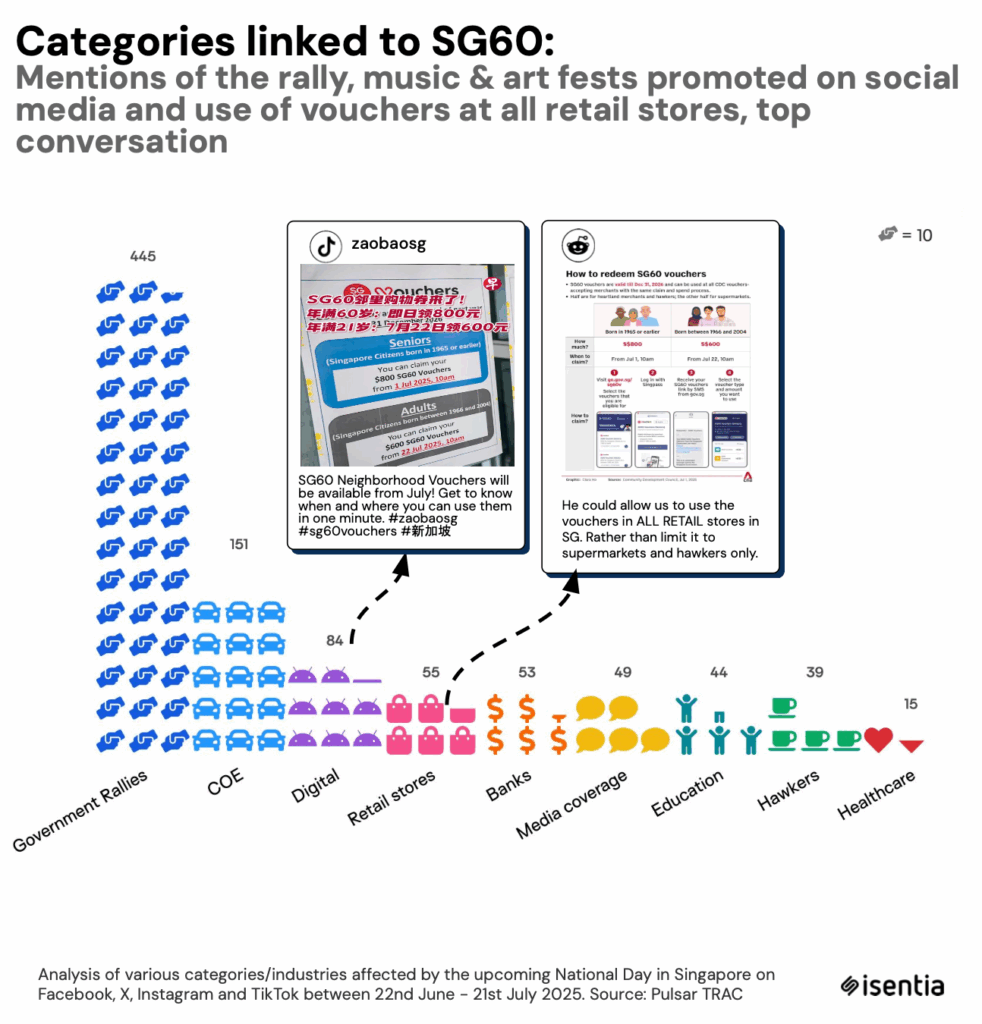
When Zaobao’s TikTok videos explaining voucher usage went viral, they demonstrated something powerful about Singapore’s multilingual strength. Chinese and Malay content creators took the onus on themselves to not just translate but provide logical solutions to counter logistical problems audiences might have. This organic response showed how minority language creators have become essential bridges in Singapore’s digital ecosystem.

The success of these practical guides reveals an opportunity: when communities are empowered to create their own solutions, they often surpass official channels in effectiveness and reach. This grassroots content creation model could inform future government communication strategies, leveraging audiences as stakeholders rather than just recipients.
Hawker centres become testing grounds for digital inclusion

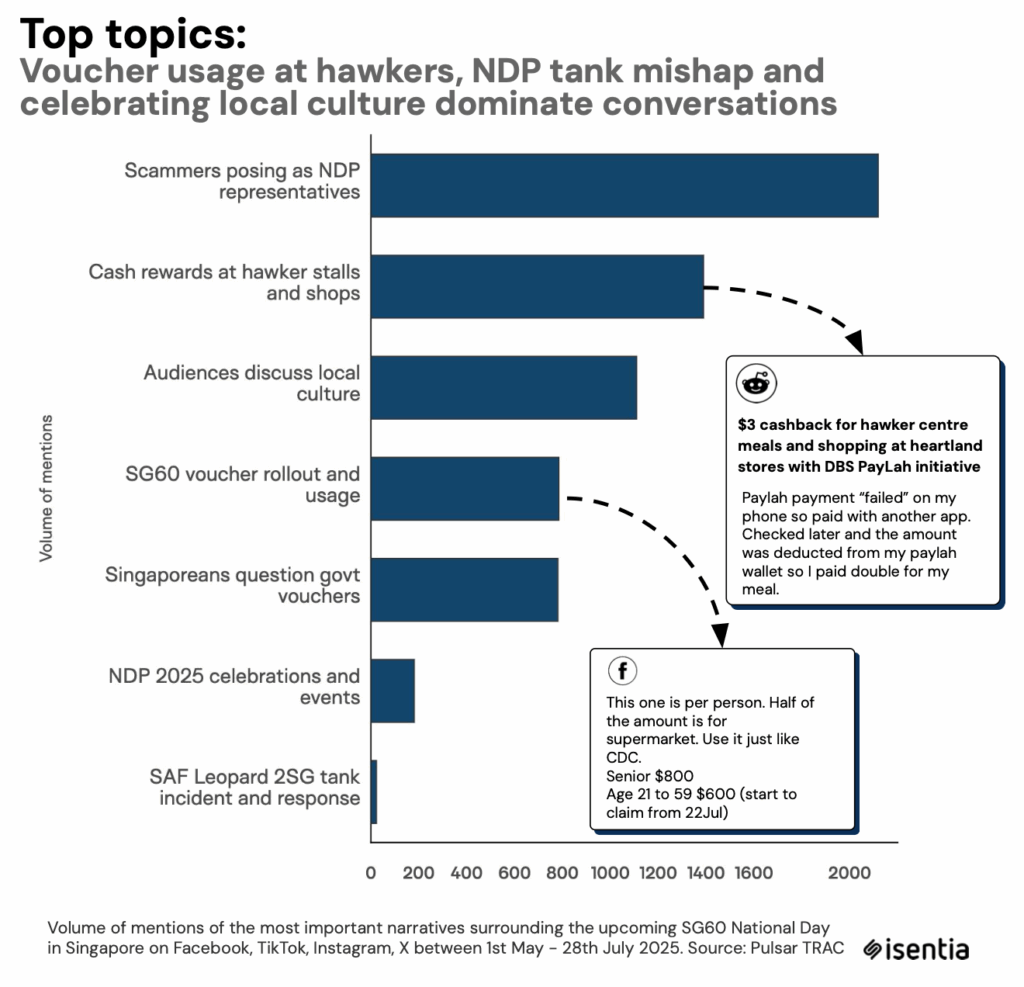
While rejection stories of vouchers at hawker stalls created initial friction, they also sparked important conversations about digital adoption and inclusivity. The challenges faced by elderly stall owners and foreign workers highlighted gaps that, once identified, can be addressed. Some stalls quickly adapted, with younger family members helping older owners navigate the digital systems, showcasing Singapore’s inter-generational support in action.

This real-world stress test of digital payment systems provides valuable data for the future. The hawker centre experience isn’t a failure – it’s a learning opportunity that will make Singapore’s next digital initiative more inclusive and robust.
Platform diversity showcases how audiences overcome roadblocks

TikTok users created comprehensive guides about voucher eligibility, sharing discoveries about unexpected places to use them, from baby spas to leather crafting workshops. This crowd-sourced innovation cleared a lot of the debate online.

Meanwhile, Facebook’s older users provided equally valuable feedback about accessibility challenges. Rather than a generational divide, this represented different perspectives contributing to a fuller picture. Younger users offered solutions while older users identified problems – both supremely essential for future policy-making. 


Citizens transform challenges into community action on social

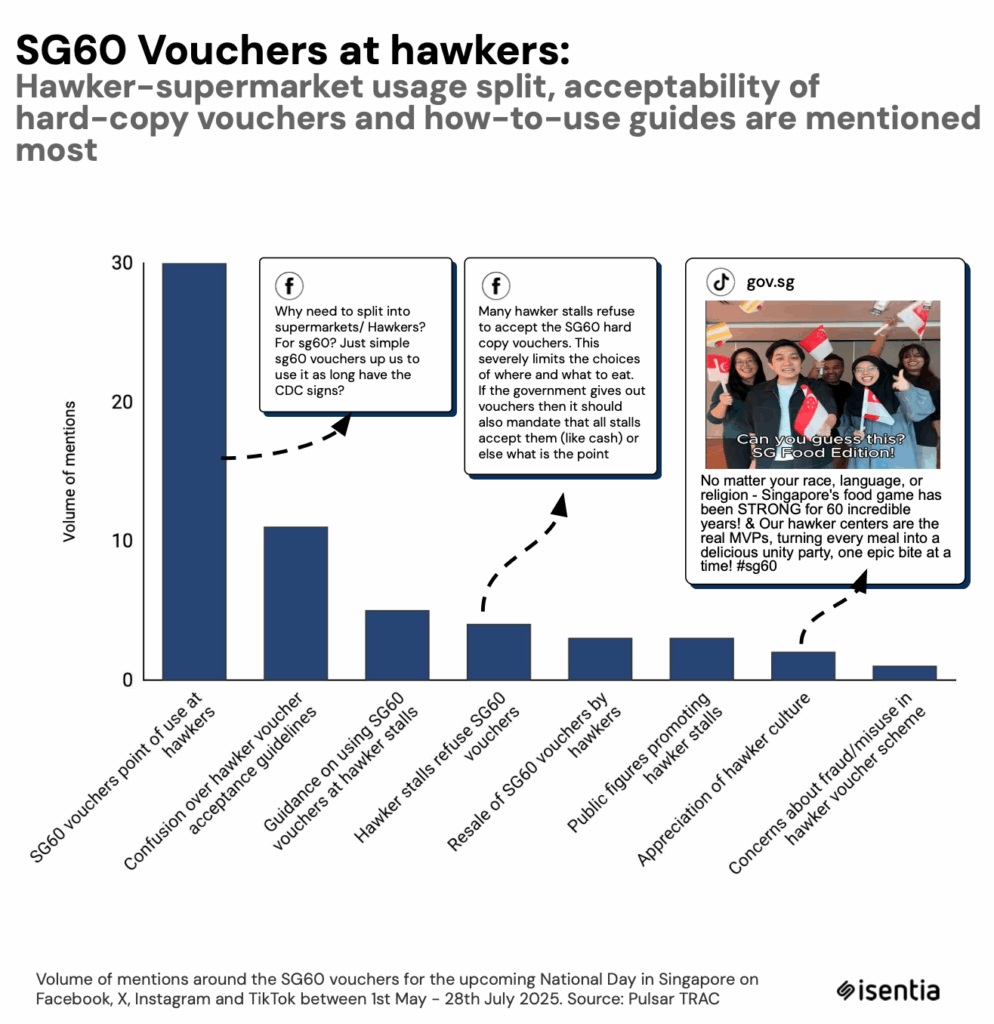
When payment app glitches occurred, users quickly shared workarounds. Stories of Paylah double-charges led to helpful PSAs about checking payment confirmations. Confusion over CDC compatibility sparked explanatory threads. Most of these conversations were happening on Facebook and Reddit with the former highlighting where the roadblocks are and the latter offering solutions to those very roadblocks.
Media adapts to audience needs in real-time

CNA’s pivot to practical how-to guides showed responsive journalism at work, recognising and meeting audience needs. While initial coverage focused on announcements, media outlets quickly adjusted to provide service journalism that citizens actually wanted.

The gap between initial coverage and audience needs created space for citizen journalists and content creators to fill, democratising distribution. This became a complementary relationship that benefited the public at the end of the day. 
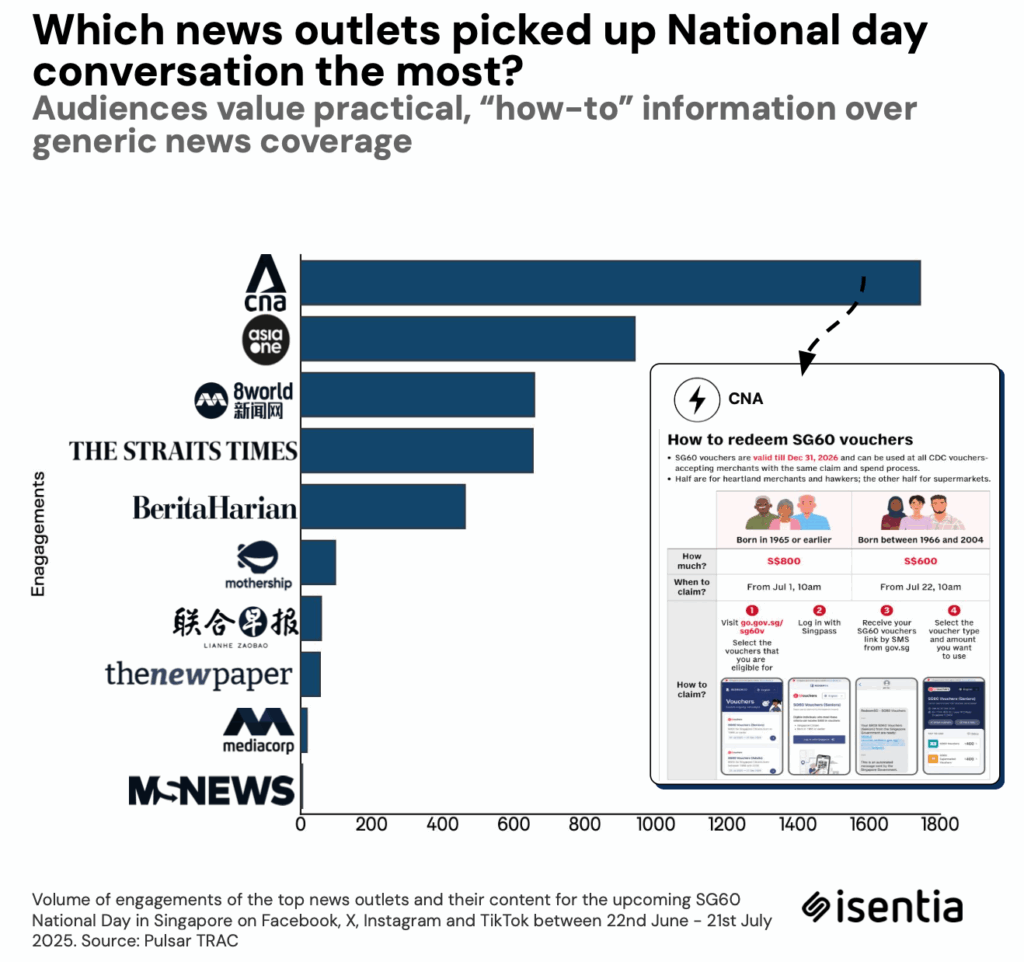
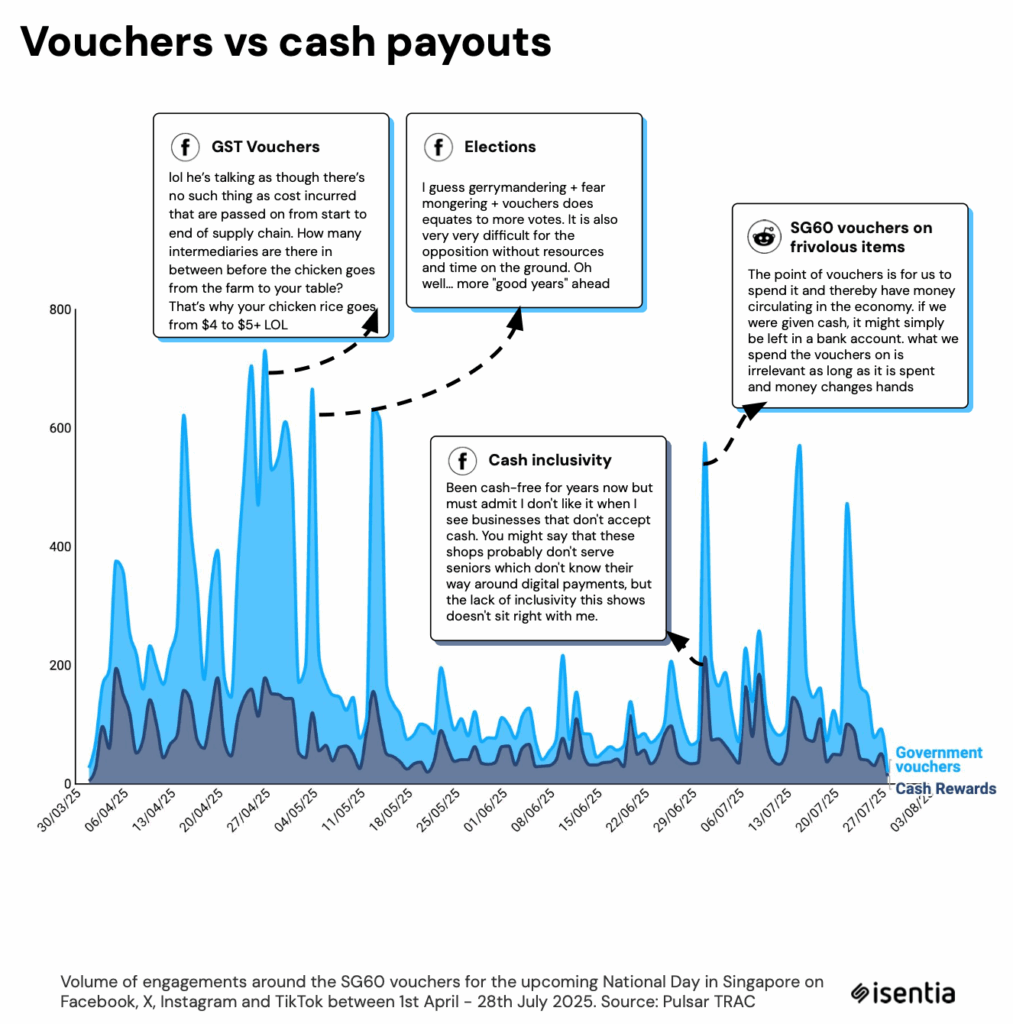
The conversation about cash versus digital payments opened important dialogues about inclusive design. Users’ suggestions about public transport integration and simplified interfaces were product feedback to shape future iterations. The elderly community’s challenges with digital usage highlighted specific areas where targeted support and education could help.


How did brands show up the most in audience conversation online?

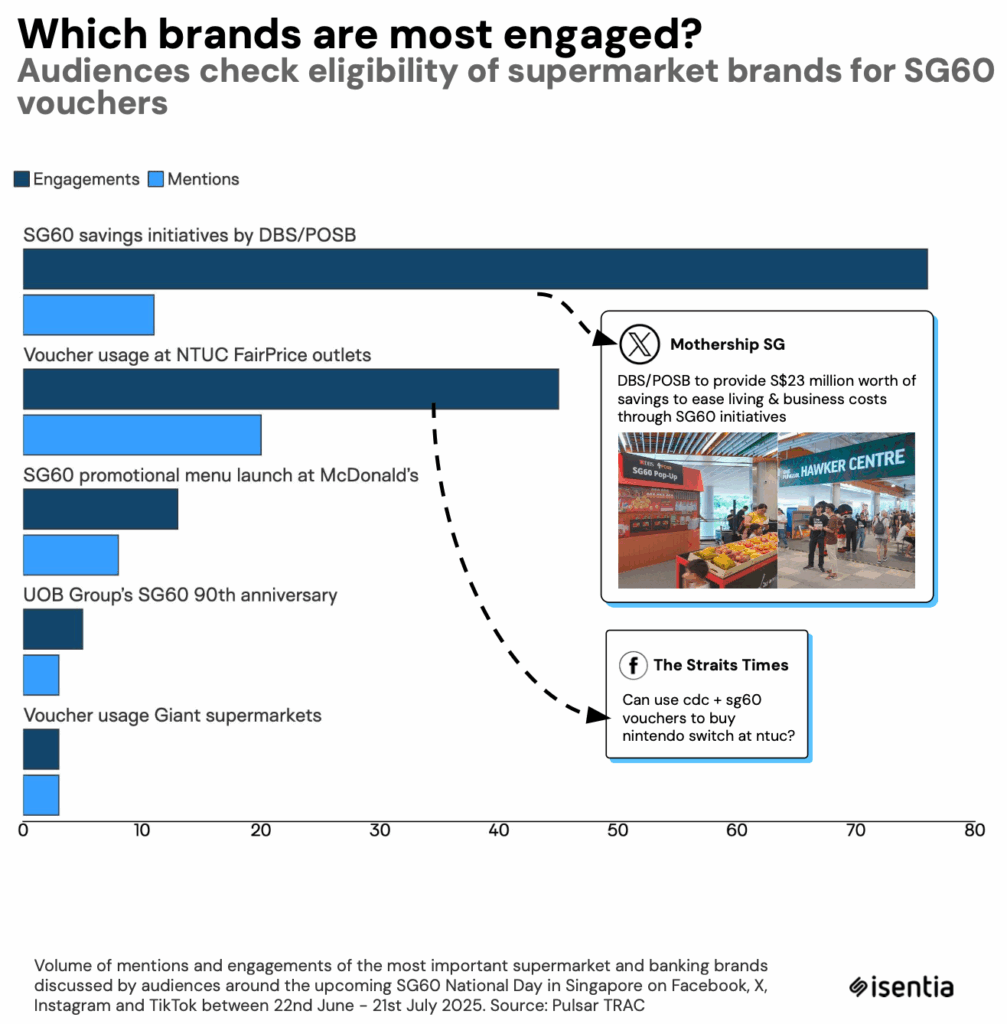
Engagement with brands like DBS/POSB, NTUC FairPrice, and McDonald’s showed how private sector participation amplified the voucher programme’s reach. These partnerships created additional touch-points for citizens to access support and information, with brands becoming part of the solution ecosystem. These were mostly promotional in nature, but also specify how compatible vouchers are at supermarket and banking touch-points.
Nation building together

Singapore’s SG60 voucher rollout revealed something profound about the nation’s character. Language communities became information networks. Social media platforms transformed into help desks. What could have been a story of digital fragmentation became one of collective problem-solving.

For communications professionals and policymakers, the SG60 conversation offers invaluable insights into effective engagement. The most viral content was citizens helping citizens navigate new territory together. This collaborative spirit suggests that Singapore’s Smart Nation journey, while not without challenges, has a powerful asset: a population ready to support each other through digital transformation.


Interested in learning more? Email us at info@isentia.com

Share

Similar articles

object(WP_Post)#8709 (24) { ["ID"]=> int(43875) ["post_author"]=> string(2) "75" ["post_date"]=> string(19) "2025-12-09 09:09:29" ["post_date_gmt"]=> string(19) "2025-12-09 09:09:29" ["post_content"]=> string(8658) "

As communications professionals look toward 2026 planning sessions, one question dominates the conversation - How can we use AI in a safe, scalable, and sustainable way?

Behind this question often lies the hope for an "AI easy button"—a one-click solution for complex measurement challenges. However, as discussed in our recent APAC webinar, the real opportunity lies not in automating old metrics, but in architecting a smarter era of measurement.

Hosted by Russ Horell, Isentia’s Chief Revenue Officer for APAC, the session featured deep dives from two industry leaders who've contributed immensely to research and planning: Ngaire Crawford (Director of Insights, ANZ) and Prashant Saxena (VP of Research and Insights, SEA). Together, they unpacked the transition from using insights and converting them into strategic, measurable storytelling.

Here are the key takeaways from the discussion.

1. From experimentation to transparency

If 2024 and 2025 were the years of "playing in the sandbox," 2026 is set to be the year of transparency.

Ngaire Crawford emphasized that while AI is incredible at summarising data and recognising patterns, it does not automatically generate insight. As we integrate these tools, the focus must shift to methodological integrity—understanding the source data, the structure, and the limitations of the models we use.

"Models are really good pattern finders. But they don't necessarily set what good looks like, or understand the consequences of being wrong. And the antidote to that is always going to be good design." – Ngaire Crawford

2. "More data, better insight" is the misconception

A major misconception remains that feeding AI endless amounts of data will naturally result in better answers. In reality, without the right framework, more data often just creates more noise.

Prashant Saxena warns against the "sameness" that AI can generate. If everyone uses the same models on the same big data sets without specific objectives, they will get similar, generic answers. The role of the insights professional is evolving from descriptive reporting to strategic storytelling—using judgment to break through the "echo chamber" of AI validation.

3. Kill, keep, create: redefining our metrics

The panelists played a game of "keep, kill, create" to determine the future of measurement metrics.

  • Kill: The panel was unanimous in moving away from vanity metrics. Ngaire called for the end of Cumulative Reach, noting it is a biased metric that offers no context. Prashant agreed, suggesting that AVEs (Advertising Value Equivalents) need to be finally left behind.
  • Keep: Share of Voice remains useful as a foundational benchmark (a "census" of market presence), provided it is redefined to measure the share of a specific idea or perception rather than just volume
  • Create: The future lies in Authenticity Metrics. Prashant argued that while reputation is a downstream outcome, authenticity is the upstream outcome that drives it.

"Authenticity is more upstream, as reputation and trust are more downstream... That's an authentic ritual on a day-to-day basis, which leads to reputation." – Prashant Saxena

4. The "home field advantage" for communicators

Despite the technical buzz surrounding AI, the panel argued that communications professionals hold a distinct advantage. "Prompt engineering" is, at its core, a language and communication skill.

The future doesn't necessarily belong to the most technical users, but to the most articulate—those who can clearly define an outcome, ask the right questions, and deconstruct language to get the best result from a model.

Trust your judgment

As we move into 2026, the advice from our experts is to not let AI replace your strategic point of view.

  • Have an opinion: Don't wait for metrics to be imposed on you. Go into conversations knowing what you want to measure and why.
  • Pause before you prompt: As Prashant advised, "Paper before a chatbot.". Define your strategy and objectives on paper, using your human experience and judgment, before turning to AI to execute the work.

By combining the speed of AI with the nuance of human strategy, communicators can finally build the sophisticated measurement systems they have always wanted.


Interested in viewing the whole recording? Watch our webinar here.

Alternatively, contact our team to learn more insights into meaningful measurement, KPIs and communicating using the right dataset.

" ["post_title"]=> string(52) "Key takeaways from the Future of Measurement webinar" ["post_excerpt"]=> string(126) "Our recent webinar explores what the future of measurement in 2026 looks like and what brands must do to scale in this AI era." ["post_status"]=> string(7) "publish" ["comment_status"]=> string(4) "open" ["ping_status"]=> string(4) "open" ["post_password"]=> string(0) "" ["post_name"]=> string(45) "build-a-scalable-ai-measurement-strategy-2026" ["to_ping"]=> string(0) "" ["pinged"]=> string(0) "" ["post_modified"]=> string(19) "2025-12-09 12:07:34" ["post_modified_gmt"]=> string(19) "2025-12-09 12:07:34" ["post_content_filtered"]=> string(0) "" ["post_parent"]=> int(0) ["guid"]=> string(32) "https://www.isentia.com/?p=43875" ["menu_order"]=> int(0) ["post_type"]=> string(4) "post" ["post_mime_type"]=> string(0) "" ["comment_count"]=> string(1) "0" ["filter"]=> string(3) "raw" }
Blog
Key takeaways from the Future of Measurement webinar

Our recent webinar explores what the future of measurement in 2026 looks like and what brands must do to scale in this AI era.

object(WP_Post)#8720 (24) { ["ID"]=> int(43742) ["post_author"]=> string(2) "75" ["post_date"]=> string(19) "2025-12-08 17:11:34" ["post_date_gmt"]=> string(19) "2025-12-08 17:11:34" ["post_content"]=> string(9544) "

The media landscape is accelerating. In an era where influence is ephemeral and every angle demands instant comprehension, PR and communications professionals require more than generic technology—they need intelligence engineered for their specific challenges.

Isentia is proud to introduce Lumina, a groundbreaking suite of intelligent AI tools. Lumina has been trained from the ground up on the complex workflows and realities of modern communications and public affairs. It is explicitly designed to shift professionals from passive media monitoring back into the role of strategic leaders and pacesetters. 

“The PR, Comms and Public Affairs sectors have been experimenting with AI, but most tools have not been built with their real challenges in mind.” said Joanna Arnold, CEO of Pulsar Group

“Lumina is different; it is the first intelligence suite designed around how narratives actually form today, combining human credibility signals with machine-level analysis. It helps teams understand how stories evolve, filter out noise and respond with context and confidence to crises and opportunities.”

Setting a new standard for PR intelligence

Lumina is centered on empowering, not replacing, the human element of communications strategy. This suite is purpose-built to help PR, Comms, and Public Affairs professionals significantly improve productivity, enhance message clarity, and facilitate early risk detection.

Lumina enables communicators to:

  • Understand & Interpret: Move beyond basic alerts to strategically map the trajectory and spread of narrative evolution.
  • Focus & Personalise: Achieve the clarity necessary to execute strategic action before critical moments pass.
  • Execute & Monitor: Rapidly deploy strategy firmly rooted in real-time, actionable insight.

Get a demo today: Stories & Perspectives module

We are launching the Lumina suite by making our first module immediately available: Stories & Perspectives.

In the current fragmented, multi-channel media environment, communications professionals need to be able to instantly perceive not just how a story is growing, but also how it is being perceived across different stakeholder groups.

Stories & Perspectives organizes raw media mentions into clustered, cohesive Stories, and the Perspectives that exist within each, reflecting distinct media, audience, and public affairs angles. This unique functionality allows users to:

  • Rise above the noise: Instantly identify which high-level topics are gaining momentum or fading from attention.
  • Get to the detail, fast: Uncover the influential voices, niche communities, and specific channels actively shaping the narrative.
  • Catch the pivot point: Precisely identify the moment a story shifts—from a strategic opportunity to a reputation risk—or when a new key opinion former begins guiding the conversation.

"Media isn’t a stream of mentions," said Kyle Lindsay, Head of Product at Pulsar Group. "But rather a living system of stories shaped by competing perspectives. When you can see those structures clearly, you gain the ability to understand issues as they form, anticipate how they’ll evolve, and act with precision. That’s what we mean when we talk about AI built for communicators, and that's what an off-the-shelf LLM can't give you."

The Lumina Roadmap: AI tools for the future of comms

The launch of Stories & Perspectives is the first release of many. Over the upcoming months, we will systematically roll out the full Lumina roadmap, introducing a comprehensive set of AI tools engineered to handle every phase of the communications lifecycle.

The full Lumina suite will soon incorporate:

  • Curated media summaries: AI-driven daily summaries customized specifically to the priorities of senior leadership, highlighting only the most relevant stories.
  • Reputation analysis: Advanced measurement tracking how critical themes like ethics, innovation, and leadership are statistically shaping corporate perception.
  • Press release & media relations assistant: Tools designed to accelerate content creation and craft hyper-focused, personalized pitches that reach the precise contacts faster.
  • Predictive intelligence layer: Technology engineered to track and anticipate story momentum and strategic change before the window of opportunity closes.
  • Intelligent agents: Background agents continuously scanning all media channels for emerging key spokespeople and previously undetected reputation risks.
  • Enhanced audio, broadcast & crisis detection: Complete, real-time oversight of all channels—including audio and broadcast—enabling rapid context building and optimal crisis response delivery.


Want to harness the power of Lumina AI for your PR, Comms, or Public Affairs team? .

Complete the form below to register your interest.

" ["post_title"]=> string(79) "Announcing Lumina: The purpose-built AI suite for PR, Comms, and Public Affairs" ["post_excerpt"]=> string(129) "An intelligent suite of AI tools trained on the language, workflows, and realities of modern public relations and communications." ["post_status"]=> string(7) "publish" ["comment_status"]=> string(4) "open" ["ping_status"]=> string(4) "open" ["post_password"]=> string(0) "" ["post_name"]=> string(76) "announcing-lumina-the-purpose-built-ai-suite-for-pr-comms-and-public-affairs" ["to_ping"]=> string(0) "" ["pinged"]=> string(0) "" ["post_modified"]=> string(19) "2025-12-09 09:39:52" ["post_modified_gmt"]=> string(19) "2025-12-09 09:39:52" ["post_content_filtered"]=> string(0) "" ["post_parent"]=> int(0) ["guid"]=> string(32) "https://www.isentia.com/?p=43742" ["menu_order"]=> int(0) ["post_type"]=> string(4) "post" ["post_mime_type"]=> string(0) "" ["comment_count"]=> string(1) "0" ["filter"]=> string(3) "raw" }
Blog
Announcing Lumina: The purpose-built AI suite for PR, Comms, and Public Affairs

An intelligent suite of AI tools trained on the language, workflows, and realities of modern public relations and communications.

Ready to get started?

Get in touch or request a demo.