Blog
5 reasons why a headline goes viral
A headline might be a reader’s first – and only – contact with a brand, and many will keep skimming until they land on something that takes their interest.
The Internet is saturated with content.
Content creators should strive to drive virality to emerge from the flood of online content. Viral content is not merely a popular piece, but it garners excessive engagement to outliers.
This paper explores some common factors of viral content.
If you would like more information about monitoring your content, get in touch with us today.

Loren is an experienced marketing professional who translates data and insights using Isentia solutions into trends and research, bringing clients closer to the benefits of audience intelligence. Loren thrives on introducing the groundbreaking ways in which data and insights can help a brand or organisation, enabling them to exceed their strategic objectives and goals.
A headline might be a reader's first – and only – contact with a brand, and many will keep skimming until they land on something that takes their interest.
If you aren't into the nitty-gritty of headlines, stop reading now. But if you want to be that content creator who writes the runaway headline, here's a snapshot of what some of the research has found.
Between 1 March and 10 May 2017, BuzzSumo analysed 100 million of the most shared article headlines on Facebook and Twitter, the platforms dominated by publisher and consumer content. Then in July, it published its analysis of 10 million B2B headlines – those shared on LinkedIn – and found that the best headline phrases, structures, numbers and lengths differed from the B2C results.
While previous research suggested that the first three and last three words were the important parts of a headline, the BuzzSumo research highlighted linking phrases as key for headlines targeting B2C audiences.
The three-word phrase – or trigram – that led the engagement charge (likes, shares, comments) was 'will make you'. In fact, on Facebook it had twice as many engagements as the trigram that took second place ('this is why'), followed by 'can we guess', 'only X in' and 'the reason is'.
BuzzSumo determined that the success of the 'will make you' phrase was based on it linking content to the emotional impact it will have on the reader – it sets you up to care ('will make you cry', 'will make you smarter', etc.).
It also found that headlines that provoke curiosity work well when readers are looking to learn something from an article. They are a little like the 'will make you' articles, but they tell you what you'll find out rather than what you'll feel.
The BuzzSumo research found that the top five phrases starting a B2C headline were:
The top five phrases ending a B2C headline were:
Admittedly, the second-place holder might not rate as well in Australia, but the five top-performing first words were:
So, what doesn't work for B2C audiences? The five worst-performing frequently used phrases were:
Confirming earlier Outbrain research, BuzzSumo found that 12 to 18 words and 80 to 95 characters had the highest engagement on Facebook.
In BuzzSumo's analysis of 10 million headlines of articles shared on LinkedIn, the practical and informative nature of how-to and list posts (see #3 below) proved to be strong performers in the top five most popular three-word phrases:
There was a clear frontrunner in the top two-word phrases starting headlines – 'How to…' was shared almost three times more on average than the second-place holder. The top two-word phrases starting B2B headings were:
Note that after the 'How to…' phrase, the next four most shared phrases were all forms of list posts, which gained more than double the average shares of ‘what’ or ‘why’ posts.
Celebrity brand names also garnered high levels of engagement. It makes sense that companies influencing the business environment and forging technological and business model innovation – like Uber, Google, Apple, Facebook, Tesla and Amazon – will have strong reader appeal. For example, nib's Ambulance or Uber: Who you gonna call?generated a lot of conversation on its Facebook page due to Uber's topicality.
At seven to 12 words, the optimum headline length for LinkedIn is much shorter than for Facebook.
In July 2017, CoSchedule founder Garrett Moon published results of an analysis that began with close to one million blog headlines – which were then put through various filters. The top takeaway was that list posts or listicles (headlines that start with a number) are "huge". Moon wrote they are "the most likely type of post to be shared 1000 or even 100 times". Interestingly, he also noted that "list posts only made up 5% of the total posts actually written".
The BuzzSumo research, confirming the power of lists and the list post format, found the six most effective numbers (in descending order) in B2C content are 10, 5, 15, 7, 20 and 6. In B2B content, the most shared numbers that start post headlines are 5, 10, 3, 7, 4 and 6, with 5 and 10 performing equally well. Note that how-to posts outstripped list posts in B2B.
CoSchedule's results show that list posts that they identified by the words 'thing', 'should' and 'reasons' – '5 things you can do…', '4 reasons why you should…' – do best on Facebook, Twitter and LinkedIn.
It's possible that this is due to a combination of clear promise (‘10 steps’, etc.) and the scannable nature of the post, where you can easily work out which bits you want to read.
While strong emotional headlines and those provoking curiosity may get you results, you need to rein in any urge to overstate.
In May 2017, Facebook announced it would demote “headlines that exaggerate the details of a story with sensational language” and those that aim “to make the story seem like a bigger deal than it really is.”
There may be some debate about what is and isn't clickbait, but there are two key points to consider. In the first place, the reader needs to feel encouraged to read. And in the second, they need to not be disappointed when they have finished reading.
There are no hard and fast rules. You always need to research what works for your audience, your topics and your social platforms, and to test your headlines. Different audiences will require different content and will be accessing it on different platforms. For example, Outbrain works for an editorial-led audience more than a business-specific audience.
In the interests of transparency, this headline isn't the first that came to mind. It's the result of trawling through this research.
Maybe we all need to take the advice of Ann Handley, chief content officer at MarketingProfs: "Spend as much time writing the headline as you do an entire blog post or social post."
Belinda Henwood, Strategy & Content
" ["post_title"]=> string(35) "5 reasons why a headline goes viral" ["post_excerpt"]=> string(159) "A headline might be a reader's first – and only – contact with a brand, and many will keep skimming until they land on something that takes their interest." ["post_status"]=> string(7) "publish" ["comment_status"]=> string(4) "open" ["ping_status"]=> string(4) "open" ["post_password"]=> string(0) "" ["post_name"]=> string(35) "5-reasons-why-a-headline-goes-viral" ["to_ping"]=> string(0) "" ["pinged"]=> string(0) "" ["post_modified"]=> string(19) "2019-06-26 00:53:19" ["post_modified_gmt"]=> string(19) "2019-06-26 00:53:19" ["post_content_filtered"]=> string(0) "" ["post_parent"]=> int(0) ["guid"]=> string(43) "https://isentiastaging.wpengine.com/?p=1842" ["menu_order"]=> int(0) ["post_type"]=> string(4) "post" ["post_mime_type"]=> string(0) "" ["comment_count"]=> string(1) "0" ["filter"]=> string(3) "raw" }A headline might be a reader’s first – and only – contact with a brand, and many will keep skimming until they land on something that takes their interest.
Is content marketing an art or a science?
It’s not a new debate but an increasingly relevant one. As technology continues to improve, the C-Suite is demanding a clearer measurement into impact. Marketing and communications professionals responsible for curating content are no longer governed by ‘gut feeling’ and instead, are increasingly driven by engagement metrics to demonstrate ROI.
These professionals are well aware how their role requires a mix of art and science thinking. They both draw from the left brain and the right brain, using data and reason to guide the creativity that fuels it.
But this relationship is less rigorously applied to content marketing – an emerging discipline that straddles both marketing and communications objectives.
Marketers and communications professionals have varying levels of social media sophistication – particularly with LinkedIn, which is often a core channel for content. With LinkedIn estimating more than 130, 000 posts are made on its newsfeed every week, organisations are increasingly turning to it as a distribution channel for thought leadership.
Far fewer, however, understand how to draw insight from the platform to ensure their content connects with their target audience.
Marketers and communications practitioners will often speak to me with this challenge solely in mind. Most are able to gauge the success of content on Facebook and Instagram to some level. Plenty of tools exist which measure various social aspects of content marketing, such as ‘likes’ or ‘shares’. But real engagement isn’t buzz. Determining whether content is connecting with a target audience is a key challenge.
Content marketers are struggling to understand whether their current LinkedIn strategy is working – whether it’s reaching the right audience and whether a piece of content is being actively engaged on the platform.
Other times, they will want to target a particular demographic; millennials for example. But they don’t have the understanding of what this group is looking for when they log onto this social networking site.
In short, what content marketers want to do is debunk the myths surrounding their own activity and drill down into strategy to make their dollars work harder.
Data is pivotal. Armed with information, marketers and communications professionals have a window into the opinions, passions and motivations of their audience.
At Isentia we’ve seen this in our own business. The Research & Insights stream has grown by 25 per cent in the last year, as this market recognises the importance of data. I’m often told by clients that they’re just at the start of their measurement journey, but still desperately rely on data to convince the C-Suite to spend money on content marketing.
Research & Insights can be used to help inform content marketing strategy by highlighting what brand-relevant topics an organisation’s audience is engaging with. It can also help content marketers understand where their brand sits against those their competitors, by measuring their share of voice on a particular topic.
But most importantly, data can help marketing and communications practitioners build out content itself. By understanding what type of content receives the most engagement on the platform, they can tailor their content strategies and measure their success at the same time.
Data is the key to debunking the myths of what does or doesn’t work in a content marketing strategy. It gives marketers and communications professionals the opportunity to ensure they understand their audience first and foremost, in order to communicate in a way that connects.
This is where science can help inform the art in content marketing.
Asha Oberoi
Head of Insights, Australia
Video content continues to rise in popularity. We have explored how marketers can connect with their video audience and drive strong engagements.
Download our whitepaper to learn more.
" ["post_title"]=> string(53) "A marketer’s guide to connect with a video audience" ["post_excerpt"]=> string(97) "Find out the importance of video content in 2019 and how you can connect with your video audience" ["post_status"]=> string(7) "publish" ["comment_status"]=> string(4) "open" ["ping_status"]=> string(4) "open" ["post_password"]=> string(0) "" ["post_name"]=> string(50) "a-marketers-guide-to-connect-with-a-video-audience" ["to_ping"]=> string(0) "" ["pinged"]=> string(0) "" ["post_modified"]=> string(19) "2023-07-07 02:41:43" ["post_modified_gmt"]=> string(19) "2023-07-07 02:41:43" ["post_content_filtered"]=> string(0) "" ["post_parent"]=> int(0) ["guid"]=> string(35) "https://isentia.wpengine.com/?p=935" ["menu_order"]=> int(0) ["post_type"]=> string(4) "post" ["post_mime_type"]=> string(0) "" ["comment_count"]=> string(1) "0" ["filter"]=> string(3) "raw" }Find out the importance of video content in 2019 and how you can connect with your video audience
Would you trust a brand more if an AI model recommended it? For many, the answer is yes – and it’s changing the very nature of PR & Comms.
Our latest report digs into the changing nature of trust, as audiences turn to AI models for quick answers instead of going to organisations or media outlets directly, with AI fast becoming the final stop in the comms cycle.
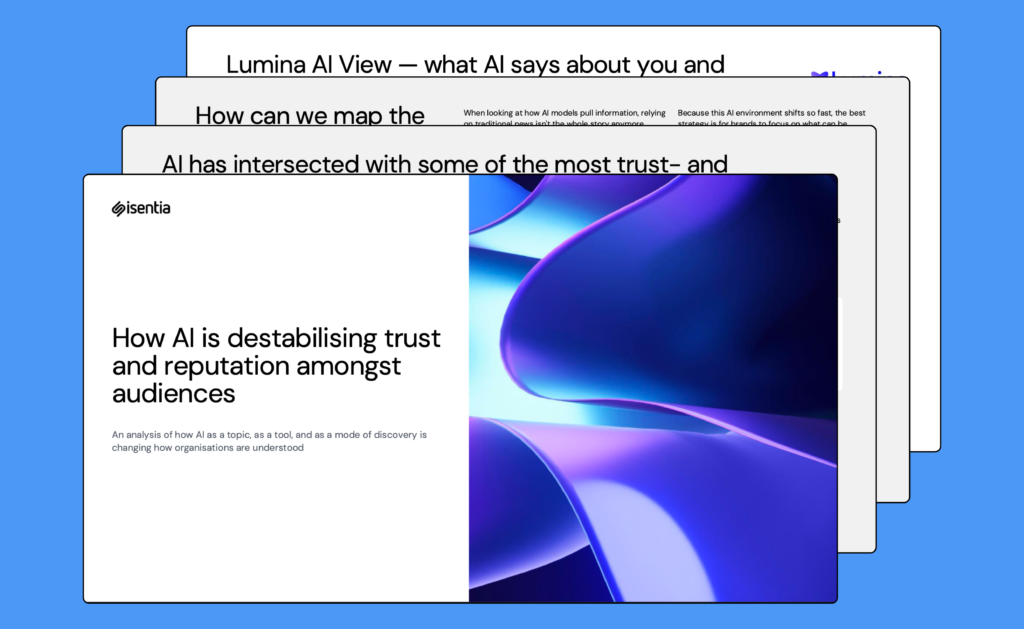
This report unpacks:
To access the full report, fill in the form below:
Discover our Lumina AI suite here.
Get in touch or request a demo.