Winning the Brisbane 2032 narrative: A media analysis
How is media coverage shaping views of Brisbane 2032 and its global impact?
The stories that resonate, whether it is a stadium cost blowout, a community campaign to preserve green space, or the push to include Australian Rules Football in the program, capture how Australians are gearing up for a once-in-a-generation Games. These specific, contested, and human stories shape the narratives across news and social media and ultimately reflect how the country is experiencing and remembering Brisbane 2032.
Leading Topics: News vs. social
The difference is while the news media is overwhelmingly concerned with the logistics of the Games, the public is more interested in its social and economic consequences.
On social media, the conversation is a mix of excitement and concern, with a strong focus on what the Games will feel like. Discussions about social impact and economic outcomes are prominent, as people debate everything from housing affordability to the potential for new community arts programs.
In the news, the narrative is far more narrow. An incredible amount of the coverage is dedicated to infrastructure, with a particular focus on the cost and controversy surrounding the main stadium. The second-largest topic is the political jousting that accompanies these infrastructure debates.
The most discussed stakeholders are institutions and communities, not individuals
While politicians dominate the news, what’s making a real impact on social media are the communities and institutions at the heart of the conversation.
In the news, the most-quoted voices around Brisbane 2032 are overwhelmingly political figures, led by the Queensland Premier and Deputy Premier. Much of the coverage has centred on Premier Crisafulli’s media appearances, including a notable stop at Rockhampton’s Fitzroy River to promote plans for a feasibility study into using the site for rowing events despite concerns about crocodiles and currents.
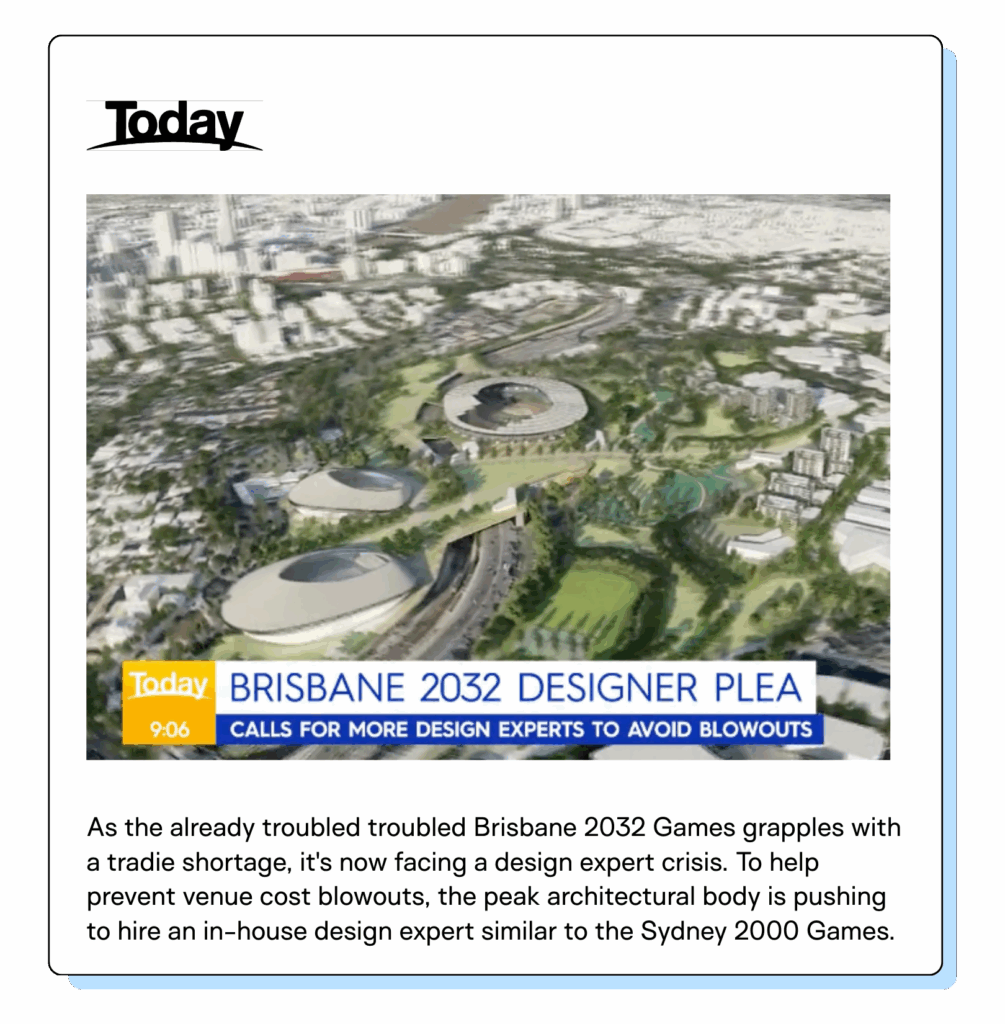
The Deputy Premier, meanwhile, has been most prominent for his push to build a new stadium at Victoria Park. That proposal has fuelled debate over whether Brisbane 2032 is shifting away from being a sporting project to a political land grab. The discussion is further sharpened by Queensland’s reported shortage of tradies, with calls for urgent measures to recruit more skilled workers to meet the surge in construction and infrastructure demand tied to the Games.
Even Donald Trump makes an appearance in the coverage, with Brisbane’s bid to host the Quad Leaders’ Summit drawing headlines and gaining the support of Prime Minister Albanese.
On social media, the conversation is being shaped largely by organisations and grassroots communities. Victoria Park, now at the centre of the stadium debate, has become a focal point for how people see the legacy of Brisbane 2032, and Queensland more broadly. Campaigns to preserve the green space are gaining traction, amplified both by smaller local outlets such as The Westender and by national publications including ABC and The Guardian.
Defining “legacy”: The public hopes and media narratives
The term “legacy” represents the most significant challenge in the Brisbane 2032 narrative, as the data reveals a mismatch between the public’s focus on experience and the media’s framing of cost and conflict.
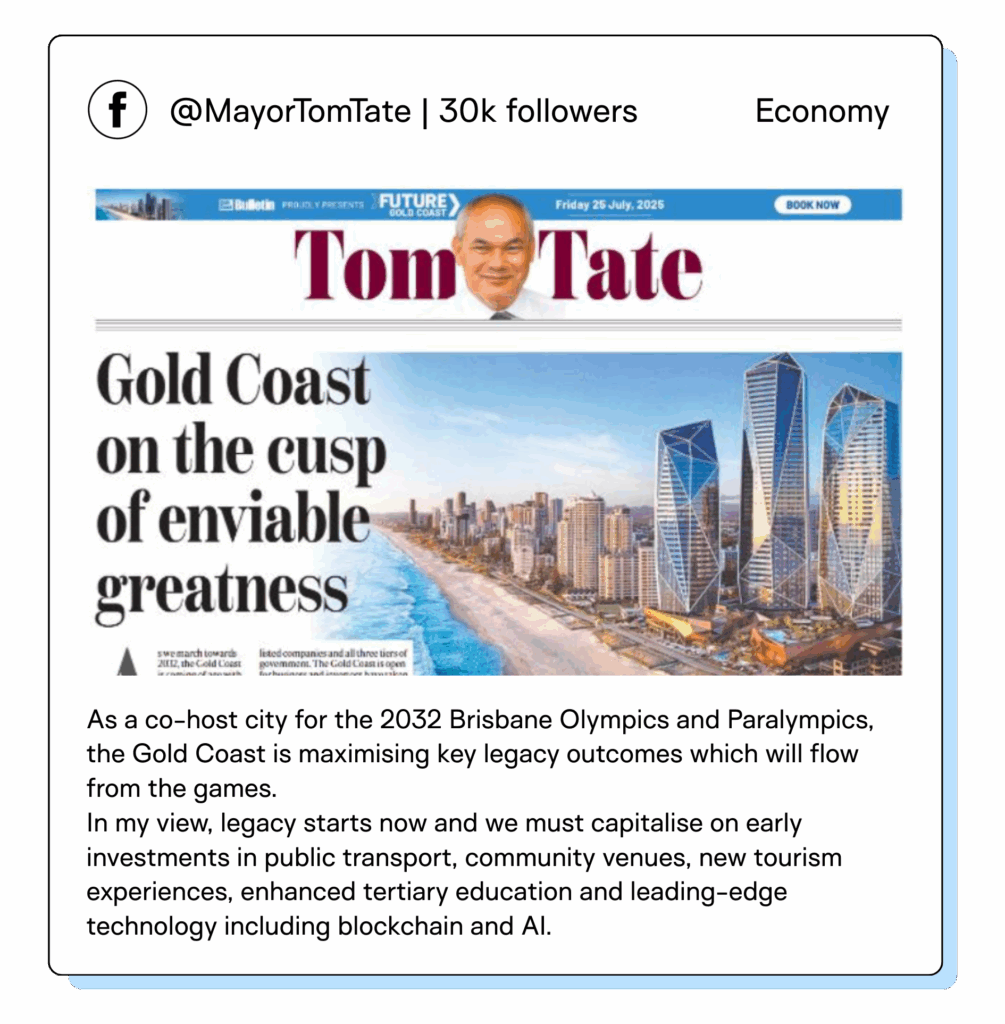
On social media, the legacy conversation is aspirational and driven by the sporting theme, where discussions about preserving green spaces like Victoria Park highlight a desire for tangible, long-term community benefits. Other cities are also seizing the aspirational momentum of events like Brisbane 2032, with figures such as Gold Coast Mayor Tom Tate using social media to highlight for hyper-local audiences the potential returns on investing in this opportunity. News coverage frames legacy as a political and economic undertaking, dominated by the cost of stadiums, the allocation of funding, and the political conflict between the government and its opposition.
Framing the use of the Fitzroy River as an opportunity for sustainability or presenting construction timelines as local job creation makes the connection between political debates and the community and sporting outcomes people truly care about more resonant, while also painting a positive vision for the legacy of Brisbane 2032.
Specificity wins: Vague PR is ignored, detailed stories drive engagement
Generic ‘good news’ posts or Olympic press tend to generate weaker engagement The content that captures public attention is highly specific, and often human-centric or controversial.
On social media, the most engaging content included the debate around HYROX judging standards, the passionate campaign to include Lawn Bowls in the games, and celebrating the specific achievements of individual swimmers.
In the news, it’s not the general updates that resonate, but detailed reports, whether on cost blowouts at specific venues, the impact of turning a local river into an Olympic event site, or the campaign to include Australian Rules Football in the program.
Media moments and narratives gain traction when meaning is applied. Shift content strategies from generalities to detailed storytelling, focus on journeys, the tangible impact of a new community facility, or a transparent explanation of a complex issue for example. The battle for the hearts and minds of the public ahead of Brisbane 2032 will be won in these details.
See how the right analysis can help you anticipate risks, shape messaging and connect with your audiences. Request a free demo.
Loren is an experienced marketing professional who translates data and insights using Isentia solutions into trends and research, bringing clients closer to the benefits of audience intelligence. Loren thrives on introducing the groundbreaking ways in which data and insights can help a brand or organisation, enabling them to exceed their strategic objectives and goals.
Audiences are no longer finding information through traditional search engines that favour established news outlets. AI models now highlight highly relevant and contextual information to audiences to often include niche and regional publications alongside major news media. This change challenges the old media hierarchy around tiered publications and pushes organisations to reconsider how and where they need to show up to stay visible in an AI-first world.
Yes, organisations must focus on optimising their own content for LLMs, but will that always drastically increase the chances of AI models picking up your page? Probably not always. Smart strategy means targeting the specific publications your actual target audience reads — because those are the sources AI models retrieve when answering niche questions.
It’s closer to digital PR than SEO
Generative Engine Optimization (GEO) is changing how brands approach online visibility. For years, traditional SEO meant focusing on your own site—optimising keywords, building backlinks, and improving on-page content. But AI models work differently. Instead of just using your website, these AI engines rely on trusted third-party sources to answer questions. This shift is taking place gradually, of course. LLMs increasingly source from earned media (where it is accessible) and even offsite links from trusted sites. Owned media is still where the organisation has maximum control of how it’s own content travels, but a pivotal strategy shift is needed to match what AI models are picking up and citing.
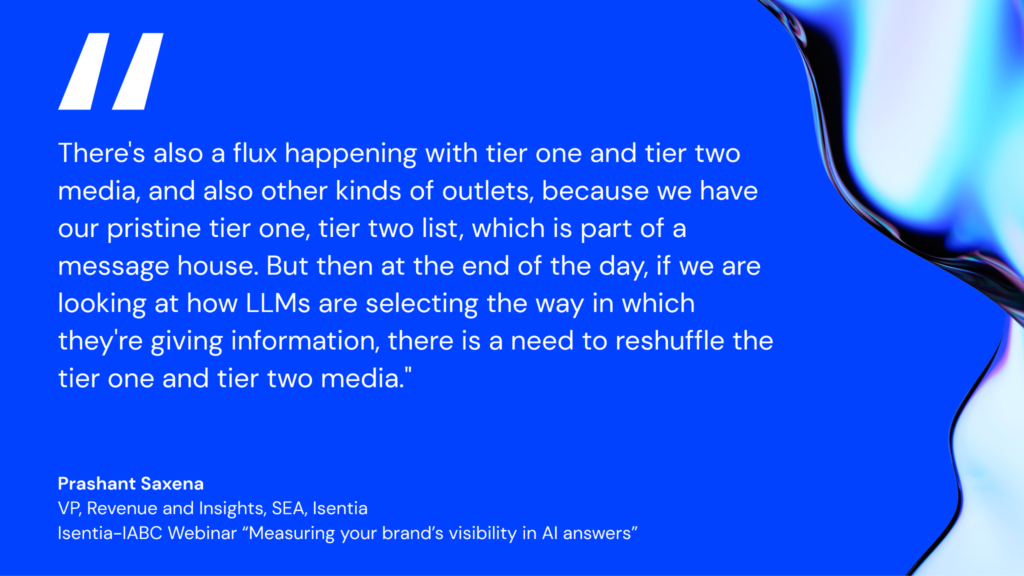
To succeed with AI search, comms professionals need to think more like a digital PR strategist than a SEO expert. The best way to stand out is by earning mentions, quotes, and citations in the external publications your audience—and the AI systems they use—trust most. This does not make a distinction between Tier 1 or Tier 2 media. If AI models are crawling sites that mention an organisation, but the organisation does not acknowledge or even know those sites are being prioritised by LLMs, they risk falling behind in being the right kind of visible.
To make this strategy work, looking beyond common metrics like traffic to the site or domain authority is not enough. Even a respected industry site will probably not influence AI answers as much if its content is behind a paywall or blocked from search engines. For AI visibility, accessibility to the site or page, structured data that can be crawled, and strong audience alignment are important. Since AI systems use both slow training cycles and fast real-time web searches (RAG), being featured on accessible, relevant niche sites helps an organisation show up accurately when models learn and when they search the web in real time.
Why is Tier 2 media punching at Tier 1 weight?
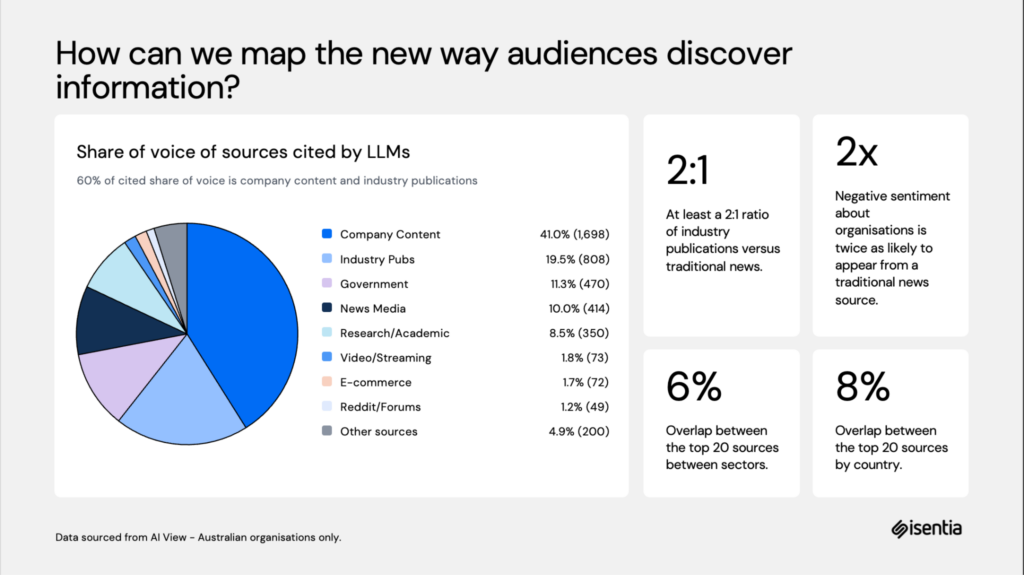
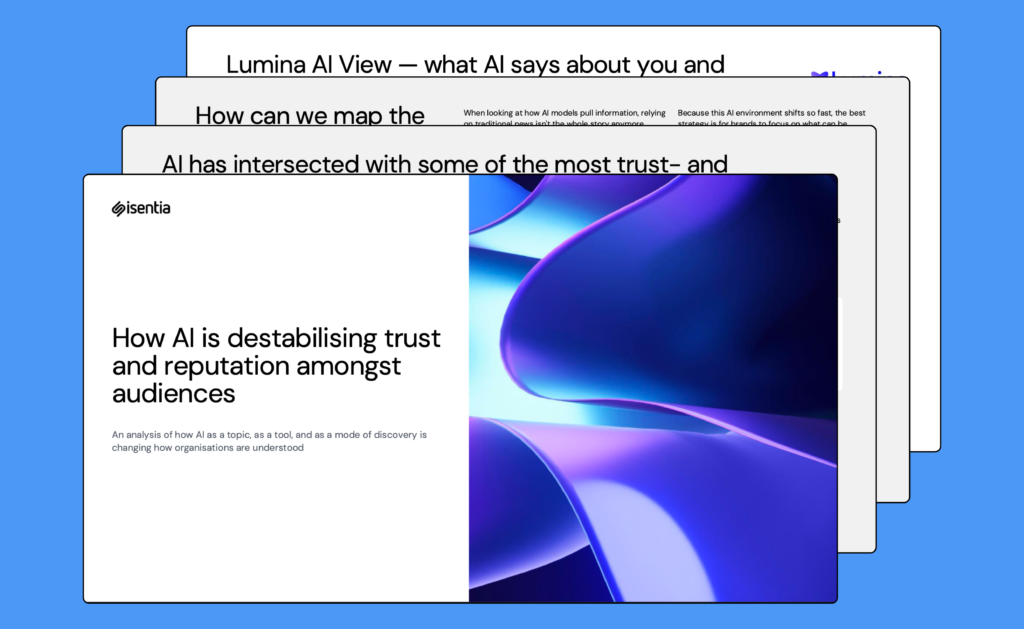
According to Isentia's report How AI is destabilising trust and reputation amongst audiences, LLMs cite industry and trade publications about twice as often as traditional news sources. Company content and industry press make up over 60% of the share of voice LLMs use, while traditional news is twice as likely to generate negative sentiment. Thus, tier 1 outlets no longer automatically dominate AI-generated responses and may sometimes have the opposite effect.
Two main factors are driving this shift in which media is picked up by LLMs:
The paywalled problem was further expanded on by Dr Momoko Fujita during the Digital News Report: Australia webinar that news organisations must figure out how to make paywalled content easily readable by LLMs. By bridging this gap, these organisations can ensure that AI tools deliver accurate, high-quality reporting rather than missing out on premium content. If not, high-quality coverage may never reach the model. Isentia’s Prashant Saxena, VP of Revenue and Insights, SEA, during a recent partner event with IABC APAC on Why AI Visibility is the next reputation frontier illustrated a paywalled Bloomberg story, for example, that was accurately summarised details it could read at the top level, but fabricated details about raised guidance, even though guidance had been cut. This is because it could not read the rest of the article and tried its best to assume what it can with the information that’s accessible.
Specificity outweighs prestige. Tier 2, trade, and specialist publications are often more accessible, focused, and likely to provide the concrete, citable facts models need. Amy Chappell, Vuelio's Head of Insights Strategy, found a similar trend across sectors in her report on the visibility of supermarkets in the UK “ The role of AI, LLMs, and earned media in shaping reputation” and noted that supermarkets were most often cited by trade publications like The Grocer and Grocery Gazette, not national newspapers. Trade press stories, being more focused and well-sourced, provide models with clearer, more citable facts than broader national articles. This doesn’t mean that Tier 1 coverage does not matter — CEOs value front-page exposure because it remains highly influential. However, relying only on tier 1 hits now means missing significant AI visibility opportunities.
Cited vs consulted: LLMs read a hundred sources, but cite only a few
Which type of media gets cited relies upon how AI models scan different pages. If these models are citing much more niche media outlets, we can assume that a lot of these pages that are consulted could be a part of very relevant Tier 2 media that ends up actually getting cited, and that we’re seeing more and more examples of in AI answers. At the IABC APAC and Isentia webinar on measuring brand visibility in AI answers, Prashant Saxena, Isentia's VP of Revenue and Insights for SEA, stated that in the search era "we would get sources on our page one, page two, mostly page one", and people would click through to form their own opinions. The combined click-through rate in that era was 35 to 40 per cent. Nowadays, he says, "it's just four to five per cent" — since LLMs provide a smooth, ready-made answer and "most of us aren't really checking the citations".
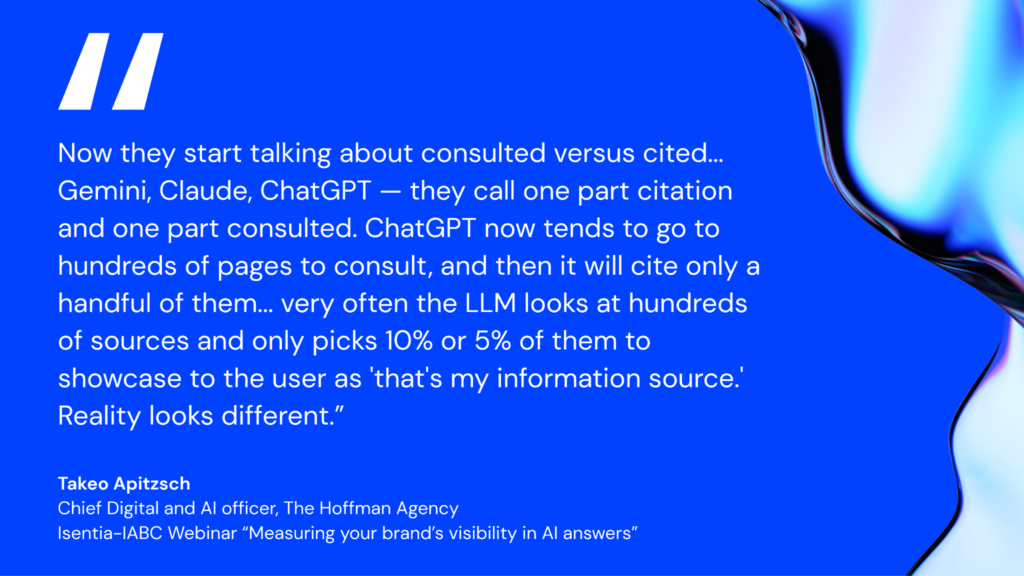
Communications teams now face a new consideration: the distinction between sources that are consulted and those that are cited. At the IABC APAC and Isentia webinar, Takeo Apitzsch, Hoffman Agency’s Chief Digital and AI Officer, explained that AI models scan hundreds of pages to generate an answer but cite only a select few to users. This means that the audience sees only a small, curated portion of the sources that actually influenced the AI's response and a lot of what actually shapes the AI answer doesn’t get visible credit. Therefore, organisations need to make sure they reach out to those publications that AI models can actually crawl and audiences trust the most.
What does this mean for communications professionals?
We are seeing four practical shifts:
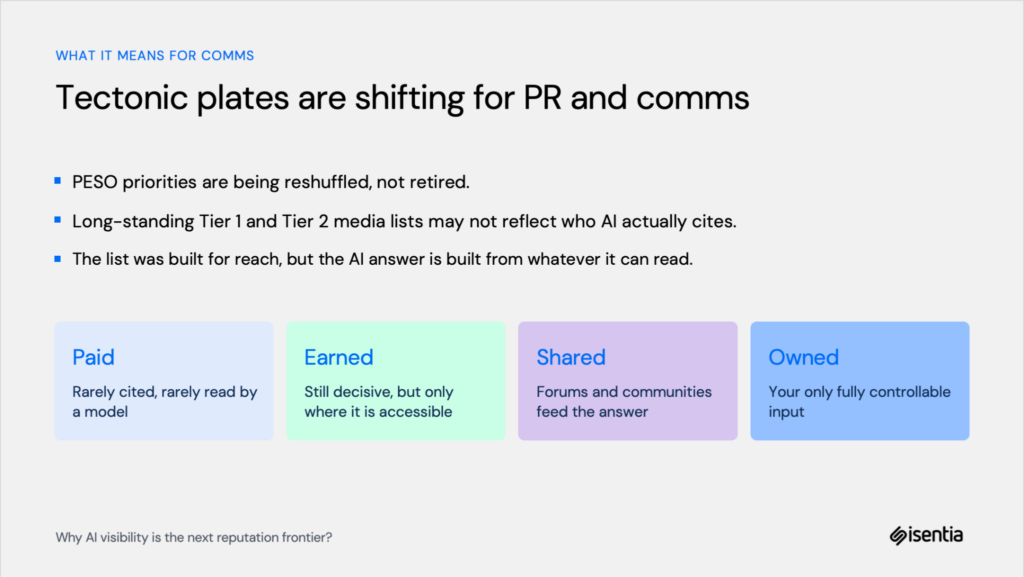
Rebuild your tier list based on what LLMs actually cite, not on internal assumptions. A so-called “low-priority” trade publication or niche forum may contribute more to your AI visibility than a national outlet you have long targeted.
Keep your reshuffled tier list fresh, not just correctly ranked. InWhy is content freshness the new currency for AI visibility? we discuss that a page that hasn't been updated in eighteen months is far more likely to drop out of AI answers altogether, no matter how well it once performed. Getting the right tier 2 outlets on side is only half the job done. Feeding them (and your own owned channels) on an ongoing basis is the other half.
Treat consistency as an essential. The largest gap between an organisation’s claims and what an LLM will confidently state is often due to inconsistencies between owned content and third-party coverage. When this occurs, the model may stop providing factual answers altogether.
Shift your focus from share of voice to share of mind. It is now less about how much you are discussed and more about whether the systems mediating the most have got the correct information about your organisation.If the system holds the wrong version, your audience may never access the right one.
Structurally, as Ashley Knapp, Head of Brand and Corporate Affairs, East Asia at Schneider Electric noted during the webinar, these efforts can no longer remain siloed. Owned, earned, shared, and paid media have traditionally been managed by separate teams. Now, because of AI visibility, this required a unified approach, as models do not distinguish between departments but are first to detect inconsistencies.
This also means reconsidering the PESO (paid, earned, shared and owned) strategy deployed by organisations since the way that LLMs access and prioritise them has changed. They prioritise brevity in content due to the high costs of GPUs and data centres. As a result, the shortest, clearest, and most trusted answers are favoured which benefits brands with strong reputations. Earned media remains important, but its influence now depends more on the credibility of the analyst than the platform. Shared content amplifies messages more than ever but is also where misinformation spreads fastest. Paid media is becoming more prominent in some models, though brands are still learning how this impacts visibility.
Media monitoring companies are becoming strategic AI visibility consultants
This shift requires media monitoring companies to evolve. Tracking mentions and sentiment across media channels has been central to media intelligence, but AI visibility has added a new dimension to this. This means monitoring not only what is said about an organisation, but also which sources AI models use when answering questions about that organisation, and assessing how current, authoritative, and consistent those sources are. This gives media monitoring organisations an opportunity to own what they’ve developed and also be thought leaders in this space. Stakeholders value the “so what” advice much more than just knowing “this is what is being said about you in the media”.
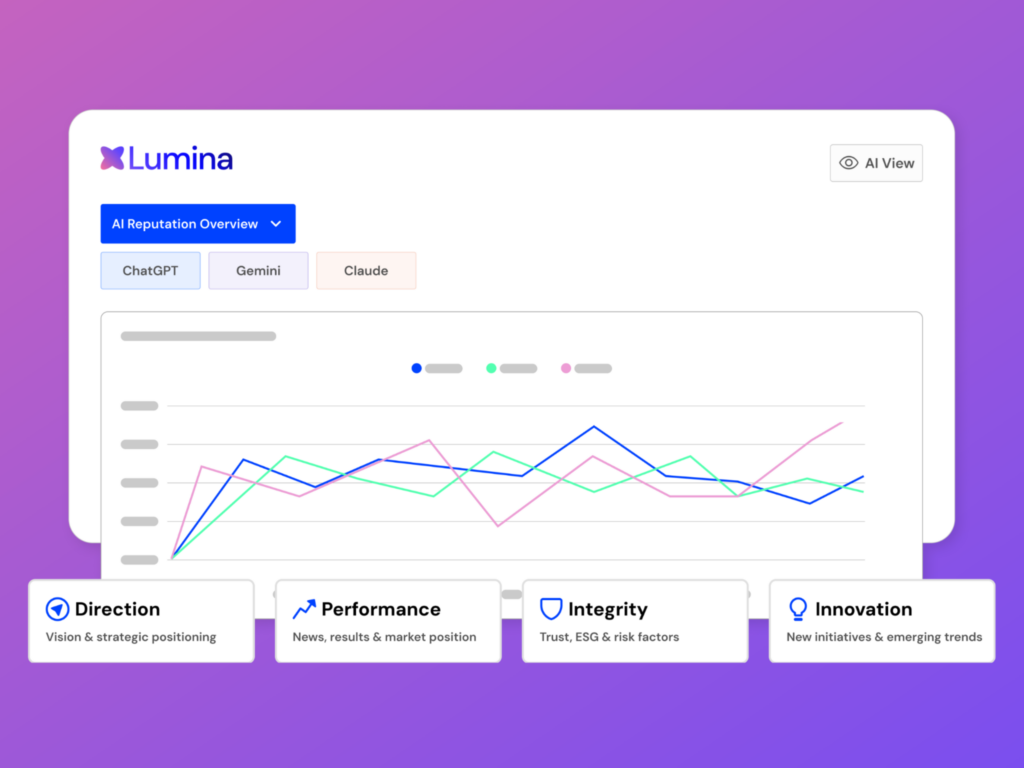
Lumina AI View addresses this by tracking which sources ChatGPT, Gemini, Claude, and other models cite when representing an organisation, benchmarks citations against competitors, identifies narrative shifts before they reach stakeholders, and regularly scores AI visibility against four reputation pillars: Direction, Performance, Integrity, and Innovation, These pillars have always supported reputation management, now applied to a largely unseen audience.
If you're weighing up where a tool like this sits alongside the rest of your stack, our own comparison,Best AI Tools for PR & Comms Teams (2026), breaks down how AI-assisted coverage, measurement, crisis response and reporting tools stack up, Lumina included.
Because that’s really the mindset shift comms teams, and the firms advising them both need to make. As Takeo put it on the IABC APAC and Isentia webinar: “I fear that this is the mindset shift communications teams and their advisors must adopt. I fear that AIs will be your secondary, and if not, at least equal… audience in the future.” Beyond human visibility, reputation is about being accurately represented by the systems that mediate access to your audience, which is an additional layer that cannot be trivialised anymore.
"
["post_title"]=>
string(97) "How relevant is Tier 1 and Tier 2 media hierarchy in impacting how organisations show up in LLMs?"
["post_excerpt"]=>
string(243) "The hierarchy that exists between Tier 1 & 2 publications today is being challenged. AI models are the new way audiences discover information requiring organisations to rethink how they show up to remain visible in an AI-mediated environment. "
["post_status"]=>
string(7) "publish"
["comment_status"]=>
string(4) "open"
["ping_status"]=>
string(4) "open"
["post_password"]=>
string(0) ""
["post_name"]=>
string(96) "how-relevant-is-tier-1-and-tier-2-media-hierarchy-in-impacting-how-organisations-show-up-in-llms"
["to_ping"]=>
string(0) ""
["pinged"]=>
string(0) ""
["post_modified"]=>
string(19) "2026-09-09 02:24:17"
["post_modified_gmt"]=>
string(19) "2026-09-09 02:24:17"
["post_content_filtered"]=>
string(0) ""
["post_parent"]=>
int(0)
["guid"]=>
string(32) "https://www.isentia.com/?p=49871"
["menu_order"]=>
int(0)
["post_type"]=>
string(4) "post"
["post_mime_type"]=>
string(0) ""
["comment_count"]=>
string(1) "0"
["filter"]=>
string(3) "raw"
}
Blog
How relevant is Tier 1 and Tier 2 media hierarchy in impacting how organisations show up in LLMs?
The hierarchy that exists between Tier 1 & 2 publications today is being challenged. AI models are the new way audiences discover information requiring organisations to rethink how they show up to remain visible in an AI-mediated environment.
Would you trust a brand more if an AI model recommended it? For many, the answer is yes – and it’s changing the very nature of PR & Comms.
Our latest report digs into the changing nature of trust, as audiences turn to AI models for quick answers instead of going to organisations or media outlets directly, with AI fast becoming the final stop in the comms cycle.
This report unpacks:
Why trust has shifted, and where audiences are having these conversations
Why AI has become the last stop in the comms cycle
Methods for staying on top of your brand trust and reputation
To access the full report, fill in the form below: