Australia’s social media ban played out in the headlines
Australia’s upcoming social media ban for minors hasn’t been primarily driven organic debate. Instead, it’s unfolded through a deliberate, tightly paced sequence of government-led communications, each phase designed to build momentum, secure legitimacy, and keep control of the public narrative.
What we’re seeing in the media data isn’t a spontaneous rise in interest, but a pattern of spikes that line up neatly with major government moments. Each one serves a purpose in a broader narrative strategy, and each reveals something about where the public conversation is heading next.
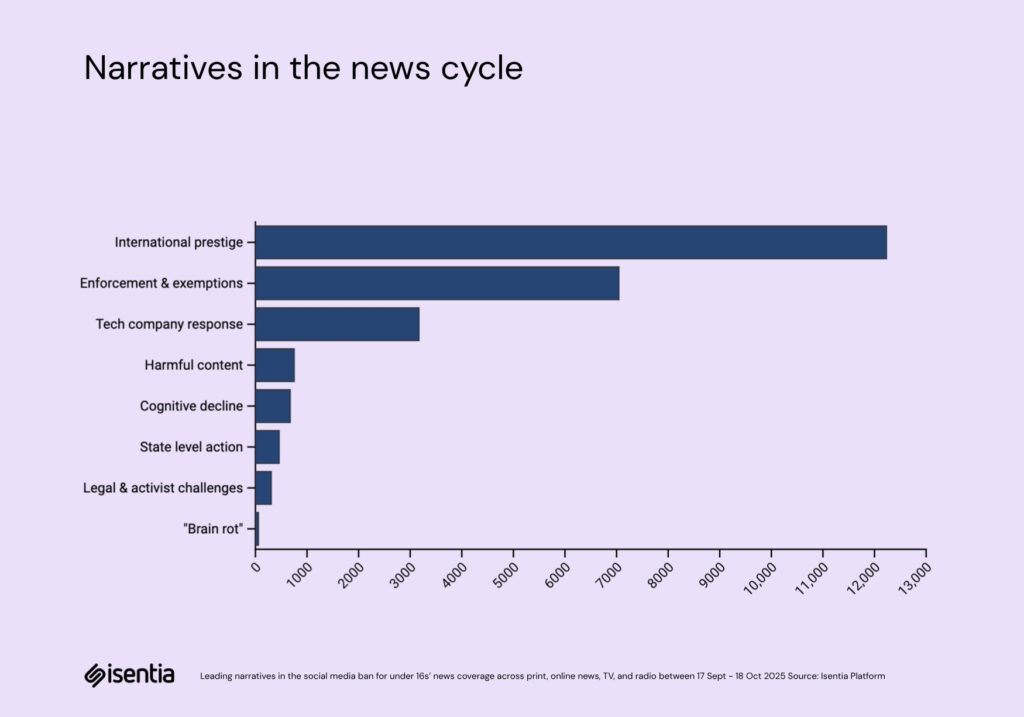
The rollout of Australia’s social media ban has followed something of a three-act script. It really began on the world stage, with Prime Minister Albanese’s UN address framing the policy as a “world-first” and earning global praise that positioned Australia as a leader rather than a legislator under pressure, a narrative heavily amplified across bulletins nationwide. Momentum built when Denmark echoed the proposal, turning the story from an Australian policy into a global movement and giving journalists a reason to return to it without new domestic detail. Subsequently, the focus shifted home, with the launch of the government’s ad campaign. Coverage has moved from delivery to confirmation, from diplomacy to daily life, embedding the message of child safety through stories designed to connect emotionally with parents before the ban takes effect.
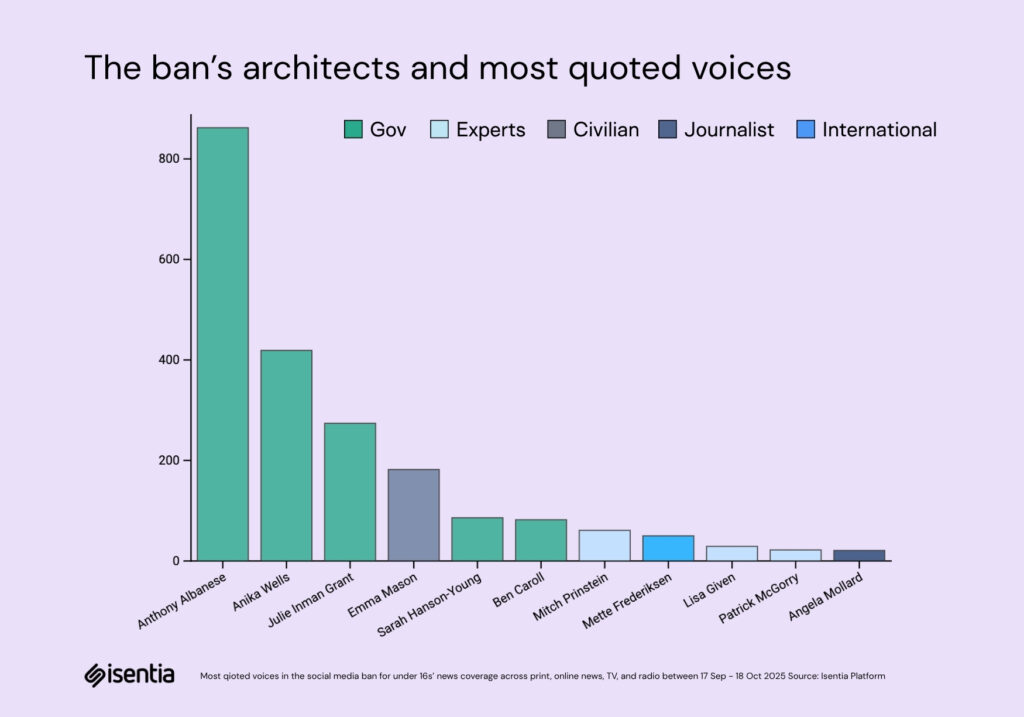
Media coverage of the social media ban is being driven by a hierarchy of voices. At the top are the political architects, Anthony Albanese and Anika Wells, who account for 68% of all quoted commentary. Their dominance reflects a message tightly controlled from the centre, with each public appearance designed to reinforce authority and focus the debate. eSafety Commissioner Julie Inman Grant follows as the enforcer, providing regulatory credibility and keeping the story alive through ongoing updates and meetings with tech companies.Around them, Emma Mason’s personal story gives the policy its emotional weight, while expert voices like Dr Jason Nagata and Mitch Prinstein lend scientific legitimacy. Counter-voices such as Patrick McGorry are present but faint, just 1% of total commentary. Together, these strands create a coordinated ecosystem where political leadership, regulation, expertise, and emotion work in unison to sustain a single, dominant narrative.
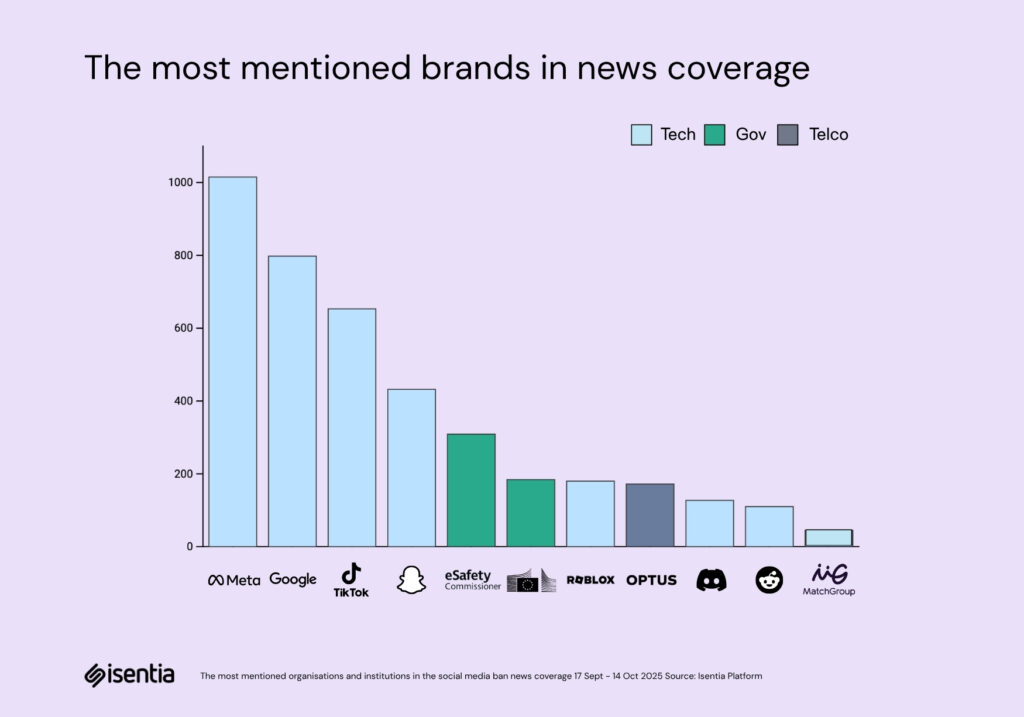
The next layer of coverage reveals how the story’s momentum is being sustained, not just by government messaging, but by the constellation of organisations caught in its orbit. Meta, Google, TikTok, and Snapchat remain the gravitational centre of the conversation, collectively shaping more than a thousand mentions each. They are the policy’s focal point and the media’s shorthand for what’s at stake.
Stories about ministerial meetings, enforcement challenges, and pleas for exemptions ensure these brands stay in the headlines, but on government terms, framed as subjects of regulation rather than equal participants in debate. This has also surfaced one of the key underlying questions: Will the ban actually work? There is a significant narrative thread focused on the practical challenges of enforcement, with YouTube widely quoted in the media as saying the ban is “‘extremely difficult’ to enforce”.
With the media also reporting that the government will rely on “artificial intelligence (AI) and behavioural data to reliably infer age” rather than hard age verification, the public is left asking: If tech giants say it’s unenforceable and teens are already finding ways around it, what will this law actually achieve?
The eSafety Commission anchors the enforcement narrative, while the European Commission’s support sustains the “world-first” framing abroad. As the scope of the ban widens, platforms like Roblox, Discord and Reddit have been pulled into focus, signalling how the policy, and its coverage, keeps expanding. This has forced the core question into the open: What is a “social media platform” in 2025?
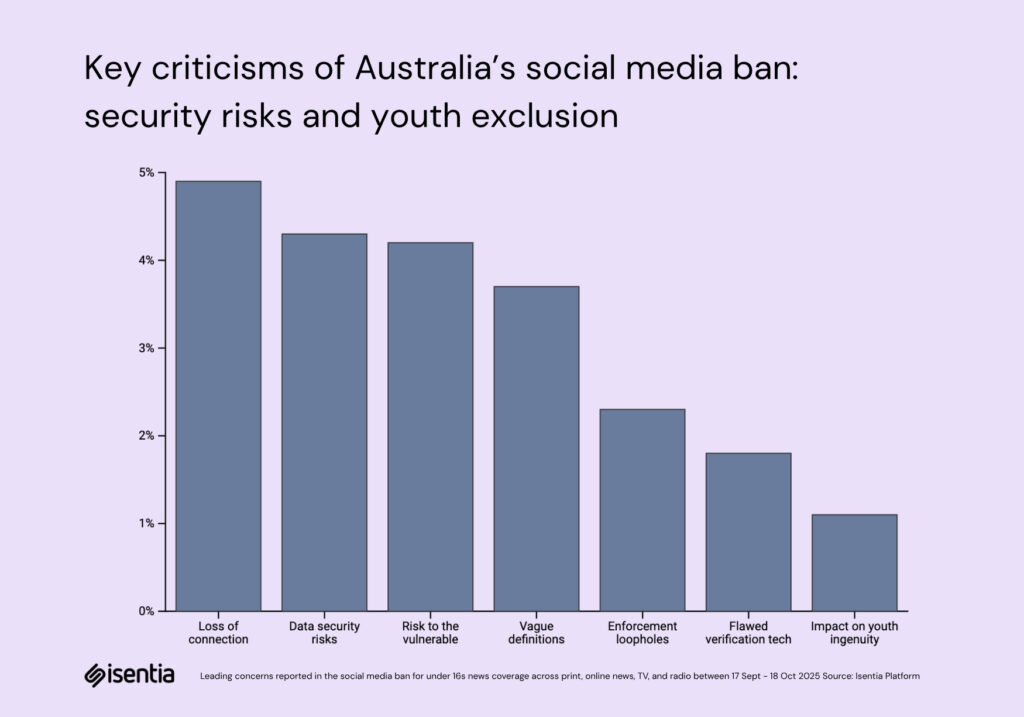
Although the government’s narrative still dominates, a set of counter-stories is emerging, focusing on the policy’s real-world consequences. Central to these stories are concerns about young people losing access to vital online connections, particularly among regional or marginalised communities. Advocates for the LGBTIQA+ community and youth mental health experts like Professor Pat McGorry argue that the ban could isolate teenagers who rely on online spaces for support, and entrepreneurial opportunities. Other reporting has questioned the reliability of AI-based age verification, the volume of data collected, and the risk that well-intended rules might backfire, creating unintended consequences that contradict the policy’s goal of child safety. These counter-narratives remain smaller in scale than the dominant political messaging, but they cut through because they frame the debate around everyday impacts rather than top-down authority.
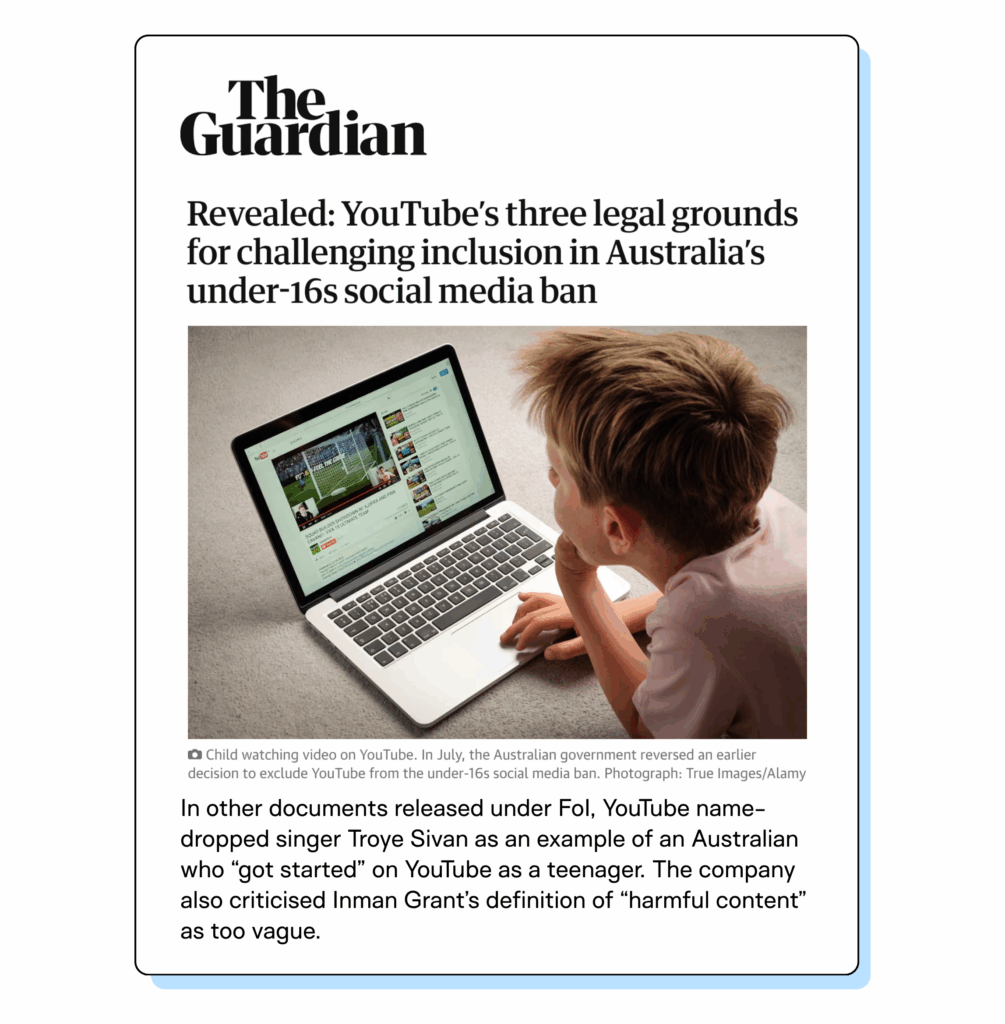
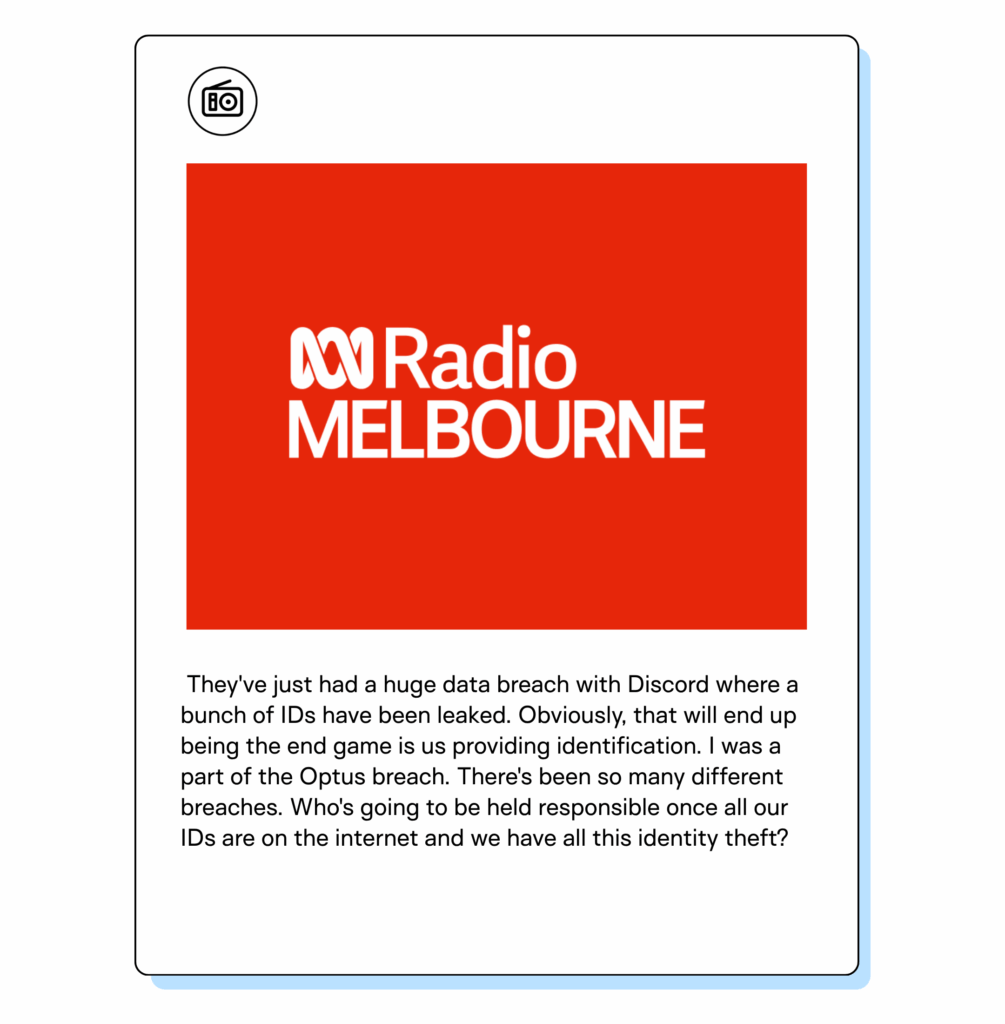
A particularly visible strand of coverage centres on the unclear definition of “social media” in the legislation. While the public typically thinks of platforms like Instagram and TikTok, the law’s wording has forced a broader debate that draws in platforms such as Roblox, Discord, and Steam. The eSafety Commissioner’s proactive enforcement measures have highlighted these regulatory ambiguities, prompting media to question whether platforms with different primary purposes should be included and whether the policy might trade one harm for another. Discord drew attention following a poorly timed data breach, which the public and media linked to potential ID theft risks. These reports show how regulators and secondary players can keep the conversation alive, highlighting risks, opening new angles, and forming alliances that complicate the policy debate. A notable example is YouTube’s effort to argue it should not be classified as a social media platform, citing the platform’s role in launching careers like Australian artist Troye Sivan as part of a broader cultural and creative ecosystem.
Together, these stories illustrate that while the government controls the main narrative, emerging counter-voices are beginning to shape the media conversation in ways that emphasise practical and social realities.
Loren is an experienced marketing professional who translates data and insights using Isentia solutions into trends and research, bringing clients closer to the benefits of audience intelligence. Loren thrives on introducing the groundbreaking ways in which data and insights can help a brand or organisation, enabling them to exceed their strategic objectives and goals.
Audiences are no longer finding information through traditional search engines that favour established news outlets. AI models now highlight highly relevant and contextual information to audiences to often include niche and regional publications alongside major news media. This change challenges the old media hierarchy around tiered publications and pushes organisations to reconsider how and where they need to show up to stay visible in an AI-first world.
Yes, organisations must focus on optimising their own content for LLMs, but will that always drastically increase the chances of AI models picking up your page? Probably not always. Smart strategy means targeting the specific publications your actual target audience reads — because those are the sources AI models retrieve when answering niche questions.
It’s closer to digital PR than SEO
Generative Engine Optimization (GEO) is changing how brands approach online visibility. For years, traditional SEO meant focusing on your own site—optimising keywords, building backlinks, and improving on-page content. But AI models work differently. Instead of just using your website, these AI engines rely on trusted third-party sources to answer questions. This shift is taking place gradually, of course. LLMs increasingly source from earned media (where it is accessible) and even offsite links from trusted sites. Owned media is still where the organisation has maximum control of how it’s own content travels, but a pivotal strategy shift is needed to match what AI models are picking up and citing.
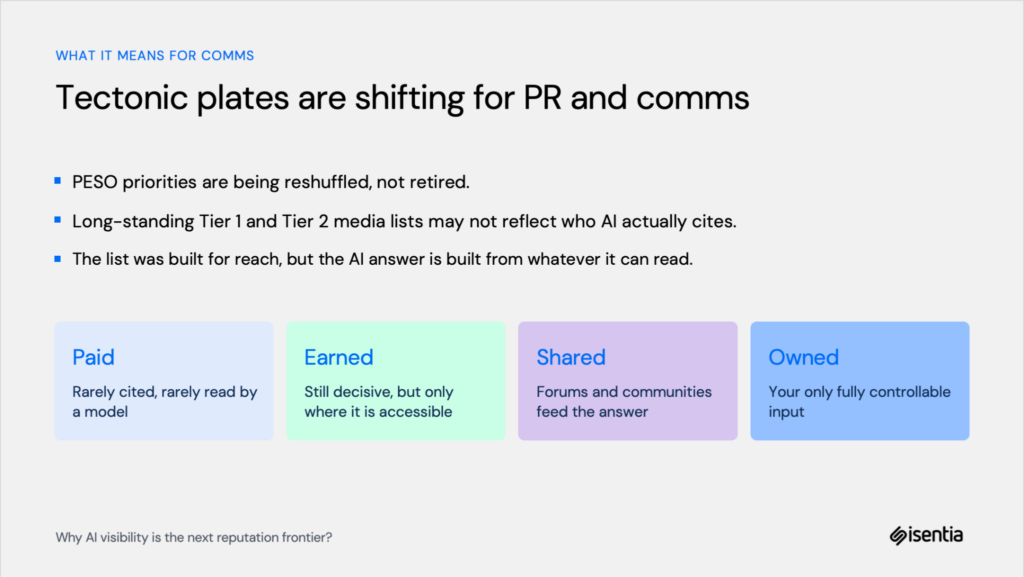
To succeed with AI search, comms professionals need to think more like a digital PR strategist than a SEO expert. The best way to stand out is by earning mentions, quotes, and citations in the external publications your audience—and the AI systems they use—trust most. This does not make a distinction between Tier 1 or Tier 2 media. If AI models are crawling sites that mention an organisation, but the organisation does not acknowledge or even know those sites are being prioritised by LLMs, they risk falling behind in being the right kind of visible.
To make this strategy work, looking beyond common metrics like traffic to the site or domain authority is not enough. Even a respected industry site will probably not influence AI answers as much if its content is behind a paywall or blocked from search engines. For AI visibility, accessibility to the site or page, structured data that can be crawled, and strong audience alignment are important. Since AI systems use both slow training cycles and fast real-time web searches (RAG), being featured on accessible, relevant niche sites helps an organisation show up accurately when models learn and when they search the web in real time.
Why is Tier 2 media punching at Tier 1 weight?
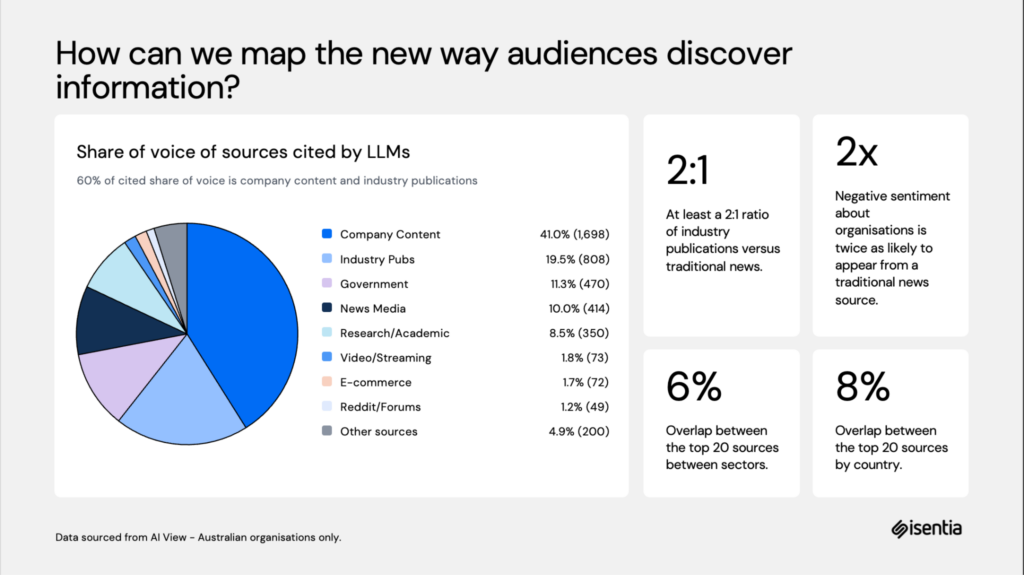
According to Isentia's report How AI is destabilising trust and reputation amongst audiences, LLMs cite industry and trade publications about twice as often as traditional news sources. Company content and industry press make up over 60% of the share of voice LLMs use, while traditional news is twice as likely to generate negative sentiment. Thus, tier 1 outlets no longer automatically dominate AI-generated responses and may sometimes have the opposite effect.
Two main factors are driving this shift in which media is picked up by LLMs:
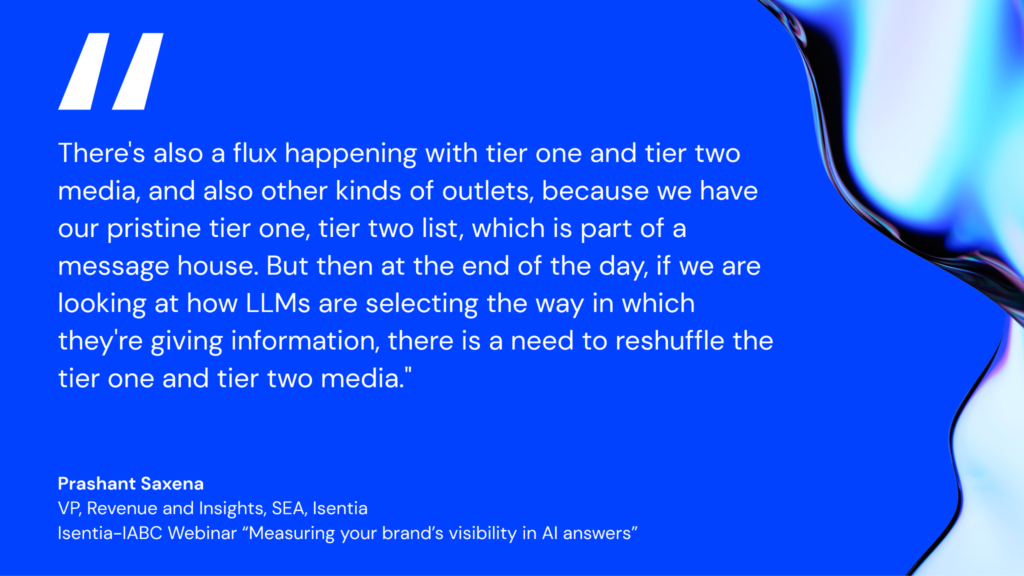
The paywalled problem was further expanded on by Dr Momoko Fujita during the Digital News Report: Australia webinar that news organisations must figure out how to make paywalled content easily readable by LLMs. By bridging this gap, these organisations can ensure that AI tools deliver accurate, high-quality reporting rather than missing out on premium content. If not, high-quality coverage may never reach the model. Isentia’s Prashant Saxena, VP of Revenue and Insights, SEA, during a recent partner event with IABC APAC on Why AI Visibility is the next reputation frontier illustrated a paywalled Bloomberg story, for example, that was accurately summarised details it could read at the top level, but fabricated details about raised guidance, even though guidance had been cut. This is because it could not read the rest of the article and tried its best to assume what it can with the information that’s accessible.
Specificity outweighs prestige. Tier 2, trade, and specialist publications are often more accessible, focused, and likely to provide the concrete, citable facts models need. Amy Chappell, Vuelio's Head of Insights Strategy, found a similar trend across sectors in her report on the visibility of supermarkets in the UK “ The role of AI, LLMs, and earned media in shaping reputation” and noted that supermarkets were most often cited by trade publications like The Grocer and Grocery Gazette, not national newspapers. Trade press stories, being more focused and well-sourced, provide models with clearer, more citable facts than broader national articles. This doesn’t mean that Tier 1 coverage does not matter — CEOs value front-page exposure because it remains highly influential. However, relying only on tier 1 hits now means missing significant AI visibility opportunities.
Cited vs consulted: LLMs read a hundred sources, but cite only a few
Which type of media gets cited relies upon how AI models scan different pages. If these models are citing much more niche media outlets, we can assume that a lot of these pages that are consulted could be a part of very relevant Tier 2 media that ends up actually getting cited, and that we’re seeing more and more examples of in AI answers. At the IABC APAC and Isentia webinar on measuring brand visibility in AI answers, Prashant Saxena, Isentia's VP of Revenue and Insights for SEA, stated that in the search era "we would get sources on our page one, page two, mostly page one", and people would click through to form their own opinions. The combined click-through rate in that era was 35 to 40 per cent. Nowadays, he says, "it's just four to five per cent" — since LLMs provide a smooth, ready-made answer and "most of us aren't really checking the citations".
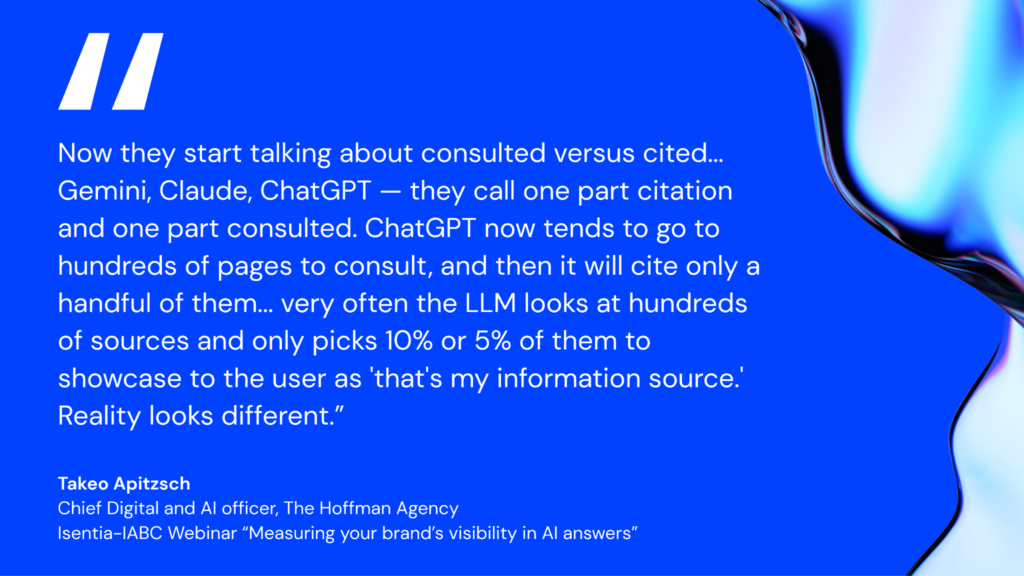
Communications teams now face a new consideration: the distinction between sources that are consulted and those that are cited. At the IABC APAC and Isentia webinar, Takeo Apitzsch, Hoffman Agency’s Chief Digital and AI Officer, explained that AI models scan hundreds of pages to generate an answer but cite only a select few to users. This means that the audience sees only a small, curated portion of the sources that actually influenced the AI's response and a lot of what actually shapes the AI answer doesn’t get visible credit. Therefore, organisations need to make sure they reach out to those publications that AI models can actually crawl and audiences trust the most.
What does this mean for communications professionals?
We are seeing four practical shifts:
Rebuild your tier list based on what LLMs actually cite, not on internal assumptions. A so-called “low-priority” trade publication or niche forum may contribute more to your AI visibility than a national outlet you have long targeted.
Keep your reshuffled tier list fresh, not just correctly ranked. InWhy is content freshness the new currency for AI visibility? we discuss that a page that hasn't been updated in eighteen months is far more likely to drop out of AI answers altogether, no matter how well it once performed. Getting the right tier 2 outlets on side is only half the job done. Feeding them (and your own owned channels) on an ongoing basis is the other half.
Treat consistency as an essential. The largest gap between an organisation’s claims and what an LLM will confidently state is often due to inconsistencies between owned content and third-party coverage. When this occurs, the model may stop providing factual answers altogether.
Shift your focus from share of voice to share of mind. It is now less about how much you are discussed and more about whether the systems mediating the most have got the correct information about your organisation.If the system holds the wrong version, your audience may never access the right one.
Structurally, as Ashley Knapp, Head of Brand and Corporate Affairs, East Asia at Schneider Electric noted during the webinar, these efforts can no longer remain siloed. Owned, earned, shared, and paid media have traditionally been managed by separate teams. Now, because of AI visibility, this required a unified approach, as models do not distinguish between departments but are first to detect inconsistencies.
This also means reconsidering the PESO (paid, earned, shared and owned) strategy deployed by organisations since the way that LLMs access and prioritise them has changed. They prioritise brevity in content due to the high costs of GPUs and data centres. As a result, the shortest, clearest, and most trusted answers are favoured which benefits brands with strong reputations. Earned media remains important, but its influence now depends more on the credibility of the analyst than the platform. Shared content amplifies messages more than ever but is also where misinformation spreads fastest. Paid media is becoming more prominent in some models, though brands are still learning how this impacts visibility.
Media monitoring companies are becoming strategic AI visibility consultants
This shift requires media monitoring companies to evolve. Tracking mentions and sentiment across media channels has been central to media intelligence, but AI visibility has added a new dimension to this. This means monitoring not only what is said about an organisation, but also which sources AI models use when answering questions about that organisation, and assessing how current, authoritative, and consistent those sources are. This gives media monitoring organisations an opportunity to own what they’ve developed and also be thought leaders in this space. Stakeholders value the “so what” advice much more than just knowing “this is what is being said about you in the media”.
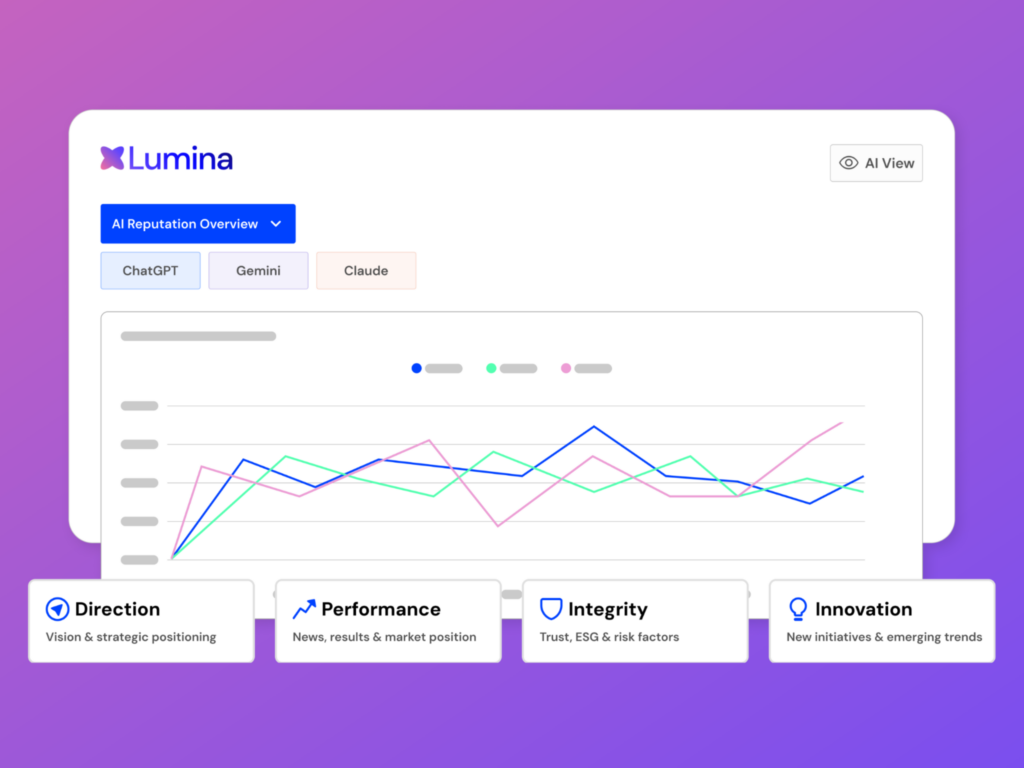
Lumina AI View addresses this by tracking which sources ChatGPT, Gemini, Claude, and other models cite when representing an organisation, benchmarks citations against competitors, identifies narrative shifts before they reach stakeholders, and regularly scores AI visibility against four reputation pillars: Direction, Performance, Integrity, and Innovation, These pillars have always supported reputation management, now applied to a largely unseen audience.
If you're weighing up where a tool like this sits alongside the rest of your stack, our own comparison,Best AI Tools for PR & Comms Teams (2026), breaks down how AI-assisted coverage, measurement, crisis response and reporting tools stack up, Lumina included.
Because that’s really the mindset shift comms teams, and the firms advising them both need to make. As Takeo put it on the IABC APAC and Isentia webinar: “I fear that this is the mindset shift communications teams and their advisors must adopt. I fear that AIs will be your secondary, and if not, at least equal… audience in the future.” Beyond human visibility, reputation is about being accurately represented by the systems that mediate access to your audience, which is an additional layer that cannot be trivialised anymore.
"
["post_title"]=>
string(97) "How relevant is Tier 1 and Tier 2 media hierarchy in impacting how organisations show up in LLMs?"
["post_excerpt"]=>
string(243) "The hierarchy that exists between Tier 1 & 2 publications today is being challenged. AI models are the new way audiences discover information requiring organisations to rethink how they show up to remain visible in an AI-mediated environment. "
["post_status"]=>
string(7) "publish"
["comment_status"]=>
string(4) "open"
["ping_status"]=>
string(4) "open"
["post_password"]=>
string(0) ""
["post_name"]=>
string(96) "how-relevant-is-tier-1-and-tier-2-media-hierarchy-in-impacting-how-organisations-show-up-in-llms"
["to_ping"]=>
string(0) ""
["pinged"]=>
string(0) ""
["post_modified"]=>
string(19) "2026-09-09 02:24:17"
["post_modified_gmt"]=>
string(19) "2026-09-09 02:24:17"
["post_content_filtered"]=>
string(0) ""
["post_parent"]=>
int(0)
["guid"]=>
string(32) "https://www.isentia.com/?p=49871"
["menu_order"]=>
int(0)
["post_type"]=>
string(4) "post"
["post_mime_type"]=>
string(0) ""
["comment_count"]=>
string(1) "0"
["filter"]=>
string(3) "raw"
}
Blog
How relevant is Tier 1 and Tier 2 media hierarchy in impacting how organisations show up in LLMs?
The hierarchy that exists between Tier 1 & 2 publications today is being challenged. AI models are the new way audiences discover information requiring organisations to rethink how they show up to remain visible in an AI-mediated environment.
Would you trust a brand more if an AI model recommended it? For many, the answer is yes – and it’s changing the very nature of PR & Comms.
Our latest report digs into the changing nature of trust, as audiences turn to AI models for quick answers instead of going to organisations or media outlets directly, with AI fast becoming the final stop in the comms cycle.
This report unpacks:
Why trust has shifted, and where audiences are having these conversations
Why AI has become the last stop in the comms cycle
Methods for staying on top of your brand trust and reputation
To access the full report, fill in the form below: