Cautious, considered, or coasting? Decoding the Albanese government’s second term
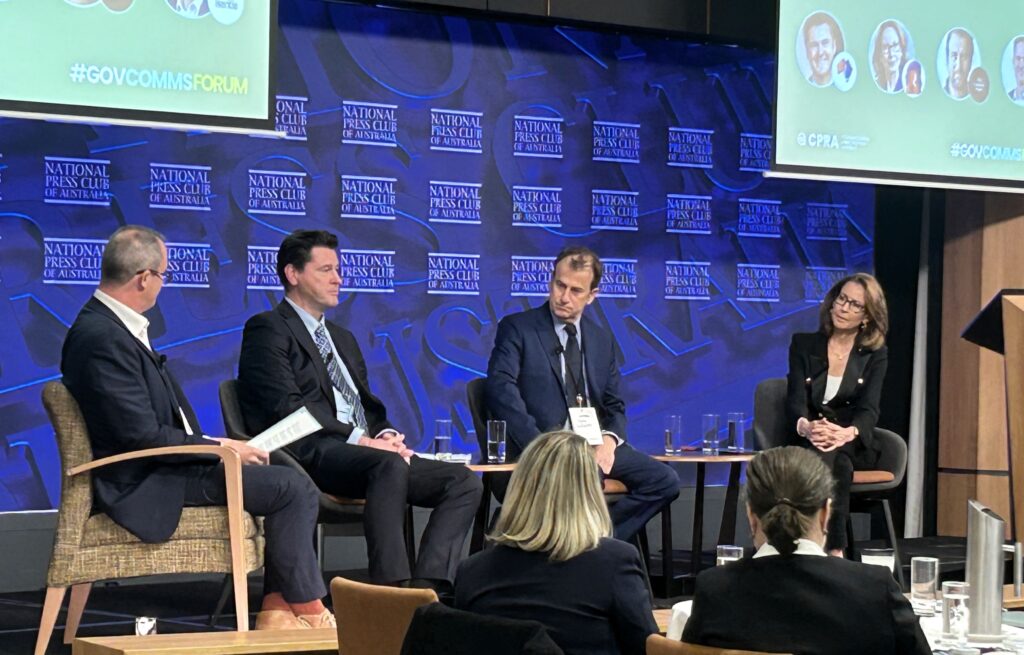
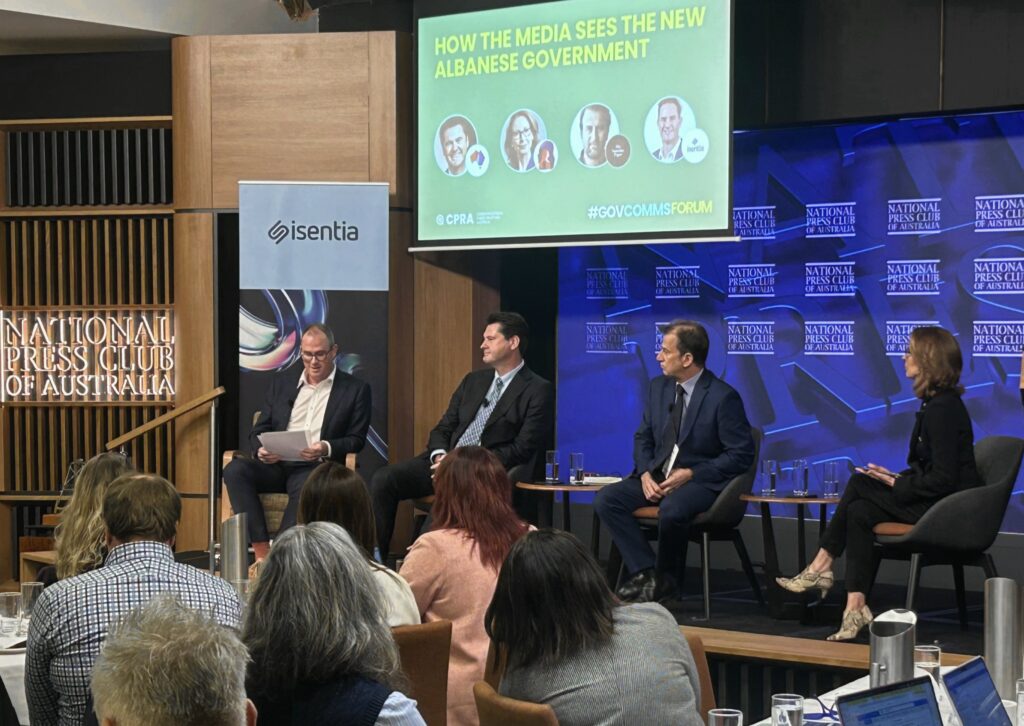
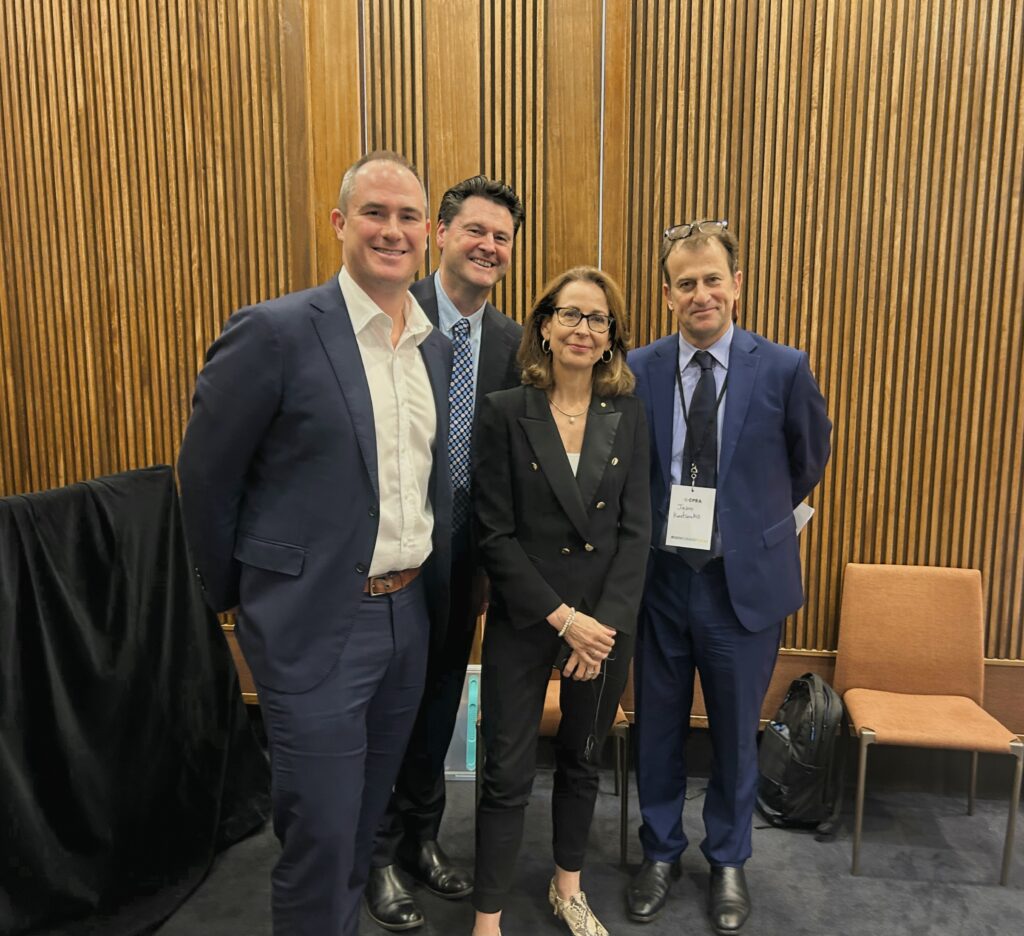
What’s the Albanese government’s real game plan for its second term, and how will it play out in the media? Isentia recently brought together three of Australia’s top political journalists to pull back the curtain: Peter Gearin, Editor in Chief atThe Mandarin, Jason Koutsoukis from The Saturday Paper, and acclaimed broadcaster Virginia Haussegger AM, for a panel with our partners CPRA at the Government Communications Forum, held at the National Press Club
For communications pros, the conversation was packed with clues about what to expect next from Canberra.
A smart strategy or a wasted opportunity?
The panel honed in on the government’s positioning since its “monumental election victory” an “oddly quiet return to political normality.” It’s a question every political operator is asking: is this a calculated, smart and stable approach, or is the government squandering a chance to be “bold and progressive”?
Peter Gearin suggested the caution is deliberate and here to stay. His take? The government learned a huge lesson from the Voice referendum, when Labor bit off too much, meaning the Government now wants to occupy the political centre and won’t risk getting caught out like that again. Expect the cautious approach and the first-term playbook to continue.
What sits behind this posture is a desire to move beyond being a party in power to being seen as the party of government. While critics argue this looks like stagnation, supporters see a measured style that prioritises trust over spectacle.
What’s on the agenda? Policy and Parliament
So, what are the key issues the government needs to nail this term? The panel highlighted several areas to watch closely:
Economic messaging: The recent Economic Roundtable was seen as the government’s attempt to carefully make the case or test the waters for change. How this translates into actual policy will be a major test.
The public sector: The Mandarin’s editor pointed to the ongoing agenda for Australia’s public servants and the government’s plans for improving the sector. Katy Gallagher is driving a vision of “evolution, not revolution” with a focus on strengthening in-house capability and reducing reliance on consultants.
Parliamentary chess: With the new makeup of parliament, will the government keep trying to find consensus with the opposition, or will it work with the Greens to drive a more progressive agenda? This strategic choice will define the term. The Greens are repositioning to be more pragmatic at the federal level, while the Coalition remains fragmented. A weak opposition could make the government’s path smoother, but it also risks reducing contestability and scrutiny in the system.
Leadership and cabinet confidence
Much of the government’s steadiness comes from its internal team. Albanese is viewed as a strategic operator with deep Labor roots, and his confidence is backed by a cohesive cabinet. Ministers like Jim Chalmers and Katy Gallagher have emerged as key players, bolstering the sense of stability. This team-based strength underpins the government’s cautious but deliberate style.
Balancing foreign policy and national interest
While domestic policy dominates headlines, the government is also asserting national interest abroad. Stability in foreign policy has been part of its strategy to project maturity and avoid overreach. This layer of pragmatism adds to the perception of a government intent on consolidating itself as a long-term, steady hand.
From broadcasting to narrowcasting
For communicators, the real gold was the discussion on how to get a message across in today’s complex and vast media landscape.
The panel explored the government’s newer tactics, like the PM’s appearances on popular podcasts with influencers such as Abby Chatfield and Hannah Ferguson. This reflects a broader shift from broadcasting to narrowcasting, with messages tailored to segmented audiences rather than a one-size-fits-all approach. Success now depends on understanding fragmented channels and feeding high-quality, diverse content into the ecosystem.
But even as the playbook evolves, there’s an argument for getting the basics right. Gearin believes the media’s core job is to talk truth to power and explain how government decisions actually affect citizens, rather than just focusing on the politics or the optics. As news consumption habits change, especially among younger Australians, this balance between accountability and relevance is more important than ever.
We are watching a government playing a cautious long game, intent on cementing itself as the party of government while avoiding the risks of overreach. At the same time, the opposition’s weakness and media’s evolution raise questions about accountability and contestability. For communicators, understanding both the government’s measured strategy and the fast-changing media playbook is essential to navigating the term ahead.
Loren is an experienced marketing professional who translates data and insights using Isentia solutions into trends and research, bringing clients closer to the benefits of audience intelligence. Loren thrives on introducing the groundbreaking ways in which data and insights can help a brand or organisation, enabling them to exceed their strategic objectives and goals.
If you ask ChatGPT or Gemini about your organisation today, the answer won't come straight from your website. Instead, it uses sources the model already trusts, which are often months or years old. So if your last big mention was a crisis or a controversy from 2023, that's probably still how AI describes you.
This is the tough reality for anyone working in PR and communications today. More people are getting their first—and sometimes only—impression of your organisation from an AI-generated summary, not from search results or the homepage. And these summaries often rely on outdated information.
What does freshness actually mean?
Content freshness refers to how recent the sources are that an AI model uses when it talks about you. It might seem like a minor technical point, but it's actually very important.
Search engines have always valued fresh content, and they let you update information quickly. If you change a page, Google recrawls it, and rankings can shift in days. Large language models don't work like this. As Lisa Main, Director at Main Bureau, said on Isentia's "AI as a Stakeholder" panel, "large language models are not databases of verified facts." These models are trained on a snapshot of the internet, updated only from time to time, and they rely on sources that were already prominent when they were trained. This means a past crisis or a controversy that is already resolved can keep showing up in AI answers long after it's no longer relevant.
She shared the example of how a day and a half after a notorious terror attack, she asked ChatGPT if the area had ever experienced a tragedy of that type. It replied that it had not." The model wasn't being careless, but it just hadn't updated to include the latest news. This gap between what reality is and what AI still believes is true sums up the content freshness problem.
Dr Nici Sweaney, founder of AI Her Way, explained on the same panel why this gap matters. She calls AI "an accidental narrator" — it shapes what people believe about your organisation just by repeating the latest information it received. The system simply uses what's available and is not trying to be harmful, so it's important to make sure that information is up to date.
How does this change the way organisations show up?
For PR and communications teams, this changes what "reputation management" means. Put simply, messaging that an LLM cites will remain relevant, no matter when it dates from. Messaging that has not been factored into the LLM’s answers, meanwhile, will have no discernible impact on an increasingly vital - even central - channel, regardless of how many other metrics it might win out on.
This leads to two important things to consider:
First, the conditions that surround recent earned media, statements, and announcements determine whether an AI model updates its picture of the brand, or keeps running on an outdated one. Catherine Arrow of the PR Knowledge Hub made a related point on the "Inside the AI Shift" webinar: LLMs and the agents built on them are "often forbidden from going behind paywalls, from scraping particular sites," which she said creates a kind of "news vacuum." The same logic applies to the brand’s own newsroom or press page. If it isn't feeding the model something current, the model has nothing current to draw from.
Second, owned content—like blog posts, media releases, and website pages — are strategically important because they’re something the organisation in question can control , but only if they are updated. If a page hasn't changed in eighteen months, it's much more likely to disappear from AI results, making any reputation built on it unstable. If something is published once and not updated, the brand risks letting older, less positive stories take its place.
For public sector and government communicators, the stakes are more immediate again. When a government agency's guidance changes, whether that's eligibility criteria, compliance requirements, or a service update, and the fresh version doesn't make it into what AI models are citing, people will still get fed old information, with potentially devastating real-world implications.
The evidence is already there
This is not just in theory. It's playing out in global research and in the day-to-day data right now.
AI is quietly replacing the front door to your content
The Reuters Institute's Digital News Report Australia 2026 confirms that many PR teams have noticed that Google organic search traffic to news sites dropped by a third worldwide between November 2024 and November 2025, and by 38% in the US, as AI Overviews and AI Mode launched. Publishers expect this traffic to nearly halve again in the next three years. Some now call this trend a move towards "Google Zero." For communications teams, this means people are increasingly less likely to click through to your website to check if information is current. More often, they're trusting what the AI says: hence why it’s so important to monitor content freshness.
AI models are now web-enabled and they might not actually guarantee source accuracy
One challenge is that most major chatbots are now web-enabled. For example, ChatGPT can browse the internet, Gemini uses Google Search, and Perplexity has its own live index. This makes it easy to assume that AI always knows the latest information. However, this does not mean that they are always accurate when it comes to citations. A study from Columbia's Tow Center for Digital Journalism tested eight AI search tools with 1,600 queries. They found that these tools failed to correctly identify or cite the source article more than 60% of the time. Some tools were wrong on most tests and rarely showed any uncertainty. New information has not had time to be checked or confirmed like older stories have. This is the real risk of relying on the newest updates — a story that is fast moving and poorly sourced about your organisation might end up in an AI answer before it’s even verified or fact-checked.
People are turning to AI chatbots specifically for what's new
The same report found that 35% of people who use AI chatbots for news do so to get the latest media updates. Dr Sora Park from the University of Canberra's News and Media Research Centre explained on the "Digital News Report Australia 2026" webinar that the main reason people use AI chatbots for news is that "AI collates stories from different news sources into a single response." People expect these tools to provide current information. If your organisation's newest content isn't included (and you have something current or novel to communicate) you miss the chance to reach audiences when they're most interested.
Fresh content doesn’t always equate to ‘new’ content
A notable example of creating freshness that LLMs reward and prioritise comes from updating existing pages, rather from creating brand-new content. Republishing and refreshing current material is more effective than many communications teams realise, as long as one actually updates the content, not just the date.
Evergreen pages are the first casualties when AI overviews roll in
The DNR Australia 2026 report also notes that once someone is inside an AI chatbot conversation, they rarely leave it to check the source — only 4% of AI chatbot users say they always or often click through to the original article, compared with 19% for search and 17% for social media. The pages that used to earn traffic just by sitting there, permanent and useful, are now the ones most likely to lose visibility, because AI models favour what's recent over what's merely correct.
One fresh statement doesn't automatically undo a stale narrative
If an executive online, especially one who has a lot of weight to what they post online, says something controversial and it quickly spreads across media articles, social media and search — it will definitely be picked up by AI as well. There is a golden window of opportunity that they need to capitalise on to clarify what they said. If they don’t, the negative story that was already built into the data AI models use, will not be affected much by the executive’s clarification statement, which wasn’t that timely anyway. As Catherine Arrow of the PR Knowledge Hub said on the "Inside the AI Shift" webinar: "public relations and media relations are not the same thing," and relying on a single release misses the point. The real lesson is not to publish faster after a crisis, but to build a strong, up-to-date presence before you need it. In our latest report, “How can leaders communicate in an age of scrutiny”, we’ve outlined exactly how comms leaders can communicate by adapting their content to audiences exposed to the “AI way” of news dissemination.
What PR & Comms teams should actually do?
The challenge is that organisations can't make an AI model update its answers whenever they want. What they can do is track whether recent work is actually being noticed, which is what Lumina AI View can help with.
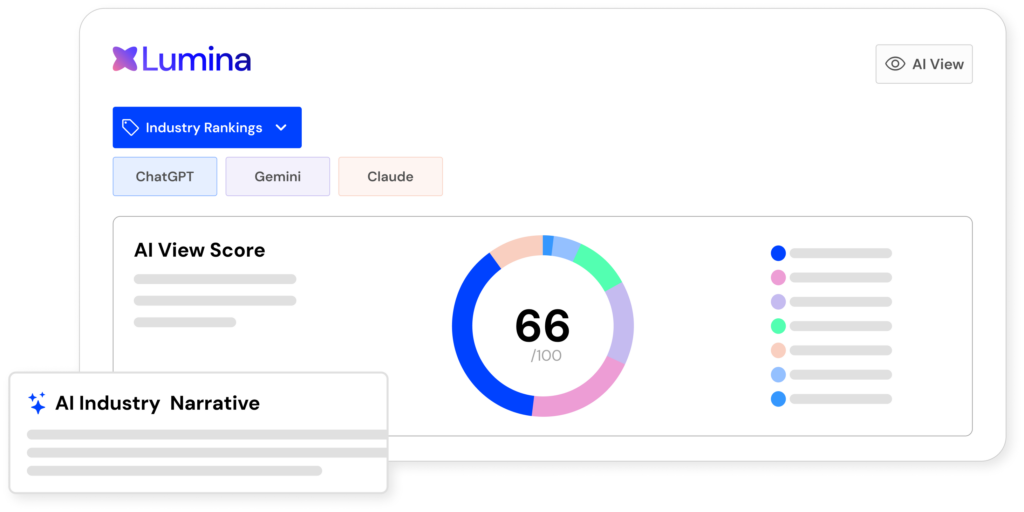
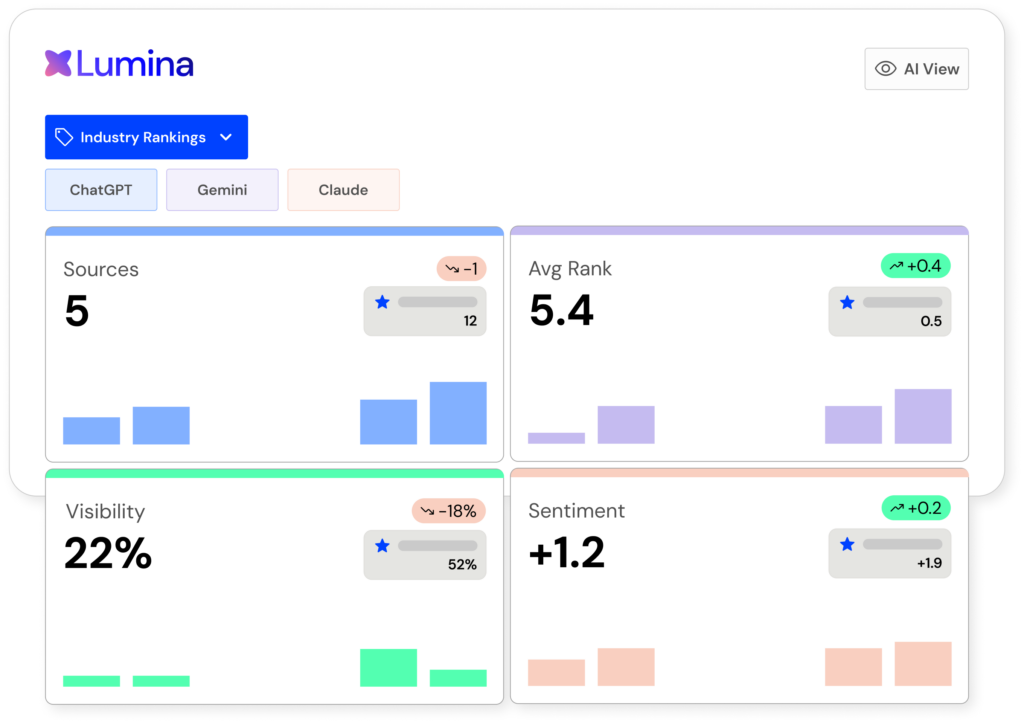
Lumina AI View monitors which sources AI models use when talking about your organisation, how strong and recent those sources are, and how you compare to competitors. Freshness is one of five key factors in the overall score. If your freshness score drops, it's an early warning that your latest campaign or announcement hasn't reached the AI ecosystem yet, and older stories are still dominating.
What’s important to note is that the tool provides a list of source citations, paired with reputation pillars like direction, integrity, performance and innovation — giving a comms professional a fully-rounded understanding of what they need to do. It’s not just the case of knowing source citations, but also of understanding your own AI perception and performance to make informed decisions — whether that’s for a brand,a government agency, a NFP or elsewhere.
This kind of tracking is even more important because it shifts by industry and by market, so "AI visibility" doesn't mean the same monitoring job for every organisation. AI answers for healthcare might draw from the smallest, highest-trust pool of sources (mostly clinical and government), but SaaS and fintech answers lean heavily on editorial reviews and comparison sites. Ngaire Crawford made a similar point regionally on the "AI as a Stakeholder" panel. For the APAC region specifically, she pushed back on the assumption that editorial media dominates AI citations — "there are a lot of really massive claims about the impact of editorial media... some as high as 85, 88%. That's not what we're seeing." Instead, she found "a fairly even split between (editorial media) and company content," alongside a real presence for review sites, forums, and academic sources. For a comms team, that means the freshness strategy that works for a media-heavy consumer brand might not work for a government agency whose AI visibility is really riding on review sites, .gov pages, or industry forums instead.
By tracking regularly — weekly or as a routine check— you turn the vague concern of "what is AI saying about us" into something that is super clear. You can see if recent coverage changed your list of citations, or if your owned content is still being found, or where there are gaps that need to be filled because old stories still exist and are causing problems.
The opportunity in staying current
There's a real advantage here too. If old content keeps you tied to an outdated story, fresh content is a direct way for PR and communications teams to influence how AI presents them. Publishing regularly, keeping your own pages updated, and getting recent, credible coverage is not just for human audiences. It's how PR professionals can make sure the systems shaping first impressions have the right information.
Teams that make it an ongoing habit of checking in regularly, watching for changes, and keeping fresh, credible content flowing, will have more control over how AI describes their organisation.
If you would like to know more about our Lumina suite, please reach out here and our team will get in touch with for you a quick demo.
"
["post_title"]=>
string(60) "Why is content freshness the new currency for AI visibility?"
["post_excerpt"]=>
string(172) "AI summaries are replacing websites as your organisation's first impression. Here’s why content freshness—and the sources feeding these models—matters more than ever."
["post_status"]=>
string(7) "publish"
["comment_status"]=>
string(4) "open"
["ping_status"]=>
string(4) "open"
["post_password"]=>
string(0) ""
["post_name"]=>
string(59) "why-is-content-freshness-the-new-currency-for-ai-visibility"
["to_ping"]=>
string(0) ""
["pinged"]=>
string(0) ""
["post_modified"]=>
string(19) "2026-08-20 02:44:18"
["post_modified_gmt"]=>
string(19) "2026-08-20 02:44:18"
["post_content_filtered"]=>
string(0) ""
["post_parent"]=>
int(0)
["guid"]=>
string(32) "https://www.isentia.com/?p=49408"
["menu_order"]=>
int(0)
["post_type"]=>
string(4) "post"
["post_mime_type"]=>
string(0) ""
["comment_count"]=>
string(1) "0"
["filter"]=>
string(3) "raw"
}
Blog
Why is content freshness the new currency for AI visibility?
AI summaries are replacing websites as your organisation’s first impression. Here’s why content freshness—and the sources feeding these models—matters more than ever.
There is a new frontier where public perception is shaped: Large Language Models. Right now, LLMs are answering critical questions about your organisation. What are they saying? And more importantly, which sources are shaping those answers?
To navigate this landscape, public relations professionals don't need generic tools, but rather technology that speaks their language, and addresses the realities of a changed media and informational landscape.
That is why we're unveiling Lumina AI View, the latest addition to our intelligent suite of AI tools from Isentia. Trained specifically on the workflows and challenges of modern PR & communications, Lumina AI View helps you understand exactly what AI knows about you, and how it learned it.
A new standard for AI visibility
AI View tracks your citation strength and source quality alongside those of your competitors, giving you a clear view of where you hold authority and where you have gaps.
Lumina AI View maps your AI reputation from the ground up, allowing you to:
See which sources matter: When tools such as ChatGPT or Gemini discuss your organisation, which outlets do they cite? Track your source footprint over time and view the impact of key target media on how you’re discussed. We measure your citation strength and source quality alongside those of competitors, giving you a clear view of where you have authority and where you have gaps.
Gain industry-specific insight: Your competitors get cited from Financial Times and Bloomberg. You get cited on Reddit. Each brings opportunity – and risk. Discover how you measure up against industry standards, and target the sources that actually influence how AI represents you.
Catch narrative shifts early: AI responses change when new sources appear, sentiment shifts, or old controversies resurface. Get alerts when citation patterns change suddenly, before they impact the way you’re perceived by stakeholders.
Measure your progress: From media monitoring to full media intelligence
Lumina AI View is built on the principle that insights get stronger with repeated measurement. To help you maintain a clear view of your reputation, our proprietary scoring system provides regular updates that show you:
Evolving trends in how sources cite your organisation
Competitive standing and benchmark metrics
Where models differ in information presented, and sources cited
Whether you run it weekly, on-demand, or whenever you need a check-in, patterns will emerge, trends will become clear, and you will build a baseline that makes any sudden narrative changes both comprehensible and the prerequisite to action.
Lumina AI View is part of Lumina AI, a comprehensive suite of AI tools built specifically for communicators. Our Lumina suite evolves traditional media monitoring into narrative intelligence, enabling you to truly understand how perceptions form, evolve, and impact your reputation.
Get in touch to register your interest and see what Lumina AI View can do for you.
"
["post_title"]=>
string(66) "Introducing Lumina AI View: AI Visibility Built for PR & Comms"
["post_excerpt"]=>
string(158) "Lumina AI View, the latest in Isentia's AI suite, is trained on PR & comms workflows to help you understand what AI knows about you — and how it learned it."
["post_status"]=>
string(7) "publish"
["comment_status"]=>
string(4) "open"
["ping_status"]=>
string(4) "open"
["post_password"]=>
string(0) ""
["post_name"]=>
string(59) "introducing-lumina-ai-view-ai-visibility-built-for-pr-comms"
["to_ping"]=>
string(0) ""
["pinged"]=>
string(0) ""
["post_modified"]=>
string(19) "2026-07-15 03:12:57"
["post_modified_gmt"]=>
string(19) "2026-07-15 03:12:57"
["post_content_filtered"]=>
string(0) ""
["post_parent"]=>
int(0)
["guid"]=>
string(32) "https://www.isentia.com/?p=47963"
["menu_order"]=>
int(0)
["post_type"]=>
string(4) "post"
["post_mime_type"]=>
string(0) ""
["comment_count"]=>
string(1) "0"
["filter"]=>
string(3) "raw"
}
Blog
Introducing Lumina AI View: AI Visibility Built for PR & Comms
Lumina AI View, the latest in Isentia’s AI suite, is trained on PR & comms workflows to help you understand what AI knows about you — and how it learned it.