How is Isentia responding to AI reshaping communications leadership?
The role of communications professionals is evolving rapidly. AI is now actively shaping how organisations build trust, manage reputation, and engage key audiences, moving beyond theoretical discussions.
Gartner’s latest forecasts for Chief Communications Officers (CCOs) highlight a growing profession under increased scrutiny. Traditional methods such as press releases and media relationships are no longer sufficient. Communication is now central to business, and supporting tools must evolve accordingly.
Isentia’s platform combines AI-driven media intelligence, real-time narrative tracking, and expert human analysis. These capabilities address several urgent needs identified by Gartner. Below, we outline key predictions and how Isentia’s tools help meet these challenges.
AI is transforming how brands are discovered and evaluated
Gartner predicts that, as large language models replace traditional search, PR, and earned media, PR and earned media budgets will double by 2027. Stakeholders will increasingly view organisations through AI-generated summaries. The quality, authority, and timeliness of earned media will directly influence how AI systems represent your organisation.
Gartner emphasises that this is a communications challenge, not a marketing or SEO issue. Search engine optimisation requires PR and communications expertise to build trust, secure media coverage, and maintain consistent messaging across stakeholders.
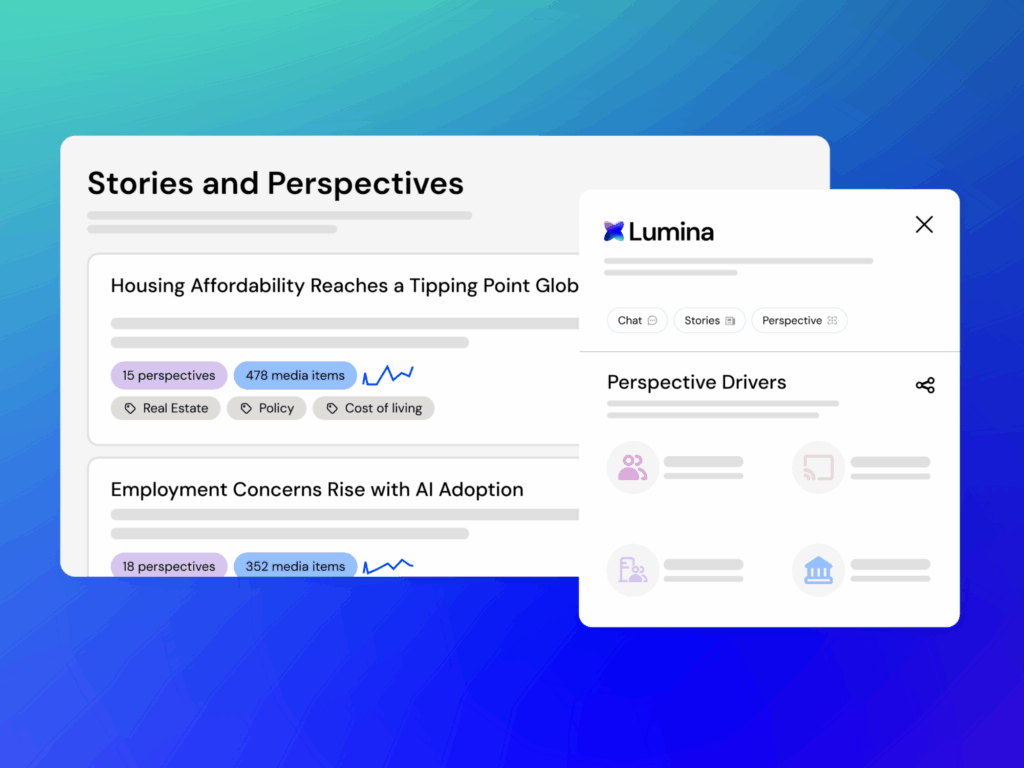
Isentia’s Lumina AI suite and Narratives AI tools address these needs. Narratives AI identifies, summarises, and ranks stories from billions of news articles and social media posts in real time and historically. It reveals how stories develop and spread, enabling communications teams to understand both the content and its influence on AI-generated perceptions.
Isentia’s upcoming Lumina AI View feature enables organisations to see how their brand appears across AI platforms and understand the information shaping those results. Intelligence is no longer a luxury.
Gartner’s second forecast was that by 2029, 45% of CCOs will use narrative intelligence technologies to monitor reputation amid rising disinformation. Traditional monitoring tools often miss early signs of harmful stories because they focus on keywords rather than story development and spread.
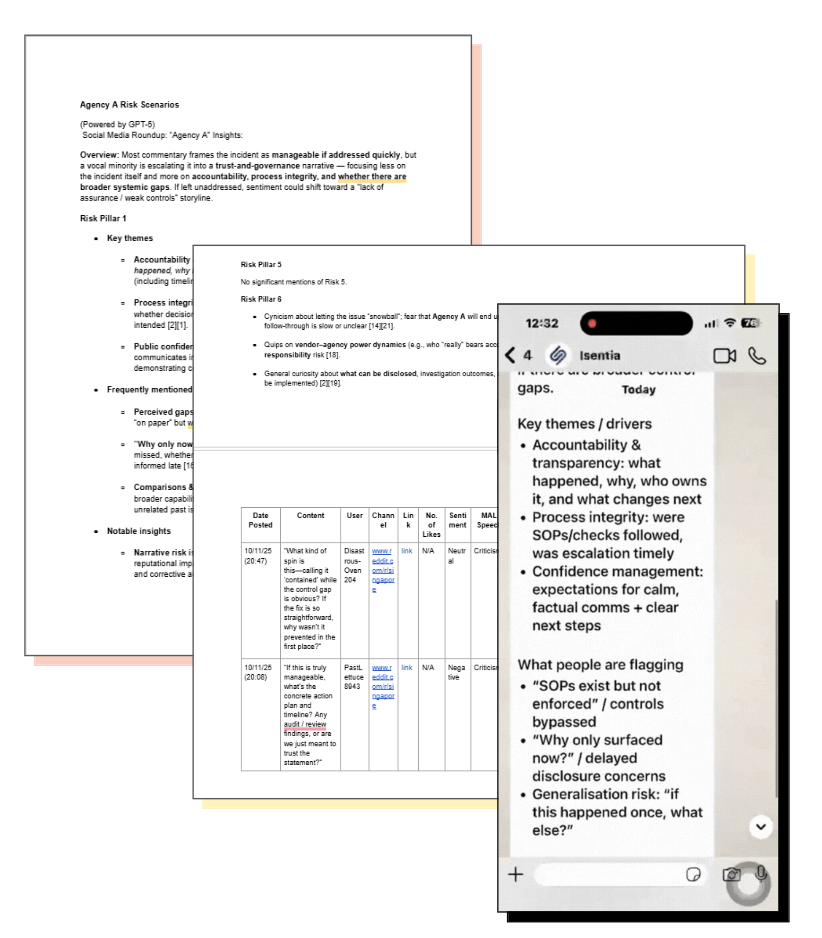
Isentia has addressed this challenge. Our crisis monitoring teams provide 24/7 coverage and real-time alerts via email, mobile app, and WhatsApp, delivering the intelligence-driven support Gartner recommends.
Our Media Impact Score (MIS) supports this approach. It evaluates not only the volume of coverage but also its reception, combining tone, importance, and audience reach into a single human-coded score that reflects true reputational impact.
The growth of AI-powered internal communications
Gartner predicts that by 2028, 75% of employees will use chatbots for internal information instead of intranets, newsletters, or manager updates. This shift from push-based to pull-based, conversational access raises important governance considerations.
Isentia’s GenAI-powered Insights Chatbot addresses this need. It allows users to query past reports and data, providing clear, evidence-based answers from the organisation’s media intelligence archive. Teams can interact with their data, compare trends, identify patterns, and access insights efficiently.
As Dr Nici Sweaney, Founder and Director at Ai Her Way, observed at Isentia’s recent webinar on AI as a new stakeholder: “What will set people apart — and what AI cannot replicate — is the human lens. The judgment, the relationships, the institutional knowledge, the strategic read of a room. The organisations that lean into supporting their people to harness these tools, rather than just deploying the tools, will be the ones best placed.”
This principle guides Isentia’s approach. Our platform combines AI with over 100 local analysts across Southeast Asia (SEA) who review AI-generated data for cultural context, slang, and sarcasm. This model achieves up to 95% sentiment accuracy, ensuring reliable results through human expertise.
Analytics must move from retrospective to predictive
Gartner’s last key prediction is that analytics must shift from retrospective to predictive, much on data, and Gartner’s final key prediction is that by 2029, communications teams will double their spending on data and analytics to 6% of budgets. This reflects increased pressure to demonstrate business impact. Nearly half of CCOs struggle to prove their value, and a third report their teams are viewed as cost centres.
RepID and interactive dashboards go far beyond simple metrics. For example, RepID measures an organisation’s reputation by analysing stories and posts across areas such as leadership, ethics, and quality. This gives a clear, evidence-based view of how reputation is really changing, not just how much coverage there is.
Our interactive insights reports enable clients to track share of voice, narrative sentiment, and influencer impact in one platform. This real-time, results-focused measurement aligns with Gartner’s recommendations for credibility in communications.
Implications for communications leaders
Communications teams must achieve more, operate with greater precision, move faster, and deliver measurable business results. AI is both the driver and enabler of this change, but success depends on investing in the right intelligence systems.
Isentia’s platform already provides the essential tools Gartner recommends, including Narratives AI, real-time risk alerts, AI-powered chatbots, human-verified insights, and advanced measurement systems. For PR & Comms leaders in Asia-Pacific and beyond, the key question is how quickly they can implement this intelligence.
Join the conversation
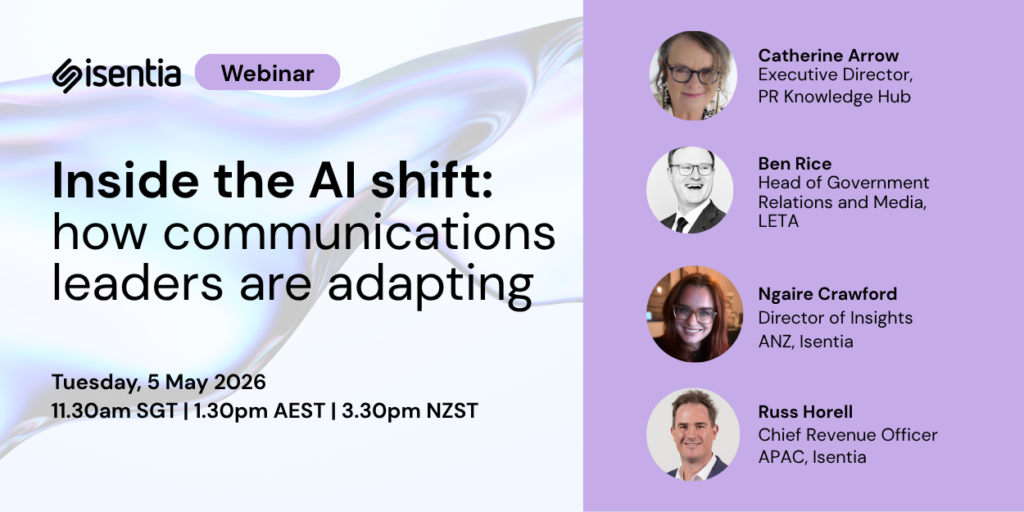
We invite you to attend our upcoming webinar, Inside the AI Shift: How Communications Leaders Are Adapting, on Tuesday, 5 May 2026 at 11:30am SGT / 1:30pm AEST / 3:30pm NZST via Zoom.
The conversation has shifted from what AI could do to what it’s already doing in the workplace. Comms leaders are now responsible for shaping how their organisations navigate this landscape
That means managing executive expectations, rethinking strategies and workflows, and staying ahead of emerging reputational risks as they unfold. The session will include top comms leaders like Catherine Arrow (Executive Director, PR Knowledge Hub), Ben Rice (Head of Government Relations and Media, Low Emission Technology Australia), Russ Horell (Isentia APAC’s Chief Revenue Officer) and Ngaire Crawford (Director of Insights, Isentia ANZ) as they explore how this new reality should be addressed and what it would take comms leaders to reset and adapt within this AI shift.
Nikita Gundala manages brand marketing and thought leadership for Pulsar Group across the SEA and ANZ markets. With over three years of first-hand experience in the influencer marketing and PR industries, she specializes in translating real-time insights and audience intelligence into actionable content. Nikita holds a master’s in Marketing and Digital from ESSEC Business School, Singapore. She has contributed to the wider industry conversation by co-authoring articles and reports for The Business Times Marketing Interactive.
A weekly tracker tracing the stories, figures and policies driving media and social coverage in the 2026 New Zealand General Election across Online News, TV, Radio, Newspaper, Magazine, X, Facebook, Instagram, TikTok, Threads and Forums. This edition covers conversations and coverage from 15th - 21st October, highlighting what’s shaping the election conversation.
1. Election Conversation
10,572
total mentions this week
2,842 media7,730 social
Media = news coverage. Social = all public posts across X, Facebook, Instagram, TikTok and Threads - everyone posting, not just media outlets.
2. Media Issue of the Week
Opportunity Party Puts the Kingmaker Question at the Centre of the Campaign
Opportunity (TOP)271 media items · 325 social posts
The Opportunity Party, led by Qiulae Wong, was the most covered new story in the news this week. It polled 8% in the 1News Verian poll on 13 October and 5.4% in the Post/Freshwater poll on 19 October, just above the 5% needed to enter Parliament. With National and Labour close together, outlets described it as a possible kingmaker. Christopher Luxon ruled out working with the party at the Herald leaders' debate, then told West Coast voters he would work with "whoever I have to", and campaign chair Simeon Brown ruled it out again. David Seymour said ACT would consider a four-party arrangement that includes Opportunity. Later in the week the focus turned to the party itself, with former board members describing internal problems and Wong saying the party's rules need another look.
News outlets ran 271 items on the party or the kingmaker question in the headline or summary (9.5% of the 2,842 election items), and it was mentioned somewhere in 724 (25.5%). Coverage was highest on 15 October, after Luxon's West Coast comments, Brown's response and Seymour's remarks, and again on 20 and 21 October, with new poll results, the former board members' claims and Wong's comments on coalition deals.
It matters because it affects who can form a government. The Post projected that Opportunity's seven MPs could give either a Labour-led bloc a narrow 61-seat majority or a National-led bloc 66 seats, so every party has had to say whether it would work with Opportunity. On social media it was a smaller conversation, with 325 posts (4.2%), and those posts were less negative than average (44.4% negative against 53.0% overall). The story is about coalition options rather than a policy position, so it is not linked to a party issue below.
3. What's happening across media and social?
2,842 media items · 7,730 social items · share of each channel's own conversation, so the two bars are directly comparable
"Social" is all public posts across X, Facebook, Instagram, TikTok and Threads - not just media organisations' own accounts.
MediaSocial
Issues
Cost of Living
Media
13.9%
Social
18%
Law & Order
Media
9.1%
Social
22.1%
Economy & Jobs
Media
16.5%
Social
12.5%
Health
Media
11.8%
Social
11.9%
Infrastructure & Transport
Media
10.1%
Social
4.1%
Parties
National
Media
25.8%
Social
21%
Labour
Media
23.5%
Social
17.8%
NZ First
Media
12.7%
Social
19.6%
Greens
Media
13.7%
Social
18.2%
ACT
Media
9.9%
Social
14.1%
Most frequent bylines and presenters: The most frequent bylines and presenters this week were Sean Plunket (The Platform), Ryan Bridge (Three), Henry Cooke (Waikato Times) and John MacDonald (Newstalk ZB).
Widest-reach accounts: The accounts with the widest reach among election posts were news outlets: the New Zealand Herald, 1News, Radio Tarana, RNZ and Stuff, along with the New Zealand Labour Party account. Party leaders' own accounts posted often but have smaller followings.
Law and order made up 22.1% of the issues discussed on social media but 9.1% in the news, about 2.4 times as much. Part of the gap is the continuing reaction to the Greens' and Te Pāti Māori's visit to a Mongrel Mob event, last week's Media Issue of the Week: 137 of the 791 law and order posts mention it. Across all social posts the visit came up in 291 (3.8%), 70.5% of them negative, and in 257 news items (9.0%).
The Opportunity Party shows the gap the other way round. It was in the headline or summary of 9.5% of news items but only 4.2% of social posts, about 2.3 times as much attention in the news. Among the parties, NZ First, the Greens and ACT had a bigger share of social mentions than news mentions (NZ First 19.6% against 12.7%, Greens 18.2% against 13.7%, ACT 14.1% against 9.9%), while National and Labour had a bigger share in the news (National 25.8% against 21.0%, Labour 23.5% against 17.8%).
4. Party Share of Conversation
1. National23.2%
2. Labour20.4%
3. NZ First16.5%
4. Greens16.2%
5. ACT12.2%
6. Te Pāti Māori6.5%
7. Opportunity (TOP)5%
Shown for seven parties, including Te Pāti Māori and the Opportunity Party (TOP), which is this week's Media Issue of the Week. Shares add up to 100% of the seven shown. Share of conversation measures attention, not polling, and is not a sign of electoral success.
5. Top candidates this week
1. Christopher Luxon1,614
2. Chris Hipkins1,611
3. Winston Peters1,133
4. David Seymour840
5. Chloe Swarbrick412
Christopher Luxon (1,614 mentions) and Chris Hipkins (1,611) were level at the top. Both were at the centre of the final leaders' debate on 20 October and the questions about working with Opportunity, and each party announced new policy during the week.
Winston Peters (1,133) was third and was mentioned far more on social media (726) than in the news (407). The most shared posts about him covered his comments on diversity, his message to David Seymour on strategic voting and his public meetings. David Seymour (840) drew attention for saying ACT could work with Opportunity.
Chloe Swarbrick (412) was in the news more than on social media (227 against 185), with coverage of the Greens' plan to reverse public service cuts and the Mongrel Mob visit. Mentions measure how much someone is being talked about, not how they are polling.
6. Election Issues
Top 4 themes this week
Cost of Living1,621
Economy & Jobs1,605
Law & Order1,430
Health1,252
What's driving conversation about each party?
Each party's top issues this week in social conversation, ranked by how much they were discussed
National
1Health
2Jobs
3Cost of living
Labour
1Health
2Education
3Cost of living
Greens
1Cost of living
2Law and order
3Training wage
ACT
1GP access
2Cost of living
Issues are ranked from social posts. Counts are not shown because the numbers for a single party and issue are small.
7. Issues to Watch
The coalition question around the Opportunity Party is likely to stay in the news until election day. Luxon has given two different answers on working with the party, and polls this month have put it between 4.8% and 8%, so a small shift in support could change which parties can form a government. The party's internal problems are also now in the spotlight.
Voter enrolment is becoming a political issue ahead of the 25 October deadline. New rules mean people cannot enrol at the polling booth, and 112 news items this week covered enrolment or the electoral roll, many focused on young and first-time voters. The number enrolled when the roll closes will show whether these concerns made a difference.
Social conversation leaned negative this week: 53.0% of posts with a clear tone were negative, 32.6% neutral and 14.4% positive. Cost of living is a top issue for four parties (National, Labour, Greens and ACT). Health is a top issue for two parties (National and Labour). Issues that matter to several parties are the ones most likely to keep shaping the campaign.
If you want to find out more about how Isentia can help you understand the NZ media landscape, please reach out to us here.
"
["post_title"]=>
string(97) "NZ Election 2026: TOP as Kingmaker, Law & Order Surge on Social, and Minor Parties Gaining Ground"
["post_excerpt"]=>
string(152) "Analysis of the latest NZ Election 2026 media tracker: The Opportunity Party's kingmaker potential, Law & Order social trends, and minor party momentum."
["post_status"]=>
string(7) "publish"
["comment_status"]=>
string(4) "open"
["ping_status"]=>
string(4) "open"
["post_password"]=>
string(0) ""
["post_name"]=>
string(92) "nz-election-2026-top-as-kingmaker-law-order-surge-on-social-and-minor-parties-gaining-ground"
["to_ping"]=>
string(0) ""
["pinged"]=>
string(0) ""
["post_modified"]=>
string(19) "2026-10-23 01:20:50"
["post_modified_gmt"]=>
string(19) "2026-10-23 01:20:50"
["post_content_filtered"]=>
string(0) ""
["post_parent"]=>
int(0)
["guid"]=>
string(32) "https://www.isentia.com/?p=50575"
["menu_order"]=>
int(0)
["post_type"]=>
string(4) "post"
["post_mime_type"]=>
string(0) ""
["comment_count"]=>
string(1) "0"
["filter"]=>
string(3) "raw"
}
Blog
NZ Election 2026: TOP as Kingmaker, Law & Order Surge on Social, and Minor Parties Gaining Ground
Analysis of the latest NZ Election 2026 media tracker: The Opportunity Party’s kingmaker potential, Law & Order social trends, and minor party momentum.