How labor and the liberal party are campaigning and communicating differently
In a world where social media amplifies every move, both parties face intense scrutiny. From policy pledges to personal attacks, how these leaders communicate shapes how Australians perceive them. But how is media coverage, and in turn, social reaction, driving the conversation with voters? Dive into the data that shows how social conversations reveal a stark disconnect between the political narratives and voters’ concerns.
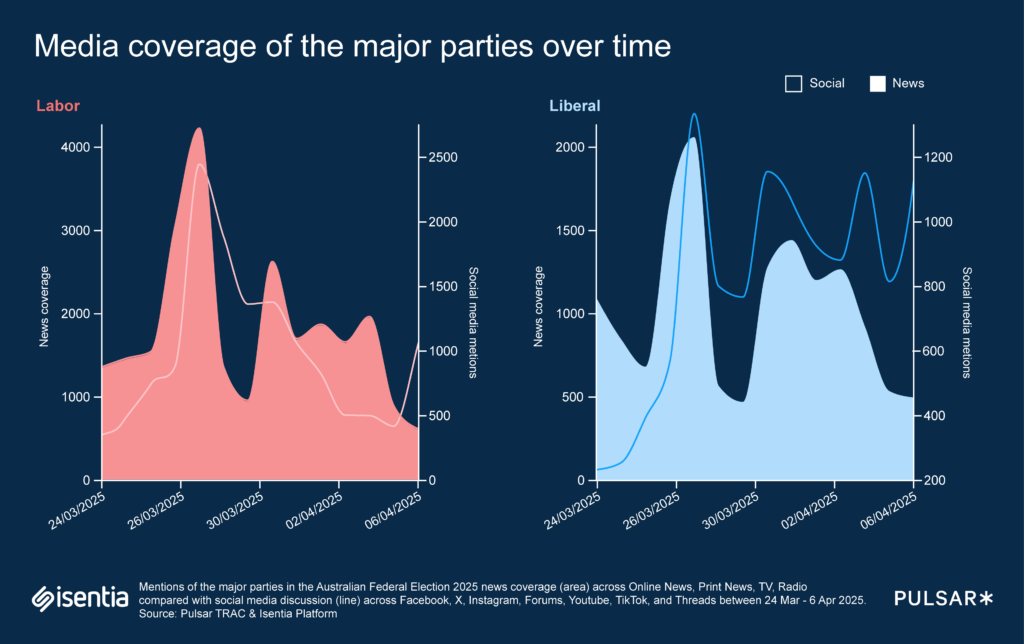
Social and news discussions have converged since the election was called on March 28th, with both major parties ramping up their campaign strategies. However, Isentia’s tracking since January shows that media coverage and social discussion have been substantially focused on the Labor Party, where media and social volumes have been consistently elevated.
The past two weeks have also seen sharply contrasting approaches to communications between the two parties. Prime Minister Anthony Albanese pledged $150 million for the Flinders University healthcare hub on March 31, with the Coalition quickly matching the offer. While some praised the investment, others questioned the Liberals’ motives—reflecting a growing desire among voters for original policy ideas, as both parties compete for support on healthcare.
In the following days, social media discussions centred on two main issues for the Liberal Party: the controversy over a volunteer removing opposition posters, which sparked accusations of unfair tactics, and a candidate’s comments against women in combat roles, which drew further criticism against the party.
Social chatter then shifted to the AEC’s dismissal of complaints about Abbie Chatfield’s interviews with Anthony Albanese and Greens leader Adam Bandt, finding no evidence of political bias. Despite significant announcements leading into the weekend, social discussion focused on the ABC’s coverage of Peter Dutton inadvertently injuring a camera operator, in comparison to covering Anthony Albanese’s fall off a stage. Social media claimed the coverage focused on Dutton’s accident was a double standard in the ABC’s reporting on Labor.
The last fortnight has shown Labor adopting a policy-focused narrative, presenting itself as the party of economic responsibility and social equity. Labor is focused on offering modest tax relief and emphasising long-term reforms to Medicare and the health system. In contrast, the Liberal Party seems to be trying aggressive, headline-grabbing tactics, focusing on cultural issues and personal attacks to generate momentum.
Media and social coverage over the past month show that both Dutton and Albanese have focused their communications on positioning themselves against each other. Albanese frequently criticises Dutton’s policies as “lazy,” calling the former work-from-home policy “borrowed from the Trump administration” and accusing him of stoking division with his “shambolic” ideas.
In contrast, Dutton targets Albanese’s economic management, labelling him “weak and incompetent” for his handling of U.S. tariffs and national debt while criticising Labor’s energy policies and spending. Dutton has accused Labor of running “scare campaigns,” and Albanese seems to counter this by calling Dutton and the Liberals dishonest, even accusing them of trying to “rewrite history.” Peter Dutton’s proposal to leverage Australia’s defence alliance with the US, akin to NATO-style cooperation in trade negotiations over Trump’s tariffs, also sparked controversy. Labor labelled it “reckless”, warning it could jeopardise national security.
While Labor looks to be trying a more measured tone, they’ve still faced backlash from the public, with voters dismissing the government’s $5-a-week tax cut as symbolic rather than substantial. Post the Federal Budget, Albanese’s media appearances were also criticised across social channels as lacking empathy and authenticity.
Albanese’s terse response to a journalist’s question was widely shared as an example of poor media engagement and the growing perception that Labor may be on the defensive. External narratives such as claims about foreign influence and immigration-based voter strategy complicate the party’s messaging, creating doubt over integrity and intent.
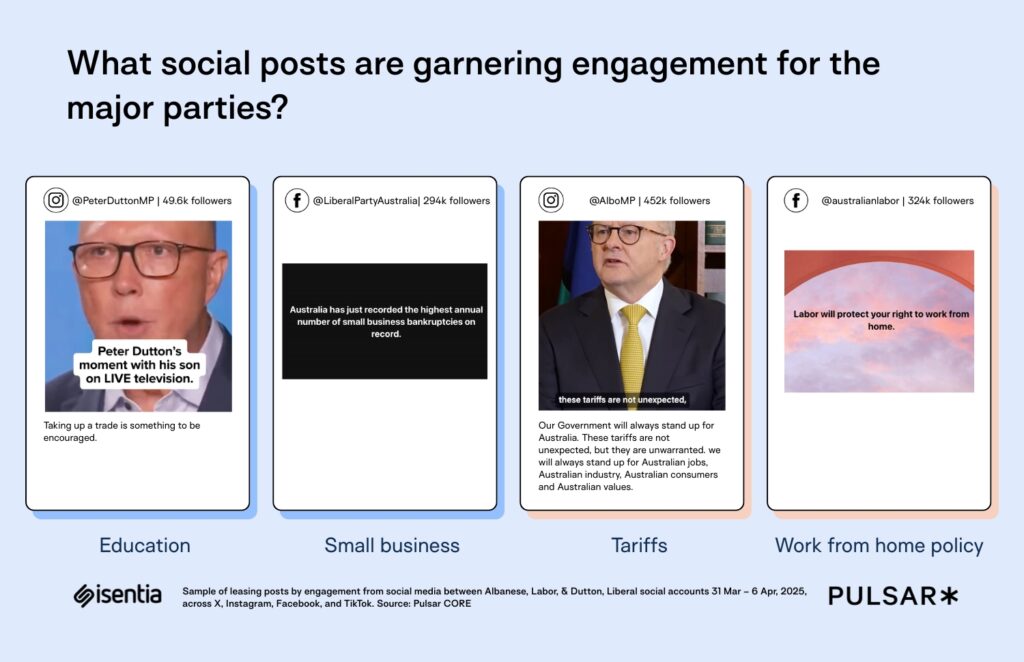
When we look at the social posts from the parties over the past week, the Liberals’ top-performing posts feature personal stories, like Dutton’s son becoming a tradesman, highlighting values that resonate with construction and small business audiences. Posts that focus on cost-of-living frustrations under Labor also drive strong engagement.
By contrast, Labor’s content had the greatest engagement when commenting on the party’s leadership on global issues. Albanese’s post on the government’s steady response to Trump’s tariffs had high engagement, with many rejecting Trump-style politics and supporting Albanese’s stance. Labor also looks to be gaining traction online after the Liberal Party backtracked on scrapping the public service’s work-from-home policy, with Labor framing themselves as defending flexible work.
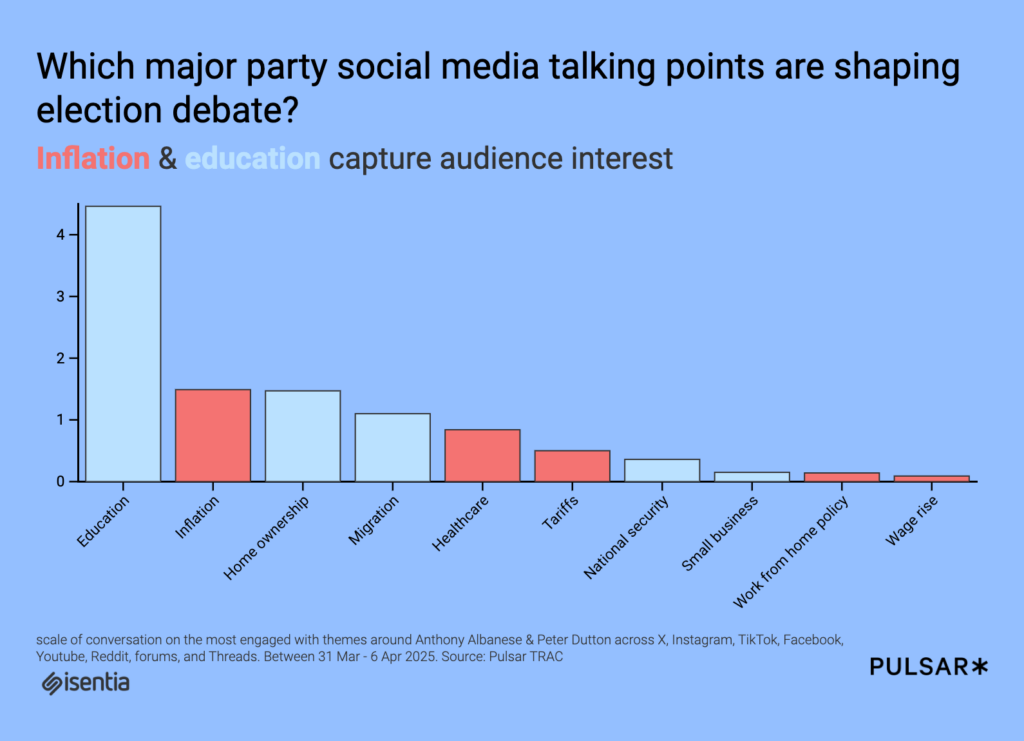
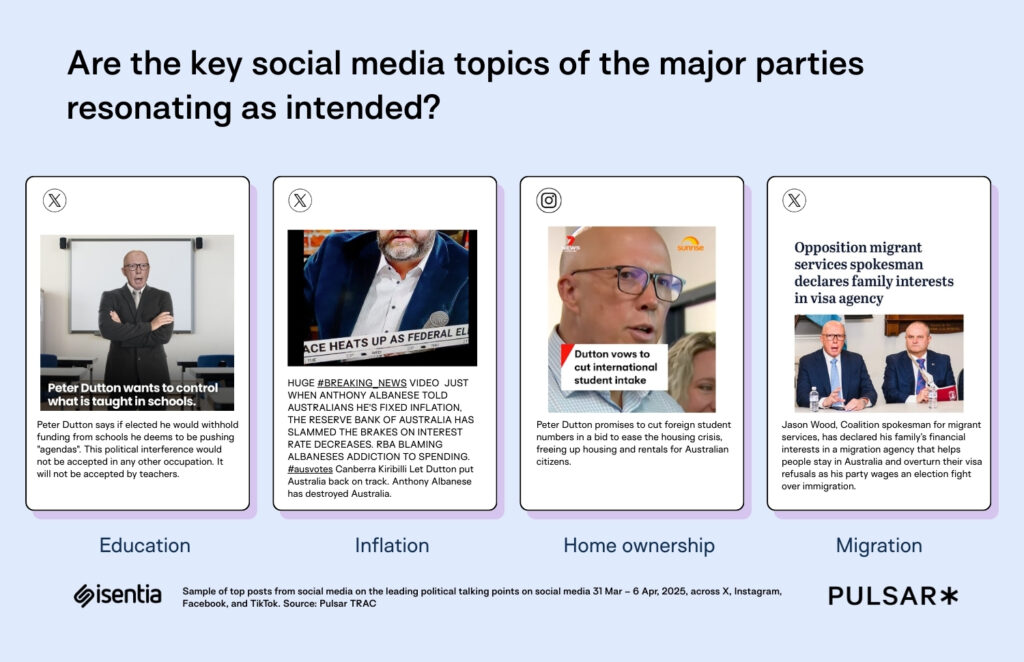
As Dutton and Albanese outline their campaign points on social media, audiences are reacting strongly. Dutton’s focus on trade skills and home-ownership, aimed at younger Australians, resonates with some, but is met with widespread frustration and cynicism from others.
Nationals Senator Bridget McKenzie was featured in news coverage and shared on feeds after she hinted on ABC’s 7.30 that there would be federal education department budget cuts under a coalition-led government—again, a policy adopted in the US. Meanwhile, reactions to Shadow Treasurer Angus Taylor’s comments on inflation and wage rises were broadly disparaging, with social media users ridiculing his data and questioning his competence.
Healthcare is a key focus for Labor, especially mental health support and health infrastructure. Social media users, particularly Gen Z and millennials, are demanding free mental health services, yet skepticism about government promises remains widespread.
After examining how the parties are positioning their campaign pledges and analysing how political leaders are framing each other, it’s clear no amount of rhetoric or spin will reduce the levels of skepticism from audiences, especially among young voters.
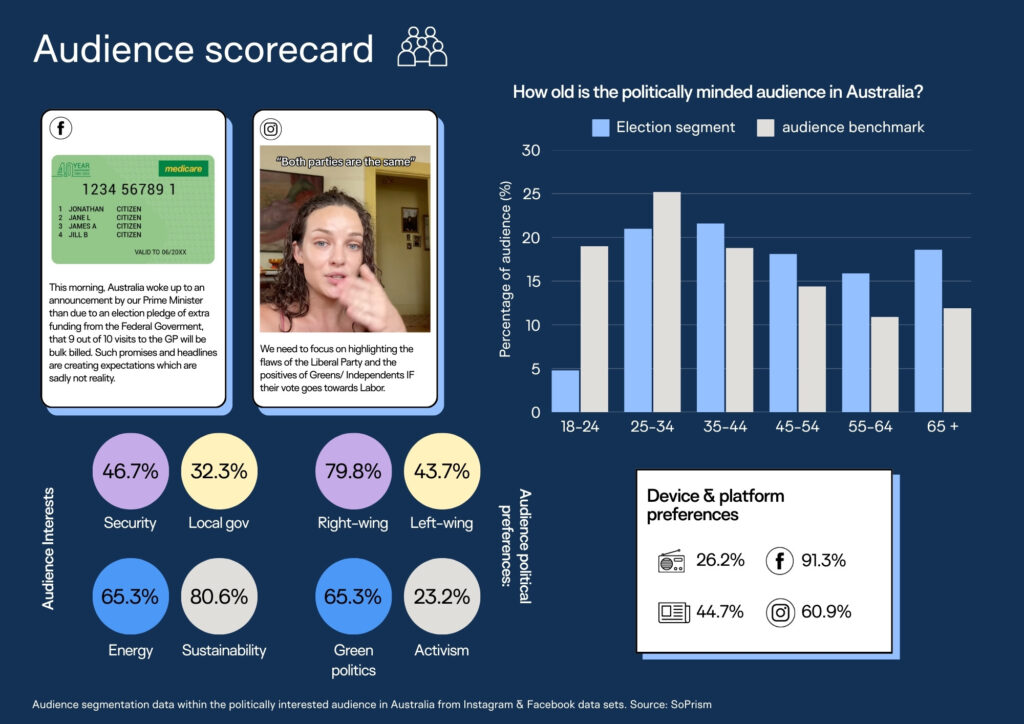
Data from the Pulsar platform shows that audiences from Australian Instagram and Facebook are reflecting trends seen amongst American voters in 2024. Interestingly, younger people aged 25-44 seem to be leaning more towards right-wing politics in the content across these platforms.
Reaction to top-performing election content online reveals a potentially bleak outlook for the major parties and growing disillusionment. With security, sustainability, energy, and local politics being key concerns for online audiences, will the parties look to address these core concerns in the next three weeks?
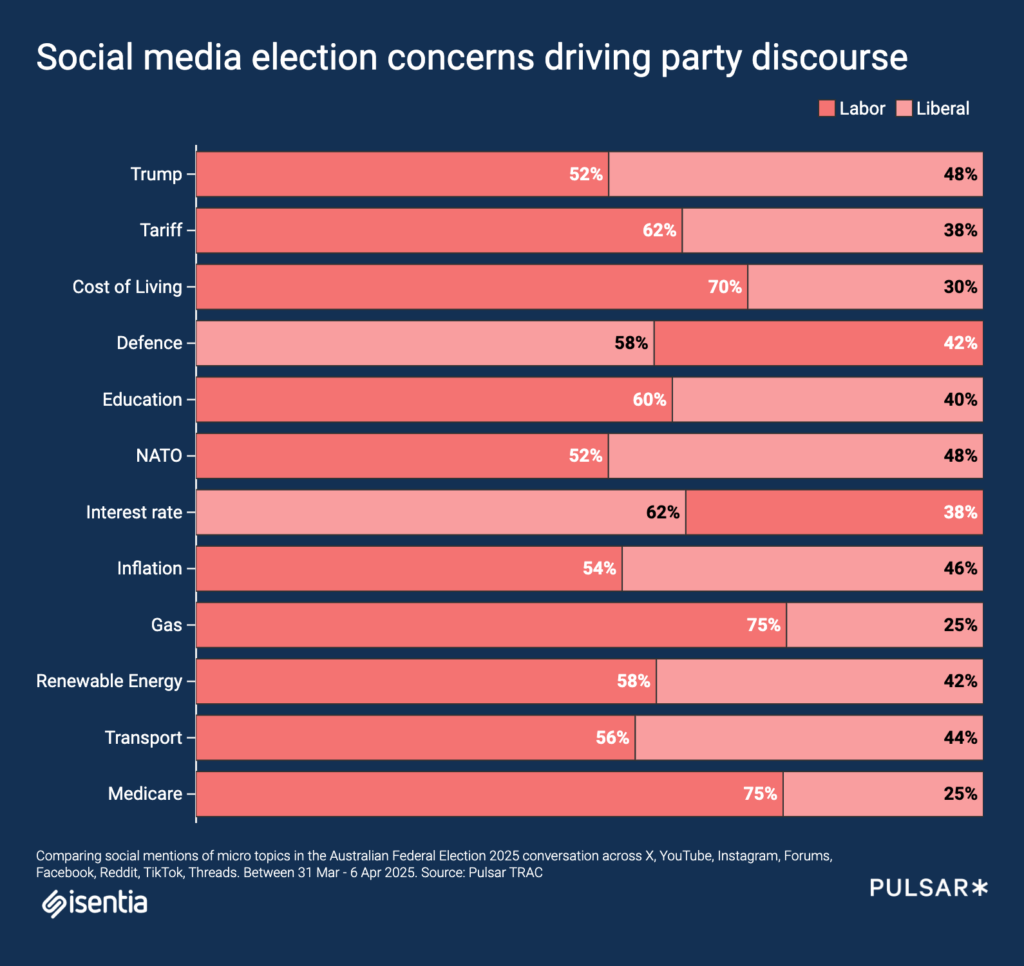
Meanwhile, social media reactions to the government’s handling of inflation highlight significant frustration, particularly with the RBA’s interest rate decisions. Social media commentary accused Albanese of misleading the public by linking government spending to rate hikes. However, many expressed disbelief over claims that government actions were directly tied to inflation, dismissing them as “lies” or “political spin.”
While the Labor and the Liberal campaigns sharpen their communication strategies to sway voters, social media responses suggest a mixed reception. Labor’s policy-driven approach often comes across as cautious, while the Liberals’ more combative tactics spark division. Despite their efforts, neither party has fully managed to align their messaging with voter expectations, leaving room for continued debate and shifting sentiments.
Loren is an experienced marketing professional who translates data and insights using Isentia solutions into trends and research, bringing clients closer to the benefits of audience intelligence. Loren thrives on introducing the groundbreaking ways in which data and insights can help a brand or organisation, enabling them to exceed their strategic objectives and goals.
AI has become a powerful stakeholder in its own right — from being just another ‘technological advancement’ to an active contributor to modern-day communications, that’s massively changed the media landscape today.
Isentia hosted an essential conversation with Lisa Main (Director, Main Bureau), Dr Nici Sweaney (Founder and Director, AI Her Way), Prashant Saxena (Isentia’s VP of Revenue and Insights, SEA), and Ngaire Crawford (Isentia’s Director of Insights, ANZ). Together, they explored how AI reshapes the world of communications and corporate affairs all the while figuring out how to manage and strategically engage with it.
In this session, we covered:
Understanding AI’s behaviour and influence as a digital stakeholder.
Navigating the unique challenges and opportunities AI presents as a new "audience."
The long-term impact of AI and LLMs on the industries central to modern communicators.
Following the webinar, our panellists took the time to answer the most insightful questions from our attendees that we couldn't get to during the live session. Here are their expert perspectives.
Ethical governance and human-centric adoption: perspectives from Dr Nici Sweaney
As the Founder and Director of AI Her Way, Dr Nici Sweaney advocates for a strategic approach to AI that prioritises human intent over technical capability. The questions directed to her focused on the ethical foundations of AI, how organisations should structure their internal AI strategy, and practical ways to start using agents today.
Q: Could you please shed a little light on what ethical AI in your language means?
Ethical AI, to me, is about two things working together: avoiding harm and actively doing good. It’s not just “don’t break anything” — but genuinely asking, does this create value for the business, for the people using it, and for the broader world? Transparency, equity, and accountability are the pillars. Transparency means being honest with your audience and colleagues about when AI is involved. Equity means asking who this helps and who it leaves behind, as AI scales existing biases. Finally, accountability means humans stay in the loop. AI should inform decisions, not make them. When the "why" is clear — like saving a team time to focus on strategy — you are using AI with integrity.
Q: Should AI adoption be owned by IT or Internal Communications? I see staff intranets being overtaken by AI and this has implications for how employees are communicated with.
My answer is probably not what IT wants to hear. AI is part of your infrastructure, so IT must be involved for security and guardrails. However, the strategy behind adoption is fundamentally a human problem, not a technical one. I advocate for a cross-functional "coalition" that brings IT, HR, communications, and strategy to the same table. If you create a dedicated AI leadership role, that person should sit closer to human-centric functions like HR and communications. The hardest part of adoption isn’t the technology; it’s the people, the culture, and the narrative you build around it internally.
Q: What are the most effective ways to address colleagues' concerns about using AI agents in the workplace — particularly around trust, accuracy, and job security?
First, acknowledge that the fear is real; it is a biological response to an unprecedented rate of change. Trust is built through honesty. Pretending AI won’t displace roles destroys trust, so be honest about how the landscape is shifting. What actually moves people is showing, not telling. Show them how AI can solve their specific "pain points" — the tedious, joyless tasks that don't add value. When people see AI as an "empowered choice" that uplifts their work rather than replacing their judgment and strategic thinking, buy-in follows. Build confidence with small wins first.
Q: What are some simple AI agents that you would recommend communications professionals experiment with setting up?
Most professionals don’t need complex autonomous agents yet; they need custom bots and automated workflows. The magic is in understanding your process first. Some practical starting points include:
Daily Briefings: A task that pulls from your calendar, email, and news to deliver a summary each morning.
Meeting Prep: Automated notes that pull context and past correspondence before a meeting, and transcription tools that turn recordings into action items afterwards.
Content Repurposing: A custom bot trained on your "voice" that can turn one talk or newsletter into 15+ social media assets and blog snippets.
Q: Our team members are using AI daily, but I know this is not safe as data is transferred back and forth. Should we create rules and ask people to sign IP protection?
Answer: Your instinct is right. If your team uses free consumer tools, your data may be used to train future models. You should move to enterprise-grade tools like Claude for Teams, Microsoft Copilot, or ChatGPT Enterprise, which offer contractual data protections. You should also build an AI Usage Policy that defines which data is public, internal, or restricted, and map AI rules to those classes. In Australia, we recommend aligning with the EU AI Act — the most comprehensive framework available — to future-proof your organisation.
Synthetic authenticity and the new media ecosystem: Perspectives from Prashant Saxena
Prashant Saxena, Isentia’s VP of Revenue and Insights for SEA, approaches AI through the lens of psychological bonding and media structural shifts. His insights address the changing role of media and the technical ways we must now communicate to satisfy AI as a new audience.
Q: Given that trust in media is dropping and media themselves are using AI more, what is the role or value media can have now?
Media's value is shifting from being the "trusted narrator" for humans to being the "training signal" for AI. When AI models generate answers, they weight authoritative media sources much more heavily than random web content. Even as human trust erodes, media’s structural influence on AI-generated information is growing. For communicators, "earned media" now serves two audiences simultaneously: the humans who read it and the machines that learn from it. Publications with strong editorial standards become more valuable because AI systems use domain authority and editorial signals as quality proxies.
Q: How does AI rank or prioritise its sources and how do you see this shaping the earned media strategy for brands?
AI models don't "rank" sources like Google does. They weight information based on source authority, recency, consistency, and structured data quality. If five credible outlets report the same fact, that fact becomes a "high-confidence training signal." This means volume across credible sources matters more than a single "big hit." For your strategy, consistency of messaging across all placements is vital because AI looks for corroboration. Factual, entity-rich statements will be picked up more reliably than narrative-heavy feature writing.
Q: With the question of trust — where does the psychology come into it when AI uses a cute nickname or 'remembers' your day? Is it harder to remain dispassionate?
This is the core of my PhD research. It is what I call "synthetic authenticity." AI systems deploy cues like warmth and memory that we evolved to interpret as human. These trigger "parasocial bonding" — the same mechanism that makes you trust a friend’s recommendation. The danger is that cognitive awareness (knowing it’s AI) doesn't override the emotional feeling. We need a new kind of literacy that teaches people to recognise when their "trust response" is being activated by design rather than by a genuine relationship.
Q: Should we be changing the format of communications to cater for AI as an audience, such as media releases in Q&A format?
Yes. This is a very practical move. AI models extract information more reliably from structured formats. A Q&A format gives the AI clear question-answer pairs that map to how people query systems. You should also focus on "AI-readable claims" — entity-rich, factual statements. Instead of saying "We are committed to sustainability," say "Our Singapore operations reduced carbon emissions by 34% between 2023 and 2025." The second version is a verifiable fact an AI can actually use and cite.
Q: PR professionals traditionally monitor media coverage through agencies like Isentia to gauge sentiment. With AI as a stakeholder, how do we monitor 'its sentiment'?
This is the new frontier. Traditional monitoring tracks what humans publish; AI sentiment monitoring tracks what AI systems say about your brand when asked. Since there is no single "AI sentiment" (ChatGPT, Grok, and Claude all give different answers based on their training), you need to monitor across platforms. We are developing capabilities to systematically query these platforms to see how their narratives change over time and identify which source materials are driving those answers.
Q: Regarding ethics and agendas in AI learning — what are the differences between models like ChatGPT and Grok, and how does this affect our brand narrative?
Every model reflects the values, training data choices, and alignment decisions of its creators. ChatGPT (OpenAI) tends towards cautious, balanced responses with strong content guardrails. Conversely, Grok (xAI) was explicitly designed to be less filtered, sometimes surfacing perspectives that other models suppress. Claude (Anthropic) prioritises honesty and nuance. For communicators, this means your brand's narrative varies by platform; you must monitor across multiple models because the same question about your brand will receive materially different answers depending on which tool is used.
Q: With many major news organisations blocking AI crawlers, how should we navigate content creation to ensure we still influence AI-generated answers?
Major publishers like the New York Times and Reuters have blocked AI crawlers, creating a gap in training data. When authoritative journalism is unavailable, AI models may fill that gap with lower-quality content or brand-owned content. For communicators, this means your "owned content" — such as your website, blog, and structured data — carries proportionally more weight in AI-generated answers. Your media targeting strategy now needs to account for which outlets are AI-accessible, as they will be disproportionately influential in shaping your narrative.
Analytical interrogation and the search for authority: Perspectives from Ngaire Crawford
Ngaire Crawford, Isentia’s Director of Insights for ANZ, emphasises the role of the analyst. Her approach is characterised by a "rhythm of interrogation," arguing that the most effective way to use AI is through constant questioning and a focus on high-authority inputs.
Q: Is AI already part of your daily work or habit? If so, how are you using it and what are your best practices?
I was initially very sceptical, but it is now part of my every day. I use models like Claude and Gemini to workshop conference outlines, plan education programmes, update code, and structure strategic thinking. My best practice advice is to develop a "rhythm of interrogation." Don't just accept the first answer; ask for evidence and challenge the output. While AI saves time on technical tasks like coding, for strategic work it simply shifts the "mental load." You spend the same amount of time, but the depth and quality are significantly improved because you aren't starting from a blank page.
Q. PR professionals traditionally monitor media coverage through agencies like Isentia to guage what stakeholders think about a brand. How do we monitor 'AI sentiment' and the information that feeds these models?
It's important to know that models are optimised to give the most useful answer, not necessarily the most accurate one. They are pattern-completing, not fact-checking. Because model responses are not fixed and change based on the conversation, I suggest focusing on the "controllable inputs" that feed them. This includes your own website, company material, Wikipedia data, and review sites (including employee reviews). Ensuring these bases are telling the intended story is the absolute best starting point for managing AI "sentiment."
Q: How does AI prioritise its sources and how does this shape earned media strategy?
There is no "PageRank" to reverse-engineer here. Models are shaped by what was prominent and widely cited in their training data. Practically, this means a shift from volume to authority. A hundred pieces of low-quality coverage do less work than ten pieces in genuinely credible outlets (major mastheads, industry publications, or your own well-structured site). The question for the modern communicator isn't "did we get coverage?", it's "does the coverage that exists, taken as a whole, tell a coherent and credible story?" AI reads the whole picture, not just the highlights reel.
Q: Now that OpenAI is opening up advertising, how much will it cost for a sentiment boost?
Honestly? We don’t know yet. The commercial layer of AI is being figured out in real time. The moment someone wonders if they are getting the "best" answer or a "sponsored" one, trust erodes. However, we still click Google ads, so it will likely happen. What's important is that organisations that "earned" their reputation through authoritative presence before the ad market caught up will be in a much stronger position than those trying to buy a shortcut later.
The path forward for the modern communicator
The insights from our panellists make one thing clear: AI is no longer a tool of the future; it is a stakeholder of the present. To lead with credibility in this new era, communicators must pivot from chasing volume to building authority. Whether it is through adopting a rigorous ethical framework, optimising content for AI readability, or maintaining a "rhythm of interrogation" with the tools we use, the goal remains the same: ensuring our brand narratives are coherent, credible, and human-led.
The tools have finally caught up to the ambitions of our industry. Now, it is up to us to provide the architect's blueprint for how they are used.
Interested in viewing the whole recording? Watch our webinar here.
Alternatively, contact our team to learn more insights into meaningful measurement, KPIs and communicating using the right dataset.
"
["post_title"]=>
string(61) "Answering your questions from the AI as a stakeholder webinar"
["post_excerpt"]=>
string(118) "In this blog, panelists from our recent webinar on "AI as a stakeholder" get to answering all your burning questions. "
["post_status"]=>
string(7) "publish"
["comment_status"]=>
string(4) "open"
["ping_status"]=>
string(4) "open"
["post_password"]=>
string(0) ""
["post_name"]=>
string(61) "answering-your-questions-from-the-ai-as-a-stakeholder-webinar"
["to_ping"]=>
string(0) ""
["pinged"]=>
string(0) ""
["post_modified"]=>
string(19) "2026-03-24 06:10:12"
["post_modified_gmt"]=>
string(19) "2026-03-24 06:10:12"
["post_content_filtered"]=>
string(0) ""
["post_parent"]=>
int(0)
["guid"]=>
string(32) "https://www.isentia.com/?p=45283"
["menu_order"]=>
int(0)
["post_type"]=>
string(4) "post"
["post_mime_type"]=>
string(0) ""
["comment_count"]=>
string(1) "0"
["filter"]=>
string(3) "raw"
}
Blog
Answering your questions from the AI as a stakeholder webinar
In this blog, panelists from our recent webinar on “AI as a stakeholder” get to answering all your burning questions.
The media landscape is accelerating. In an era where influence is ephemeral and every angle demands instant comprehension, PR and communications professionals require more than generic technology—they need intelligence engineered for their specific challenges.
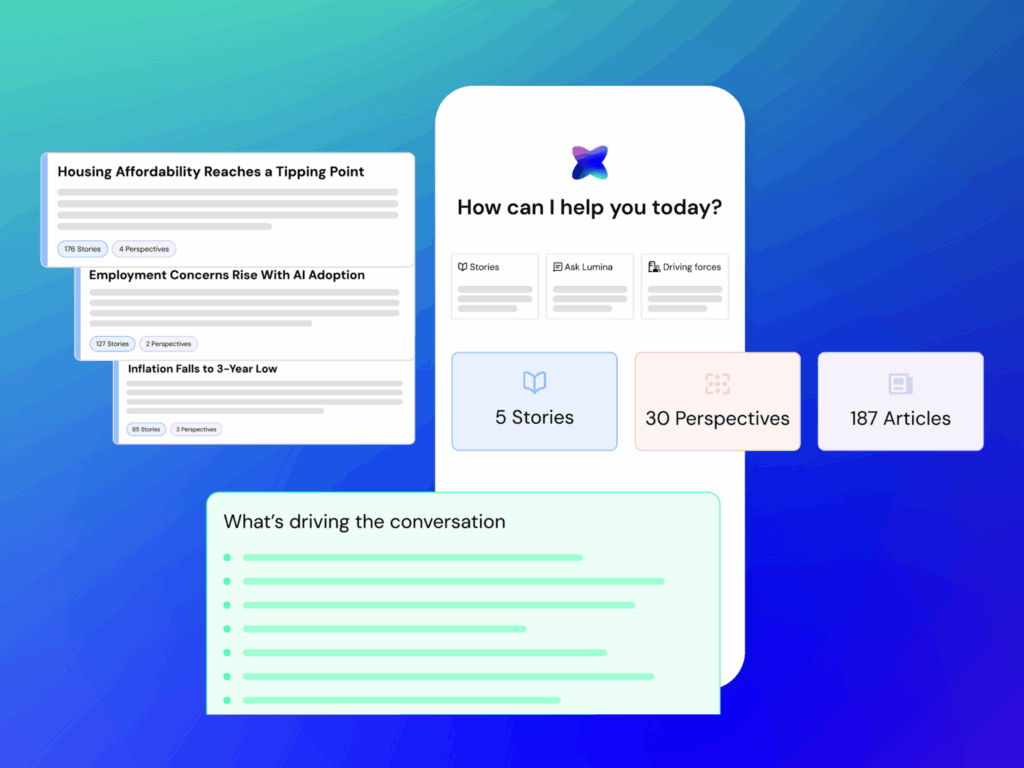
Isentia is proud to introduce Lumina, a groundbreaking suite of intelligent AI tools. Lumina has been trained from the ground up on the complex workflows and realities of modern communications and public affairs. It is explicitly designed to shift professionals from passive media monitoring back into the role of strategic leaders and pacesetters.
“The PR, Comms and Public Affairs sectors have been experimenting with AI, but most tools have not been built with their real challenges in mind.” said Joanna Arnold, CEO of Pulsar Group.
“Lumina is different; it is the first intelligence suite designed around how narratives actually form today, combining human credibility signals with machine-level analysis. It helps teams understand how stories evolve, filter out noise and respond with context and confidence to crises and opportunities.”
Setting a new standard for PR intelligence
Lumina is centered on empowering, not replacing, the human element of communications strategy. This suite is purpose-built to help PR, Comms, and Public Affairs professionals significantly improve productivity, enhance message clarity, and facilitate early risk detection.
Lumina enables communicators to:
Understand & Interpret: Move beyond basic alerts to strategically map the trajectory and spread of narrative evolution.
Focus & Personalise: Achieve the clarity necessary to execute strategic action before critical moments pass.
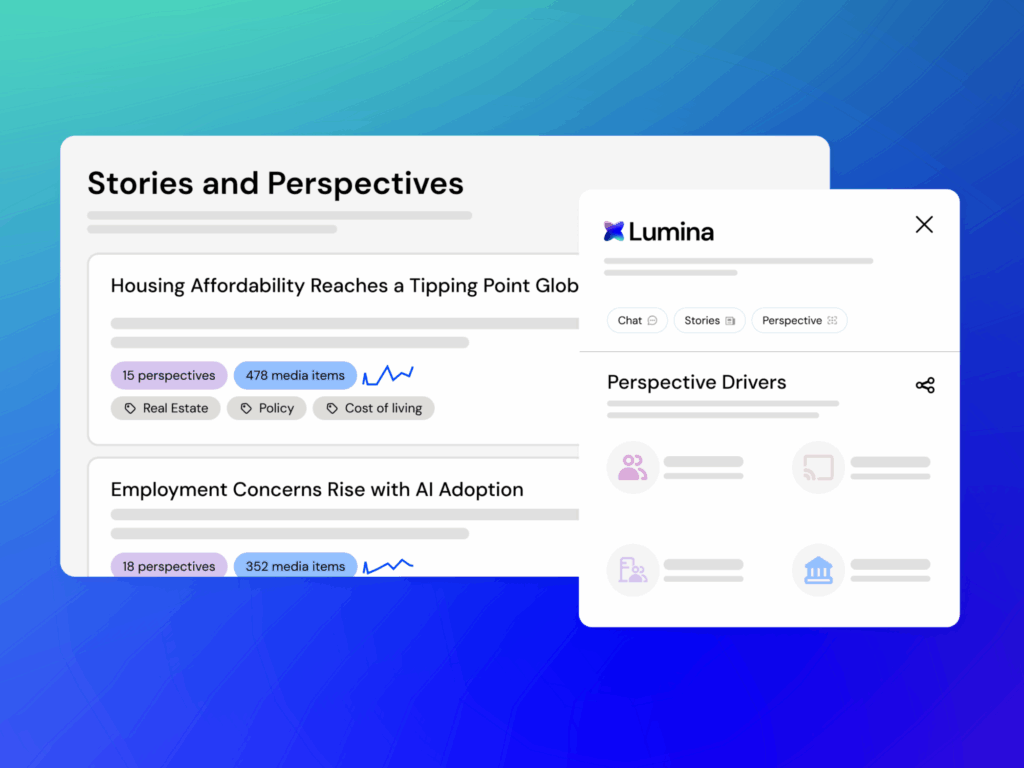
We are launching the Lumina suite by making our first module immediately available: Stories & Perspectives.
In the current fragmented, multi-channel media environment, communications professionals need to be able to instantly perceive not just how a story is growing, but also how it is being perceived across different stakeholder groups.
Stories & Perspectives organizes raw media mentions into clustered, cohesive Stories, and the Perspectives that exist within each, reflecting distinct media, audience, and public affairs angles. This unique functionality allows users to:
Rise above the noise: Instantly identify which high-level topics are gaining momentum or fading from attention.
Get to the detail, fast: Uncover the influential voices, niche communities, and specific channels actively shaping the narrative.
Catch the pivot point: Precisely identify the moment a story shifts—from a strategic opportunity to a reputation risk—or when a new key opinion former begins guiding the conversation.
"Media isn’t a stream of mentions," said Kyle Lindsay, Head of Product at Pulsar Group. "But rather a living system of stories shaped by competing perspectives. When you can see those structures clearly, you gain the ability to understand issues as they form, anticipate how they’ll evolve, and act with precision. That’s what we mean when we talk about AI built for communicators, and that's what an off-the-shelf LLM can't give you."
The Lumina Roadmap: AI tools for the future of comms
The launch of Stories & Perspectives is the first release of many. Over the upcoming months, we will systematically roll out the full Lumina roadmap, introducing a comprehensive set of AI tools engineered to handle every phase of the communications lifecycle.
The full Lumina suite will soon incorporate:
Curated media summaries: AI-driven daily summaries customized specifically to the priorities of senior leadership, highlighting only the most relevant stories.
Reputation analysis: Advanced measurement tracking how critical themes like ethics, innovation, and leadership are statistically shaping corporate perception.
Press release & media relations assistant: Tools designed to accelerate content creation and craft hyper-focused, personalized pitches that reach the precise contacts faster.
Predictive intelligence layer: Technology engineered to track and anticipate story momentum and strategic change before the window of opportunity closes.
Intelligent agents: Background agents continuously scanning all media channels for emerging key spokespeople and previously undetected reputation risks.
Enhanced audio, broadcast & crisis detection: Complete, real-time oversight of all channels—including audio and broadcast—enabling rapid context building and optimal crisis response delivery.
Want to harness the power of Lumina AI for your PR, Comms, or Public Affairs team? .
Complete the form below to register your interest.
"
["post_title"]=>
string(79) "Announcing Lumina: The purpose-built AI suite for PR, Comms, and Public Affairs"
["post_excerpt"]=>
string(129) "An intelligent suite of AI tools trained on the language, workflows, and realities of modern public relations and communications."
["post_status"]=>
string(7) "publish"
["comment_status"]=>
string(4) "open"
["ping_status"]=>
string(4) "open"
["post_password"]=>
string(0) ""
["post_name"]=>
string(76) "announcing-lumina-the-purpose-built-ai-suite-for-pr-comms-and-public-affairs"
["to_ping"]=>
string(0) ""
["pinged"]=>
string(0) ""
["post_modified"]=>
string(19) "2025-12-09 09:39:52"
["post_modified_gmt"]=>
string(19) "2025-12-09 09:39:52"
["post_content_filtered"]=>
string(0) ""
["post_parent"]=>
int(0)
["guid"]=>
string(32) "https://www.isentia.com/?p=43742"
["menu_order"]=>
int(0)
["post_type"]=>
string(4) "post"
["post_mime_type"]=>
string(0) ""
["comment_count"]=>
string(1) "0"
["filter"]=>
string(3) "raw"
}
Blog
Announcing Lumina: The purpose-built AI suite for PR, Comms, and Public Affairs
An intelligent suite of AI tools trained on the language, workflows, and realities of modern public relations and communications.