Blog post
April 10, 2024

24-Hour Blitz: Brands Under Media & Social Fire After Gender Pay Gap Research Launch

When data exposing gender-based pay disparities in over 5000 organisations goes public, it triggers intense scrutiny and debate. But how do major businesses and media outlets respond to this revealing information?

The WGEA’s use of ABS data on February 27th brought Australia’s major businesses under public and media scrutiny. This data highlighted issues like overtime discrepancies and gender imbalances. Underperforming companies, including major employers like Qantas and Telstra, faced media scrutiny post-data release and ahead of International Women’s Day. While the report encourages reforms, not everyone sees value in researching the gender pay gap. Analysing how the media covered this data and the implicated organisations, along with gauging the public’s reaction, uncovers trends, dispels misconceptions, and highlights areas requiring advocacy for gender equality in the workforce.

Gender Pay Gap by Pulsar

As companies received backlash for having significant discrepancies, media coverage focused on how they planned to rectify the situation. Westpac’s launch of a back-to-work program aimed at narrowing the gender pay gap and promoting diversity in the tech workforce gained attention in the Australian Financial Review (AFR).

Lorna Jane, known for its women’s activewear and employing a predominantly female workforce, received substantial broadcast media coverage. This attention highlighted potential hypocrisy, prompting a humorous tone in some reports. However, beyond the humour, these broadcasts also provided a platform for industry experts like Megan Dalla-Camina, CEO of Women Rising, to discuss tangible solutions. As Megan mentioned in The Project, it’s crucial to analyse the data, identify gaps, and invest in women’s career development for meaningful progress.

Airlines were among the top offenders in WGEA’s data, notably with Qantas revealing a median pay gap of 37 percent. Chief People Officer Catherine Walsh’s looked to mediate the attention on the brand with a public statement. Walsh explained the figure, attributing it to the under-representation of women in higher-paying roles such as engineers. She emphasised that upskilling women for these positions would require time and concerted effort.

Telstra, as a major employer in Australia, has drawn significant attention from journalists covering the data release.

Similarly, Westpac’s status as a top Australian company has made it a prime target, especially when political figures call them out on social media channels.

In community discussions, opinions on the gender pay gap are sharply divided. While some dismiss it as a myth, others critique the Labor Party for its perceived socialist alignment. Critics note that the discourse often focuses solely on the pay gap without considering the breakdown of workforce composition.

This suggests a need for clearer communication in the media to emphasise that the gender pay gap data isn’t about equal pay for the same role but broader workforce discrepancies. These gaps expose systemic inequalities, such as women’s underrepresentation in higher-paying roles or industries and challenges related to maternity or caregiving responsibilities, perpetuating inequality throughout their careers.

Beyond these controversies, many agree that the public availability of gender pay gap data is a step towards addressing these discrepancies. Politicians who express opinions that fail to encourage progress and action on this topic garner significant, and often highly critical media coverage. One senator’s post on X provided a case in point:

Popular media figure and ABC journalist Annabel Crabb wrote an article emphasising the importance of data and critiquing the senator’s outlook on the research.

With media scrutiny and public awareness, companies are increasingly held accountable, paving the way for fairer, more inclusive workplaces. Analysing media discussions helps us understand how audience perceptions of impactful and divisive data differ from those of major figures or organisations, and how mainstream media can influence these perceptions moving forward.

Interested in learning more? Email us at info@isentia.com

Share

Similar articles

object(WP_Post)#8949 (24) { ["ID"]=> int(44820) ["post_author"]=> string(2) "75" ["post_date"]=> string(19) "2026-02-20 06:47:39" ["post_date_gmt"]=> string(19) "2026-02-20 06:47:39" ["post_content"]=> string(4605) "

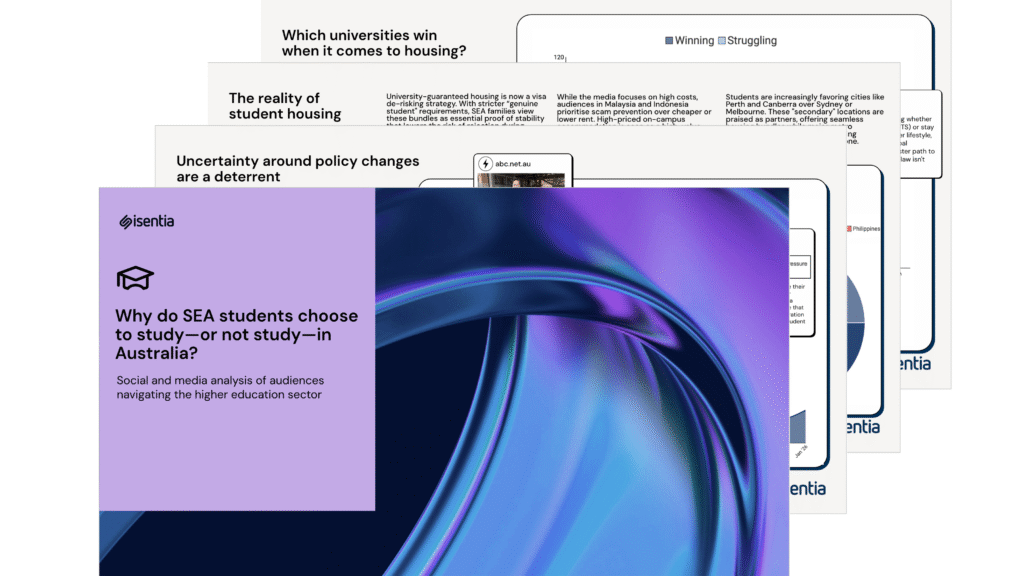
Australia has been a hot destination in higher education for international students, but with recent policy changes and growing anxiety around housing, the student journey has seen a shift, impacting intake into the top Australian universities and making the process a bit unpredictable.

In our analysis we also zoom into the Southeast Asian region, where we uncover what priorities drive students from this region to apply at Australian universities, how housing plays a role and what kind of career outcomes they would expect post-study.

In this report we analyse over 3k posts across social and online media to unpack:

  • How Australian universities are navigating a "crisis of governance" and public trust, with intense media scrutiny on budget deficits, leadership accountability, and long-term financial sustainability.
  • How the rapid integration of AI is seen as both a transformative academic toolkit and an existential threat, forcing institutions to prioritise AI literacy and redesign assessments to combat risks like deep fakes and academic misconduct.
  • How shifting Australian migration policies have made policy safety the primary concern for Southeast Asian students, influencing how they weigh university reputation against visa hurdles and long-term career ambitions.

Reflecting on the media reporting from 2025 provides institutions with the tools to craft communication strategies that address both the domestic demand for accountability and the international student's need for security and value.


Please fill in the forms below and access our reports to get a deeper insight on audience sentiment and behaviour when deciding an education and career in Australia.

Access the SEA insights report here

Access the ANZ insights report here

" ["post_title"]=> string(56) "Analysing Australia's higher education landscape in 2025" ["post_excerpt"]=> string(136) "A deep dive into how global audiences perceive Australian higher education and the university sector with a spotlight on the SEA region." ["post_status"]=> string(7) "publish" ["comment_status"]=> string(4) "open" ["ping_status"]=> string(4) "open" ["post_password"]=> string(0) "" ["post_name"]=> string(77) "analysing-australias-higher-education-landscape-in-2025-amidst-policy-changes" ["to_ping"]=> string(0) "" ["pinged"]=> string(0) "" ["post_modified"]=> string(19) "2026-02-23 08:08:30" ["post_modified_gmt"]=> string(19) "2026-02-23 08:08:30" ["post_content_filtered"]=> string(0) "" ["post_parent"]=> int(0) ["guid"]=> string(32) "https://www.isentia.com/?p=44820" ["menu_order"]=> int(0) ["post_type"]=> string(4) "post" ["post_mime_type"]=> string(0) "" ["comment_count"]=> string(1) "0" ["filter"]=> string(3) "raw" }
Blog
Analysing Australia’s higher education landscape in 2025

A deep dive into how global audiences perceive Australian higher education and the university sector with a spotlight on the SEA region.

object(WP_Post)#11691 (24) { ["ID"]=> int(43742) ["post_author"]=> string(2) "75" ["post_date"]=> string(19) "2025-12-08 17:11:34" ["post_date_gmt"]=> string(19) "2025-12-08 17:11:34" ["post_content"]=> string(9544) "

The media landscape is accelerating. In an era where influence is ephemeral and every angle demands instant comprehension, PR and communications professionals require more than generic technology—they need intelligence engineered for their specific challenges.

Isentia is proud to introduce Lumina, a groundbreaking suite of intelligent AI tools. Lumina has been trained from the ground up on the complex workflows and realities of modern communications and public affairs. It is explicitly designed to shift professionals from passive media monitoring back into the role of strategic leaders and pacesetters. 

“The PR, Comms and Public Affairs sectors have been experimenting with AI, but most tools have not been built with their real challenges in mind.” said Joanna Arnold, CEO of Pulsar Group

“Lumina is different; it is the first intelligence suite designed around how narratives actually form today, combining human credibility signals with machine-level analysis. It helps teams understand how stories evolve, filter out noise and respond with context and confidence to crises and opportunities.”

Setting a new standard for PR intelligence

Lumina is centered on empowering, not replacing, the human element of communications strategy. This suite is purpose-built to help PR, Comms, and Public Affairs professionals significantly improve productivity, enhance message clarity, and facilitate early risk detection.

Lumina enables communicators to:

  • Understand & Interpret: Move beyond basic alerts to strategically map the trajectory and spread of narrative evolution.
  • Focus & Personalise: Achieve the clarity necessary to execute strategic action before critical moments pass.
  • Execute & Monitor: Rapidly deploy strategy firmly rooted in real-time, actionable insight.

Get a demo today: Stories & Perspectives module

We are launching the Lumina suite by making our first module immediately available: Stories & Perspectives.

In the current fragmented, multi-channel media environment, communications professionals need to be able to instantly perceive not just how a story is growing, but also how it is being perceived across different stakeholder groups.

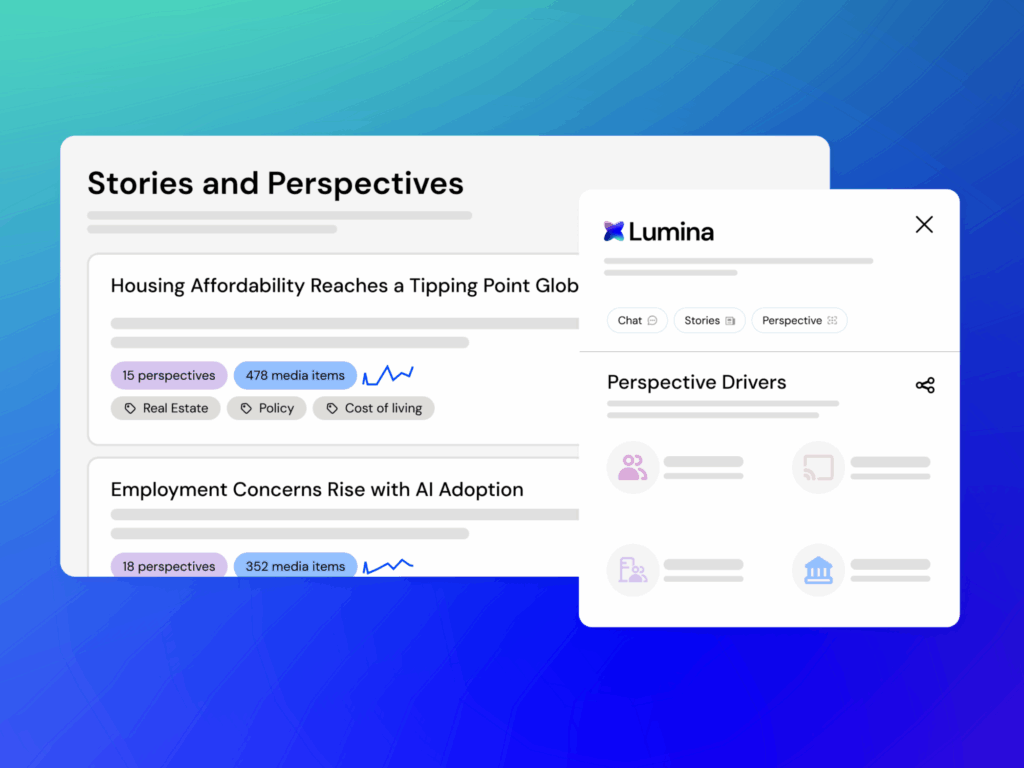
Stories & Perspectives organizes raw media mentions into clustered, cohesive Stories, and the Perspectives that exist within each, reflecting distinct media, audience, and public affairs angles. This unique functionality allows users to:

  • Rise above the noise: Instantly identify which high-level topics are gaining momentum or fading from attention.
  • Get to the detail, fast: Uncover the influential voices, niche communities, and specific channels actively shaping the narrative.
  • Catch the pivot point: Precisely identify the moment a story shifts—from a strategic opportunity to a reputation risk—or when a new key opinion former begins guiding the conversation.

"Media isn’t a stream of mentions," said Kyle Lindsay, Head of Product at Pulsar Group. "But rather a living system of stories shaped by competing perspectives. When you can see those structures clearly, you gain the ability to understand issues as they form, anticipate how they’ll evolve, and act with precision. That’s what we mean when we talk about AI built for communicators, and that's what an off-the-shelf LLM can't give you."

The Lumina Roadmap: AI tools for the future of comms

The launch of Stories & Perspectives is the first release of many. Over the upcoming months, we will systematically roll out the full Lumina roadmap, introducing a comprehensive set of AI tools engineered to handle every phase of the communications lifecycle.

The full Lumina suite will soon incorporate:

  • Curated media summaries: AI-driven daily summaries customized specifically to the priorities of senior leadership, highlighting only the most relevant stories.
  • Reputation analysis: Advanced measurement tracking how critical themes like ethics, innovation, and leadership are statistically shaping corporate perception.
  • Press release & media relations assistant: Tools designed to accelerate content creation and craft hyper-focused, personalized pitches that reach the precise contacts faster.
  • Predictive intelligence layer: Technology engineered to track and anticipate story momentum and strategic change before the window of opportunity closes.
  • Intelligent agents: Background agents continuously scanning all media channels for emerging key spokespeople and previously undetected reputation risks.
  • Enhanced audio, broadcast & crisis detection: Complete, real-time oversight of all channels—including audio and broadcast—enabling rapid context building and optimal crisis response delivery.


Want to harness the power of Lumina AI for your PR, Comms, or Public Affairs team? .

Complete the form below to register your interest.

" ["post_title"]=> string(79) "Announcing Lumina: The purpose-built AI suite for PR, Comms, and Public Affairs" ["post_excerpt"]=> string(129) "An intelligent suite of AI tools trained on the language, workflows, and realities of modern public relations and communications." ["post_status"]=> string(7) "publish" ["comment_status"]=> string(4) "open" ["ping_status"]=> string(4) "open" ["post_password"]=> string(0) "" ["post_name"]=> string(76) "announcing-lumina-the-purpose-built-ai-suite-for-pr-comms-and-public-affairs" ["to_ping"]=> string(0) "" ["pinged"]=> string(0) "" ["post_modified"]=> string(19) "2025-12-09 09:39:52" ["post_modified_gmt"]=> string(19) "2025-12-09 09:39:52" ["post_content_filtered"]=> string(0) "" ["post_parent"]=> int(0) ["guid"]=> string(32) "https://www.isentia.com/?p=43742" ["menu_order"]=> int(0) ["post_type"]=> string(4) "post" ["post_mime_type"]=> string(0) "" ["comment_count"]=> string(1) "0" ["filter"]=> string(3) "raw" }
Blog
Announcing Lumina: The purpose-built AI suite for PR, Comms, and Public Affairs

An intelligent suite of AI tools trained on the language, workflows, and realities of modern public relations and communications.

Ready to get started?

Get in touch or request a demo.