Blog post
June 25, 2019

It’s time to jump on that bandwagon

Isentia’s Russ Horell on social media, influencers and the future of journalism.

Gone are the days of media monitors delivering clients a package of newspaper cutouts each morning, but that doesn’t mean monitoring is no longer required.

Rather, it’s as important than ever clients have a pair of eyes on the news gaining attention across the expanding media landscape. 

Russ Horell, Isentia’s New Zealand country manager, has been in the media monitoring world for 11 years and in that time has seen it go from a job of cutting out newspapers and faxing them through to clients, to broadening the view to cover websites and social media, and feeding all the media to clients via an app.

“It seems like a light year ago”, says Horell when thinking about how far news media has come since the morning newspaper was the news breaker, adding that while it can be daunting and tempting for clients to run and hide, it should rather be seen as an amazing opportunity to talk to customers, voters or whoever their audience might be.

“If anyone is not embracing social media then it’s time to jump on that bandwagon.”

And because social media happens in real time, unlike a newspaper going to the printer the night following the news, monitoring social media raises the importance of knowing what is happening in real time.

“If you are just looking at what happened yesterday, you’ve got your eye off the ball.”

Machine learning

In response to these changes, Isentia has jumped on a bandwagon to improve its offer to clients. It’s working with the machine learning aspect of AI to take a wider scope with its monitoring, looking beyond client’s specified search terms that they know they are interested in, in order to create a bigger picture. 

“Growing up and watching Blade Runner and The Terminator, it seemed a bit grim. But we think of machine learning as something that can do those tedious tasks a lot better and quicker so we can do more creative things,” says Horell.

Giving Ford as an example, he says it can cluster stories relating to other automotive brands and industry topics as well as just stories about Ford and its people. It will also look at how important stories are based on how many people are looking at them and whether it’s controversial or positive feedback.

“No longer are clients saying: ‘I’m going tell you what I need to know and then you tell me when it happens’. It’s us saying: ‘Hey, there’s something that’s happening here, it’s getting bigger and you need to be across’.”

And not only can it see what is happening in real time, Horell adds AI is also allowing it to assess and predict the best strategy to moving forward by taking a look at what did and did not work, in past scenarios.

The rise of the influencers

In clustering stories and looking at all forms of media to see what’s earning attention, an unexpected outcome has been going down what Horell calls “the rabbit hole” of influencers.

He says they’ve been popping up alongside stories on the front pages of The New Zealand Herald and questions are being raised about the importance of their influence and monitoring of Instagram and influencers.

Looking at Asian markets as an example of why attention needs to be paid, he says those social influencers can have the same credibility as news media. Tech Wire Asia, elaborates on this point saying influencers are taking off due to Asia Pacific’s highly social populations.

However, the same article questions whether the influencer market bubble is bursting as the audience is becoming hardened to commercially-motivated posts. It suggests digital marketers revise their approach if their messages are not to get dismissed.

Looking closer to home at New Zealand and Australian markets, Horell says while influencers may not take off to the same level here as that in Asian markets, the same fundamentals apply and the early adopters who get it right have a big opportunity to be ahead of the curve.

“We think it’s here to stay and we can look to our Asian brothers and sisters to see what’s it’s going to look like here in few years’ time.”

Homing in on the media

And beyond the innovation taking place in Isentia to monitor media across all media in all places, it’s also looking at location-based monitoring and homing in on an area to see what’s going on there.

Horell gives the example of the Gold Coast 2018 Commonwealth Games, at which Isenta will be analysing and evaluating all media coverage received to up to and during games.

To do that, it’s created ring fencing around stadiums to see what people are talking about within the area. Whether it’s the queues or warm beer, the insights will enable it to identify key markets, customise messaging and track sentiment to ‘Share the Dream’ – the campaign line for the games.

When it was announced that Isentia was the official supplier to the Gold Coast 2018 Commonwealth Games back in February last year, it was already able to show the mascot—a blue surfing Koala called Borobi—had generated more than 3000 news articles since April 2016.

From letters to comments

Referring back to the days of cutting out newspaper articles, another change in the media landscape is those with opinions to share no longer putting pen to paper in a letter to the editor.

Now, they can comment directly below a social post or a news story, and when Horell put it to clients to identify their most important social media platforms at a recent event, comment sections sat alongside Snapchat and Neighbourly.

“Comment sections give new life and legs to stories,” he explains, adding that it’s only if the website allows.

Some, like RNZ, have disabled comments as well-researched options would descend into a few people bickering among themselves.

“It’s fine for something to go off-topic but not wildly off-topic and frankly between that and moderating comments through Facebook, and we get vastly more comments on Facebook, we thought it better to focus on those areas,” said RNZ community engagement editor Megan Whelan when speaking to StopPress about the decision.

Thinking about the irrelevant and incorrect comments that comment sections can attract, Horell looks at the move to paywalls – pointing out NZME’s announcement earlier this year that it plans to put a one around its premium journalism – and how they may have an impact on the tone of comments.

He says suggestions have been made that the point of view of comments sections may become limited to those who chose to pay to get behind the paywall.

The future of journalism

In the same way Isentia has changed the way it’s monitoring the media for clients, Horell sees the way in which journalists search for stories changing—so much so the days of press releases may be limited.

“There are so many different avenues and ways to get your message out there,” he says, giving the examples of Facebook and Twitter. So rather than sending out a press release to break a story, he sees them needing a rethink to possibly be something that directs people back to a website.

And looking further into the future, Horell says Isentia us looking into how its products will be able to sit within Google Glass or a chip that might integrate news into people’s lives.

“If I’m going to an interview with you, my app will tell me all the news articles you have written over the last 20 days so I can keep up to date with what you are doing and it will show me your LinkedIn profile so I know you connect with people that I also connect with, so we’ll have things to talk about. On top of that, I’ll know on my way there that there will be roadworks.”

It’s an advancement that may have some quiver in fear, but Horell points out it should be seen as something that’s “more exciting than worrying”.

“Our lives will become more customised and things like AI will allow that.”

Originally published at stoppress.co.nz.

Share

Similar articles

object(WP_Post)#7666 (24) { ["ID"]=> int(1811) ["post_author"]=> string(2) "36" ["post_date"]=> string(19) "2019-06-24 22:26:08" ["post_date_gmt"]=> string(19) "2019-06-24 22:26:08" ["post_content"]=> string(2766) "

Who will win – journalists, influencers or something else?

Unlike the popular television program, it’s harder to distinguish the ‘voice’ that’s connecting with the most people or generating the most impact. It’s noisy, changing and diverging as new technology and behaviours’ continue to change at rapid pace.

The mixture of voices from traditional journalists and radio jockeys to social influencers and television personalities seems to have grown almost overnight. And while the growth of this noise isn’t new, it’s interesting to watch the overlap that’s happening already – and to question whether it’s one, or a combination of all that will win out in the end.

For those in Communications and Marketing, it’s intriguing to watch the disruption that this is having on the industry. The swell of activity for communicators and marketers to understand (at speed) the integrated approaches and the numerous voices that exist to help get their messages across is exciting to watch, as it also has the potential to be more dynamic.

While traditional journalists experience shifts in their mediums, their roles and core responsibilities have seemingly remained largely unchanged. However, for many social influencers there’s an interesting struggle occurring between creativity and business. Not only do you need to nail your content, you must also have a sound business knowledge to ensure you aren’t caught off guard by the algorithms at play and their potential to harm further growth. 

We’ve seen countless examples of former TV stars turn radio jockeys – some more successful than others – but wouldn’t it be interesting to see the same with journalists turn influencer, or vice versa?

In the example shared by Bottle for Botol below, the argument could be made that this strikes a nice balance between both. Fulfilling the more traditional journalistic needs to find and present information, while leveraging social channels to distribute the message.

We may not know who will win yet, but it’s sure to be an interesting finale.

" ["post_title"]=> string(9) "The voice" ["post_excerpt"]=> string(155) "Unlike the popular television program, it’s harder to distinguish the ‘voice’ that’s connecting with the most people or generating the most impact." ["post_status"]=> string(7) "publish" ["comment_status"]=> string(4) "open" ["ping_status"]=> string(4) "open" ["post_password"]=> string(0) "" ["post_name"]=> string(9) "the-voice" ["to_ping"]=> string(0) "" ["pinged"]=> string(0) "" ["post_modified"]=> string(19) "2019-06-25 07:46:07" ["post_modified_gmt"]=> string(19) "2019-06-25 07:46:07" ["post_content_filtered"]=> string(0) "" ["post_parent"]=> int(0) ["guid"]=> string(36) "https://isentia.wpengine.com/?p=1811" ["menu_order"]=> int(0) ["post_type"]=> string(4) "post" ["post_mime_type"]=> string(0) "" ["comment_count"]=> string(1) "0" ["filter"]=> string(3) "raw" }
Blog
The voice

Unlike the popular television program, it’s harder to distinguish the ‘voice’ that’s connecting with the most people or generating the most impact.

object(WP_Post)#9085 (24) { ["ID"]=> int(48739) ["post_author"]=> string(2) "75" ["post_date"]=> string(19) "2026-07-23 02:33:57" ["post_date_gmt"]=> string(19) "2026-07-23 02:33:57" ["post_content"]=> string(14557) "

The Australian public’s reaction to government reforms and leaders was especially eventful. Debates about campus safety by the Royal Commission, a tax deal between Labor and the Greens unsettling the finance and property sectors, and a speech on “monoculture” by Pauline Hanson shifting opinion polls in an unexpected way; were three complex stories that saw audiences taking different sides, leading to many perspectives and angles.

We used Isentia's Lumina to track the different viewpoints, key people, and stories with the largest volume and audience. Over four weeks (22 June to 17 July), we found 62 unique perspectives and nearly 900 media items across these three stories.

Key Stories, Key Drivers

Here’s a quick overview:

The Royal Commission on campus anti-semitism

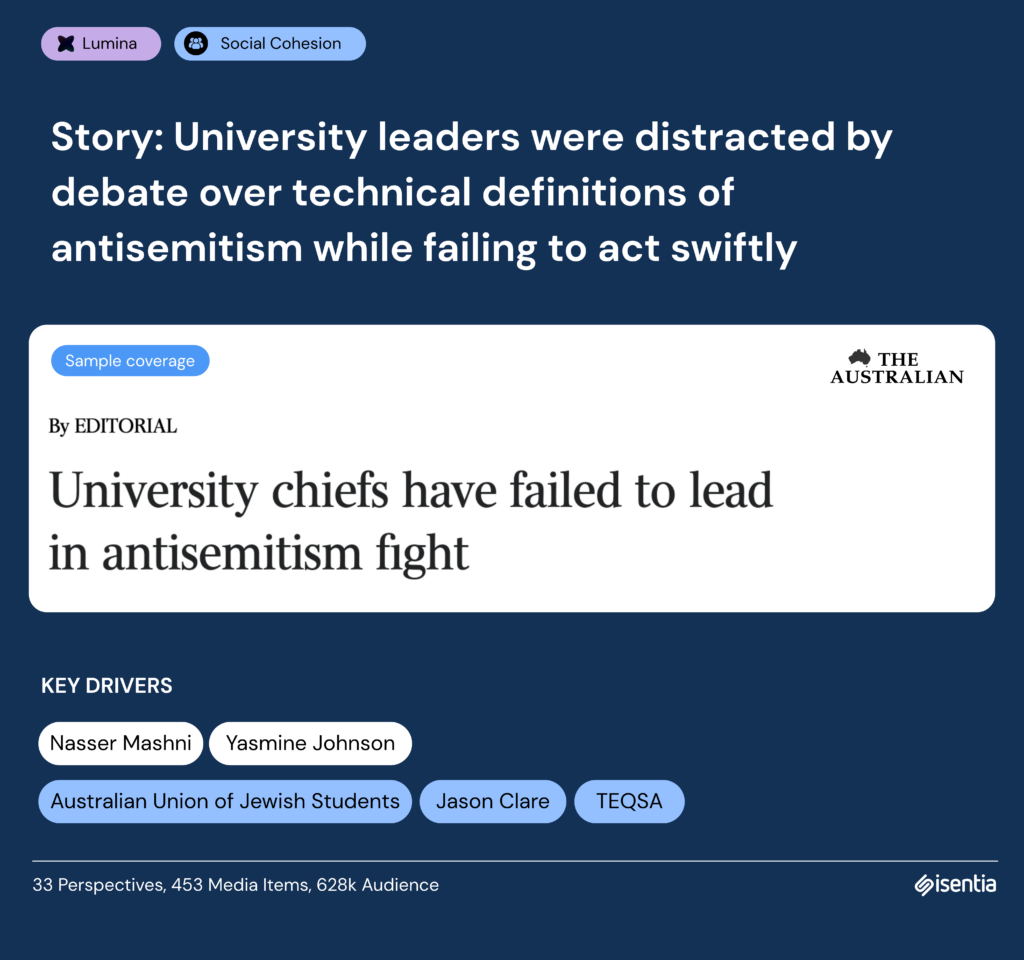
The Royal Commission on Antisemitism and Social Cohesion’s hearings on university campuses was the biggest story by far. In less than a week, it drew 33 perspectives and 453 media items, reaching over 628k audiences. The story’s size came from the many institutions involved—student groups, representative bodies, and the federal government—each offering their own view on the same testimony.

Pro-Palestinian advocacy groups had the widest reach, making up about a third of all coverage. Spokespeople like Yasmine Johnson from Students for Palestine and Nasser Mashni from the Australia Palestine Advocacy Network told the commission their campus protests are a legitimate justice movement. They also raised concerns that criticism of government policy is being confused with antisemitism, which they say limits open debate.

Jewish student and staff groups also received significant coverage, making up about a fifth of the total. The Australian Union of Jewish Students described campuses where some students feel hesitant to attend and highlighted gaps in how universities handle complaints and support those affected. Most of this coverage came from wire services and was widely shared across news outlets like The Australian or the Midwest Times.

The federal government provided a third perspective, with similar coverage. Education Minister Jason Clare said universities had been slow to act and announced plans to tighten governance standards. This includes clearer anti-racism policies covering both antisemitism and Islamophobia. Reports also noted that TEQSA, the regulator, warned universities about outside groups joining campus protests, and the government’s antisemitism envoy suggested universities could face funding cuts if they do not do enough.

The Labor-Greens Tax Deal

The second-biggest story was more focused but still managed to stir strong reactions. Labor’s deal with the Greens to close a borrowing loophole for self-managed super funds, in return for Greens support on capital gains tax and negative gearing changes, led to 22 perspectives and 232 media items, reaching nearly 177k audiences.

The government, supported by the Greens, presented the deal simply — it closed a loophole that allowed wealthy investors to use their super funds to compete with first-home buyers at auctions. Treasurer Jim Chalmers cited a 2014 recommendation to support the change, and Greens treasury spokesman Nick McKim called it a win against "wealthy property investors."

The Greens, however, took a tougher stance and received similar coverage for saying the deal was only a partial win. They argued that allowing existing arrangements to continue would let Labour protect wealthy investors rather than renters, and said the housing crisis would now be "squarely of Labor's design." This shows that support from a governing partner does not always mean they are satisfied, as Country News highlighted.

Finance and business groups pushed back with nearly as much coverage. The Self-Managed Super Fund Association and the Australian Finance Industry Association said the borrowing rules did not pose a systemic risk and argued that regulators should focus on "aggressive marketing" and property spruiking, not legitimate investors. The Australian Chamber of Commerce and Industry warned that the wider capital gains tax changes could hurt business investment. ABC News gave the most detailed account of this perspective, noting the sector was "surprised" by how the deal was made.

Pauline Hanson’s monoculture speech

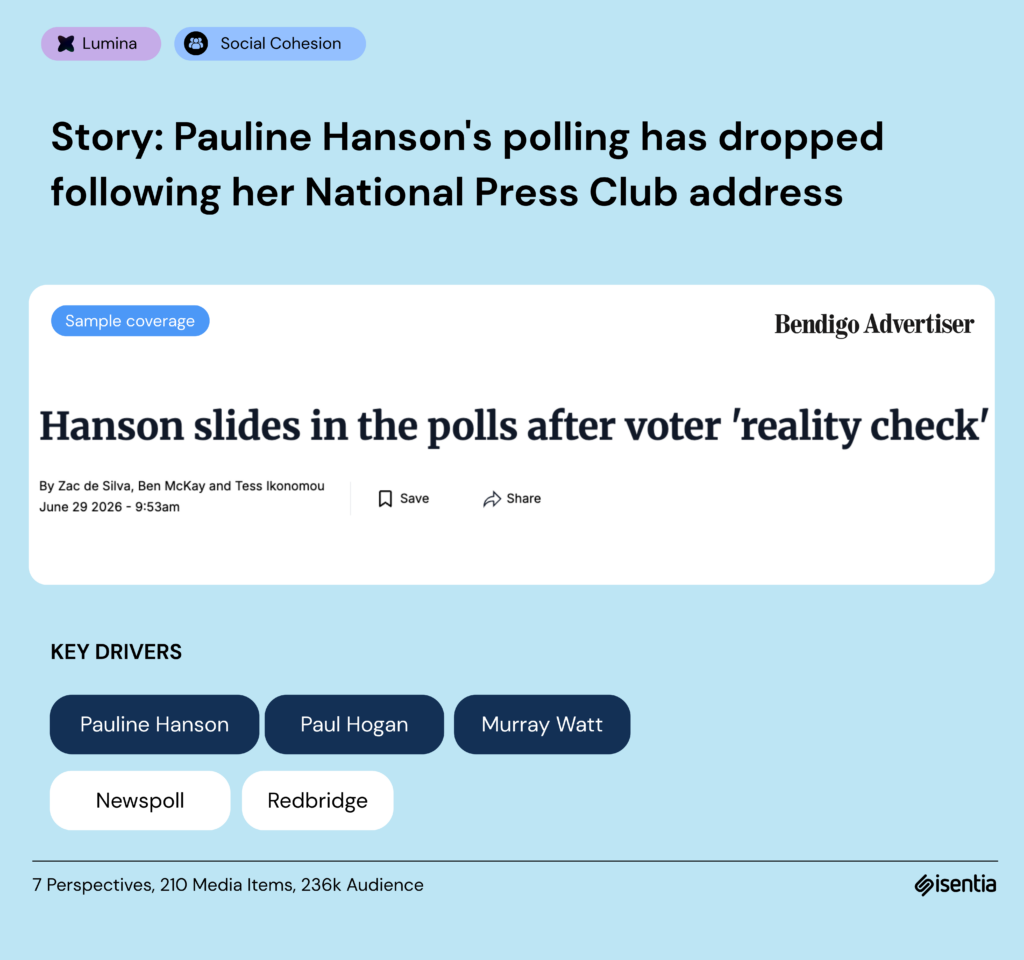
This story had the fewest perspectives (just seven) but still reached nearly 236k people through 210 media items. That’s a bigger audience than the tax story, which had three times as many viewpoints.

The story began when Pauline Hanson used a National Press Club speech to argue that Australia should replace multiculturalism with a single "monoculture." She cited Paul Hogan and the Socceroos as examples. The backlash was quick and unexpected and Hogan himself called her a "pelican" and said her views were racist. His response ended up shaping the story more than her monoculture speech.

What makes this story notable is what happened afterward. Two polls, Newspoll and Redbridge, showed One Nation’s primary vote dropping by about two points (Dairy News Australia) and Hanson’s personal approval falling ten points into negative territory. Labor regained a narrow lead and Labor minister Murray Watt quickly described the numbers as a "reality check,". This framing spread almost as widely as the original speech, as the Bendigo Advertiser reported.

The speech and the poll results are really one story seen from three sides — Hanson’s message, her critics’ reactions, and Labor’s use of the polling. Each angle received similar coverage, showing that the speech missed its mark and gave the government a useful talking point.

How does this inform PR & Comms Strategy?

First, the number of perspectives in a story is important. A story with many viewpoints, like the antisemitism hearings, needs a different monitoring approach than one with just a few, because the loudest voices might not always be the most important.

Second, pay attention when several perspectives are about the same size, as in the tax deal. If no single viewpoint stands out, the issue is likely still being debated. It’s a good idea to check back after some time instead of treating the first coverage as the final answer.

Third, compare any polarising message to the Hanson example before recommending it to a client. The numbers show that a divisive message can get attention but still turn public opinion against the speaker.

Conclusion

What links these stories is how much is lost when they are reduced to just two sides. The antisemitism hearings, the tax deal, and Hanson’s polling drop were all more complex than their main headlines suggested.

That’s why it’s valuable to track a story by its different perspectives and key drivers. See what Lumina can reveal for your industry or clients, and check out more analysis like this on the Isentia blog


" ["post_title"]=> string(61) "Who really shaped Australia's latest social cohesion debates?" ["post_excerpt"]=> string(170) "See how Isentia's Lumina tracked 62 perspectives across 3 major Australian stories, revealing how media coverage really spreads and who ends up controlling the narrative." ["post_status"]=> string(7) "publish" ["comment_status"]=> string(4) "open" ["ping_status"]=> string(4) "open" ["post_password"]=> string(0) "" ["post_name"]=> string(59) "who-really-shaped-australias-latest-social-cohesion-debates" ["to_ping"]=> string(0) "" ["pinged"]=> string(0) "" ["post_modified"]=> string(19) "2026-07-23 02:35:20" ["post_modified_gmt"]=> string(19) "2026-07-23 02:35:20" ["post_content_filtered"]=> string(0) "" ["post_parent"]=> int(0) ["guid"]=> string(32) "https://www.isentia.com/?p=48739" ["menu_order"]=> int(0) ["post_type"]=> string(4) "post" ["post_mime_type"]=> string(0) "" ["comment_count"]=> string(1) "0" ["filter"]=> string(3) "raw" }
Blog
Who really shaped Australia’s latest social cohesion debates?

See how Isentia’s Lumina tracked 62 perspectives across 3 major Australian stories, revealing how media coverage really spreads and who ends up controlling the narrative.

object(WP_Post)#12042 (24) { ["ID"]=> int(47963) ["post_author"]=> string(2) "75" ["post_date"]=> string(19) "2026-06-03 02:01:58" ["post_date_gmt"]=> string(19) "2026-06-03 02:01:58" ["post_content"]=> string(5651) "

There is a new frontier where public perception is shaped: Large Language Models. Right now, LLMs are answering critical questions about your organisation. What are they saying? And more importantly, which sources are shaping those answers?

To navigate this landscape, public relations professionals don't need generic tools, but rather technology that speaks their language, and addresses the realities of a changed media and informational landscape.

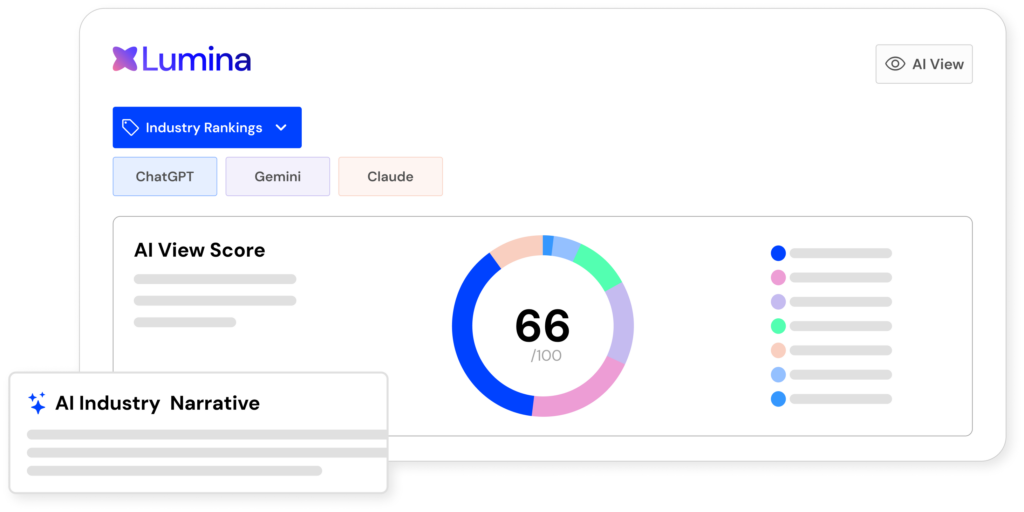
That is why we're unveiling Lumina AI View, the latest addition to our intelligent suite of AI tools from Isentia. Trained specifically on the workflows and challenges of modern PR & communications, Lumina AI View helps you understand exactly what AI knows about you, and how it learned it.

A new standard for AI visibility

AI View tracks your citation strength and source quality alongside those of your competitors, giving you a clear view of where you hold authority and where you have gaps.

Lumina AI View maps your AI reputation from the ground up, allowing you to:

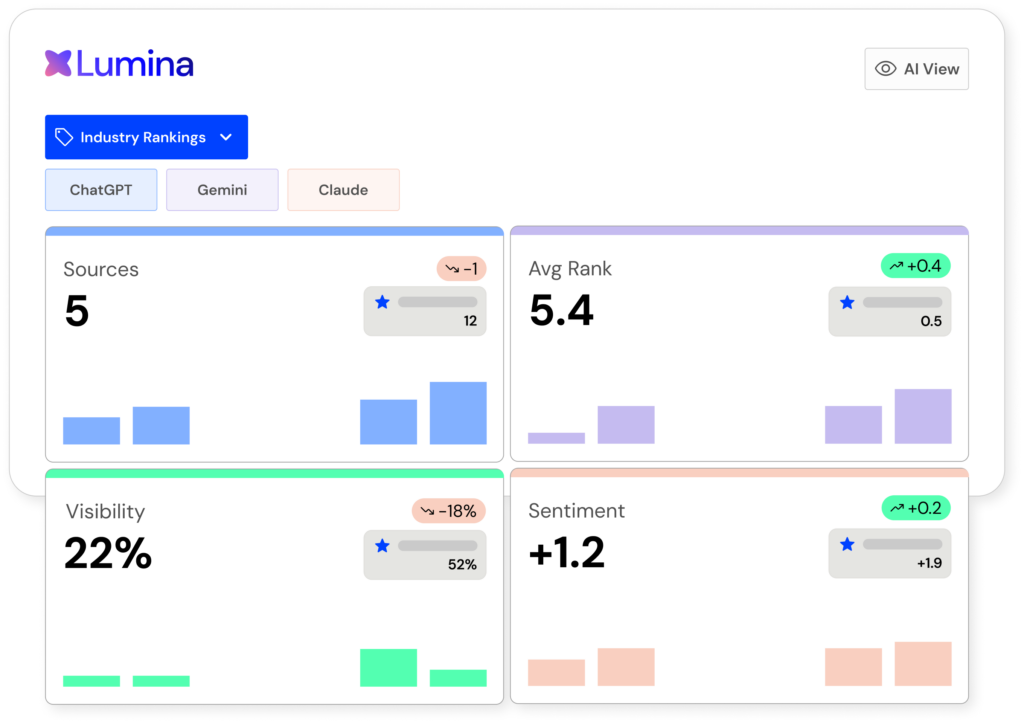
  • See which sources matter: When tools such as ChatGPT or Gemini discuss your organisation, which outlets do they cite? Track your source footprint over time and view the impact of key target media on how you’re discussed. We measure your citation strength and source quality alongside those of competitors, giving you a clear view of where you have authority and where you have gaps.
  • Gain industry-specific insight: Your competitors get cited from Financial Times and Bloomberg. You get cited on Reddit. Each brings opportunity – and risk. Discover how you measure up against industry standards, and target the sources that actually influence how AI represents you.
  • Catch narrative shifts early: AI responses change when new sources appear, sentiment shifts, or old controversies resurface. Get alerts when citation patterns change suddenly, before they impact the way you’re perceived by stakeholders.

Measure your progress: From media monitoring to full media intelligence

Lumina AI View is built on the principle that insights get stronger with repeated measurement. To help you maintain a clear view of your reputation, our proprietary scoring system provides regular updates that show you:

  • Evolving trends in how sources cite your organisation
  • Competitive standing and benchmark metrics
  • Where models differ in information presented, and sources cited 

Whether you run it weekly, on-demand, or whenever you need a check-in, patterns will emerge, trends will become clear, and you will build a baseline that makes any sudden narrative changes both comprehensible and the prerequisite to action.

Lumina AI View is part of Lumina AI, a comprehensive suite of AI tools built specifically for communicators. Our Lumina suite evolves traditional media monitoring into narrative intelligence, enabling you to truly understand how perceptions form, evolve, and impact your reputation.


Get in touch to register your interest and see what Lumina AI View can do for you.

" ["post_title"]=> string(66) "Introducing Lumina AI View: AI Visibility Built for PR & Comms" ["post_excerpt"]=> string(158) "Lumina AI View, the latest in Isentia's AI suite, is trained on PR & comms workflows to help you understand what AI knows about you — and how it learned it." ["post_status"]=> string(7) "publish" ["comment_status"]=> string(4) "open" ["ping_status"]=> string(4) "open" ["post_password"]=> string(0) "" ["post_name"]=> string(59) "introducing-lumina-ai-view-ai-visibility-built-for-pr-comms" ["to_ping"]=> string(0) "" ["pinged"]=> string(0) "" ["post_modified"]=> string(19) "2026-07-15 03:12:57" ["post_modified_gmt"]=> string(19) "2026-07-15 03:12:57" ["post_content_filtered"]=> string(0) "" ["post_parent"]=> int(0) ["guid"]=> string(32) "https://www.isentia.com/?p=47963" ["menu_order"]=> int(0) ["post_type"]=> string(4) "post" ["post_mime_type"]=> string(0) "" ["comment_count"]=> string(1) "0" ["filter"]=> string(3) "raw" }
Blog
Introducing Lumina AI View: AI Visibility Built for PR & Comms

Lumina AI View, the latest in Isentia’s AI suite, is trained on PR & comms workflows to help you understand what AI knows about you — and how it learned it.

Ready to get started?

Get in touch or request a demo.