Can we really understand the mysterious and random virality of social media? In an immense sea of content, how do we predict which trends will generate enough movement to form a wave?
Some trends can be picked ahead of their time, however the explosiveness of a random tweet, call-to-action or cat video is almost impossible to pin-point.
While trends will mostly fade back and be replaced with another, the occasional and rare trend can have legitimate and measurable impacts on society. A recent example of this is the anti-plastic straw movement that took off in 2018.
It started with a terribly sad and visceral video of a straw being removed from the nose of a sea turtle – it’s likely you’ve seen it yourself. The internet is filled with images and videos relating to the impacts of pollution and climate change on the wildlife, however this video happened to stick in the social media sphere long enough to cause a stir.
In the context of environmental upset and helplessness, the plastic straw became the epitome of our harmful single-use plastic culture. In the space of a couple of months, plastic straws were disappearing from venues and public discourse stigmatised their use. Massive chain restaurants such as McDonalds and Starbucks announced plans to ban the plastic straw, as well as some cities and countries introducing bans or taxes on similar single-use products.
While this is ultimately a positive movement with good intention, rejecting the use of plastic straws is an easy and short-term relief to an overwhelming frustration with single-use consumer culture. This year we’ve been seeing similar trends emerge with the rise of keep-cup popularity and debates over plastic bags in super markets.
These trends may be tokenistic, however, they are telling of widespread sentiment and signify the public’s desire to be heard and responded too.
Loren is an experienced marketing professional who translates data and insights using Isentia solutions into trends and research, bringing clients closer to the benefits of audience intelligence. Loren thrives on introducing the groundbreaking ways in which data and insights can help a brand or organisation, enabling them to exceed their strategic objectives and goals.
An organisation’s reputation is at its core, really how people feel about them. These feelings can be based on their interaction and knowledge of the brand, or their experience with the products and services the organisation provides. This reputation is important as it can often dictate the actions or choices audiences and buyers make, impacting an organisation financially and its ability to grow. If managed and measured, the value of an organisations reputation can safeguarded and used as a source of growth by strategically influencing key consumer’s consideration over the competition and the market more broadly.
People can interact directly with an organisation more than ever before, on social media, targeted advertisements, in-store experiences, customer support to name a few.
Given how wide reaching reputation is, how would your organisation make improvements given that it encompasses ‘everything’ an organisation does? What would be an efficient channeling of resources?
Social media is a great place to listen to the voice of consumers and key audiences who choose to voice their experiences online. It provides insight into what your organisation has done well or needs to do better. When used in conjunction with additional data, like survey analysis it can also reveal what channels and content are contributing to this perception, and how this can be shifted. Drawing from online resources and social media, Isentia has established 3 drivers to identify and quantify an organisation’s reputation.
1st Driver: Strategy
The first driver is about the future direction of an organisation.
Does your organisation have a strong leader? Does your organisation seek toinnovate? Does it shape the way society thinks? Is your organisation authentic in its messaging? Is your organisation likely to succeed?
When an organisation shows these qualities, it raises consumer trust and confidence, but it’s important that this is authentic. An example of this is Honestbee. Honestbee’s strategy covered several of these points - they were a fast expanding and innovative Singaporean startup in the online grocery delivery business. The founders focused on being perceived as successful, with plans for rapid expansion.
However, In October 2018, Habitat, the world’s first tech-integrated multi-sensory grocery and dining destination launched. Three months after the launch of Habitat, it was discovered Honestbee was deep in financial debt. This was a shock to the industry as Honestbee had a good strategy. Their downfall had been in their inauthentic messaging which resulted in the organisation losing trust of their consumers and investors.
2nd Driver: Culture
Culture is determined by the organisation having strong values and integrity.
Is the organisation socially responsible? Are practices fair and transparent? Do they promote a balanced workplace? Is it an environment where people aspire to work? Do they have ethical relationships with their business partners?
The growing number of organisations ‘going green’ is as good example of how the market can reflect and appeal to the values of today, in this case by demonstrating they're more environmentally conscious. In a 2019 Nielsen study, it was shown 1 in 3 consumers prefer eco- friendly products. Both Fairprice and Redmart, grocery chains in Singapore, also expressed growth in demand for their environmentally friendly products.
An organisation’s workplace culture, including ethical behaviour can also negatively impact an organisation. For example, Google was challenged for the way cases of sexual harassment were handled within the workplace. They were also challenged for questionable deals in AI technology that resulted in a protest of 20,000 employees across their offices. Google’s poor behaviour was exposed which led to criticism from Amnesty International and a backlash on social media.
3rd Driver: Delivery
Delivery is how good an organisation is at delivering on it’s day to day business.
Do people perceive the organisations products are good quality? Are the products well received? Is the organisation well knownin the industry? Do customers have a good experience? Are they successful?
A good example of how delivery can be analysed is in the sphere of reputation is the case of, Razer Inc. known as an organisation passionate about gaming. With a tagline ‘For Gamers. By Gamers’, they are well known in the gaming industry for supply gaming software, hardware and accessories.
According to their annual report, their revenue last year, hit an all-time high of 712 billion US dollars. While online reviews of their mostly praise the high quality of Razer products, a common complaint on sites such as trustpilot.com, Reddit and Forum Hardwarezone are about slow or unhelpful customer support. Some customers even expressed that due to the poor customer support for products, they were even considering switching brands. This signals an opportunity. While Razer Inc has performed well financially and seemingly has a message that appeals to their key consumer, by improving their touchpoint experience and capacity to deliver they could potentially eclipse the competition and swing those who were apathetic towards other brands.
This is just a small glimpse of how your organisation’s reputation can be analysed and measured by a combination of social media data and more traditional market research techniques. Executing a broad analysis of your organisation based on the 3 drivers of Strategy, Culture and Delivery, we can assist in gauging your organisation’s reputation and how it fares against competitors. With a clear metric for overall reputation and a breakdown of performance by driver, Isentia's Reputation Analysis helps your organisation identify areas for improvement and where there are opportunities to strengthen PR, marketing and engagement strategies.
An organisation’s reputation is at its core, really how people feel about them. These feelings can be based on their interaction and knowledge of the brand, or their experience with the products and services the organisation provides. This reputation is important as it can often dictate the actions or choices audiences and buyers make, impacting […]
The advent of LLMs and AI search means that there has been a colossal shift in how audiences are consuming information today, and a reciprocal shift in how all types of organisations, from government agencies to brands are responding . But while discussion amongst PR and comms pros tends to fall disproportionately on how brands are impacted, the needs of the former are just as keenly felt, and often quite distinctive.
So how can government agencies respond, especially in a time of global flux, when major policy changes need to be communicated and important stakeholders need to be managed? After all, government organisations do care about reputation, much as brands do, but have quite distinctive goals when it comes to ensuring accurate information reaches the right audiences.
There is a new entry point for stakeholders
The era of "Let me Google that" is rapidly fading. Instead of clicking through to official websites, people are asking chatbots for direct answers. What’s striking is that government agencies often have no visibility on how they’re being talked about in the LLM space, even as it becomes a central channel for messaging and reputation.
When AI models become the primary gatekeeper, audiences bypass official portals entirely — driving down site traffic and leaving agencies vulnerable to misinformation, negative sentiment, or worse, being left out of the conversation altogether.
Therefore, the entry point is different. For commercial brands, this shift is profound but in some ways mediated – an FMCG brand, for instance, often discovered through third-party platforms in any case. But for government entities, the stakes are entirely different. As the sole, authoritative source for public information, they need citizens on their websites to get accurate details. Government agencies, especially if they are the authority or regulator in a particular industry or sector, need to make sure audiences know where to go to get the right information.
Different types of government agencies have different considerations
Not all government agencies are alike, and they all have different parameters that are quite non-negotiable for them, just by the way they function.
Service delivery agencies - these rely heavily on content freshness. They can’t risk outdated sources impacting eligibility or process changes not reaching audiences.
Regulators - these need to transmit authority and trust. Regulators have to make it a priority that they’re amongst the first place audiences go to for information and that the industry they’re regulating does not put them in the shade on the channels stakeholders are actually using
Policy departments - did the AI's account of a policy match what was actually announced? They want to be able to make sure the accuracy of a policy (and ideally, its effectiveness) is translated when audiences search through LLMs.
Local and state authorities want to make sure the services they carry out on behalf of locals are visible too. Much like service providers, there is a question around access and awareness of programmes and regulations, but also an added consideration: not appearing on LLMs discontent amongst those wishing to see a return on taxation and electoral mandates, and give credence to bad actors.
What do government agencies want to get out of this new LLM-mediated landscape?
Reputation is important, but that exists downstream from maintaining a flow of accurate information. It’s useful for communications teams in government organisations to self reflect and ask themselves the following questions:
Where are citizens going to find information about your services if not your website — and do you know what they're being told?
If there was a significant policy change or incident in the last twelve months, do you know how it's currently being characterised when someone asks an Al tool about your agency?
When you communicate a major service change or policy update, do you have any way of measuring whether it’s surfacing in searches about you?
How do you currently understand the gap between what your agency publishes and what citizens actually receive when they search for information?
Are there community groups, advocacy organisations, or media outlets shaping perception of your agency - and do you know if that's feeding into what Al models say?
These are gaps they already realise, but they don’t actually know what to do about it – how to manage or measure them. They need a tool that allows them to know this critical piece of information and make informed decisions.
Ngaire Crawford, Pulsar Group’s Executive Director for AI Strategy says, “It’s easy to disregard LLM reputation as part of a difficult AI landscape or something that is only really relevant to more product-based communication or marketing. Government communications is about social licence, and ensuring the public have access to up to date and accurate information about things that matter to them, the role that Generative AI plays in how a community understand an issue will only continue to grow, and knowing the impact that you can have in that through small shifts in channel strategies or more consistent messaging is a crucial part of the communications toolkit.”
Lumina AI View: AI visibility for PR & Comms
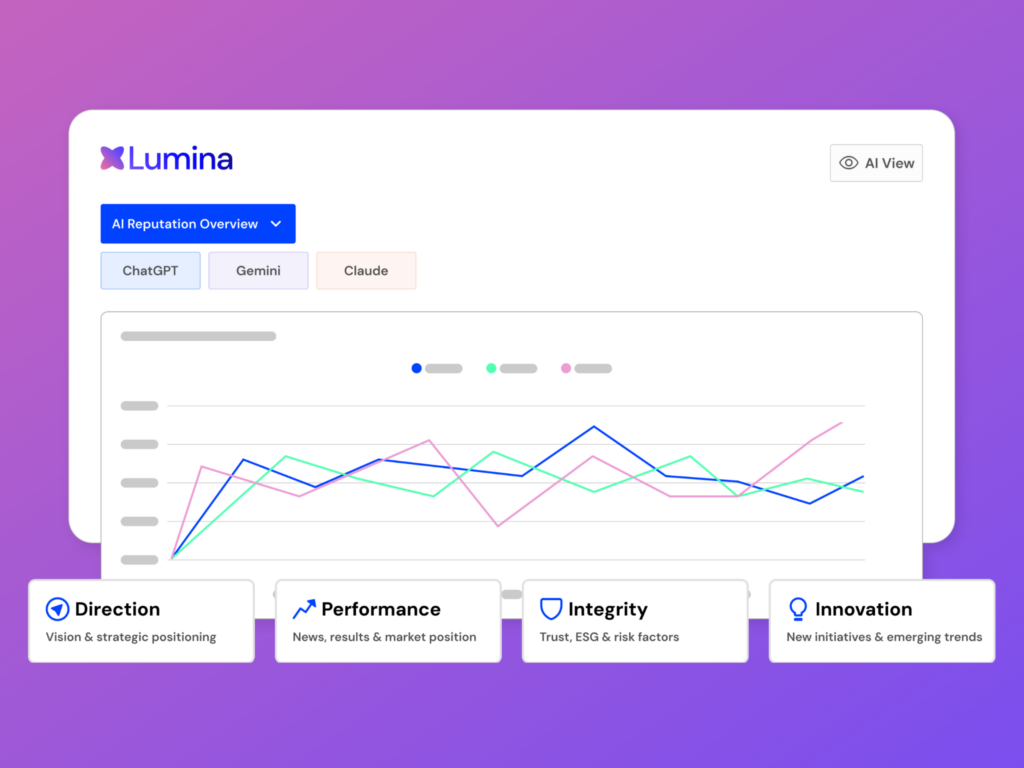
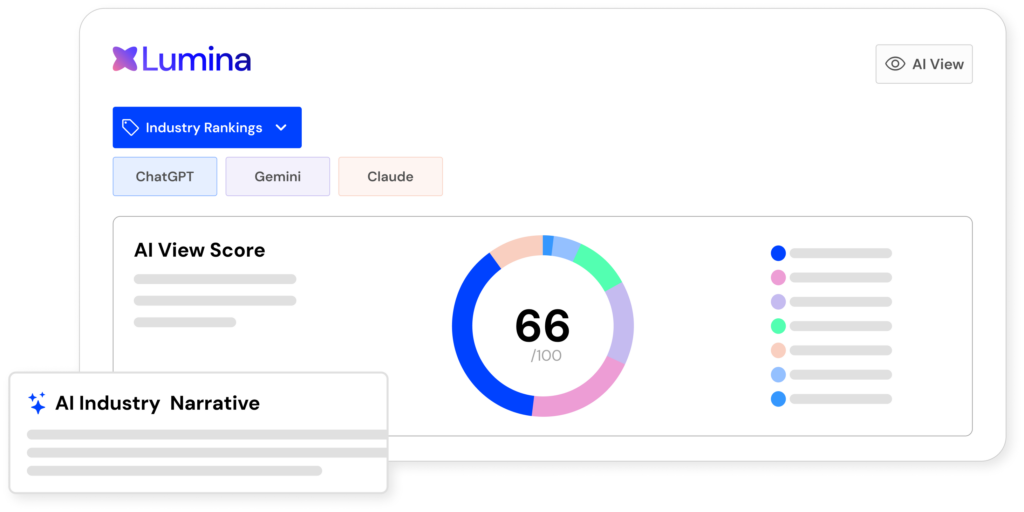
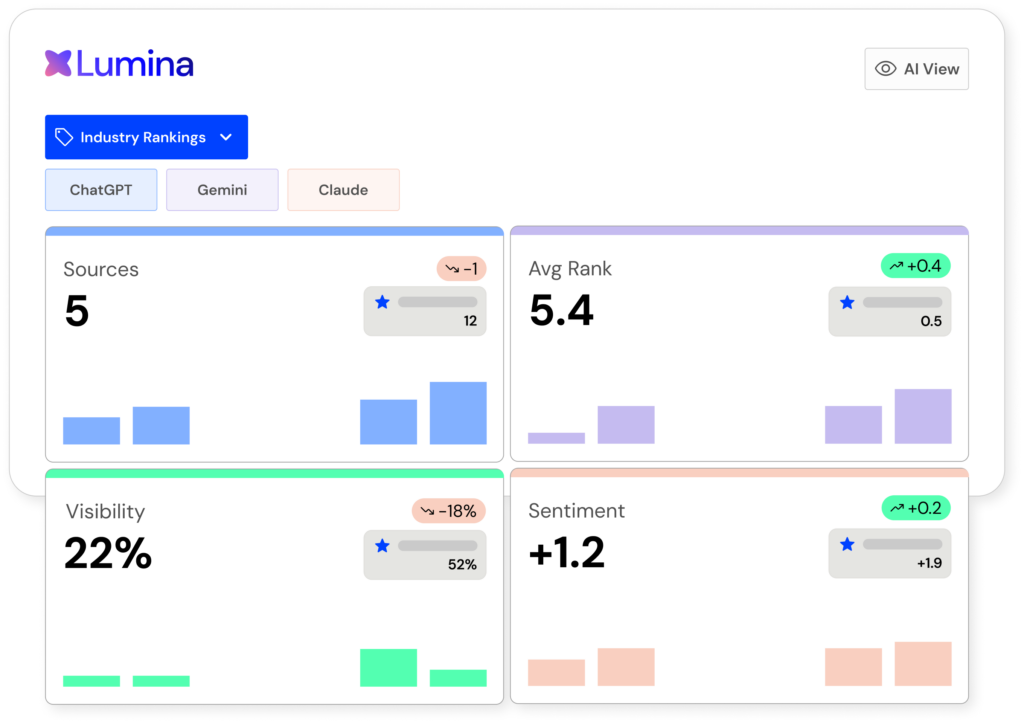
Lumina AI view is built for communicators who want to understand how their organisation and their competitors are being talked about by various AI models – including ChatGPT, Gemini, and Claude. AI View users get an insight into which sources are being cited, and how they would need to respond as a way of protecting their reputation or making sure correct information about them is being disseminated.
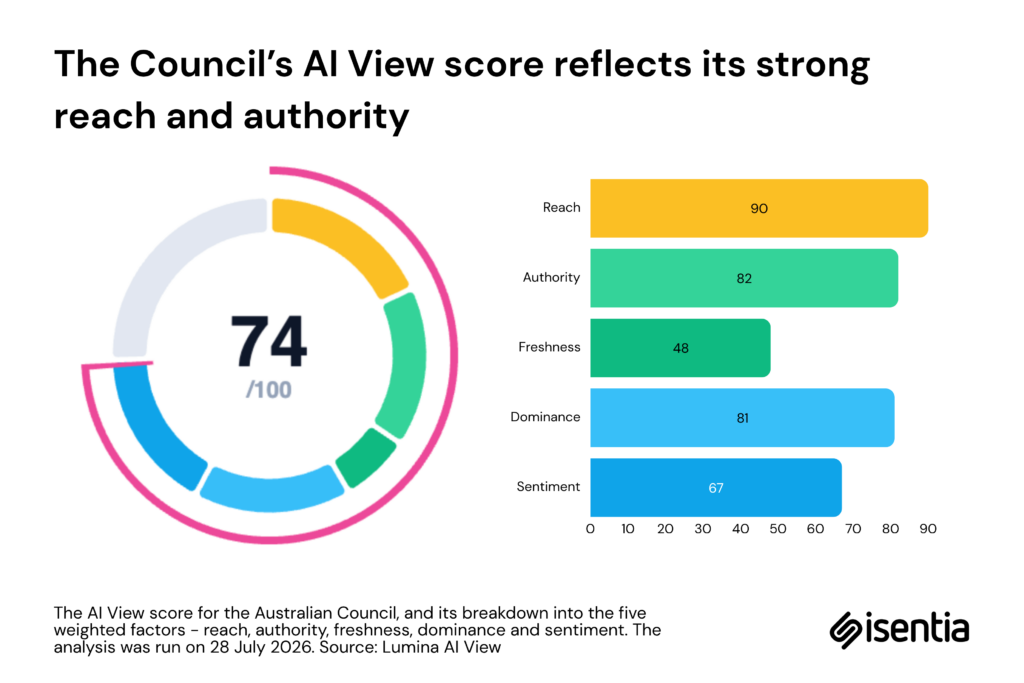
The tool provides an AI view score — a composite metric ranging from zero to 100, designed to help track brand performance over time and facilitate comparisons against competitors. It is calculated using five weighted factors — sentiment, visibility, authority, dominance and freshness. Beyond the overall score, the platform provides a summary of a brand's AI narrative based on four distinct reputation pillars — direction, performance, integrity and innovation.
These pillars help users identify exactly which dimension of a brand's reputation is under pressure, offering specific, actionable insights for board presentations or reviews. Ultimately, while the AI view platform provides the necessary intelligence, the strategic decisions regarding how to respond to these insights remain with the organisation.
Spotlight: An Australian Council
This progressive local government council is located in Australia’s leading center for culture and sports.
The council earned an AI view score of 74 reflected by strong reach and authority. Publications like CBD News and its own website are the most cited by LLMs — interestingly, most of them being cited by Claude.
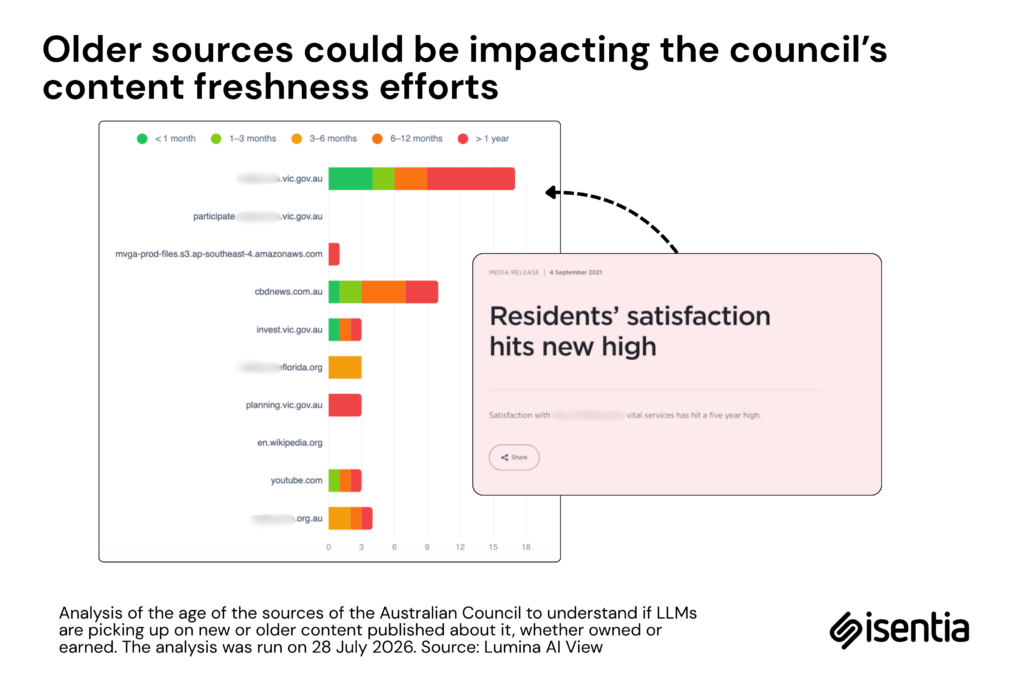
Content freshness scored lower at 48. Their website still carries error pages and annual reports from a few years ago. If a report — one that is seen as an organisation’s most comprehensive and authoritative content, is still being cited even if it’s older, might potentially be in the way of the organisation’s own perception. Which means more work is needed to prevent outdated content from still appearing.
What type of content is showing up?
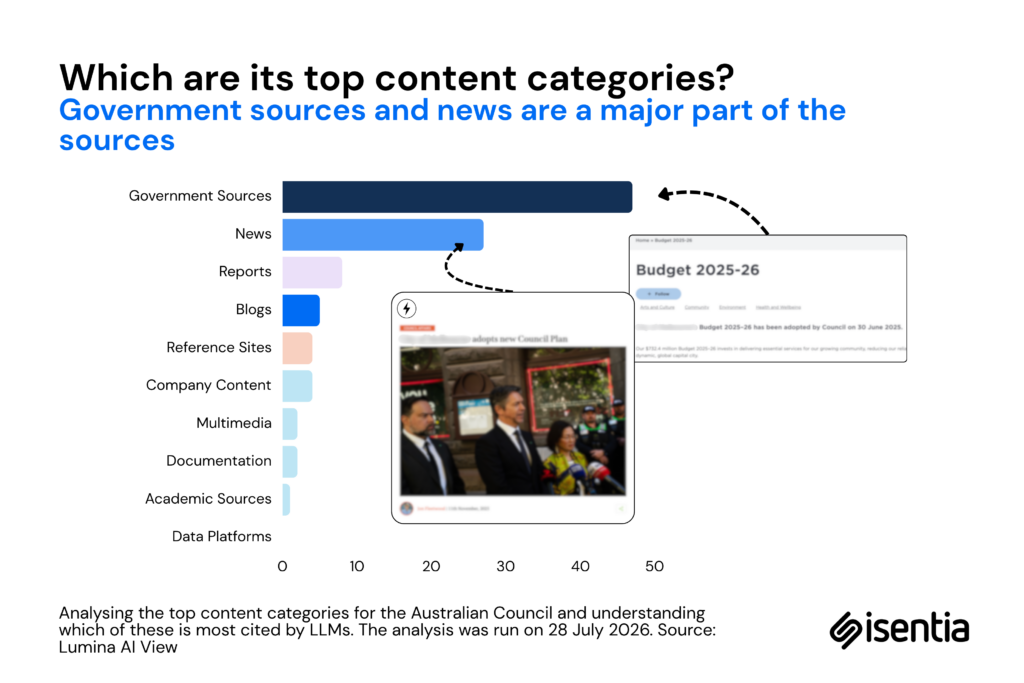
Most citations for the council originate from government sources, followed by news outlets, reports, and blogs. The domain is evenly split between owned content and content earned from external sources media articles and independent authorities.
While most are recent, some older articles from major outlets such as The BBC remain visible and may significantly influence how LLMs perceive the council. Owned content typically addresses last year’s budget plans and the council’s latest vision for the city, which LLMs are referencing. Government sources are the major content type, however, external sources have a greater impact on the council’s overall LLM score.
The stakes are higher for government agencies
When brands track LLM visibility, they often ask, "Are we shown in a positive light?" or "Are we cited accurately?" For the government, additional questions arise: "Is this information accurate enough for someone to act on?" and "Are we still viewed as more authoritative than what we oversee?" Mistakes can have serious consequences, such as individuals applying for ineligible programs or missing critical deadlines for new initiatives or elections. This can quickly lead to public frustration. It is essential for government communicators to recognize these risks.
If you would like to know more about our Lumina suite, please reach out here and our team will get in touch with for you a quick demo.
"
["post_title"]=>
string(77) "Why is tracking government visibility on LLMs different from tracking brands?"
["post_excerpt"]=>
string(121) "Government agencies often can't see how AI chatbots describe them. Here's why LLM visibility matters and how to track it."
["post_status"]=>
string(7) "publish"
["comment_status"]=>
string(4) "open"
["ping_status"]=>
string(4) "open"
["post_password"]=>
string(0) ""
["post_name"]=>
string(46) "latest-reads-ai-visibility-government-agencies"
["to_ping"]=>
string(0) ""
["pinged"]=>
string(0) ""
["post_modified"]=>
string(19) "2026-08-11 02:14:19"
["post_modified_gmt"]=>
string(19) "2026-08-11 02:14:19"
["post_content_filtered"]=>
string(0) ""
["post_parent"]=>
int(0)
["guid"]=>
string(32) "https://www.isentia.com/?p=49040"
["menu_order"]=>
int(0)
["post_type"]=>
string(4) "post"
["post_mime_type"]=>
string(0) ""
["comment_count"]=>
string(1) "0"
["filter"]=>
string(3) "raw"
}
Blog
Why is tracking government visibility on LLMs different from tracking brands?
Government agencies often can’t see how AI chatbots describe them. Here’s why LLM visibility matters and how to track it.
There is a new frontier where public perception is shaped: Large Language Models. Right now, LLMs are answering critical questions about your organisation. What are they saying? And more importantly, which sources are shaping those answers?
To navigate this landscape, public relations professionals don't need generic tools, but rather technology that speaks their language, and addresses the realities of a changed media and informational landscape.
That is why we're unveiling Lumina AI View, the latest addition to our intelligent suite of AI tools from Isentia. Trained specifically on the workflows and challenges of modern PR & communications, Lumina AI View helps you understand exactly what AI knows about you, and how it learned it.
A new standard for AI visibility
AI View tracks your citation strength and source quality alongside those of your competitors, giving you a clear view of where you hold authority and where you have gaps.
Lumina AI View maps your AI reputation from the ground up, allowing you to:
See which sources matter: When tools such as ChatGPT or Gemini discuss your organisation, which outlets do they cite? Track your source footprint over time and view the impact of key target media on how you’re discussed. We measure your citation strength and source quality alongside those of competitors, giving you a clear view of where you have authority and where you have gaps.
Gain industry-specific insight: Your competitors get cited from Financial Times and Bloomberg. You get cited on Reddit. Each brings opportunity – and risk. Discover how you measure up against industry standards, and target the sources that actually influence how AI represents you.
Catch narrative shifts early: AI responses change when new sources appear, sentiment shifts, or old controversies resurface. Get alerts when citation patterns change suddenly, before they impact the way you’re perceived by stakeholders.
Measure your progress: From media monitoring to full media intelligence
Lumina AI View is built on the principle that insights get stronger with repeated measurement. To help you maintain a clear view of your reputation, our proprietary scoring system provides regular updates that show you:
Evolving trends in how sources cite your organisation
Competitive standing and benchmark metrics
Where models differ in information presented, and sources cited
Whether you run it weekly, on-demand, or whenever you need a check-in, patterns will emerge, trends will become clear, and you will build a baseline that makes any sudden narrative changes both comprehensible and the prerequisite to action.
Lumina AI View is part of Lumina AI, a comprehensive suite of AI tools built specifically for communicators. Our Lumina suite evolves traditional media monitoring into narrative intelligence, enabling you to truly understand how perceptions form, evolve, and impact your reputation.
Get in touch to register your interest and see what Lumina AI View can do for you.
"
["post_title"]=>
string(66) "Introducing Lumina AI View: AI Visibility Built for PR & Comms"
["post_excerpt"]=>
string(158) "Lumina AI View, the latest in Isentia's AI suite, is trained on PR & comms workflows to help you understand what AI knows about you — and how it learned it."
["post_status"]=>
string(7) "publish"
["comment_status"]=>
string(4) "open"
["ping_status"]=>
string(4) "open"
["post_password"]=>
string(0) ""
["post_name"]=>
string(59) "introducing-lumina-ai-view-ai-visibility-built-for-pr-comms"
["to_ping"]=>
string(0) ""
["pinged"]=>
string(0) ""
["post_modified"]=>
string(19) "2026-07-15 03:12:57"
["post_modified_gmt"]=>
string(19) "2026-07-15 03:12:57"
["post_content_filtered"]=>
string(0) ""
["post_parent"]=>
int(0)
["guid"]=>
string(32) "https://www.isentia.com/?p=47963"
["menu_order"]=>
int(0)
["post_type"]=>
string(4) "post"
["post_mime_type"]=>
string(0) ""
["comment_count"]=>
string(1) "0"
["filter"]=>
string(3) "raw"
}
Blog
Introducing Lumina AI View: AI Visibility Built for PR & Comms
Lumina AI View, the latest in Isentia’s AI suite, is trained on PR & comms workflows to help you understand what AI knows about you — and how it learned it.