Blog
Is Social Media A Good Source For News?
With more than 1 billion users on Facebook, and millions more active on sites such as YouTube and Twitter, it has become obvious that social media is an important platform for businesses.
In the wake of the Facebook Cambridge Analytica scandal, there have been a myriad of changes impacting users of Facebook and Instagram content recently. These changes were made without any notice and were effective immediately which has impacted third-party apps worldwide.
Albeit the speed in which the changes have been made is likely to have been partly driven by the pressure to tighten data practices and potentially align certain timing as CEO Mark Zuckerberg prepares to testify before Congress next week to answer questions about the company’s privacy and data policies.From the perspective of everyday users accessing the content you know and love via the Facebook and Instagram apps will see little to no change. For developers like us on the other hand, the impacts are significant and are only a hint of what is yet to come.In case you missed it, the changes made have been many and impact all third-party apps, whether legitimate or not.
Given the changes have been quick, varied and came without prior notification, we’ve pulled together a quick summary of a few that left developers and other third-party content users of these content feeds frustrated:
This means something as simple as code to access recent posts of a public company, suddenly stopped working. Quick changes had to be made to use alternative methods.
Fields like how many followers a user has, or how many posts you have made, but many more have gone.
The Instagram API restricted the flow of content by 25x, meaning that public posts previously being collected has been reduced significantly, requiring different approaches to be taken that are more efficient.
These are only a few of the changes that have happened with more expect in future. With CTO Mike Schroepfer commenting that they will lock down access, review previously allowed apps, and then hand out access to the apps that deserve it.
While this is promising from the perspective that Facebook is taking action to breath some confidence back into their data practices, it will still be interesting to see how they now start to crack down on third-party apps that are using and abusing content. With the advent of AI and machine learning, the content which appeared innocuous can now be exploited and abused in the wrong hands. That means Facebook is forcing all apps that have previously been approved for accessing Events, Groups and Pages, have to be reviewed again.
For the developers working on these changes behind the scenes, it’s a difficult process but something we monitor constantly to ensure the client experience is supported, and uncompromised. While at times frustrating, it’s also fascinating to watch the complexities of today’s interconnected environment play, shift and unfold.
Ian Young,
Isentia Technical Architect

Loren is an experienced marketing professional who translates data and insights using Isentia solutions into trends and research, bringing clients closer to the benefits of audience intelligence. Loren thrives on introducing the groundbreaking ways in which data and insights can help a brand or organisation, enabling them to exceed their strategic objectives and goals.
Connecting with the huge variety of consumers already on these sites can open up significant opportunities for marketing and lead generation. Additionally, social media monitoring provides insight and understanding into how your industry, audience and competitors are reacting to market trends and products.
As well as giving businesses and consumers a platform to share their thoughts and participate in ongoing conversations, social media is also a channel through which many people access news stories and important information.
A recent study from Pew Research found that 64 per cent of adults are active on Facebook, and 30 per cent are using the site to receive news. This means that approximately half of the people using Facebook trust the site to deliver their news.
Not only are users reading news on social media, but they are also participating in the sharing and telling of stories. Half of all social network users have shared news stories on their own profiles and a further 46 per cent have discussed news on social media.
However, while social networking sites are a popular media through which to access news, Pew Research found that users on these sites spend significantly less time engaging with the news they read.
Readers who visit news stories directly through a provider's website spend an average of 4 minutes and 36 seconds on each page. In comparison, those who arrive through a link on Facebook spend just 1 minute 41 seconds reading the page.
This shows that while news is being shared and read on social media sites, engagement is significantly greater when consumers go out of their way to access the stories.
" ["post_title"]=> string(39) "Is Social Media A Good Source For News?" ["post_excerpt"]=> string(187) "With more than 1 billion users on Facebook, and millions more active on sites such as YouTube and Twitter, it has become obvious that social media is an important platform for businesses." ["post_status"]=> string(7) "publish" ["comment_status"]=> string(4) "open" ["ping_status"]=> string(4) "open" ["post_password"]=> string(0) "" ["post_name"]=> string(38) "is-social-media-a-good-source-for-news" ["to_ping"]=> string(0) "" ["pinged"]=> string(0) "" ["post_modified"]=> string(19) "2019-09-24 08:55:44" ["post_modified_gmt"]=> string(19) "2019-09-24 08:55:44" ["post_content_filtered"]=> string(0) "" ["post_parent"]=> int(0) ["guid"]=> string(43) "https://isentiastaging.wpengine.com/?p=1874" ["menu_order"]=> int(0) ["post_type"]=> string(4) "post" ["post_mime_type"]=> string(0) "" ["comment_count"]=> string(1) "0" ["filter"]=> string(3) "raw" }With more than 1 billion users on Facebook, and millions more active on sites such as YouTube and Twitter, it has become obvious that social media is an important platform for businesses.
It’s been a whirlwind year trying to keep up with the various changes made by social media platforms – especially for professional communicators, developers, agencies, and brands.
At the same time as understanding and usage of the term ‘API’ has accelerated across offices worldwide, social media platforms have begun to restrict access to their application programming interfaces (APIs). With implications ranging from global politics to individual user privacy, that trend is showing no signs of stopping.
API changes have been introduced in order to reduce risks around data privacy, security concerns for users and stamping out improper use of user data.
Most of the changes can be categorised as:
Generally, these are positive changes for the whole ecosystem. Users can be reassured at an individual level that there are more controls in place and consideration given to matters of privacy and the prevention of misuse. Facebook’s ‘Here Together’ video, released in the aftermath of the Cambridge Analytica data breach, reflects some of this desired messaging and the drives for these changes.
Here's how the changes impact the three types of Instagram analysis:
These may not be the last of the changes, but they are necessary growing pains to regain user trust and provide higher quality authentic engagements. For small businesses and influencers these changes are fairly straightforward - however for those looking to manage communications or marketing strategies they present new challenges in order to stay informed.
These changes apply across the board so all API users will need to jump the same hoops and prove that both privacy measures are met and use of data is acceptable. If you’re interested, you can learn more about the official changes from Instagram read on here.
It’s been a whirlwind year trying to keep up with the various changes made by social media platforms – especially for professional communicators, developers, agencies, and brands.
If you ask ChatGPT or Gemini about your organisation today, the answer won't come straight from your website. Instead, it uses sources the model already trusts, which are often months or years old. So if your last big mention was a crisis or a controversy from 2023, that's probably still how AI describes you.
This is the tough reality for anyone working in PR and communications today. More people are getting their first—and sometimes only—impression of your organisation from an AI-generated summary, not from search results or the homepage. And these summaries often rely on outdated information.
Content freshness refers to how recent the sources are that an AI model uses when it talks about you. It might seem like a minor technical point, but it's actually very important.
Search engines have always valued fresh content, and they let you update information quickly. If you change a page, Google recrawls it, and rankings can shift in days. Large language models don't work like this. As Lisa Main, Director at Main Bureau, said on Isentia's "AI as a Stakeholder" panel, "large language models are not databases of verified facts." These models are trained on a snapshot of the internet, updated only from time to time, and they rely on sources that were already prominent when they were trained. This means a past crisis or a controversy that is already resolved can keep showing up in AI answers long after it's no longer relevant.
She shared the example of how a day and a half after a notorious terror attack, she asked ChatGPT if the area had ever experienced a tragedy of that type. It replied that it had not." The model wasn't being careless, but it just hadn't updated to include the latest news. This gap between what reality is and what AI still believes is true sums up the content freshness problem.
Dr Nici Sweaney, founder of AI Her Way, explained on the same panel why this gap matters. She calls AI "an accidental narrator" — it shapes what people believe about your organisation just by repeating the latest information it received. The system simply uses what's available and is not trying to be harmful, so it's important to make sure that information is up to date.
For PR and communications teams, this changes what "reputation management" means. Put simply, messaging that an LLM cites will remain relevant, no matter when it dates from. Messaging that has not been factored into the LLM’s answers, meanwhile, will have no discernible impact on an increasingly vital - even central - channel, regardless of how many other metrics it might win out on.
This leads to two important things to consider:
For public sector and government communicators, the stakes are more immediate again. When a government agency's guidance changes, whether that's eligibility criteria, compliance requirements, or a service update, and the fresh version doesn't make it into what AI models are citing, people will still get fed old information, with potentially devastating real-world implications.
This is not just in theory. It's playing out in global research and in the day-to-day data right now.
The Reuters Institute's Digital News Report Australia 2026 confirms that many PR teams have noticed that Google organic search traffic to news sites dropped by a third worldwide between November 2024 and November 2025, and by 38% in the US, as AI Overviews and AI Mode launched. Publishers expect this traffic to nearly halve again in the next three years. Some now call this trend a move towards "Google Zero." For communications teams, this means people are increasingly less likely to click through to your website to check if information is current. More often, they're trusting what the AI says: hence why it’s so important to monitor content freshness.
One challenge is that most major chatbots are now web-enabled. For example, ChatGPT can browse the internet, Gemini uses Google Search, and Perplexity has its own live index. This makes it easy to assume that AI always knows the latest information. However, this does not mean that they are always accurate when it comes to citations. A study from Columbia's Tow Center for Digital Journalism tested eight AI search tools with 1,600 queries. They found that these tools failed to correctly identify or cite the source article more than 60% of the time. Some tools were wrong on most tests and rarely showed any uncertainty. New information has not had time to be checked or confirmed like older stories have. This is the real risk of relying on the newest updates — a story that is fast moving and poorly sourced about your organisation might end up in an AI answer before it’s even verified or fact-checked.
The same report found that 35% of people who use AI chatbots for news do so to get the latest media updates. Dr Sora Park from the University of Canberra's News and Media Research Centre explained on the "Digital News Report Australia 2026" webinar that the main reason people use AI chatbots for news is that "AI collates stories from different news sources into a single response." People expect these tools to provide current information. If your organisation's newest content isn't included (and you have something current or novel to communicate) you miss the chance to reach audiences when they're most interested.
A notable example of creating freshness that LLMs reward and prioritise comes from updating existing pages, rather from creating brand-new content. Republishing and refreshing current material is more effective than many communications teams realise, as long as one actually updates the content, not just the date.
The DNR Australia 2026 report also notes that once someone is inside an AI chatbot conversation, they rarely leave it to check the source — only 4% of AI chatbot users say they always or often click through to the original article, compared with 19% for search and 17% for social media. The pages that used to earn traffic just by sitting there, permanent and useful, are now the ones most likely to lose visibility, because AI models favour what's recent over what's merely correct.
If an executive online, especially one who has a lot of weight to what they post online, says something controversial and it quickly spreads across media articles, social media and search — it will definitely be picked up by AI as well. There is a golden window of opportunity that they need to capitalise on to clarify what they said. If they don’t, the negative story that was already built into the data AI models use, will not be affected much by the executive’s clarification statement, which wasn’t that timely anyway. As Catherine Arrow of the PR Knowledge Hub said on the "Inside the AI Shift" webinar: "public relations and media relations are not the same thing," and relying on a single release misses the point. The real lesson is not to publish faster after a crisis, but to build a strong, up-to-date presence before you need it. In our latest report, “How can leaders communicate in an age of scrutiny”, we’ve outlined exactly how comms leaders can communicate by adapting their content to audiences exposed to the “AI way” of news dissemination.
The challenge is that organisations can't make an AI model update its answers whenever they want. What they can do is track whether recent work is actually being noticed, which is what Lumina AI View can help with.
Lumina AI View monitors which sources AI models use when talking about your organisation, how strong and recent those sources are, and how you compare to competitors. Freshness is one of five key factors in the overall score. If your freshness score drops, it's an early warning that your latest campaign or announcement hasn't reached the AI ecosystem yet, and older stories are still dominating.
What’s important to note is that the tool provides a list of source citations, paired with reputation pillars like direction, integrity, performance and innovation — giving a comms professional a fully-rounded understanding of what they need to do. It’s not just the case of knowing source citations, but also of understanding your own AI perception and performance to make informed decisions — whether that’s for a brand,a government agency, a NFP or elsewhere.
This kind of tracking is even more important because it shifts by industry and by market, so "AI visibility" doesn't mean the same monitoring job for every organisation. AI answers for healthcare might draw from the smallest, highest-trust pool of sources (mostly clinical and government), but SaaS and fintech answers lean heavily on editorial reviews and comparison sites. Ngaire Crawford made a similar point regionally on the "AI as a Stakeholder" panel. For the APAC region specifically, she pushed back on the assumption that editorial media dominates AI citations — "there are a lot of really massive claims about the impact of editorial media... some as high as 85, 88%. That's not what we're seeing." Instead, she found "a fairly even split between (editorial media) and company content," alongside a real presence for review sites, forums, and academic sources. For a comms team, that means the freshness strategy that works for a media-heavy consumer brand might not work for a government agency whose AI visibility is really riding on review sites, .gov pages, or industry forums instead.
By tracking regularly — weekly or as a routine check— you turn the vague concern of "what is AI saying about us" into something that is super clear. You can see if recent coverage changed your list of citations, or if your owned content is still being found, or where there are gaps that need to be filled because old stories still exist and are causing problems.
There's a real advantage here too. If old content keeps you tied to an outdated story, fresh content is a direct way for PR and communications teams to influence how AI presents them. Publishing regularly, keeping your own pages updated, and getting recent, credible coverage is not just for human audiences. It's how PR professionals can make sure the systems shaping first impressions have the right information.
Teams that make it an ongoing habit of checking in regularly, watching for changes, and keeping fresh, credible content flowing, will have more control over how AI describes their organisation.
If you would like to know more about our Lumina suite, please reach out here and our team will get in touch with for you a quick demo.
" ["post_title"]=> string(60) "Why is content freshness the new currency for AI visibility?" ["post_excerpt"]=> string(172) "AI summaries are replacing websites as your organisation's first impression. Here’s why content freshness—and the sources feeding these models—matters more than ever." ["post_status"]=> string(7) "publish" ["comment_status"]=> string(4) "open" ["ping_status"]=> string(4) "open" ["post_password"]=> string(0) "" ["post_name"]=> string(59) "why-is-content-freshness-the-new-currency-for-ai-visibility" ["to_ping"]=> string(0) "" ["pinged"]=> string(0) "" ["post_modified"]=> string(19) "2026-08-20 02:44:18" ["post_modified_gmt"]=> string(19) "2026-08-20 02:44:18" ["post_content_filtered"]=> string(0) "" ["post_parent"]=> int(0) ["guid"]=> string(32) "https://www.isentia.com/?p=49408" ["menu_order"]=> int(0) ["post_type"]=> string(4) "post" ["post_mime_type"]=> string(0) "" ["comment_count"]=> string(1) "0" ["filter"]=> string(3) "raw" }AI summaries are replacing websites as your organisation’s first impression. Here’s why content freshness—and the sources feeding these models—matters more than ever.
The advent of LLMs and AI search means that there has been a colossal shift in how audiences are consuming information today, and a reciprocal shift in how all types of organisations, from government agencies to brands are responding . But while discussion amongst PR and comms pros tends to fall disproportionately on how brands are impacted, the needs of the former are just as keenly felt, and often quite distinctive.
So how can government agencies respond, especially in a time of global flux, when major policy changes need to be communicated and important stakeholders need to be managed? After all, government organisations do care about reputation, much as brands do, but have quite distinctive goals when it comes to ensuring accurate information reaches the right audiences.
The era of "Let me Google that" is rapidly fading. Instead of clicking through to official websites, people are asking chatbots for direct answers. What’s striking is that government agencies often have no visibility on how they’re being talked about in the LLM space, even as it becomes a central channel for messaging and reputation.
When AI models become the primary gatekeeper, audiences bypass official portals entirely — driving down site traffic and leaving agencies vulnerable to misinformation, negative sentiment, or worse, being left out of the conversation altogether.
Therefore, the entry point is different. For commercial brands, this shift is profound but in some ways mediated – an FMCG brand, for instance, often discovered through third-party platforms in any case. But for government entities, the stakes are entirely different. As the sole, authoritative source for public information, they need citizens on their websites to get accurate details. Government agencies, especially if they are the authority or regulator in a particular industry or sector, need to make sure audiences know where to go to get the right information.
Not all government agencies are alike, and they all have different parameters that are quite non-negotiable for them, just by the way they function.
Reputation is important, but that exists downstream from maintaining a flow of accurate information. It’s useful for communications teams in government organisations to self reflect and ask themselves the following questions:
These are gaps they already realise, but they don’t actually know what to do about it – how to manage or measure them. They need a tool that allows them to know this critical piece of information and make informed decisions.
Ngaire Crawford, Pulsar Group’s Executive Director for AI Strategy says, “It’s easy to disregard LLM reputation as part of a difficult AI landscape or something that is only really relevant to more product-based communication or marketing. Government communications is about social licence, and ensuring the public have access to up to date and accurate information about things that matter to them, the role that Generative AI plays in how a community understand an issue will only continue to grow, and knowing the impact that you can have in that through small shifts in channel strategies or more consistent messaging is a crucial part of the communications toolkit.”
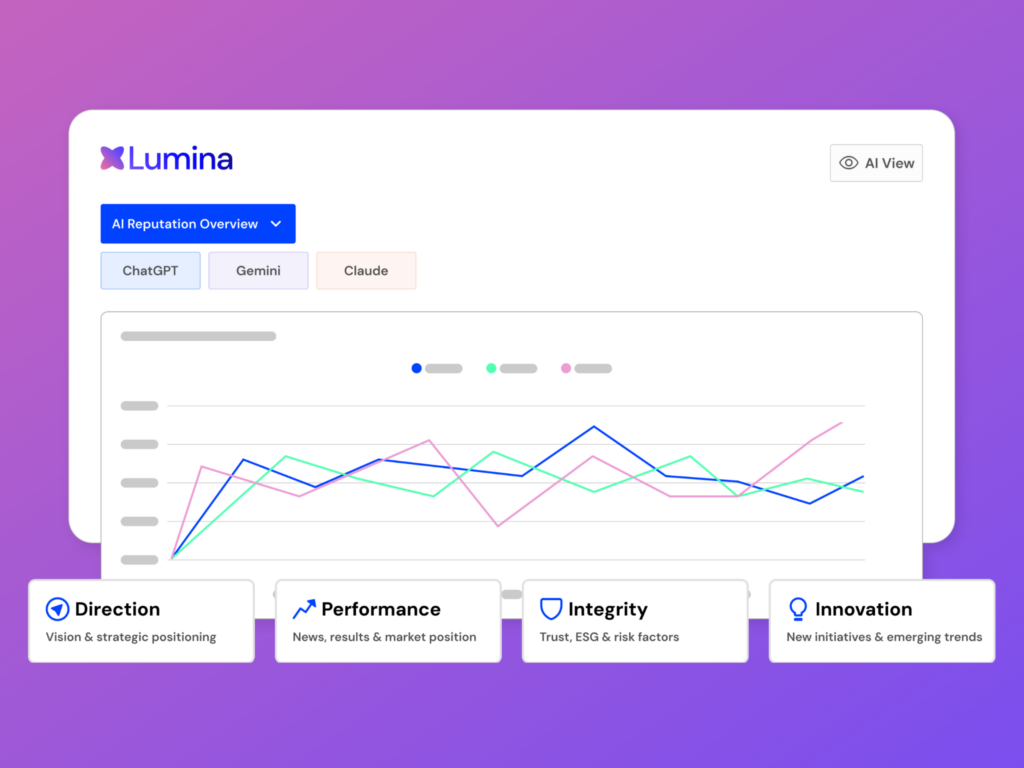
Lumina AI view is built for communicators who want to understand how their organisation and their competitors are being talked about by various AI models – including ChatGPT, Gemini, and Claude. AI View users get an insight into which sources are being cited, and how they would need to respond as a way of protecting their reputation or making sure correct information about them is being disseminated.
The tool provides an AI view score — a composite metric ranging from zero to 100, designed to help track brand performance over time and facilitate comparisons against competitors. It is calculated using five weighted factors — sentiment, visibility, authority, dominance and freshness. Beyond the overall score, the platform provides a summary of a brand's AI narrative based on four distinct reputation pillars — direction, performance, integrity and innovation.
These pillars help users identify exactly which dimension of a brand's reputation is under pressure, offering specific, actionable insights for board presentations or reviews. Ultimately, while the AI view platform provides the necessary intelligence, the strategic decisions regarding how to respond to these insights remain with the organisation.
This progressive local government council is located in Australia’s leading center for culture and sports.
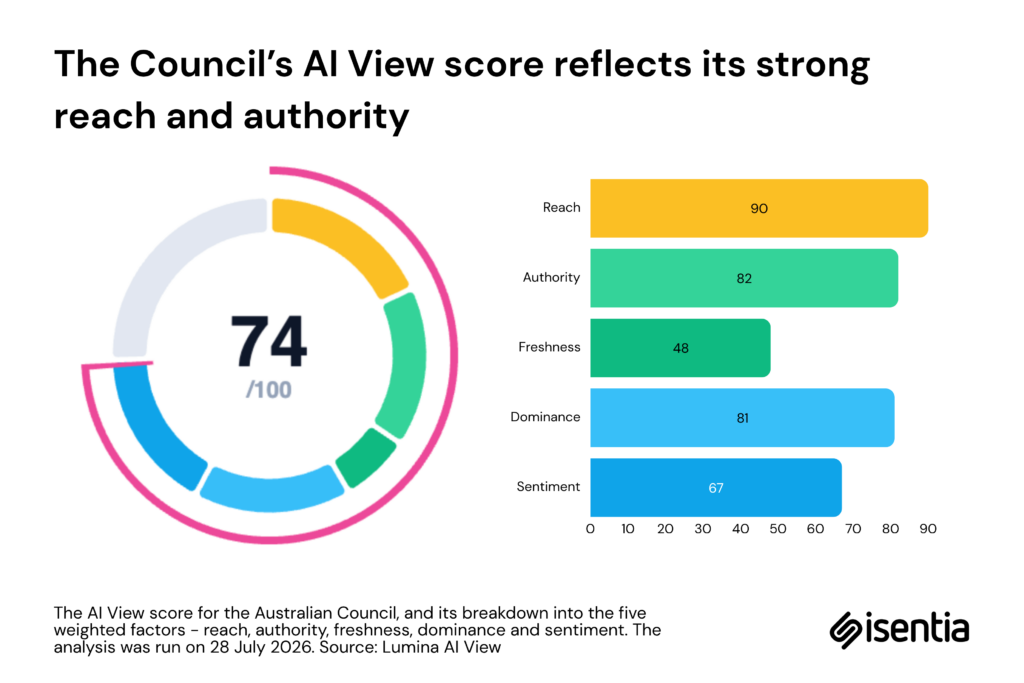
The council earned an AI view score of 74 reflected by strong reach and authority. Publications like CBD News and its own website are the most cited by LLMs — interestingly, most of them being cited by Claude.
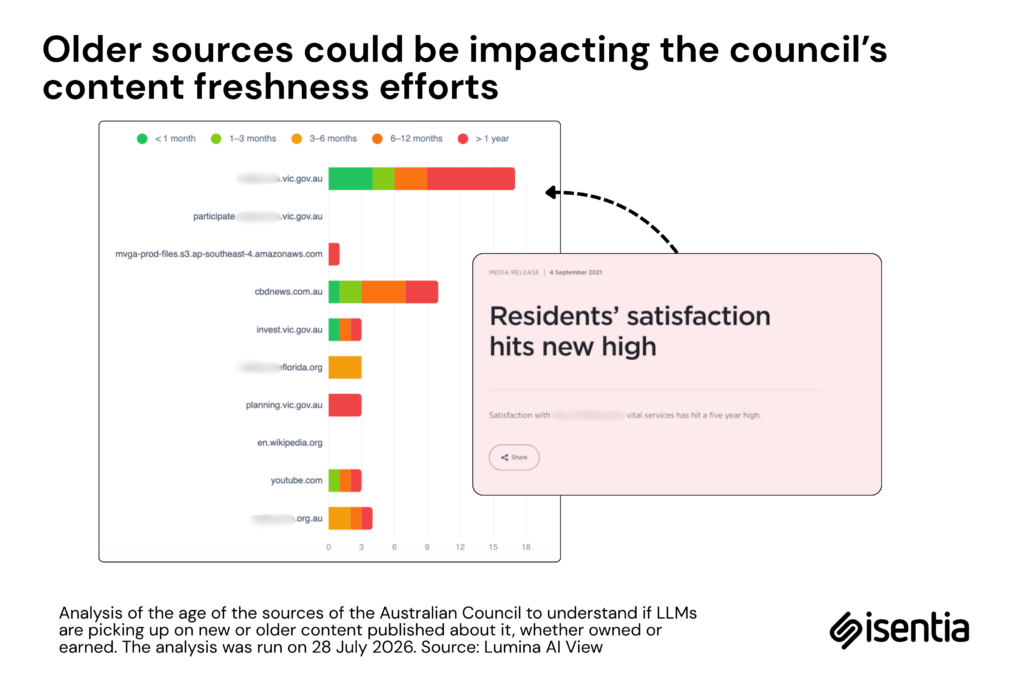
Content freshness scored lower at 48. Their website still carries error pages and annual reports from a few years ago. If a report — one that is seen as an organisation’s most comprehensive and authoritative content, is still being cited even if it’s older, might potentially be in the way of the organisation’s own perception. Which means more work is needed to prevent outdated content from still appearing.
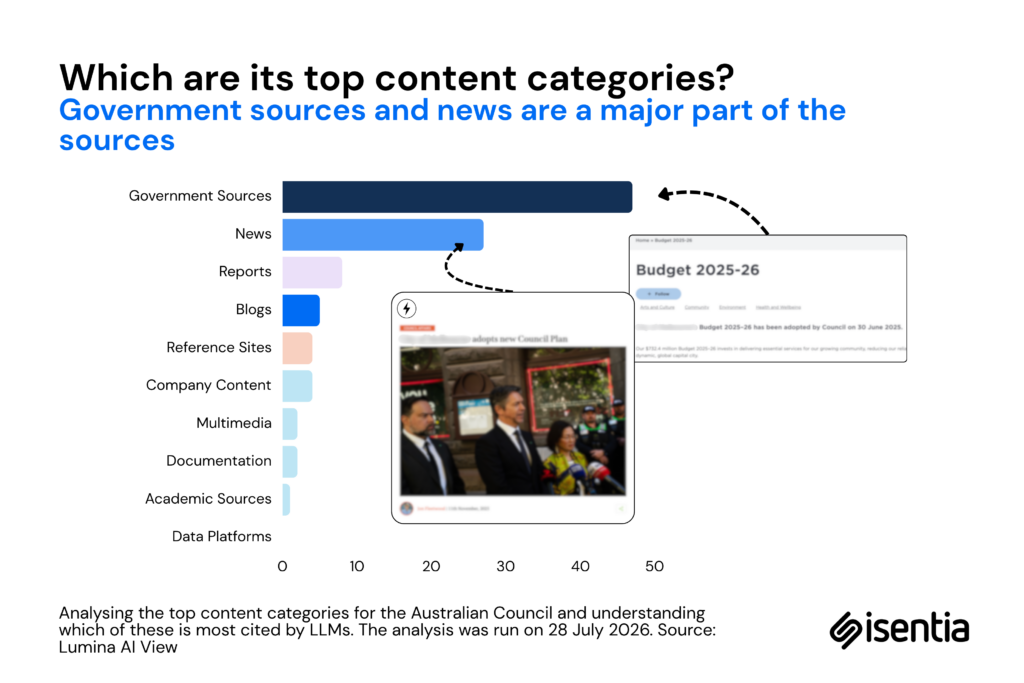
Most citations for the council originate from government sources, followed by news outlets, reports, and blogs. The domain is evenly split between owned content and content earned from external sources media articles and independent authorities.
While most are recent, some older articles from major outlets such as The BBC remain visible and may significantly influence how LLMs perceive the council. Owned content typically addresses last year’s budget plans and the council’s latest vision for the city, which LLMs are referencing. Government sources are the major content type, however, external sources have a greater impact on the council’s overall LLM score.
When brands track LLM visibility, they often ask, "Are we shown in a positive light?" or "Are we cited accurately?" For the government, additional questions arise: "Is this information accurate enough for someone to act on?" and "Are we still viewed as more authoritative than what we oversee?" Mistakes can have serious consequences, such as individuals applying for ineligible programs or missing critical deadlines for new initiatives or elections. This can quickly lead to public frustration. It is essential for government communicators to recognize these risks.
If you would like to know more about our Lumina suite, please reach out here and our team will get in touch with for you a quick demo.
" ["post_title"]=> string(77) "Why is tracking government visibility on LLMs different from tracking brands?" ["post_excerpt"]=> string(121) "Government agencies often can't see how AI chatbots describe them. Here's why LLM visibility matters and how to track it." ["post_status"]=> string(7) "publish" ["comment_status"]=> string(4) "open" ["ping_status"]=> string(4) "open" ["post_password"]=> string(0) "" ["post_name"]=> string(46) "latest-reads-ai-visibility-government-agencies" ["to_ping"]=> string(0) "" ["pinged"]=> string(0) "" ["post_modified"]=> string(19) "2026-08-11 02:14:19" ["post_modified_gmt"]=> string(19) "2026-08-11 02:14:19" ["post_content_filtered"]=> string(0) "" ["post_parent"]=> int(0) ["guid"]=> string(32) "https://www.isentia.com/?p=49040" ["menu_order"]=> int(0) ["post_type"]=> string(4) "post" ["post_mime_type"]=> string(0) "" ["comment_count"]=> string(1) "0" ["filter"]=> string(3) "raw" }Get in touch or request a demo.