Blog post
September 11, 2024

Watt’s up? Australia’s energy crisis & the price surge

It’s agreed Australia is experiencing an energy problem. Energy in Australia has traditionally relied on fossil fuels, significantly impacting the environment and driving public demand for a transition to abundant natural resources like solar and wind. However, high interest rates and inflation have escalated the cost of living, making energy bills a substantial burden for consumers. This energy crisis isn’t just a political or environmental issue—it’s a pressing challenge that directly affects the everyday lives of residents across Australia, underscoring the urgent need for viable, sustainable solutions.

With rising costs of living and energy bills, there is increasing public interest in renewable resources like solar and wind. However, the debate over their cost-effectiveness continues, especially in comparison to other energy sources like nuclear. By aligning this public sentiment with media coverage, we gain a clearer understanding of the energy crisis, ensuring that the conversation addresses the real challenges faced by residents and drives more relevant, actionable solutions.

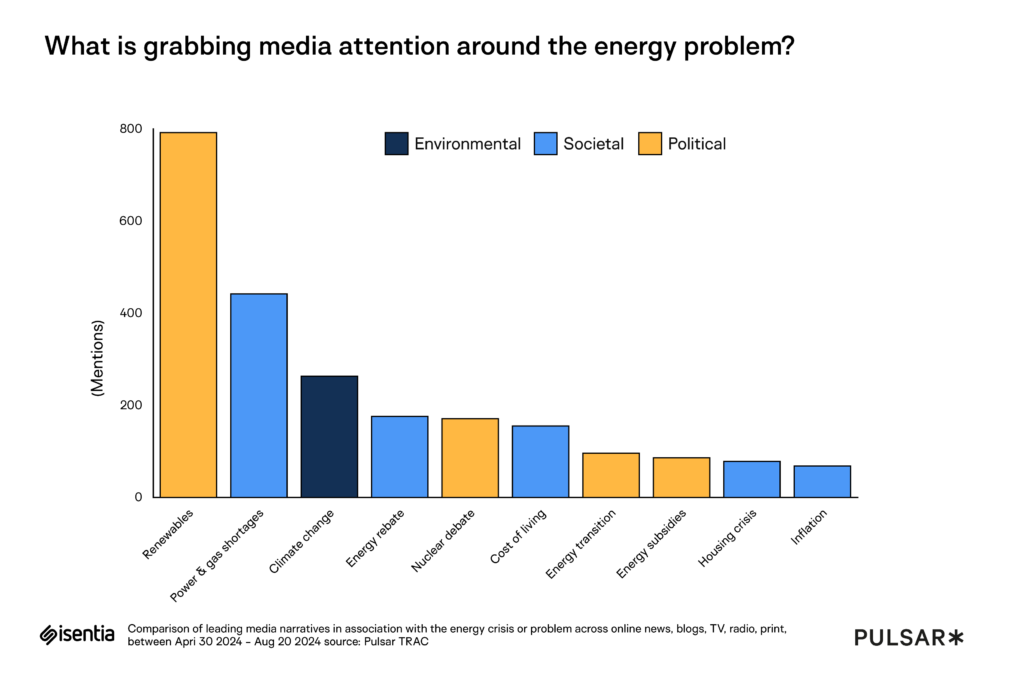
As some energy companies report challenges in meeting grid demand and governments urge caution around energy and electricity usage, significant proposals are announced to make energy consumption more affordable for consumers and the planet. Political agendas appear to dominate energy coverage, leaving less room for stories on household energy consumption and challenges. Public engagement often mirrors this focus, gravitating toward politically driven narratives. Conversation on energy doesn’t follow a general consensus on which political party has the right plan or what is the right way of helping people afford their bills, or even what energy source is genuinely beneficial for the planet.

The societal repercussions of the energy crisis are a major theme, with extensive coverage on how rising energy costs and supply challenges are affecting households and personal consumption. Discussions on renewable energy and alternative sources often intersect with political policy and are used as political pawns in energy debates. While renewables and the energy transition are promoted as pathways to sustainable and affordable energy, some industry and political figures argue the opposite, claiming that the swift shift toward renewables is causing issues that negatively impact communities and households. Climate change remains a significant issue, but as domestic stories dominate the news, concerns about inflation and the persistently high cost of living are taking precedence over environmental matters when it comes to energy coverage. Energy rebates, like the $1000 provided to Queenslanders by the State Government and relief measures in the Federal budget, are being used as short-term solutions to recurring issues. These discussions are more directly tied to household relief, reflecting the immediate need to ease the burden on consumers facing rising energy costs, rather than addressing the root causes of the crisis.

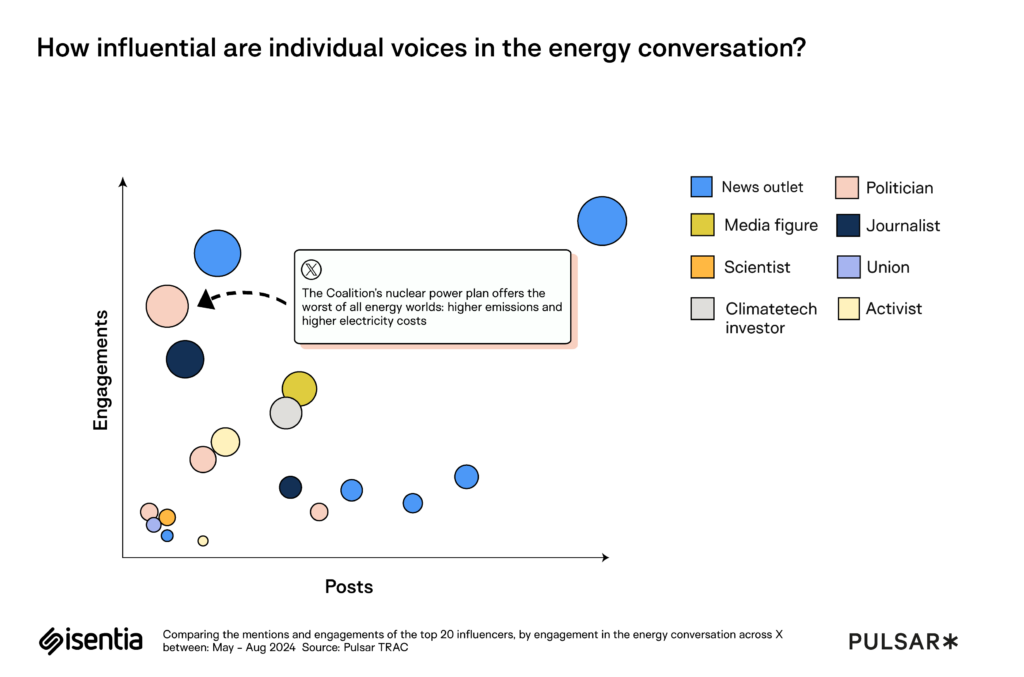
Experts like scientists, who have the qualifications to offer informed critiques, receive far less engagement than unqualified commentators. Meanwhile, activists with a vested interest in climate impact are notably less vocal. Political leaders, news outlets, and public figures dominate the conversation on X, overshadowing voices grounded in expertise. The prominence of a Union as a leading voice underscores how politics is overshadowing facts. Audience reactions often dismiss their content as propaganda, irrelevant to the real needs of Australian workers.

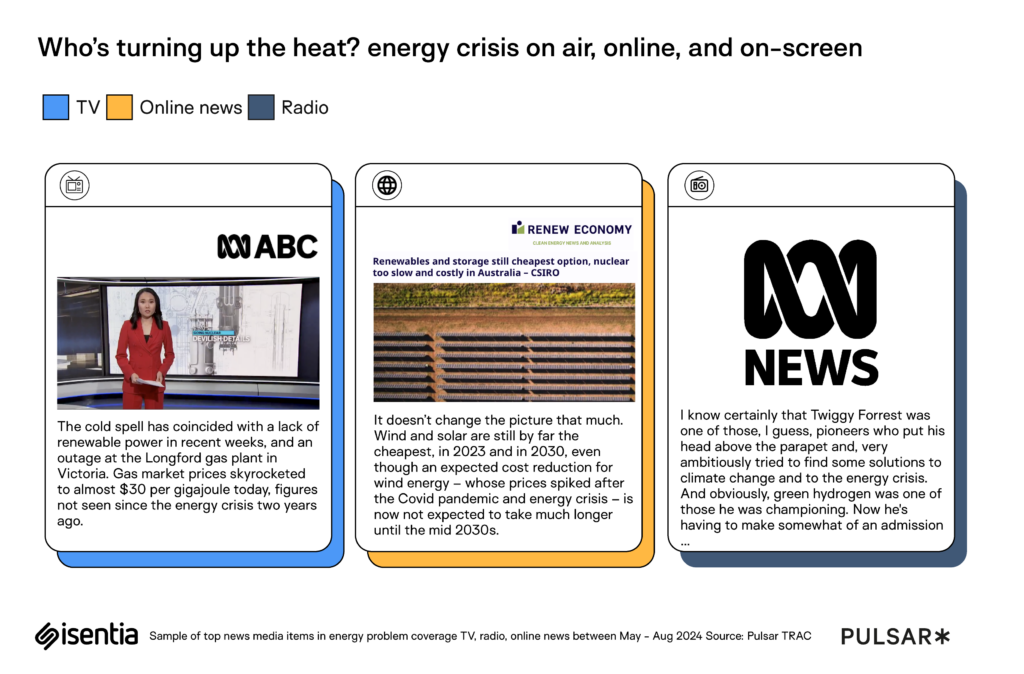
The coverage of the energy crisis differs across radio, print, online news, and TV. Radio takes a conversational yet urgent tone, emphasising immediate impacts like low hydro levels and rising prices. Print and online news are more analytical, discussing long-term energy cost trends and current spikes without alarm. TV is dramatic and urgent, highlighting recent events such as gas plant outages and soaring prices, drawing comparisons to past crises. These broad conversational trends show each medium reflecting its strengths: radio engages emotionally, print and online provide depth, and TV delivers real-time impact.

Some of the top stories by platform hone in on the region’s vulnerability to extreme weather conditions, from intense cold to scorching heat, exposing the weaknesses in its energy production.

TV coverage of the energy crisis vividly portrays its urgency and complexity, using real-time visuals to highlight immediate impacts like cold spells and gas plant outages on soaring prices. Unlike print news or radio, TV can show the tangible effects of extreme weather and energy shortages in more detail, adding a personal touch through on-the-ground reports. The coverage not only underscores job losses and community effects but also reflects political angles, emphasising perceived failures or inadequacies in government policies. Future concerns are addressed with market warnings about potential shortages and delays in transitioning to renewables and nuclear energy, blending immediate challenges with long-term uncertainties.

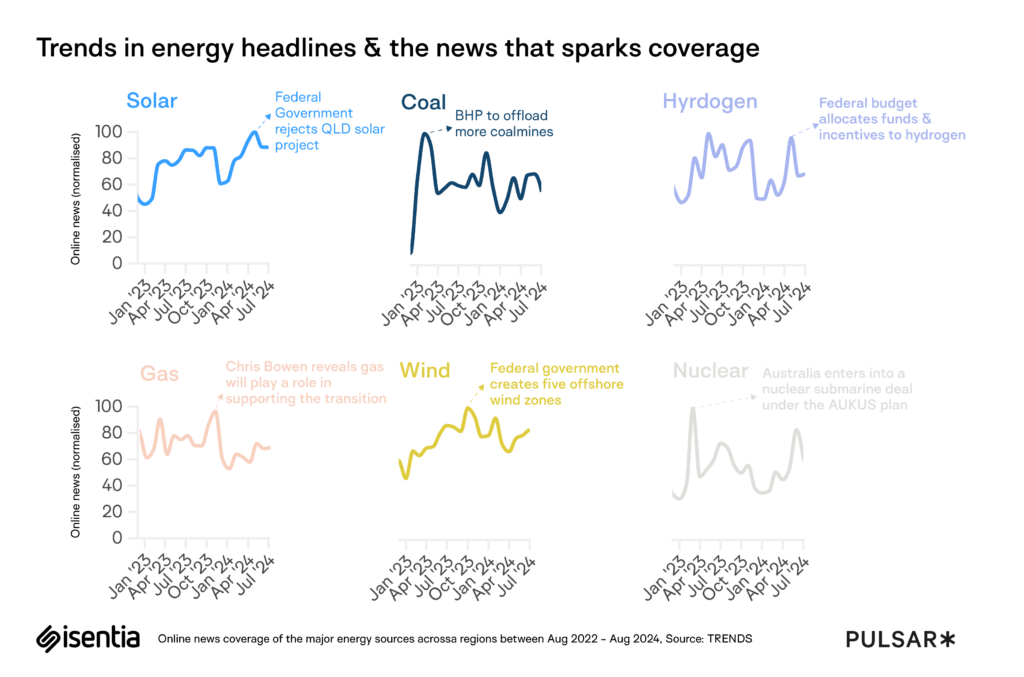
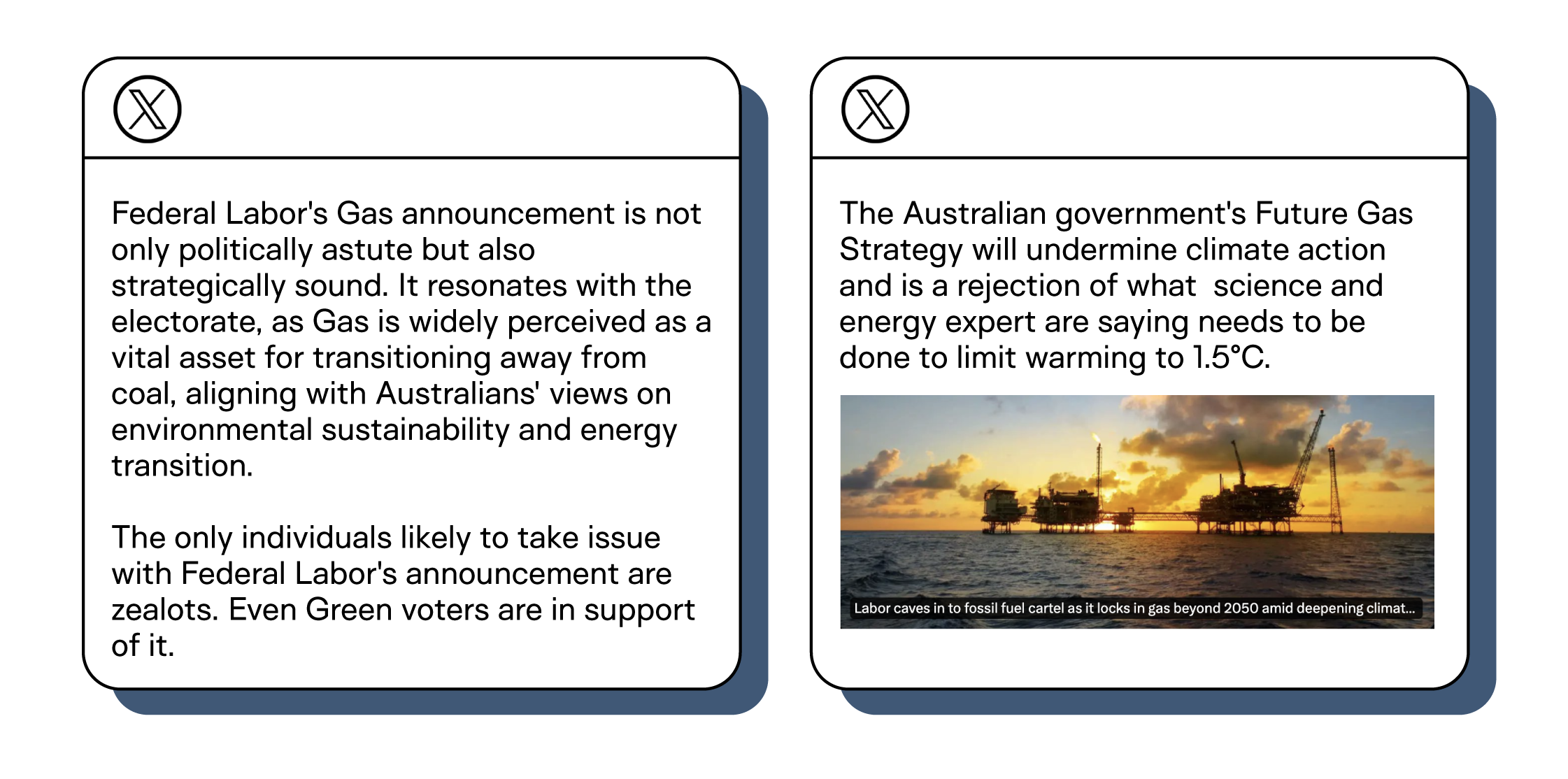
News suggests that major energy sources are being used as political leverage, with true costs and benefits hidden behind competing agendas and ideological battles. The top headlines, for example, indicate that decisions and public understanding are informed more by political posturing than a genuine commitment to sustainable solutions. We’ll delve into the media analysis of these energy sources in the weeks to come. Media coverage highlights this shift, but social media reactions are polarised, often driven by political ideology rather than the substance of the policy. Experts opposing views on social media show just how layered the understanding of energy, climate change and ultimately the energy transition is.

This shift from expert-driven discussion to politically charged rhetoric distorts public understanding and sidelines the critical dialogue needed to address the region’s energy and climate challenges. The energy crisis in Australia has reached a critical point, where rising costs, political debates, and the push for renewable energy are all converging. The situation is impacting everyday lives, and the media’s portrayal, combined with consumer voices, is shaping public perception and the urgency for actionable solutions.

Interested in learning more? Email us at info@isentia.com

Share

Similar articles

object(WP_Post)#8713 (24) { ["ID"]=> int(43875) ["post_author"]=> string(2) "75" ["post_date"]=> string(19) "2025-12-09 09:09:29" ["post_date_gmt"]=> string(19) "2025-12-09 09:09:29" ["post_content"]=> string(8658) "

As communications professionals look toward 2026 planning sessions, one question dominates the conversation - How can we use AI in a safe, scalable, and sustainable way?

Behind this question often lies the hope for an "AI easy button"—a one-click solution for complex measurement challenges. However, as discussed in our recent APAC webinar, the real opportunity lies not in automating old metrics, but in architecting a smarter era of measurement.

Hosted by Russ Horell, Isentia’s Chief Revenue Officer for APAC, the session featured deep dives from two industry leaders who've contributed immensely to research and planning: Ngaire Crawford (Director of Insights, ANZ) and Prashant Saxena (VP of Research and Insights, SEA). Together, they unpacked the transition from using insights and converting them into strategic, measurable storytelling.

Here are the key takeaways from the discussion.

1. From experimentation to transparency

If 2024 and 2025 were the years of "playing in the sandbox," 2026 is set to be the year of transparency.

Ngaire Crawford emphasized that while AI is incredible at summarising data and recognising patterns, it does not automatically generate insight. As we integrate these tools, the focus must shift to methodological integrity—understanding the source data, the structure, and the limitations of the models we use.

"Models are really good pattern finders. But they don't necessarily set what good looks like, or understand the consequences of being wrong. And the antidote to that is always going to be good design." – Ngaire Crawford

2. "More data, better insight" is the misconception

A major misconception remains that feeding AI endless amounts of data will naturally result in better answers. In reality, without the right framework, more data often just creates more noise.

Prashant Saxena warns against the "sameness" that AI can generate. If everyone uses the same models on the same big data sets without specific objectives, they will get similar, generic answers. The role of the insights professional is evolving from descriptive reporting to strategic storytelling—using judgment to break through the "echo chamber" of AI validation.

3. Kill, keep, create: redefining our metrics

The panelists played a game of "keep, kill, create" to determine the future of measurement metrics.

  • Kill: The panel was unanimous in moving away from vanity metrics. Ngaire called for the end of Cumulative Reach, noting it is a biased metric that offers no context. Prashant agreed, suggesting that AVEs (Advertising Value Equivalents) need to be finally left behind.
  • Keep: Share of Voice remains useful as a foundational benchmark (a "census" of market presence), provided it is redefined to measure the share of a specific idea or perception rather than just volume
  • Create: The future lies in Authenticity Metrics. Prashant argued that while reputation is a downstream outcome, authenticity is the upstream outcome that drives it.

"Authenticity is more upstream, as reputation and trust are more downstream... That's an authentic ritual on a day-to-day basis, which leads to reputation." – Prashant Saxena

4. The "home field advantage" for communicators

Despite the technical buzz surrounding AI, the panel argued that communications professionals hold a distinct advantage. "Prompt engineering" is, at its core, a language and communication skill.

The future doesn't necessarily belong to the most technical users, but to the most articulate—those who can clearly define an outcome, ask the right questions, and deconstruct language to get the best result from a model.

Trust your judgment

As we move into 2026, the advice from our experts is to not let AI replace your strategic point of view.

  • Have an opinion: Don't wait for metrics to be imposed on you. Go into conversations knowing what you want to measure and why.
  • Pause before you prompt: As Prashant advised, "Paper before a chatbot.". Define your strategy and objectives on paper, using your human experience and judgment, before turning to AI to execute the work.

By combining the speed of AI with the nuance of human strategy, communicators can finally build the sophisticated measurement systems they have always wanted.


Interested in viewing the whole recording? Watch our webinar here.

Alternatively, contact our team to learn more insights into meaningful measurement, KPIs and communicating using the right dataset.

" ["post_title"]=> string(52) "Key takeaways from the Future of Measurement webinar" ["post_excerpt"]=> string(126) "Our recent webinar explores what the future of measurement in 2026 looks like and what brands must do to scale in this AI era." ["post_status"]=> string(7) "publish" ["comment_status"]=> string(4) "open" ["ping_status"]=> string(4) "open" ["post_password"]=> string(0) "" ["post_name"]=> string(45) "build-a-scalable-ai-measurement-strategy-2026" ["to_ping"]=> string(0) "" ["pinged"]=> string(0) "" ["post_modified"]=> string(19) "2025-12-09 12:07:34" ["post_modified_gmt"]=> string(19) "2025-12-09 12:07:34" ["post_content_filtered"]=> string(0) "" ["post_parent"]=> int(0) ["guid"]=> string(32) "https://www.isentia.com/?p=43875" ["menu_order"]=> int(0) ["post_type"]=> string(4) "post" ["post_mime_type"]=> string(0) "" ["comment_count"]=> string(1) "0" ["filter"]=> string(3) "raw" }
Blog
Key takeaways from the Future of Measurement webinar

Our recent webinar explores what the future of measurement in 2026 looks like and what brands must do to scale in this AI era.

object(WP_Post)#11460 (24) { ["ID"]=> int(43742) ["post_author"]=> string(2) "75" ["post_date"]=> string(19) "2025-12-08 17:11:34" ["post_date_gmt"]=> string(19) "2025-12-08 17:11:34" ["post_content"]=> string(9544) "

The media landscape is accelerating. In an era where influence is ephemeral and every angle demands instant comprehension, PR and communications professionals require more than generic technology—they need intelligence engineered for their specific challenges.

Isentia is proud to introduce Lumina, a groundbreaking suite of intelligent AI tools. Lumina has been trained from the ground up on the complex workflows and realities of modern communications and public affairs. It is explicitly designed to shift professionals from passive media monitoring back into the role of strategic leaders and pacesetters. 

“The PR, Comms and Public Affairs sectors have been experimenting with AI, but most tools have not been built with their real challenges in mind.” said Joanna Arnold, CEO of Pulsar Group

“Lumina is different; it is the first intelligence suite designed around how narratives actually form today, combining human credibility signals with machine-level analysis. It helps teams understand how stories evolve, filter out noise and respond with context and confidence to crises and opportunities.”

Setting a new standard for PR intelligence

Lumina is centered on empowering, not replacing, the human element of communications strategy. This suite is purpose-built to help PR, Comms, and Public Affairs professionals significantly improve productivity, enhance message clarity, and facilitate early risk detection.

Lumina enables communicators to:

  • Understand & Interpret: Move beyond basic alerts to strategically map the trajectory and spread of narrative evolution.
  • Focus & Personalise: Achieve the clarity necessary to execute strategic action before critical moments pass.
  • Execute & Monitor: Rapidly deploy strategy firmly rooted in real-time, actionable insight.

Get a demo today: Stories & Perspectives module

We are launching the Lumina suite by making our first module immediately available: Stories & Perspectives.

In the current fragmented, multi-channel media environment, communications professionals need to be able to instantly perceive not just how a story is growing, but also how it is being perceived across different stakeholder groups.

Stories & Perspectives organizes raw media mentions into clustered, cohesive Stories, and the Perspectives that exist within each, reflecting distinct media, audience, and public affairs angles. This unique functionality allows users to:

  • Rise above the noise: Instantly identify which high-level topics are gaining momentum or fading from attention.
  • Get to the detail, fast: Uncover the influential voices, niche communities, and specific channels actively shaping the narrative.
  • Catch the pivot point: Precisely identify the moment a story shifts—from a strategic opportunity to a reputation risk—or when a new key opinion former begins guiding the conversation.

"Media isn’t a stream of mentions," said Kyle Lindsay, Head of Product at Pulsar Group. "But rather a living system of stories shaped by competing perspectives. When you can see those structures clearly, you gain the ability to understand issues as they form, anticipate how they’ll evolve, and act with precision. That’s what we mean when we talk about AI built for communicators, and that's what an off-the-shelf LLM can't give you."

The Lumina Roadmap: AI tools for the future of comms

The launch of Stories & Perspectives is the first release of many. Over the upcoming months, we will systematically roll out the full Lumina roadmap, introducing a comprehensive set of AI tools engineered to handle every phase of the communications lifecycle.

The full Lumina suite will soon incorporate:

  • Curated media summaries: AI-driven daily summaries customized specifically to the priorities of senior leadership, highlighting only the most relevant stories.
  • Reputation analysis: Advanced measurement tracking how critical themes like ethics, innovation, and leadership are statistically shaping corporate perception.
  • Press release & media relations assistant: Tools designed to accelerate content creation and craft hyper-focused, personalized pitches that reach the precise contacts faster.
  • Predictive intelligence layer: Technology engineered to track and anticipate story momentum and strategic change before the window of opportunity closes.
  • Intelligent agents: Background agents continuously scanning all media channels for emerging key spokespeople and previously undetected reputation risks.
  • Enhanced audio, broadcast & crisis detection: Complete, real-time oversight of all channels—including audio and broadcast—enabling rapid context building and optimal crisis response delivery.


Want to harness the power of Lumina AI for your PR, Comms, or Public Affairs team? .

Complete the form below to register your interest.

" ["post_title"]=> string(79) "Announcing Lumina: The purpose-built AI suite for PR, Comms, and Public Affairs" ["post_excerpt"]=> string(129) "An intelligent suite of AI tools trained on the language, workflows, and realities of modern public relations and communications." ["post_status"]=> string(7) "publish" ["comment_status"]=> string(4) "open" ["ping_status"]=> string(4) "open" ["post_password"]=> string(0) "" ["post_name"]=> string(76) "announcing-lumina-the-purpose-built-ai-suite-for-pr-comms-and-public-affairs" ["to_ping"]=> string(0) "" ["pinged"]=> string(0) "" ["post_modified"]=> string(19) "2025-12-09 09:39:52" ["post_modified_gmt"]=> string(19) "2025-12-09 09:39:52" ["post_content_filtered"]=> string(0) "" ["post_parent"]=> int(0) ["guid"]=> string(32) "https://www.isentia.com/?p=43742" ["menu_order"]=> int(0) ["post_type"]=> string(4) "post" ["post_mime_type"]=> string(0) "" ["comment_count"]=> string(1) "0" ["filter"]=> string(3) "raw" }
Blog
Announcing Lumina: The purpose-built AI suite for PR, Comms, and Public Affairs

An intelligent suite of AI tools trained on the language, workflows, and realities of modern public relations and communications.

Ready to get started?

Get in touch or request a demo.