What are some trends that mattered to SEA audiences (and the media) in 2024?
Tracking industry trends, and learning what audiences and the media have to say about them, is a large part of what we do at Isentia. With that in mind, we’ve gathered together 5 of the most interesting ones we spotted this year in South East Asia, to hone in how the region reflects (and defies) global trends.
SEA audiences buck global veganism trends amid a broader decline
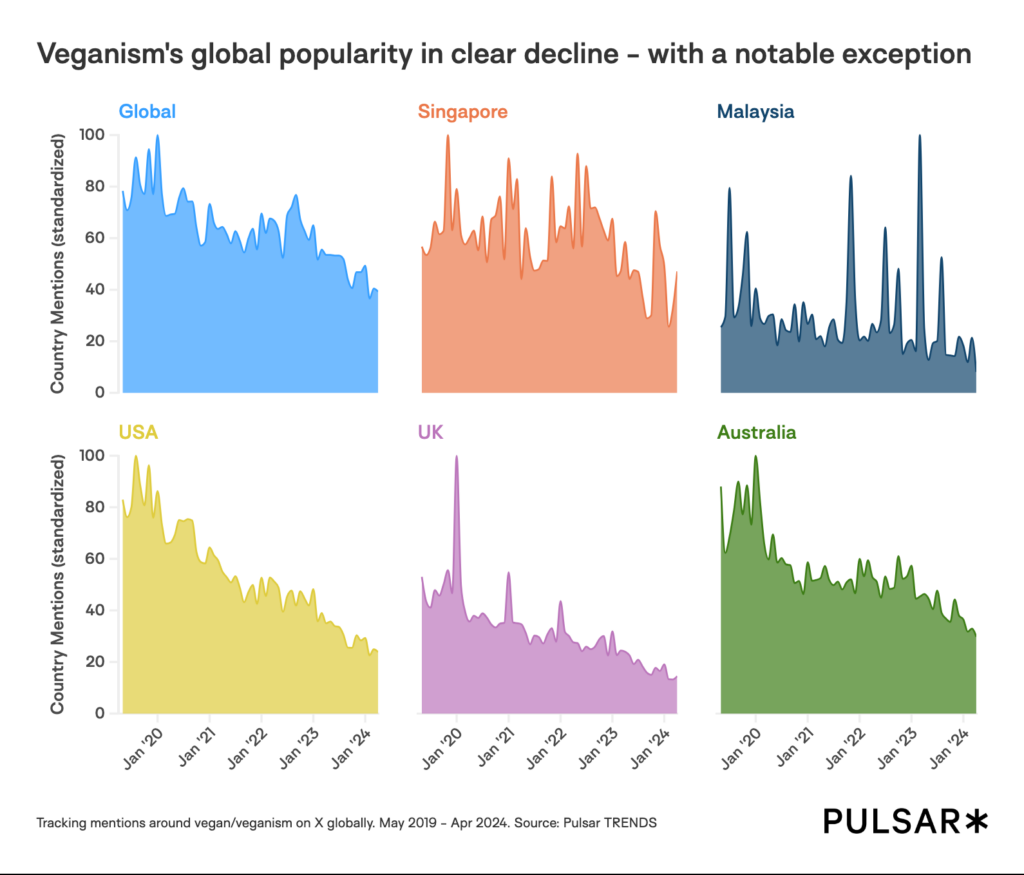
Over the past five years, mentions of veganism have experienced a noticeable global decline across major markets like the USA, UK, and Australia. However, Southeast Asia, particularly Singapore and Malaysia, buck this trend by maintaining steady interest in veganism. Singapore’s relatively higher mentions compared to neighbouring countries suggest a niche but engaged demographic focused on plant-based living. This suggests that audiences in Singapore, with access to a range of gastronomic options and consistent cultural exchange with other communities, are open to embracing a greener lifestyle, although adapting to this lifestyle can be more of a challenge for other Southeast Asian countries with strict dietary preferences.
Nice-to-haves still drive most SEA conversation around BNPL
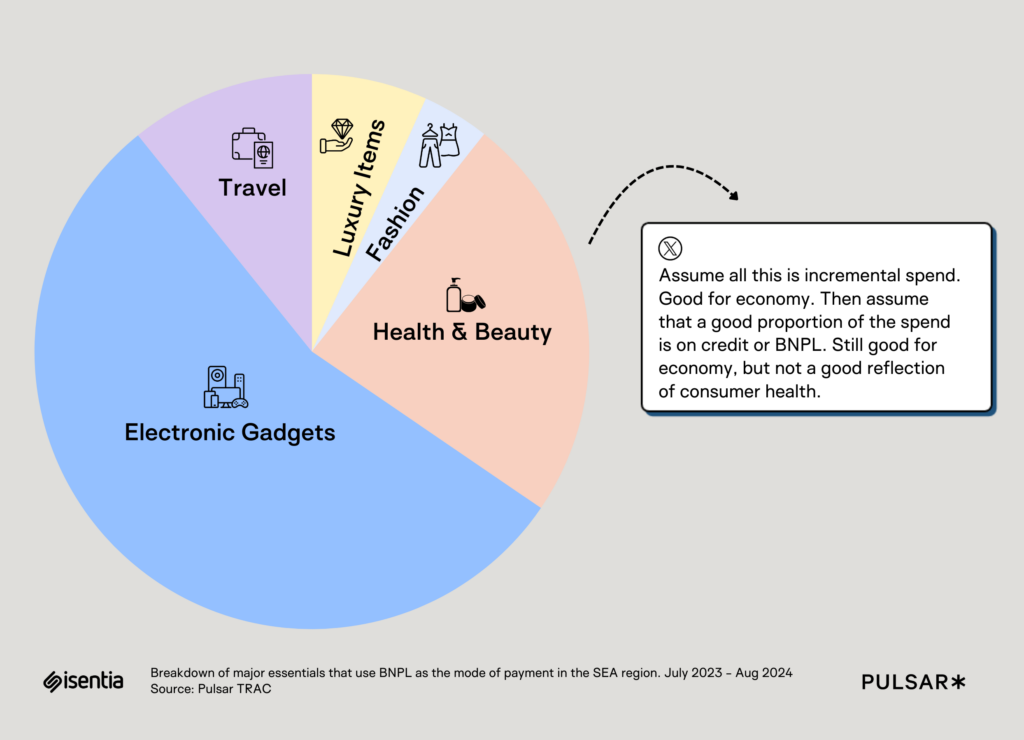
With an increased penetration of mobile phones in the region, Buy Now Pay Later apps have started to thrive, giving an illusion of affordability to younger generations. The breakdown of BNPL transactions reveals that electronic gadgets dominate consumer spending, followed by health and beauty products. While this incremental spending is positive for the economy, the significant reliance on credit and BNPL schemes highlights concerns about consumer financial health. These insights present dual opportunities for brands to align strategic campaigns in consumer goods categories like electronics and beauty products, while also addressing concerns around responsible spending.
We can benchmark this conversation against what is taking place in the UK, for instance, where the conversation skews towards borrowing for essentials, specifically household bills, medical bills and automotive payments. Media discussions suggest increased calls for regulation and consumer transparency.
Singapore maintains image as “global hub” throughout fractious geopolitical period
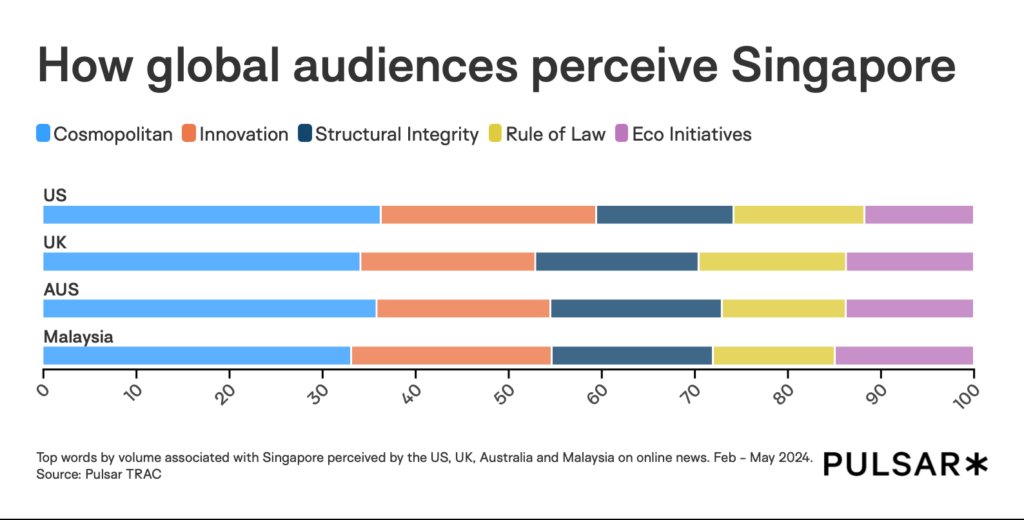
The Singapore brand has been receiving global attention, whether it’s talk around how efficient the public transport is or the way that Singapore dealt with Covid-19. When we look at associations that most resonate with Singapore globally, words like “cosmopolitan” and “innovation” dominate in the US, UK, and Australia. Malaysia’s perception mirrors this positivity but places slightly more emphasis on structural integrity and rule of law. This uniformity in perception presents an excellent opportunity to reinforce Singapore’s positioning, where the government is trying its best to mirror what the world expects of the city-state. PR & Comms professionals must leverage these strengths through storytelling or partnerships that can solidify Singapore’s brand equity on the global stage.
Singapore GP narratives extend far beyond the glamour of the sport itself
This chart highlights how specific narratives dominated online conversations leading up to the Singapore Grand Prix, including accessibility to the venue, themed events, and pop music excitement. This suggests how media coverage builds up anticipation and excitement amongst audiences towards the sport. Peaks in mentions suggest that audience interest surged around logistical convenience like public transport and viewing spots as well as entertainment offerings like musical acts and innovative culinary experiences. Leveraging audience intelligence, we understand that there is more to the event than glamour, emphasising emotional and logistical appeal, and that it provides an opportunity for partner brands to gain audiences to maximise engagement during high-impact events such as these.
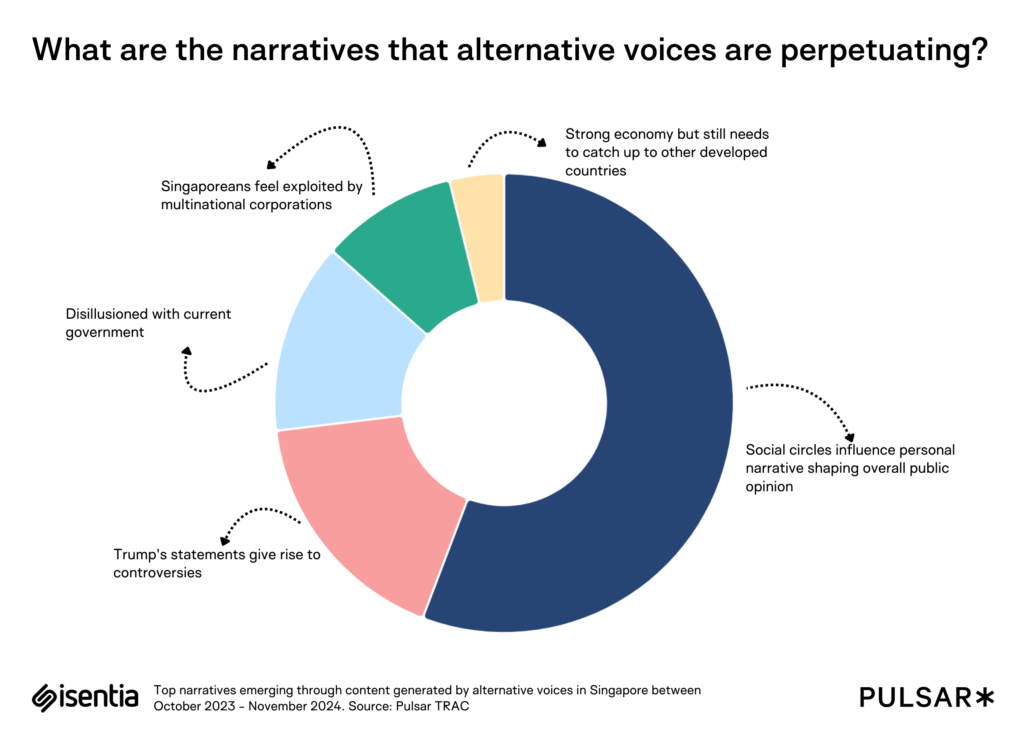
Alternative voices focus on government policies and influence of public discourse as dominant narratives in SEA
The chart highlights key narratives from a selection of top alternative voices in Southeast Asia, and their impact on shaping public opinion. A dominant theme is the influence of social circles in shaping personal and public narratives. This trend underscores the power of peer networks in driving sentiment and perceptions, often overshadowing traditional sources of influence.
Additionally, issues such as disillusionment with governance and perceptions of exploitation by multinational corporations are gaining traction in a city-state with rising costs of living. For communicators, these findings emphasise the importance of audience intelligence for understanding how communities talk to one another, who act as information brokers, and what topics there is most appetite to learn about.
These insights illustrate how monitoring media trends and audience sentiment equips brands to better anticipate shifts in consumer behavior, refine their messaging, and build deeper connections with their audiences. In a region like Southeast Asia, where cultures and lifestyles are heterogenous, this becomes even more pronounced.
Nikita Gundala manages brand marketing and thought leadership for Pulsar Group across the SEA and ANZ markets. With over three years of first-hand experience in the influencer marketing and PR industries, she specializes in translating real-time insights and audience intelligence into actionable content. Nikita holds a master’s in Marketing and Digital from ESSEC Business School, Singapore. She has contributed to the wider industry conversation by co-authoring articles and reports for The Business Times Marketing Interactive.
Isentia’s analysis of stakeholder reactions to the NSW Budget across 11 key sectors.
The 60-second summary
In his fourth budget, handed down on Tuesday, Treasurer Daniel Mookhey prioritised cost-of-living assistance for New South Wales residents.
In response to rising fuel prices and three interest rate increases, the government announced a $100 discount on car registration, a reduced toll cap, and frozen Opal fares. The budget also includes a record $10.3 billion commitment to health and a significant increase in funding for domestic violence services.
In reaction to the announcements, stakeholders responded with caution rather than celebration. Economic growth forecasts have been revised down to 1%. The budget has returned to deficit, and property tax revenue is declining.
Industry groups broadly described the budget as careful and responsible, while advocates for renters, farmers, the homeless and people with disabilities criticised the limited support. Groups representing the almost 3 million people who live in regional New South Wales - almost one-third of the state’s population - felt the budget fell short for the regions.
And with a state election approaching in early 2027, many stakeholders indicated they will continue to advocate for additional measures from the Minns government.
The numbers at a glance
Key figures highlighted by stakeholders:
$10.3 billion Health funding increase (4 yrs)
$561.4 million Transport Affordability Package
$100 Off private car registration
$50 Weekly toll cap (down from $60)
$184.1 million Domestic & family violence boost
$9.2 billion New & upgraded schools
$6.5 billion Electric buses (10 yrs)
$116.7 billion Total infrastructure pipeline
$2.3 billion 2026-27 deficit
1.0% Growth forecast (down from 2.5%)
Sector scorecards
Cost of living relief [Mixed]
The budget’s headline announcement is a 12-month, $561.4 million Transport Affordability Package, offering $100 off private car registration, a reduced weekly toll cap from $60 to $50, Opal fares frozen at 2025 prices, and the removal of toll administration fees.
Additionally, $557.1 million was committed to the Home Energy Saver scheme, continuing the interest-free loans for households to install energy-saving upgrades.
The New South Wales public sector is the largest employer in Australia, so a $1,000 bonus for 120,000 government workers was well received by the Public Service Association and for public servants living in Sydney. The bonus comes off the back of the announcement that Sydney’s CPI had exceeded 4 per cent since this time last year.
Australia’s peak industry association, the Australian Industry Group, described the cost-of-living measures as a sensible response, acknowledging current economic challenges, noting that the relief is intended to be temporary.
"Today's NSW Budget treads carefully, given the challenging economic times ahead for the State's economy."
— Helen Waldron, NSW State Head, Australian Industry Group
Leading community services organisation Social Futures welcomed the support but cautioned that it is limited, noting that lower public transport fares and tolls primarily benefit urban areas, and that low-income households remain at risk.
And the Insurance Council of Australia expressed concern that the Emergency Services Levy continues to rise, with NSW households and businesses carrying the load, set to pay $1.5 billion this year.
Health and mental health [Mixed]
The NSW health sector received the largest commitments in this year’s budget, with a $10.3 billion increase over four years. This increase includes 9,000 additional health workers, and an $11.9 billion building program for 32 hospitals and 2,500 extra beds.
The industry group representing NSW general practitioners welcomed support for patient transitions out of hospital, funding for rural travel, and the Thriving Kids and ADHD initiatives.
"GPs can help to cure a healthcare system struggling under the burdens of an ageing population, an epidemic of chronic disease, and a growing need for mental health care."
— Dr Rebekah Hoffman, RACGP NSW & ACT Chair
The doctors’ union was more guarded in its response, with the Australian Salaried Medical Officers Federation (ASMOF) welcoming the funding but stating it does not address the core issue of recruiting and retaining staff, as NSW continues to offer the lowest doctor salaries in Australia.
"Doctors, nurses and other health professionals have kept the public health system functioning under enormous pressure, but dedication is not a workforce plan."
— Dr Nicholas Spooner, President, ASMOF NSW
The NSW branch of the Australian Medical Association took the criticism further, with NSW AMA claiming the government’s health funding has gone backwards in real terms, due to health inflation rising at 4.9 per cent.
"The NSW Government has promised 9,000 additional health workers, including paramedics, nurses and allied health staff, but there is no mention of doctors. That is a serious gap in today’s Budget."
—Dr Fred Betros. President, AMA NSW
Mental health groups expressed concerns about their stakeholders being overlooked in this year’s budget. The Mental Health Coordinating Council welcomed crisis funding, but stated the budget relies too heavily on hospitals to deliver services.
"Mental health reform cannot rely primarily on hospitals and crisis responses."
— Dr Evelyne Tadros, CEO, Mental Health Coordinating Council
NSW’s Network of Alcohol and Other Drugs Agencies (NADA) also criticised the government for not addressing priorities from the 2024 Drug Summit, leaving over 100,000 people waiting for treatment.
Housing, property and homelessness [Negative]
Housing was the most challenged area in the budget announcement. The government highlighted planning reforms, an expanded Pre-Sale Finance Guarantee, and funding for Modern Methods of Construction.
Community housing group, Faith Housing and the Planning Institute of Australia viewed these as positive steps. However, the Urban Development Institute raised concern over an $8 billion reduction in property tax revenue.
"The lack of direct investments in supply-side initiatives in this Budget will make it harder for us to turn around the housing crisis."
— Stuart Ayres, CEO, UDIA NSW
The peak body for property developers in Australia, Urban Taskforce described the budget as a missed opportunity to increase housing supply, and the Property Council warned that additional federal tax changes could further reduce the number of new homes.
Homelessness and tenant advocates were more critical. Homelessness NSW described the housing package as insufficient, and the Tenants' Union noted that the government holds $2.5 billion in renters' bonds, forgoing up to $200 million annually in interest.
"We should not let the pursuit of budget savings punish the state's most vulnerable people by putting off meaningful investment in housing and homelessness."
— Amy Hains, A/CEO, Homelessness NSW
The Retirement Living Council welcomed the removal of foreign surcharge duty on large retirement village projects, describing retirement living as essential infrastructure.
Domestic violence and social services [Positive]
A $184.1 million increase put forward by the government would raise funding by 50% across six frontline domestic and family violence programs, marking the largest core funding boost for the sector in over a decade.
The Male Family Violence Prevention Association, or “No to Violence”, had advocated for this change, and welcomed the recognition of programs directly addressing men who use violence.
"Men's Behaviour Change Programs play a vital role in stopping violence at the source."
— Phillip Ripper, CEO, No to Violence
The NSW Council of Social Service (NCOSS), NSW’s peak social services body, responded to the announcements positively. They welcomed funding for award wage increases for community workers and enhanced patient travel support, while advocating for increased investment in preventative measures.
"This Budget lays the groundwork for deeper investment in people and communities."
— Cara Varian, CEO, NCOSS
Community groups like Uniting NSW.ACT and Social Futures agreed, stating the budget missed an opportunity to invest in early support to prevent families from reaching crisis.
Infrastructure and construction [Mixed]
While the government highlighted a $116.7 billion infrastructure pipeline, industry stakeholders pointed to a downward trend. Infrastructure Partnerships Australia reported a $1.1 billion reduction in infrastructure funding, but characterised this as a deliberate measure, rather than neglect.
"The Budget isn't flash, it doesn't hand out treats like confetti, but it does deliver a sizeable serving of sensible government."
— Adrian Dwyer, CEO, Infrastructure Partnerships Australia
Construction industry groups expressed concern, with the NSW Civil Contractors Federation (CCF NSW) warning that without a consistent pipeline, skilled workers may relocate interstate and become costly to attract back.
"This State Budget reflects an underwhelming level of infrastructure investment relative to the scale of NSW's growth needs."
— Kylie Yates, CEO, CCF NSW
The NSW Master Builders Association and the Housing Industry Association were more optimistic, noting increased housing approvals and welcoming the emphasis on prefabrication and materials supply.
Business and industry [Mixed]
Business groups acknowledged the Treasurer’s fiscal discipline but noted a lack of direct support.
Business NSW welcomed the $4.1 billion workers’ compensation premium freeze for employers but highlighted the absence of a payroll tax cut and no changes to the Emergency Services Levy.
"The Government is expecting to collect an additional $1 billion in payroll tax – or about $25,000 per eligible business – pushing more of the tax burden onto employers at a time they can least afford it."
— Daniel Hunter, CEO, Business NSW
Unions NSW viewed the budget differently, describing the end of the wage cap and the return of hospitals and prisons to public management as positive outcomes for workers.
"We are seeing the dividend of a government that understands the value of essential workers."
— Mark Morey, Secretary, Unions NSW
Regional NSW and agriculture [Negative]
Perhaps the strongest criticism on budget night came from regional stakeholders across the state. The Country Women’s Association of NSW stated the budget prioritised those living in Sydney, with significant funding for Western Sydney hospitals, schools, and transport, while regional roads, maternity services, and mobile coverage were not addressed.
"Billions for Western Sydney. Crumbs for the bush. The Budget does not lie."
— Tanya Jolly, State President, CWA of NSW
NSW Farmers also criticised the budget, stating it was repeating previous announcements and not in support of the sector’s goal of reaching a $30 billion industry by 2030. Both groups indicated they will make regional NSW a key campaign platform ahead of the 2027election.
"Producers are facing generational challenges and what we've seen today is a recycled response that does nothing to address the issues that matter most."
— Xavier Martin, President, NSW Farmers
Education and early learning [Mixed]
The budget included education commitments of $9.2 billion, including over 260 new and upgraded schools, with a quarter of the funding to be directed to regional areas.
Education workers unions welcomed the move to make tens of thousands of teaching positions permanent. However, the early learning sector received no immediate funding boost, noted by the Independent Education Union. They cited the absence of promised support for community preschools, although an announcement is expected soon.
"It's time for wages that properly value the work of community preschool staff."
— Carol Matthews, Branch Secretary, IEUA NSW/ACT
Energy, environment and transport [Positive]
The budget outlined $6.5 billion over ten years to build electric buses and depots in NSW, a measure supported by unions for supporting local manufacturing.
The continuation of funding to households looking to make energy savings was mostly well received, with $557.1 million promised for the Home Energy Saver program.
Further to this, the budget looks to unlock up to $77 billion in private investment through the Electricity Infrastructure Roadmap. Master Builders of NSW emphasised the benefits of the funding, creating regional construction jobs with the rollout of renewable energy projects.
Legal and justice [Negative]
The NSW Police were promised funding across a range of initiatives in a challenging period for law and order in the state. In reaction to the funding announcements, the Police Association of NSW (PANSW) welcomed the $108.8 million investment targeting digital infrastructure and crime-fighting technology. However, the union pushed for more workplace reform and funding for front-line resources.
To the contrary, the legal sector expressed dismay about being excluded from infrastructure spending. The Law Society of NSW stated the legal profession was overlooked in the budget’s building program, with no funding for key asks such as safe rooms for victims or digital court upgrades.
"Our members will be disappointed that the court system was allocated a meagre share of the $116.7 billion in state infrastructure investments through to 2030."
— Ronan MacSweeney, President, Law Society of NSW
Community Legal Centres NSW further noted that $3.5 million promised under a national agreement for community legal practice a year ago remains unfunded.
"People cannot pay their rent with promises, and community legal centres cannot deliver services with funding that has never arrived."
— Sarah Marland, Executive Director, Community Legal Centres NSW
Mining and resources [Positive]
The resources sector responded positively, highlighting in statements that mining royalties are projected to reach $3.4 billion next year. The Association of Mining and Exploration Companies (AMEC) welcomed the continuation of the Critical Minerals Royalty Deferral Scheme and progress on land access reform, while emphasising the need for faster project approvals.
"There's no better way to improve productivity than approving projects quicker."
— Warren Pearce, CEO, AMEC
The NSW Minerals Council had a similar sentiment but took the opportunity to criticise the federal government for recent inflation and interest rate hikes and proposed changes to capital gains tax and negative gearing. They pointed to the claim that the NSW budget will now lose at least $8.4 billion in foregone property-related taxation revenues, and that mining royalties will need to help cover that gap.
The winners and losers
Stakeholders point to the positives and negatives out of this year’s Budget.
WINNERS
LOSERS
Nurses, midwives and essential public workers — the wage cap is gone, with pay rises of 16–28% over three years and a $1,000 cost-of-living payment for 120,000 staff.
Drivers and commuters — $100 off rego, a $50 weekly toll cap, frozen Opal fares and scrapped toll admin fees.
Women and children escaping violence — a 50% funding lift across six frontline domestic violence programs.
First home buyers — average savings of $20,400, with about 30,000 more expected to benefit next year.
Hospital patients — $11.9 billion to build 32 new and upgraded hospitals and 2,500 extra beds.
Older people downsizing — foreign surcharge duty waived on large retirement village and build-to-rent projects.
Local bus manufacturing — $6.5 billion to build electric buses and depots in NSW.
Renters — the government forgoes up to $200 million a year in interest on $2.5 billion of held bonds.
People sleeping rough — homelessness advocates call the $224 million housing package “crumbs”.
Young people without a home — no new investment in specialist homelessness services since 2012.
Farmers and the bush — no new transformational funding; “billions for Western Sydney, crumbs for the bush.”
Businesses — no payroll tax or Emergency Services Levy relief, with payroll taking up about $1 billion.
Insurance holders — the Emergency Services Levy is forecast to raise $1.5 billion, up 66% over five years.
Drug and alcohol services — the 2024 Drug Summit priorities go unfunded as 100,000 people wait for treatment.
Community legal centres — $3–3.5 million promised a year ago, still undistributed.
What this means for communicators
This budget is defensive in nature, presented as a relief budget to the people of New South Wales. With growth slowing, inflation continuing to rise, and an election approaching in March 2027, the government is prioritising measures that directly impact voters, such as everyday costs for fuel, tolls, fares, and power bills, over large new projects.
Cost-of-living measures, health funding, and domestic violence spending are expected to be central to the government’s messaging in the coming days and weeks.
A clear pattern in stakeholder reactions is the divide between metropolitan and regional interests. Regional groups, including the CWA, NSW Farmers, and rural health and legal groups have consistently expressed concerns about being overlooked, and have noted Sydney projects receiving significant funding. This regional grievance is likely to become a prominent narrative in the lead-up to the election.
Housing remains another hot issue for the government. Industry representatives warn that housing supply is stagnating and the tax base is shrinking, while homelessness and tenant advocates argue that vulnerable groups are being overlooked.
With both ends of the spectrum - from developers to welfare organisations - claiming ongoing dissatisfaction, housing will be a persistent challenge for the Minns government.
The opposition has characterised the budget as evidence that NSW is regressing, suggesting that housing, regional services, and business costs will shape the election debate as we head into 2027. A clear understanding of audience groups and what drives them will be key to success for any government in such uncertain times.
For real-time monitoring of the budget reactions and the journey to the 2027 state election, register here and we'll reach out to you.
"
["post_title"]=>
string(101) "NSW Budget 2026: Cost of living relief ahead, but regions, renters, and businesses remain unconvinced"
["post_excerpt"]=>
string(135) "NSW Budget 2026: a sector breakdown of who gained and who didn't, with stakeholder reactions across housing, health, business and more."
["post_status"]=>
string(7) "publish"
["comment_status"]=>
string(4) "open"
["ping_status"]=>
string(4) "open"
["post_password"]=>
string(0) ""
["post_name"]=>
string(25) "nsw-budget-2026-reactions"
["to_ping"]=>
string(0) ""
["pinged"]=>
string(0) ""
["post_modified"]=>
string(19) "2026-06-26 03:13:41"
["post_modified_gmt"]=>
string(19) "2026-06-26 03:13:41"
["post_content_filtered"]=>
string(0) ""
["post_parent"]=>
int(0)
["guid"]=>
string(32) "https://www.isentia.com/?p=48311"
["menu_order"]=>
int(0)
["post_type"]=>
string(4) "post"
["post_mime_type"]=>
string(0) ""
["comment_count"]=>
string(1) "0"
["filter"]=>
string(3) "raw"
}
Blog
NSW Budget 2026: Cost of living relief ahead, but regions, renters, and businesses remain unconvinced
NSW Budget 2026: a sector breakdown of who gained and who didn’t, with stakeholder reactions across housing, health, business and more.
There is a new frontier where public perception is shaped: Large Language Models. Right now, LLMs are answering critical questions about your organisation. What are they saying? And more importantly, which sources are shaping those answers?
To navigate this landscape, public relations professionals don't need generic tools, but rather technology that speaks their language, and addresses the realities of a changed media and informational landscape.
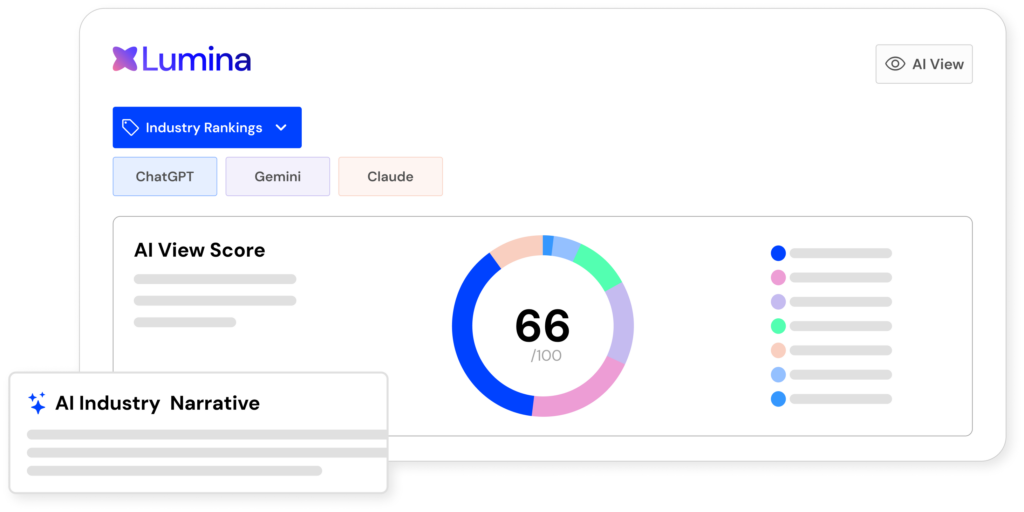
That is why we're unveiling Lumina AI View, the latest addition to our intelligent suite of AI tools from Isentia. Trained specifically on the workflows and challenges of modern PR & communications, Lumina AI View helps you understand exactly what AI knows about you, and how it learned it.
A new standard for AI visibility
AI View tracks your citation strength and source quality alongside those of your competitors, giving you a clear view of where you hold authority and where you have gaps.
Lumina AI View maps your AI reputation from the ground up, allowing you to:
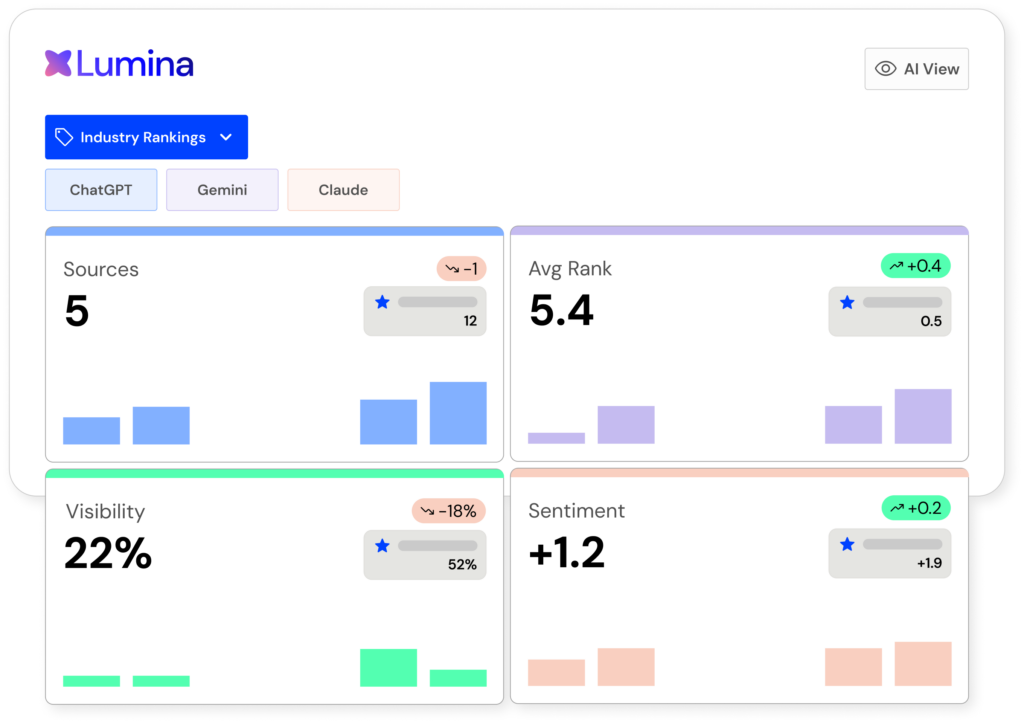
See which sources matter: When tools such as ChatGPT or Gemini discuss your organisation, which outlets do they cite? Track your source footprint over time and view the impact of key target media on how you’re discussed. We measure your citation strength and source quality alongside those of competitors, giving you a clear view of where you have authority and where you have gaps.
Gain industry-specific insight: Your competitors get cited from Financial Times and Bloomberg. You get cited on Reddit. Each brings opportunity – and risk. Discover how you measure up against industry standards, and target the sources that actually influence how AI represents you.
Catch narrative shifts early: AI responses change when new sources appear, sentiment shifts, or old controversies resurface. Get alerts when citation patterns change suddenly, before they impact the way you’re perceived by stakeholders.
Measure your progress: From media monitoring to full media intelligence
Lumina AI View is built on the principle that insights get stronger with repeated measurement. To help you maintain a clear view of your reputation, our proprietary scoring system provides regular updates that show you:
Evolving trends in how sources cite your organisation
Competitive standing and benchmark metrics
Where models differ in information presented, and sources cited
Whether you run it weekly, on-demand, or whenever you need a check-in, patterns will emerge, trends will become clear, and you will build a baseline that makes any sudden narrative changes both comprehensible and the prerequisite to action.
Lumina AI View is part of Lumina AI, a comprehensive suite of AI tools built specifically for communicators. Our Lumina suite evolves traditional media monitoring into narrative intelligence, enabling you to truly understand how perceptions form, evolve, and impact your reputation.
Get in touch to register your interest and see what Lumina AI View can do for you.
"
["post_title"]=>
string(66) "Introducing Lumina AI View: AI Visibility Built for PR & Comms"
["post_excerpt"]=>
string(158) "Lumina AI View, the latest in Isentia's AI suite, is trained on PR & comms workflows to help you understand what AI knows about you — and how it learned it."
["post_status"]=>
string(7) "publish"
["comment_status"]=>
string(4) "open"
["ping_status"]=>
string(4) "open"
["post_password"]=>
string(0) ""
["post_name"]=>
string(59) "introducing-lumina-ai-view-ai-visibility-built-for-pr-comms"
["to_ping"]=>
string(0) ""
["pinged"]=>
string(0) ""
["post_modified"]=>
string(19) "2026-06-04 04:13:37"
["post_modified_gmt"]=>
string(19) "2026-06-04 04:13:37"
["post_content_filtered"]=>
string(0) ""
["post_parent"]=>
int(0)
["guid"]=>
string(32) "https://www.isentia.com/?p=47963"
["menu_order"]=>
int(0)
["post_type"]=>
string(4) "post"
["post_mime_type"]=>
string(0) ""
["comment_count"]=>
string(1) "0"
["filter"]=>
string(3) "raw"
}
Blog
Introducing Lumina AI View: AI Visibility Built for PR & Comms
Lumina AI View, the latest in Isentia’s AI suite, is trained on PR & comms workflows to help you understand what AI knows about you — and how it learned it.