Blog post
September 30, 2019

The burning issues: bushfires and climate change

The early start of the bushfire season is being raised by the fire authorities as a serious concern. With another summer of record high temperatures still to come and no sign of the drought breaking, the bushfires have sparked the use of terms such as crisis, emergency, unprecedented and historic in the media. But bushfires in Queensland are not unusual and the subject of climate change being a contributor is also a hot topic. 

In this blog, we delve deeper into these topics by analysing the media coverage around the Queensland bushfires and climate change.

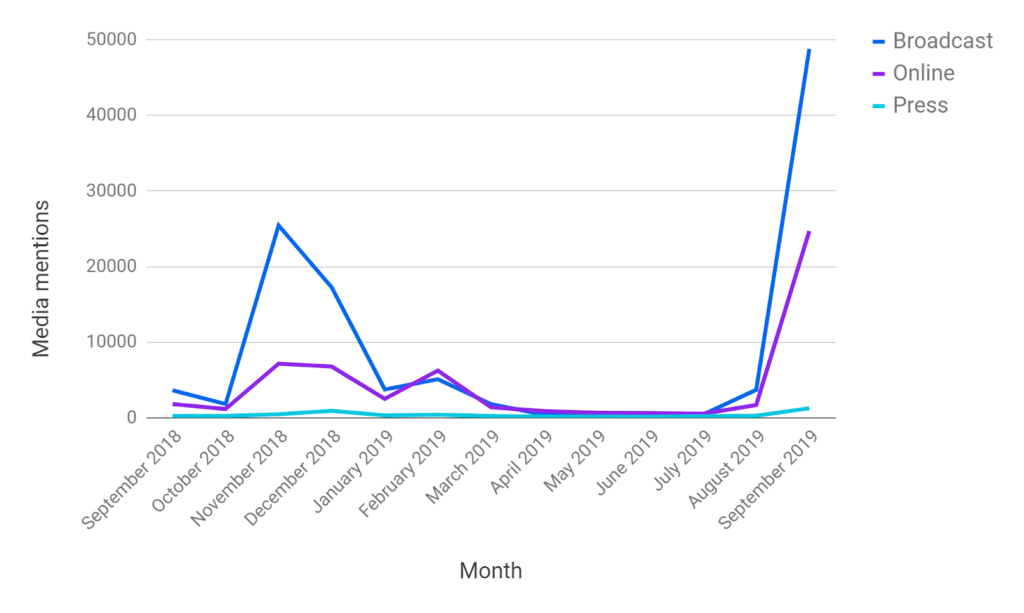
In the past year, “bushfire,” “Queensland” and related keywords returned close to 174,000 mentions.  

Throughout November and December 2018, we saw a spike in mentions predominantly across Broadcast. During this time, the media communicated great concern over an early start to the fire season and the lack of rain that was expected in the coming weeks and months.

Interestingly, the number of mentions from these months combined equates to less than the number of mentions that have happened in September 2019. These figures tell a story with emphasis being placed on the severity of the bushfires, the surrounding issues around climate change and the government’s response.

Media mentions for “bushfires,” Queensland” and related terms from September 2018 to September 2019

The current landscape

Queensland has been facing it’s most catastrophic bushfire season in recorded history – with more than fifty bushfires burning at one time. The Bureau of Meteorology’s data on climate change shows that rising temperatures have been evident since the beginning of the 20th century and have been gaining momentum with rising carbon emissions year on year.

This year, a warming climate has contributed to the early fire season. With an unusually dry winter, very little rainfall and above average temperatures, weather conditions like these have not been seen so early in Spring. Vegetation such as rainforests are now flammable thanks to a drier and hotter climate. These conditions are also putting more people at risk with health issues as well as fires threatening people’s homes. 

The drought that’s now across much of the eastern seaboard has set the scene for more frequent and intense fires this summer.  Currently, approximately 98 per cent of New South Wales and 65 per cent of Queensland are drought affected. Many towns in regional New South Wales and southern Queensland are having to get water supplies transported to them to avoid water shortages. 

The warming climate has also increased the possibility of bushfires burning in different states simultaneously.  Due to this, the paradigm to a strategic firefighting plan is required whereby states will need to resource their own fires as the resources aren’t available to lend a helping hand.

The economic effects

Despite the numerous bushfires that have happened in recent weeks, politicians have been insisting that climate change isn’t relevant to this year’s fire season.

Climate scientists advise this is a dangerous approach and Queensland’s summer of disasters is evidence that climate change will take an economic toll on taxpayers

Bushfires and floods have been ravaging Queensland over the past three months and if natural disasters continue, the State Budget is estimated to take a hit of at least $1.5b.

The government has made disaster recovery payments available for eligible residents, where up to 13 weeks of income assistance can be claimed for those affected by natural disasters. 

Global climate strike

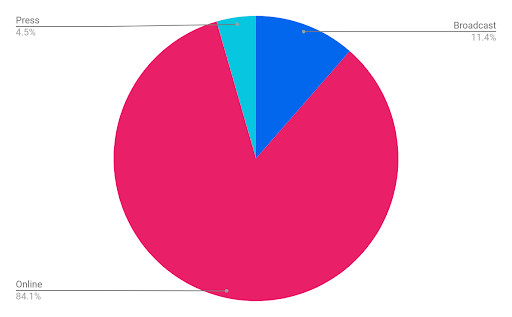
Strikes for climate change have been prominent on a global scale with ‘Strike for Climate’ rallies that have taken place in multiple cities around the world. The first rallies took place Friday 20th September 2019 and continued until Friday 27th September. During the week period, there were over 16,000 media mentions on the subject with 84 per cent of these mentions made online. These numbers depict just how prominent the subject of climate change is in the media.  

In the below, we see the dispersion of mentions about the climate change strikes across Broadcast, Print and Online news. 

Media mentions for “Global Climate Strike” and related terms from
September 20 – September 27 2019

These strikes were brought on after Swedish teenage activist, Greta Thunberg started to raise global awareness of the risks posed by climate change. She wanted to put pressure on politicians to be held accountable for their lack of action on the climate crisis. 

Within Australia, hundreds of thousands of school students walked out of classrooms and rallied for action to be taken. The September strikes followed strikes that were held in March this year where over 150,000 people marched in Australia and 1.5million world wide.

Australia was one of the first countries in the world to join the global climate strike protests, with hundreds of thousands rallying in countries around the world. In capital cities around Australia, people prepared signs and chanted slogans in favour of swift climate action.

In Australia protesters want the Federal Government to commit to:

  • No new coal, oil or gas projects
  • 100 per cent renewable energy generation and exports by 2030
  • Funding for “a just transition and job creation for all fossil-fuel industry workers and communities”

Looking to the future, it will be interesting to see how government bodies around the world respond to the rallies, to the changing climate and the effect they are having on the environment and community. 

If you would like to learn more about the media coverage about this topic or anything media intelligence related, get in touch with us today.

Share

Similar articles

object(WP_Post)#9086 (24) { ["ID"]=> int(49040) ["post_author"]=> string(2) "75" ["post_date"]=> string(19) "2026-08-11 02:14:11" ["post_date_gmt"]=> string(19) "2026-08-11 02:14:11" ["post_content"]=> string(14309) "

The advent of LLMs and AI search means that there has been a colossal shift in how audiences are consuming information today,  and a reciprocal shift in how all types of organisations, from government agencies to brands are responding . But while discussion amongst PR and comms pros tends to fall disproportionately on how brands are impacted, the needs of the former are just as keenly felt, and often quite distinctive.

So how can government agencies respond, especially in a time of global flux, when major policy changes need to be communicated and important stakeholders need to be managed? After all, government organisations do care about reputation, much as brands do, but have quite distinctive goals when it comes to ensuring accurate information reaches the right audiences.

There is a new entry point for stakeholders


The era of "Let me Google that" is rapidly fading. Instead of clicking through to official websites, people are asking chatbots for direct answers.  What’s striking is that government agencies often have no visibility on how they’re being talked about in the LLM space, even as it becomes a central channel for messaging and reputation. 

When AI models become the primary gatekeeper, audiences bypass official portals entirely — driving down site traffic and leaving agencies vulnerable to misinformation, negative sentiment, or worse, being left out of the conversation altogether. 

Therefore, the entry point is different. For commercial brands, this shift is profound but in some ways mediated – an FMCG brand, for instance, often discovered through third-party platforms in any case. But for government entities, the stakes are entirely different. As the sole, authoritative source for public information, they need citizens on their websites to get accurate details. Government agencies, especially if they are the authority or regulator in a particular industry or sector, need to make sure audiences know where to go to get the right information.

Different types of government agencies have different considerations

Not all government agencies are alike, and they all have different parameters that are quite non-negotiable for them, just by the way they function. 

  1. Service delivery agencies - these rely heavily on content freshness. They can’t risk outdated sources impacting eligibility or process changes not reaching audiences.
  2. Regulators - these need to transmit authority and trust. Regulators have to make it a priority that they’re amongst the first place audiences go to for information and that the industry they’re regulating does not put them in the shade on the channels stakeholders are actually using
  3. Policy departments - did the AI's account of a policy match what was actually announced? They want to be able to make sure the accuracy of a policy (and ideally, its effectiveness) is translated when audiences search through LLMs.
  4. Local and state authorities want to make sure the services they carry out on behalf of locals are visible too. Much like service providers, there is a question around access and awareness of programmes and regulations, but also an added consideration: not appearing on LLMs discontent amongst those wishing to see a return on taxation and electoral mandates, and give credence to bad actors.

What do government agencies want to get out of this new LLM-mediated landscape? 

Reputation is important, but that exists downstream from maintaining a flow of accurate information. It’s useful for communications teams in government organisations to self reflect and ask themselves the following questions:

  • Where are citizens going to find information about your services if not your website — and do you know what they're being told?
  • If there was a significant policy change or incident in the last twelve months, do you know how it's currently being characterised when someone asks an Al tool about your agency?
  • When you communicate a major service change or policy update, do you have any way of measuring whether it’s surfacing in searches about you?
  • How do you currently understand the gap between what your agency publishes and what citizens actually receive when they search for information?
  • Are there community groups, advocacy organisations, or media outlets shaping perception of your agency - and do you know if that's feeding into what Al models say?

These are gaps they already realise, but they don’t actually know what to do about it – how to manage or measure them. They need a tool that allows them to know this critical piece of information and make informed decisions. 

Lumina AI View: AI visibility for PR & Comms


Lumina AI view is built for communicators who want to understand how their organisation and their competitors are being talked about by various AI models – including ChatGPT, Gemini, and Claude. AI View users get an insight into which sources are being cited, and how they would need to respond as a way of protecting their reputation or making sure correct information about them is being disseminated. 

The tool provides an AI view score — a composite metric ranging from zero to 100, designed to help track brand performance over time and facilitate comparisons against competitors. It is calculated using five weighted factors — sentiment, visibility, authority, dominance and freshness. Beyond the overall score, the platform provides a summary of a brand's AI narrative based on four distinct reputation pillars — direction, performance, integrity and innovation. 

These pillars help users identify exactly which dimension of a brand's reputation is under pressure, offering specific, actionable insights for board presentations or reviews. Ultimately, while the AI view platform provides the necessary intelligence, the strategic decisions regarding how to respond to these insights remain with the organisation.

Spotlight: An Australian Council


This progressive local government council is located in Australia’s leading center for culture and sports.

The council earned an AI view score of 74 reflected by strong reach and authority. Publications like CBD News and its own website are the most cited by LLMs — interestingly, most of them being cited by Claude.

Content freshness scored lower at 48. Their website still carries error pages and annual reports from a few years ago. If a report — one that is seen as an organisation’s most comprehensive and authoritative content, is still being cited even if it’s older, might potentially be in the way of the organisation’s own perception. Which means more work is needed to prevent outdated content from still appearing.

What type of content is showing up?

Most citations for the council originate from government sources, followed by news outlets, reports, and blogs. The domain is evenly split between owned content and content earned from external sources media articles and independent authorities. 

While most are recent, some older articles from major outlets such as The BBC remain visible and may significantly influence how LLMs perceive the council. Owned content typically addresses last year’s budget plans and the council’s latest vision for the city, which LLMs are referencing. Government sources are the major content type, however, external sources have a greater impact on the council’s overall LLM score.

The stakes are higher for government agencies

When brands track LLM visibility, they often ask, "Are we shown in a positive light?" or "Are we cited accurately?" For the government, additional questions arise: "Is this information accurate enough for someone to act on?" and "Are we still viewed as more authoritative than what we oversee?" Mistakes can have serious consequences, such as individuals applying for ineligible programs or missing critical deadlines for new initiatives or elections. This can quickly lead to public frustration. It is essential for government communicators to recognize these risks.


If you would like to know more about our Lumina suite, please reach out here and our team will get in touch with for you a quick demo.

" ["post_title"]=> string(77) "Why is tracking government visibility on LLMs different from tracking brands?" ["post_excerpt"]=> string(121) "Government agencies often can't see how AI chatbots describe them. Here's why LLM visibility matters and how to track it." ["post_status"]=> string(7) "publish" ["comment_status"]=> string(4) "open" ["ping_status"]=> string(4) "open" ["post_password"]=> string(0) "" ["post_name"]=> string(46) "latest-reads-ai-visibility-government-agencies" ["to_ping"]=> string(0) "" ["pinged"]=> string(0) "" ["post_modified"]=> string(19) "2026-08-11 02:14:19" ["post_modified_gmt"]=> string(19) "2026-08-11 02:14:19" ["post_content_filtered"]=> string(0) "" ["post_parent"]=> int(0) ["guid"]=> string(32) "https://www.isentia.com/?p=49040" ["menu_order"]=> int(0) ["post_type"]=> string(4) "post" ["post_mime_type"]=> string(0) "" ["comment_count"]=> string(1) "0" ["filter"]=> string(3) "raw" }
Blog
Why is tracking government visibility on LLMs different from tracking brands?

Government agencies often can’t see how AI chatbots describe them. Here’s why LLM visibility matters and how to track it.

object(WP_Post)#12085 (24) { ["ID"]=> int(47963) ["post_author"]=> string(2) "75" ["post_date"]=> string(19) "2026-06-03 02:01:58" ["post_date_gmt"]=> string(19) "2026-06-03 02:01:58" ["post_content"]=> string(5651) "

There is a new frontier where public perception is shaped: Large Language Models. Right now, LLMs are answering critical questions about your organisation. What are they saying? And more importantly, which sources are shaping those answers?

To navigate this landscape, public relations professionals don't need generic tools, but rather technology that speaks their language, and addresses the realities of a changed media and informational landscape.

That is why we're unveiling Lumina AI View, the latest addition to our intelligent suite of AI tools from Isentia. Trained specifically on the workflows and challenges of modern PR & communications, Lumina AI View helps you understand exactly what AI knows about you, and how it learned it.

A new standard for AI visibility

AI View tracks your citation strength and source quality alongside those of your competitors, giving you a clear view of where you hold authority and where you have gaps.

Lumina AI View maps your AI reputation from the ground up, allowing you to:

  • See which sources matter: When tools such as ChatGPT or Gemini discuss your organisation, which outlets do they cite? Track your source footprint over time and view the impact of key target media on how you’re discussed. We measure your citation strength and source quality alongside those of competitors, giving you a clear view of where you have authority and where you have gaps.
  • Gain industry-specific insight: Your competitors get cited from Financial Times and Bloomberg. You get cited on Reddit. Each brings opportunity – and risk. Discover how you measure up against industry standards, and target the sources that actually influence how AI represents you.
  • Catch narrative shifts early: AI responses change when new sources appear, sentiment shifts, or old controversies resurface. Get alerts when citation patterns change suddenly, before they impact the way you’re perceived by stakeholders.

Measure your progress: From media monitoring to full media intelligence

Lumina AI View is built on the principle that insights get stronger with repeated measurement. To help you maintain a clear view of your reputation, our proprietary scoring system provides regular updates that show you:

  • Evolving trends in how sources cite your organisation
  • Competitive standing and benchmark metrics
  • Where models differ in information presented, and sources cited 

Whether you run it weekly, on-demand, or whenever you need a check-in, patterns will emerge, trends will become clear, and you will build a baseline that makes any sudden narrative changes both comprehensible and the prerequisite to action.

Lumina AI View is part of Lumina AI, a comprehensive suite of AI tools built specifically for communicators. Our Lumina suite evolves traditional media monitoring into narrative intelligence, enabling you to truly understand how perceptions form, evolve, and impact your reputation.


Get in touch to register your interest and see what Lumina AI View can do for you.

" ["post_title"]=> string(66) "Introducing Lumina AI View: AI Visibility Built for PR & Comms" ["post_excerpt"]=> string(158) "Lumina AI View, the latest in Isentia's AI suite, is trained on PR & comms workflows to help you understand what AI knows about you — and how it learned it." ["post_status"]=> string(7) "publish" ["comment_status"]=> string(4) "open" ["ping_status"]=> string(4) "open" ["post_password"]=> string(0) "" ["post_name"]=> string(59) "introducing-lumina-ai-view-ai-visibility-built-for-pr-comms" ["to_ping"]=> string(0) "" ["pinged"]=> string(0) "" ["post_modified"]=> string(19) "2026-07-15 03:12:57" ["post_modified_gmt"]=> string(19) "2026-07-15 03:12:57" ["post_content_filtered"]=> string(0) "" ["post_parent"]=> int(0) ["guid"]=> string(32) "https://www.isentia.com/?p=47963" ["menu_order"]=> int(0) ["post_type"]=> string(4) "post" ["post_mime_type"]=> string(0) "" ["comment_count"]=> string(1) "0" ["filter"]=> string(3) "raw" }
Blog
Introducing Lumina AI View: AI Visibility Built for PR & Comms

Lumina AI View, the latest in Isentia’s AI suite, is trained on PR & comms workflows to help you understand what AI knows about you — and how it learned it.

Ready to get started?

Get in touch or request a demo.