International Women’s Day (March 8) is a global day celebrating the social, economic, cultural and political achievements of women. The day also marks a call to action for accelerating gender parity.
For International Women’s Day this year the call is to #pressforprogress. With the World Economic Forum releasing information that gender parity is still over 200 years away and an intense global spotlight on women through #metoo and #timesup there is pause for thought on how this information and data can drive change. However, the broad nature of global movements means that it can be easy to disconnect and not always understand the impact in your local environment.
One of the IWD calls to action is to forge positive visibility of women by identifying ways to make them more visible and select them as spokespeople and leaders. I work in communications measurement and media research, and we deal with data about organisations, media strategies and consumer behaviour on a daily basis. Our work is built on the idea that media representation and public opinion can be understood and changed.
I’ve been lucky enough to see a desire for change from the clients that I work with and to produce research that should be a driver for change. Some of the consistent findings across media in New Zealand are: Significantly lower volumes of women presented as a subject matter expert or commentator.
Significantly lower volumes of women presented as a subject matter expert or commentator
Women are described as having earned their position or success more often than men.
Female success is often contextualised by male failure. (This is particularly true in coverage of athletes).
Women are not shown in a diversity of roles, and are more likely to be positioned with their family, partners, coaches and other support people.
As a quick example, over the past 12 months 72% of all sources quoted in banking and financial coverage in New Zealand, were men. For the dairy industry, 82% were men. In the tertiary sector, which I thought would be a palate cleanser, only 33% of all sources were women.
As with anything involving communication, this is a two-way street with media. For some organisations we specifically examine how often they position women for comment, or are quoted in media releases and kits, and what the specific take up of that is compared to men. So far, the data supports that a female spokesperson is more likely to be cut out of final copy. We have also found that there is a higher likelihood that journalists have a direct relationship with experts and commentators who are men. Women are more likely to have this relationship facilitated through a communications function or other support network.
Organisations are becoming more conscious of the impact that representation may have on their brand in the future. In the context of ethical and values-based consumerism, where the expectation on brands is to match with personal beliefs and authenticity, gender can play an important role. It may contribute to reputation in unexpected ways, including being an employer of choice.
While some of these findings are challenging, the increased interest from organisations to understand how the representation of women affects their brand, is a positive step. We now have clients who are solely focused on improving their profile – not only by an increased presence of women – but openly celebrating gender diversity initiatives and how these initiatives are being reported on, and discussed online by potential employees or customers.
If nothing else, I hope that this information allows for pause, and reflection on how we all contribute to the representation of women through our small choices, whether that be who is positioned to speak on a topic, or what language is used, and how much space is given. Representation is important. How often we see women, and how they are framed helps to shape our expectations. We can’t change what we don’t understand or can’t see clearly.
Ngaire Crawford is Head of Insights for Isentia in New Zealand. Her team of New Zealand-based analysts work across a broad range of clients measuring their communication strategies, and use media to help organisations understand their audiences and issues that are important to them.
Loren is an experienced marketing professional who translates data and insights using Isentia solutions into trends and research, bringing clients closer to the benefits of audience intelligence. Loren thrives on introducing the groundbreaking ways in which data and insights can help a brand or organisation, enabling them to exceed their strategic objectives and goals.
Following our webinar on 5 May, our panelists respond to the questions we didn’t get to on the day.
How comms leaders need to adapt to this new AI shift at the workplace?
AI is already shaping your organisation’s reputation — whether you’re managing it or not.
On 5 May, Isentia brought together three leading voices in communications and insights for a conversation about what’s really happening on the ground as AI reshapes the workspace. Catherine Arrow (Executive Director, PR Knowledge Hub), Russ Horell (Isentia APAC’s ex-Chief Revenue Officer) and Ngaire Crawford (Isentia and Vuelio's Executive Director for AI Strategy in PR & Comms) explored how communications leaders are navigating AI conversations with executives and boards, where pressure is increasing across risk, measurement and strategic advisory, how teams are adapting workflows and decision-making in response to AI influence, and where do communicators see the right opportunity.
The session saw many questions popping up from our audiences that we couldn't really address them all. So we went back to our panelists and asked them to respond. Below, Catherine Arrow and Ngaire Crawford share their thoughts on what attendees most wanted to know.
Catherine Arrow is the Executive Director of PR Knowledge Hub, a professional development and training organisation for public relations practitioners. A veteran of the communications industry with deep expertise in strategic counsel, crisis and issues management, and information disorder, Catherine is known for her clear-eyed thinking on the intersection of AI, reputation and organisational responsibility. She is a trusted voice on what AI actually means for practitioners — not in theory, but in practice.
Q1. Comms professionals often have an idea of how AI can help us, but often the C-Suite have other (less informed) ideas. Do you have examples of how you’ve tactfully pushed back or diverted focus back to where you feel it should be (outcomes focused)?
One of the main difficulties is that organisations and their leaders seldom have a clear picture of what they already have at their fingertips when it comes to AI. Many organisations, for example, use the Microsoft suite and may already have access to Copilot, but what can actually be achieved depends on the licences, payments and subscriptions in place. At the same time, leadership teams are influenced, as we all are, by the level of hype that has bubbled to the surface over the last 12 months. Too often, AI is regarded as a passive tool that lives inside a box and as practitioners we have a role to play helping leaders move beyond that limited view. We need to help them understand not only the functional use of particular tools but the bigger picture, to understand the impact AI may have on the organisation’s decision-making, relationships, reputation and licence to operate. The issue is whether the organisation understands the consequences of handing decisions, or the appearance of decisions, to AI in ways that may affect stakeholders, employees, communities of interest and others connected to the organisation’s activities.
So, when I need to tactfully push back or redirect the conversation, my starting point is usually a set of simple questions. What are you trying to achieve with this? How does it align with your organisational outcomes? Is it being applied ethically? Do you understand the consequences? What could it do to your reputation, relationships and ability to maintain your licence to operate?
That approach allows the conversation to move away from the excitement of the new shiny tools and back towards purpose, responsibility and organisational impact. From there, you can begin to workshop the options, discuss the implications, consider the real costs and identify the areas that need attention before AI of any kind is deployed.
Q2. How much is AI picking up on social media commentary as part of its description of organisations?
Yes, AI picks up social media commentary but it will only pick up what it can access. Generally, that means publicly available commentary or material available through an API connection or approved data source. So, in terms of general digital chatter, yes, AI can identify and interpret some of that activity.
The difficulty is that we have to be careful about what it is actually reading. You can already see this in some AI overviews and AI-generated summaries, where the system may refer to “chatter” or online discussion without always digging deeply enough into whether the original sources are genuine, reliable or themselves AI-generated. So we end up with AI nested inside AI, nested inside AI.
That creates a bigger problem for communication and engagement. People are increasingly using AI to generate and optimise social media content but that is not the same as engaging with people. At the same time, many platform algorithms are designed to reward optimised content. The result is a circular loop where AI feeds AI, which feeds AI again. Human language, judgement and connection get pushed aside.
People can become immune to this kind of content because it does not sound like the way we speak to each other, nor does it reflect the way genuine relationships are built. Then, when conflict or outrage is layered on top, the environment becomes even harder to interpret.
So the short answer is yes, AI can monitor social media commentary. The longer answer is that it often does so in ways that require considerable caution, human judgement and a much deeper understanding of what is being surfaced, amplified and missed.
Q3. How are you maintaining credibility in a landscape flooded with AI-generated content?
Personally, I try to maintain credibility by doing my best to remain human. That is probably the best advice I would give to others as well. Use your own intelligence to understand the people and communities you want to engage with. Do not use AI as a barrier between you and them. Use it as a handy tool. Let it help you edit where necessary, test an idea or explore an angle, but do not hand over your voice, judgement or identity. The same applies to imagery. If you are creating images with AI, treat it as a collaboration rather than giving the system an idea and simply running with whatever it gives back. AI-generated imagery carries assumptions and bias, so we must question what is produced and make conscious choices about what we use.
For me, maintaining credibility and authenticity means being yourself and not allowing AI to suffocate your identity. That will become harder to do as digital twins, synthetic voices and other tools make it easier for organisations to use it as a mask. The real challenge is not so much maintaining credibility. It is about maintaining humanity, empathy, kindness and a genuine wish to connect with others beyond the AI-intermediated space.
Q4. Globally, it would be interesting to learn how each country’s culture is reflected in the messaging as filtered by LLMs.
Different AI systems can reflect, distort or flatten cultural context in several ways and one of the biggest concerns is the continental drift between the major model providers. Many of the systems most widely used are strongly shaped by US language, culture, law, commercial assumptions and social norms. At the same time, Chinese models are being developed within a very different political, linguistic and cultural environment – much better at APAC languages for example. So the question is twofold: whether an AI system is “accurate” and “accurate according to whom, trained on what, governed by which assumptions and optimised for which worldview”?
Training data matters enormously. In the early days of the general release of generative AI, we saw certain words and phrases appear everywhere. “Delve” is one example, and “dive into” is another. These were signals of the linguistic patterns embedded in the data, the training process and the reinforcement layers shaping outputs. When those patterns are repeated at scale, they begin to influence the way people write, speak and frame ideas. Over time, that blunts understanding, with distinctive voices, local idioms and cultural ways of knowing pushed towards a generic machine-mediated style.
There is important work being done by Māori researchers and others on the cultural impact of AI, particularly in relation to language and data sovereignty, indigenous knowledge and the right of communities to determine how their knowledge is represented, protected and used. The research is still developing but the concern is real. AI systems can absorb, repackage and reproduce cultural knowledge without context, consent or accountability. They can also misread or flatten concepts that do not translate neatly into dominant languages or Western knowledge structures.
That is why the homogenisation of culture and language is something we need to understand and contest. In many ways, AI becomes a form of digital colonisation. Knowledge is scraped, curated, classified and reproduced by systems that may have no meaningful relationship with the people, histories or communities from which that knowledge came. In some instances, it risks rewriting history, or at least a narrowing of it, where contested, local or marginalised perspectives are buried beneath the most available, most optimised or most dominant version of events.
So, different AI systems may distort cultural context by privileging dominant languages, simplifying complex meanings, mistranslating concepts, omitting local histories or reproducing the worldview of their developers and training environments. They may flatten culture by making everything sound the same. And that presents a real danger, not only for communication professionals but for society more broadly, because shared understanding, cultural memory and social cohesion all depend on our ability to recognise difference, preserve nuance and respect the knowledge that communities hold for themselves.
Q5. Where can we find Catherine’s upcoming sessions on misinformation and AI?
The Managing Information Disorder session will stream live on 2nd July. Please register here.
In case you can't make it, you can always signup and access the live recording. As part of the session, you will also receive the Information Disorder Framework and the practical tools that accompany it, designed to help you recognise and respond to misinformation, disinformation, mal-information, narrative attacks, deepfakes and other risks in the current information environment.
If you would like to know more about AI, the AI in Public Relations – What’s New, What’s Next and What Now? session is also available. It is designed to help you get up to speed with the latest developments, understand what they mean for public relations practice and identify what you need to do next.
You can also access some of the resources Catherine mentioned during the webinar, including the Chaos Compendium, which is freely available. It exists to help you think through what is happening now, prepare your organisation for the months ahead and take practical steps to manage the risks, issues and pressures already coming into view.
Ngaire Crawford, Executive Director, AI Strategy
Ngaire Crawford is Executive Director for AI Strategy, with a mandate spanning both Isentia and Vuelio to ensure the Group’s AI strategy is coherent, credible and commercially effective. A driving force behind Isentia’s insights and measurement capability for a number of years, Ngaire is a well-respected voice across the communications measurement industry — with customers, at industry events, and in the broader conversation about the future of PR and communications. Her curious, thoughtful approach, deep expertise in measurement, and early adopter mindset with AI have helped shape much of what Isentia is building.
Q1. What are some of the top errors or mistakes you see communications leaders make in regards to AI?
If we assume people are already off the first rung and past treating AI as a workflow assistant for drafting and summarising, the more interesting mistakes tend to start after that.
The one I’d put first is assuming this is a more neutral information environment than it actually is. It’s a tempting thing to believe after years of algorithmic outrage, the idea that AI hands everyone a calmer, more balanced version of events is genuinely appealing. But I don’t think the echo chamber disappears with LLMs; it just gets dressed differently. Social platforms built echo chambers by amplifying whatever made you angry. LLMs have a gentler version of the same habit, they’re built to be helpful and agreeable, so if you ask a leading question you’ll often get an answer that politely validates your framing. And the more personalised they get, the more pronounced that becomes. So when you’re thinking about how your audiences are forming views through these tools, what matters isn’t just what the system “says” — it’s who’s doing the asking, how they’re asking, and what the system has already learned about them.
And then a more practical one: getting the order of operations wrong when you build out intelligence capability. The instinct to bring more of this in-house is understandable, but it often gets handed straight to a data or tech team, and however good the pipeline they build, you can end up with something impressive that produces information nobody quite knows how to act on. What’s signal versus noise for this organisation, what’s actually useful to a comms leader — are communications questions, not engineering ones. Sort those out first and the technology tends to slot in behind them; do it the other way round and you usually get the impressive-but-unusable version.
Q2. Would it be accurate to say content with an overt evidence base will “perform” better in an AI information environment?
The thing is, “perform” is doing two jobs. There’s visibility (does evidence-rich content get cited more?) and there’s reputation (when you do get cited, is the picture the system paints one you’d actually recognise?) They’re not the same question, and an evidence base does fairly different things for each.
On visibility, it’s, broadly yes. Well-sourced, clearly structured, quotable content does tend to get picked up more, there’s research pointing that way, though honestly it’s mostly from controlled studies and it moves around a lot depending on the topic and the platform. But what’s getting rewarded there is just clarity, good sourcing, consistency, authority. Which is less a shiny new lever and more the basics of communications.
Reputation is where “perform better” can start to lead you astray. Getting cited isn’t the same as being represented well. You can have a flawless evidence base, get pulled into an answer, and still find that answer describes you in a way you’d never have approved because the model’s also leaning on everything everyone else has said about you. You can definitely nudge your visibility, but how you’re represented is downstream of your whole information environment, and that’s a slower, longer term shift.
So yes, a real evidence base matters, but not because it’s a button you press to perform better. It matters because being genuinely worth referencing is what trusted sources cite, and it’s those sources, built up over time, that shape how these systems talk about you. What I’d be wary of is treating an “overt evidence base” as something you manufacture to game your way in.
The conversation continues
What comes through clearly in both Catherine’s and Ngaire’s responses is that AI is a shifting set of conditions that communications professionals need to understand, question and actively work within, not just hand over.
The organisations that will navigate this well are not necessarily those with the most sophisticated AI tools. They are the ones asking better questions earlier, about purpose, about accountability, about what it means to remain genuinely credible and human in an environment where both are increasingly easy to fake.
If you missed the webinar or want to revisit it, access the recording here. Watch this space — there’s more to come.
"
["post_title"]=>
string(44) "Inside the AI Shift: Your Questions Answered"
["post_excerpt"]=>
string(189) "Panelists from Isentia's "Inside the AI Shift" webinar address some of the audiences' unanswered questions on maintaining credibility, AI leadership and evidence-based content performance. "
["post_status"]=>
string(7) "publish"
["comment_status"]=>
string(4) "open"
["ping_status"]=>
string(4) "open"
["post_password"]=>
string(0) ""
["post_name"]=>
string(43) "inside-the-ai-shift-your-questions-answered"
["to_ping"]=>
string(0) ""
["pinged"]=>
string(0) ""
["post_modified"]=>
string(19) "2026-06-09 02:26:47"
["post_modified_gmt"]=>
string(19) "2026-06-09 02:26:47"
["post_content_filtered"]=>
string(0) ""
["post_parent"]=>
int(0)
["guid"]=>
string(32) "https://www.isentia.com/?p=48129"
["menu_order"]=>
int(0)
["post_type"]=>
string(4) "post"
["post_mime_type"]=>
string(0) ""
["comment_count"]=>
string(1) "0"
["filter"]=>
string(3) "raw"
}
Blog
Inside the AI Shift: Your Questions Answered
Panelists from Isentia’s “Inside the AI Shift” webinar address some of the audiences’ unanswered questions on maintaining credibility, AI leadership and evidence-based content performance.
There is a new frontier where public perception is shaped: Large Language Models. Right now, LLMs are answering critical questions about your organisation. What are they saying? And more importantly, which sources are shaping those answers?
To navigate this landscape, public relations professionals don't need generic tools, but rather technology that speaks their language, and addresses the realities of a changed media and informational landscape.
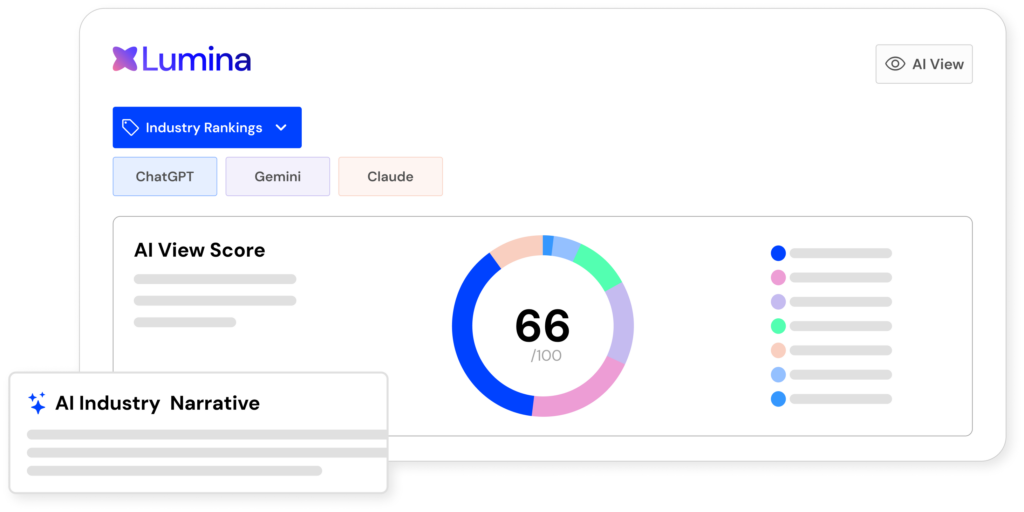
That is why we're unveiling Lumina AI View, the latest addition to our intelligent suite of AI tools from Isentia. Trained specifically on the workflows and challenges of modern PR & communications, Lumina AI View helps you understand exactly what AI knows about you, and how it learned it.
A new standard for AI visibility
AI View tracks your citation strength and source quality alongside those of your competitors, giving you a clear view of where you hold authority and where you have gaps.
Lumina AI View maps your AI reputation from the ground up, allowing you to:
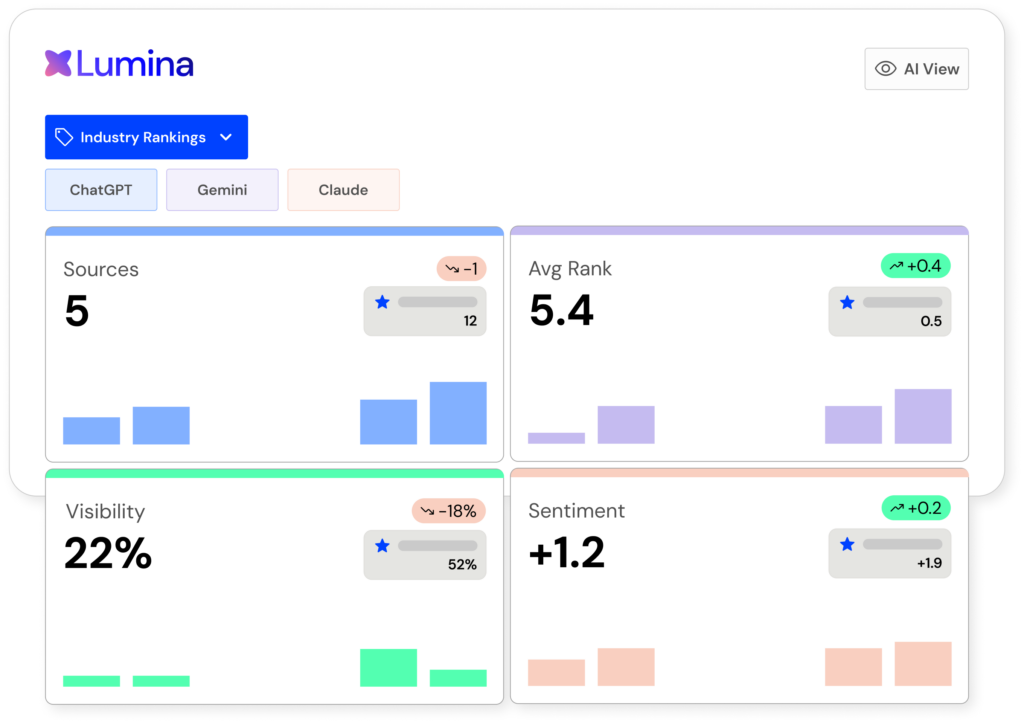
See which sources matter: When tools such as ChatGPT or Gemini discuss your organisation, which outlets do they cite? Track your source footprint over time and view the impact of key target media on how you’re discussed. We measure your citation strength and source quality alongside those of competitors, giving you a clear view of where you have authority and where you have gaps.
Gain industry-specific insight: Your competitors get cited from Financial Times and Bloomberg. You get cited on Reddit. Each brings opportunity – and risk. Discover how you measure up against industry standards, and target the sources that actually influence how AI represents you.
Catch narrative shifts early: AI responses change when new sources appear, sentiment shifts, or old controversies resurface. Get alerts when citation patterns change suddenly, before they impact the way you’re perceived by stakeholders.
Measure your progress: From media monitoring to full media intelligence
Lumina AI View is built on the principle that insights get stronger with repeated measurement. To help you maintain a clear view of your reputation, our proprietary scoring system provides regular updates that show you:
Evolving trends in how sources cite your organisation
Competitive standing and benchmark metrics
Where models differ in information presented, and sources cited
Whether you run it weekly, on-demand, or whenever you need a check-in, patterns will emerge, trends will become clear, and you will build a baseline that makes any sudden narrative changes both comprehensible and the prerequisite to action.
Lumina AI View is part of Lumina AI, a comprehensive suite of AI tools built specifically for communicators. Our Lumina suite evolves traditional media monitoring into narrative intelligence, enabling you to truly understand how perceptions form, evolve, and impact your reputation.
Get in touch to register your interest and see what Lumina AI View can do for you.
"
["post_title"]=>
string(66) "Introducing Lumina AI View: AI Visibility Built for PR & Comms"
["post_excerpt"]=>
string(158) "Lumina AI View, the latest in Isentia's AI suite, is trained on PR & comms workflows to help you understand what AI knows about you — and how it learned it."
["post_status"]=>
string(7) "publish"
["comment_status"]=>
string(4) "open"
["ping_status"]=>
string(4) "open"
["post_password"]=>
string(0) ""
["post_name"]=>
string(59) "introducing-lumina-ai-view-ai-visibility-built-for-pr-comms"
["to_ping"]=>
string(0) ""
["pinged"]=>
string(0) ""
["post_modified"]=>
string(19) "2026-06-04 04:13:37"
["post_modified_gmt"]=>
string(19) "2026-06-04 04:13:37"
["post_content_filtered"]=>
string(0) ""
["post_parent"]=>
int(0)
["guid"]=>
string(32) "https://www.isentia.com/?p=47963"
["menu_order"]=>
int(0)
["post_type"]=>
string(4) "post"
["post_mime_type"]=>
string(0) ""
["comment_count"]=>
string(1) "0"
["filter"]=>
string(3) "raw"
}
Blog
Introducing Lumina AI View: AI Visibility Built for PR & Comms
Lumina AI View, the latest in Isentia’s AI suite, is trained on PR & comms workflows to help you understand what AI knows about you — and how it learned it.
Why PR and comms teams need to take LLM visibility seriously — and what to do about it
The next time a journalist, investor or potential customer wants to know about your organisation, it’s now increasingly likely they won’t Google you. They'll ask an AI.
They'll type a question into ChatGPT, Claude or Gemini, something like "Who are the leading renewable energy companies in Australia?" or "What's the best PR agency for healthcare in Singapore?" and the AI will give them an answer. The question is whether your own organisation shows up in that answer.
The implications are significant for communications professionals, whether they’re in the agency-side working with clients or in-house managing a brand. The rules of reputation and discovery are being rewritten, and there’s a new kind of playbook that we all need to adapt to. That’s what’s going to take us forward.
The shift no one saw coming, but perhaps should have
For decades, earned media has been the backbone of credibility. A strong piece in a respected outlet signalled trust, authority and relevance. This hasn't particularly changed, but the way that coverage gets used has.
Large language models (LLMs) are trained on vast amounts of publicly available content - news articles, company websites, industry reports, social media, expert commentary. When someone asks an AI a question, it synthesises all of that material into a single answer. If an organisation has a strong, consistent, well-sourced presence across those channels, it is more likely to show up. If it doesn't, it becomes invisible and is absent from the conversation entirely.
Gartner's latest predictions for Chief Communications Officers underline how serious this shift is. They forecast that as LLMs increasingly replace traditional search, PR and earned media budgets will double by 2027. What they say is that this is a communications challenge, one that requires PR expertise to build trust, secure quality coverage, and maintain consistent messaging across stakeholders.
Their research also predicts that by 2029, 45% of CCOs will be using narrative intelligence technologies to monitor reputation amid rising disinformation, a recognition that the old keyword-based approach to media monitoring simply can't keep up with the way stories now form, spread and multiply.
The AI-generated content loop and why it matters
One of the less obvious risks in this new landscape is what happens when AI starts feeding on itself.
Catherine Arrow, Executive Director of the PR Knowledge Hub, raised this point during Isentia's recent Inside the AI Shift webinar. As she explained, "AI can identify and interpret some publicly available commentary. The difficulty is that we have to be careful about what it is actually reading. You can already see this in AI overviews where the system may refer to online discussion without digging deeply enough into whether the original sources are genuine, reliable or themselves AI-generated. So we end up with AI nested inside AI, nested inside AI."
That creates a real problem for anyone in communications. If the content landscape is increasingly populated by AI-generated material which is optimised to be found by algorithms rather than to inform real people, then the signals that LLMs rely on to build their answers become less trustworthy. Human judgement, original thinking and genuine expertise become harder for these systems to find, precisely because they're being drowned out by content that was designed to game them.
Catherine puts it simply, "People can become immune to this kind of content because it does not sound like the way we speak to each other, nor does it reflect the way genuine relationships are built. Then, when conflict or outrage is layered on top, the environment becomes even harder to interpret."
For PR and comms teams, it's not enough to produce more content. The right content needs to be produced, one that is original, expert-led, and well-placed in the channels and formats that LLMs are most likely to surface.
What this means in practice
So what does it actually look like to build LLM visibility into your communications strategy? It starts with the fundamentals, but applied with new intent:
Expert commentary placed in credible publications.
Thought leadership that's genuinely distinctive, not a rehash of what everyone else is saying.
Consistent messaging across channels.
Media coverage that's authoritative enough for an AI system to treat it as a reliable source.
This is where the gap between media monitoring and media intelligence becomes critical. Monitoring tells you what's been said. Intelligence tells you how stories are forming, which perspectives are shaping them, and where your organisation sits within those narratives — including how AI systems are representing you.
Dr Nici Sweaney, Founder and Director of AI Her Way, made this distinction sharply during Isentia's AI as a New Stakeholder webinar. "What will set people apart, and what AI cannot replicate is the human lens. The judgment, the relationships, the institutional knowledge, the strategic read of a room. The organisations that lean into supporting their people to harness these tools, rather than just deploying the tools, will be the ones best placed.”
That's an important framing. The answer to AI disruption is to get clear on what only humans can do and then make sure the tools we’re using actually support that.
Staying credible when the noise is deafening
There's a temptation, when faced with a challenge like this, to throw more content at the problem – more posts, more articles, more releases. But Catherine Arrow points out the risks of that approach.
"Maintaining credibility and authenticity means being yourself and not allowing AI to suffocate your identity. That will become harder to do as digital twins, synthetic voices and other tools make it easier for organisations to use it as a mask. The real challenge is not so much maintaining credibility. It is about maintaining humanity, empathy, kindness and a genuine wish to connect with others beyond the AI-intermediated space.”
That advice matters just as much for organisations as it does for individuals. Brands that let AI do their thinking, generating bland, interchangeable content at scale, will find themselves blending into the noise rather than cutting through it. The brands that show up in LLM answers will be the ones with a clear, consistent, well-evidenced point of view.
Dr Nici Sweaney reinforced this from the operational side. "Ethical use is not about not using AI. It’s about using it with intention, honesty, and a clear sense of what good looks like on the other side.” She was also direct about the risks of rushing in, "Don’t add new shiny AI projects on top of already overloaded teams. That creates resentment, not buy-in. Start by solving the problems people already have."
The cultural dimension
There's another layer to this that often gets overlooked and that’s the cultural one.
Catherine Arrow raised important concerns about how different AI systems can distort or flatten cultural context. Many of the most widely used models are shaped by US language, commercial assumptions and social norms. Chinese models operate within a different political and cultural framework. For organisations working across the Asia-Pacific region, it directly affects how the brand, messaging and the market are understood and represented by AI.
"Different AI systems may distort cultural context by privileging dominant languages, simplifying complex meanings, mistranslating concepts, omitting local histories or reproducing the worldview of their developers and training environments. They may flatten culture by making everything sound the same.”
For communicators operating across diverse markets, this means paying close attention to where content sits, who produced it, and whether the AI systems the audiences are using can actually interpret it with the nuance it deserves.
Where Isentia's platform fits with its new toolkit for AI visibility
This is precisely the challenge that Isentia's Lumina suite was built to address. Lumina is an intelligent suite of AI tools trained on the language, workflows and realities of modern public relations and communications, designed to empower, not replace, the human element of communications strategy.
Isentia's Lumina AI View feature will allow organisations to track how their brand, competitors and key topics are described by leading LLMs, with auditable claims, citations and transparency with regards to the sources. It's the difference between wondering whether AI is getting your story right and actually being able to see for yourself. These aren't generic AI features bolted onto a monitoring tool. They're intelligence systems built for the way communicators actually work.
The bottom line
The communications landscape has shifted. AI isn't just a tool the team might use, it's a stakeholder in its own right, actively shaping how an organisation is discovered, understood and evaluated.
For PR and comms professionals, the priorities are to ensure experts, commentary and evidence are placed widely enough for LLMs to find them and include them in their answers. Intelligence is imperative and required to how narratives are forming across both traditional media and AI platforms. All of this needs to be done without losing the human credibility that makes communications worth paying attention to in the first place.
As Dr Nici Sweaney put it, "The people who get the most from AI aren’t the ones who use the most tools, they’re the ones who understand their work deeply enough to know exactly where AI can add the most leverage."
That's the opportunity. The question is whether we’re set up to take it.
To explore how Isentia's Lumina suite can help your team navigate AI visibility, get in touch or discover Lumina.
"
["post_title"]=>
string(51) "If AI can't find you, neither can your stakeholders"
["post_excerpt"]=>
string(140) "We explore why LLM visibility should be a priority for PR and comms teams — and why harnessing AI, not just deploying it, is what matters."
["post_status"]=>
string(7) "publish"
["comment_status"]=>
string(4) "open"
["ping_status"]=>
string(4) "open"
["post_password"]=>
string(0) ""
["post_name"]=>
string(49) "if-ai-cant-find-you-neither-can-your-stakeholders"
["to_ping"]=>
string(0) ""
["pinged"]=>
string(0) ""
["post_modified"]=>
string(19) "2026-05-20 04:07:57"
["post_modified_gmt"]=>
string(19) "2026-05-20 04:07:57"
["post_content_filtered"]=>
string(0) ""
["post_parent"]=>
int(0)
["guid"]=>
string(32) "https://www.isentia.com/?p=47943"
["menu_order"]=>
int(0)
["post_type"]=>
string(4) "post"
["post_mime_type"]=>
string(0) ""
["comment_count"]=>
string(1) "0"
["filter"]=>
string(3) "raw"
}
Blog
If AI can’t find you, neither can your stakeholders
We explore why LLM visibility should be a priority for PR and comms teams — and why harnessing AI, not just deploying it, is what matters.