How do different LLMs represent your organisation?
A customer evaluating a brand, a journalist researching a CEO, and a policymaker looking up a public agency are all doing the same thing — discovering organisations through AI. The difference is that they may each receive a different description, supporting evidence, and overall impression.
This shift represents a major change in modern communications.
Large language models (LLMs) now interpret information for audiences, rather than just helping them find it. Instead of listing search results, they retrieve content, select authoritative sources, and generate a single synthesised answer that many users accept without reviewing the original articles.
For PR, communications, and marketing professionals, this presents a new reputation challenge. Your organisation now has multiple AI-generated reputations, each shaped by the model your stakeholders use. Understanding these differences is becoming as important as understanding media coverage – in fact, the two are often closely linked.
There isn’t one AI version of your organisation
A common misconception is that ChatGPT, Gemini, Claude, and Perplexity all access the same information. In reality, they don’t.
At a high level, all leading LLMs are built on similar foundations. They’re trained on vast collections of books, websites, news articles, public documents and licensed datasets that help them understand language and generate human-like responses. Increasingly, they’re also capable of retrieving live web information, allowing answers to incorporate recent events rather than relying solely on historical training data.
However, their similarities end there.
Each LLM uses a unique combination of training data, retrieval architecture, and ranking logic. As a result, each model answers three key questions differently before generating a response:
What information should I retrieve?
Which sources should I trust most?
What deserves emphasis in the final answer?
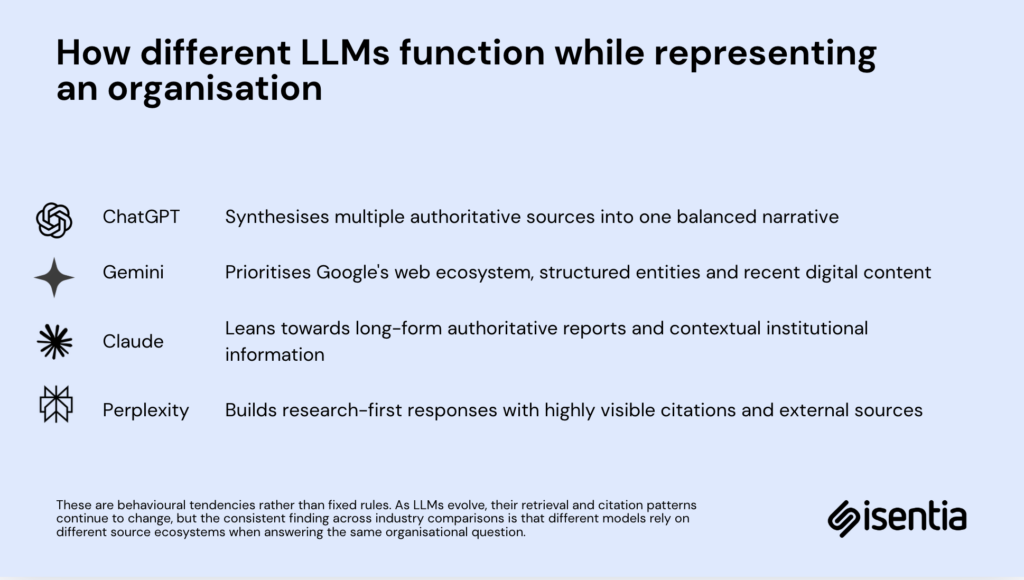
These decisions fundamentally shape how organisations are represented. To explain this better, we summarise how different AI models consult different publications and finally cite them in AI answers:
LLMs are not impartial, but come with their own weights and balances. In a sense, it reflects dynamics we already see at play across PR & Comms.
If four experienced journalists had to write a profile of the same CEO after attending the same press conference and have access to the same reports, one may write about leadership, another financial performance, another governance and another might frame the story around innovation. None are necessarily wrong—they’re simply viewing the event through a lens of individual expertise, and therefore, making different editorial decisions.
LLMs behave in similar ways. As a result, organisations are now represented by multiple AI-generated narratives, rather than a single authoritative digital narrative.
The same prompt can produce four different narratives
These differences are most apparent when users ask AI questions that require judgment rather than simple factual recall.
Consider a prompt like: “Which are the leading banks in Southeast Asia?” Across ChatGPT, Gemini, Claude, and Perplexity, you will likely see many of the same names — DBS, UOB, OCBC, and Maybank. This overlap occurs because all four models recognise these institutions as major regional banks.
However, the models differ in their explanations of why these banks are considered leaders.
ChatGPT may highlight DBS’s digital banking leadership and customer experience. Claude is potentially more likely to discuss governance, regional strategy, and long-term institutional strength. Gemini may emphasise recent awards and publicly available web information, while Perplexity often presents answers as research comparisons supported by multiple citations. These changes are not necessarily so big as to be immediately noticeable, but over time the results accumulate.
An organisation may not meaningfully change between two users asking two different LLMs , but the reputation narrative shifts accordingly. This distinction matters because stakeholders rarely ask AI for isolated facts. They ask questions like:
Should I work with this company?
Which university is most innovative?
Has this government agency delivered on its commitments?
Who are the market leaders in this sector?
AI responds by interpreting credibility, authority, and context, rather than simply retrieving documents.
For communications teams, this means your organisation is increasingly evaluated through comparative prompts, where competitors, industry peers, and institutional benchmarks appear alongside your organisation by default.
Every LLM has its own citation fingerprint
When ChatGPT, Gemini, Claude, or Perplexity answer a question, they first retrieve documents from distinct information ecosystems. A recent study analysed 17.2 million AI citations across ChatGPT, Gemini, Claude and Perplexity and found that each model retrieves from substantially different source ecosystems rather than a shared pool of webpages. Two LLMs can answer the same question accurately while relying on entirely different publications.
Instead of viewing these as technical differences, it is more useful to consider them as citation behaviours. Each model consistently references different types of publications when explaining organisations.
ChatGPT – Building consensus from multiple sources
ChatGPT functions more like an executive briefing writer than a traditional search engine.
Rather than listing multiple links, ChatGPT typically combines information from several credible publications into a coherent narrative. If mainstream media, company information, and industry commentary consistently describe an organisation as a market leader, ChatGPT is likely to reinforce that positioning, regardless of the original source.
For a prompt like “Tell me about Singapore Airlines”, a typical ChatGPT response integrates its history, customer experience, awards it has won over time, its financial performance, etc., into a cohesive description. Individual articles become almost invisible, as the model prioritises a coherent narrative in its answer over transparently showcasing all citations.
For brands, this means consistency across publications is very valuable. ChatGPT values credible signals that repeat across multiple publications over one off news moments.
Gemini – Reading the living web
Gemini approaches organisations differently, as its retrieval is closely linked to Google’s broader information ecosystem.
When we ask “What has Enterprise Singapore done to support AI businesses?”, Gemini is more likely to include recent programme announcements, official government webpages, and newer online reporting. Its responses often feel more current because they draw from a web ecosystem designed to reflect continuously updated information.
For government agencies, this has practical implications. Official announcements and well-structured public information become machine-readable assets that help AI explain policy more accurately. These become important information touchpoints into how audiences understand government through AI.
Claude — explains the ‘why’, in addition to the ‘what’
Claude’s defining feature is its emphasis on context.
Other models often prioritise concise answers but Claude frequently elaborates on why an organisation is respected. Questions about leadership, governance, ethics, and institutional reputation tend to produce more detailed explanations rather than brief summaries.
For a prompt like “Why is DBS considered one of Asia’s leading banks?”, Claude is more likely to discuss how the bank has regionally expanded, its digital transformation, what’s unique about its leadership etc. Its responses resemble analyst reports more than search summaries, as it favours high-authority editorial and institutional content.
For executive communications, this makes Claude particularly influential. Leadership narratives and corporate values often receive more contextual treatment than with other models.
Perplexity — makes your media strategy visible
Perplexity changes the experience by treating citations as a central feature rather than a supporting detail.
A question comparing two sustainability leaders, for example, typically returns numerous linked sources from business media and research publications. Users can immediately review the origin of each claim.
For PR teams, this creates greater transparency. Publication quality becomes visible within the user experience and is not hidden behind an AI summary. This means media strategy influences the evidence presented alongside the perception of the organisation.
How commercial brands and government agencies are represented differently
Although LLMs behave similarly across sectors, the questions users ask differ fundamentally.
For brands, AI compares before customers get the chance
Consumers rarely ask AI what a brand does. They definitely do ask which brand is better.
Questions like:
1. Which airline has the best customer experience? 2. Is Salesforce better than HubSpot? 3. Which bank is most innovative? 4. Who are the leaders in cloud computing?
These questions are inherently comparative.
As a result, your organisation is often introduced alongside competitors before stakeholders visit your website.
During a recent Isentia webinar on Measuring your brand’s visibility in AI answers, we analysed airlines across multiple LLMs with Lumina AI View. Using identical prompts, different models highlighted different airlines and emphasised varying strengths, such as premium service, operational performance, innovation, and customer experience. Competitive positioning shifted depending on the model, even though the underlying organisations remained unchanged.
For commercial communicators, competitor association is becoming as important as share of voice. AI evaluates brands in context, not in isolation.
AI becomes the interpreter of policy for government agencies
Public sector organisations encounter a different reputational challenge. Audiences increasingly ask questions that begin with how, why and can I trust:
1. What support does this agency provide? 2. Has this ministry achieved its policy goals? 3. What AI initiatives has this department introduced? 4. Has this programme faced criticism?
LLMs then synthesise official publications and institutional information into a single accessible explanation. This changes the role of public communications. The objective is not to ensure AI models have sufficient credible, authoritative context to explain complex policy accurately.
As AI becomes the primary interpreter of government information, communications teams are responsible for managing both visibility and understanding.
Measuring AI reputation with Lumina AI View
Reputation has been shaped across three familiar environments: media, search and social. AI introduces a fourth environment.
LLMs condense dozens of publications into a single response, reducing the traditional discovery process between a question and an opinion.
During the recent webinar, Prashant Saxena, VP of Revenue and Insights says, “We used to Google it. Now we’re ChatGPT-ing it.”
This behavioural shift is significant. Reuters Institute research found that only a small proportion of AI chatbot users regularly click through to original articles.
Practically, every piece of earned coverage now has two audiences:
The people reading it.
The AI models learning from it.
Both shape reputation.
This is the challenge Lumina AI View was designed to solve.
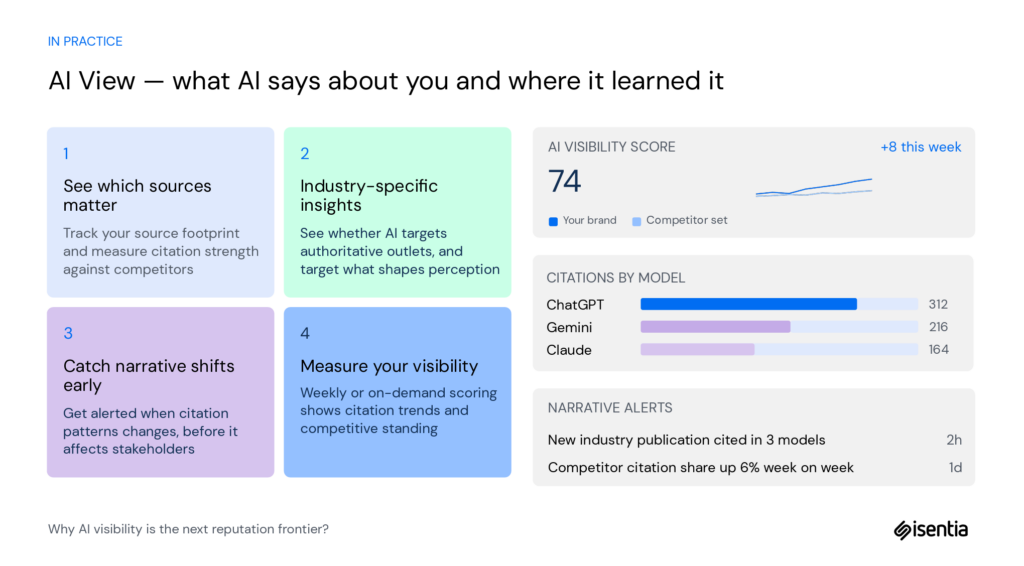
Instead of measuring whether an organisation appears in ChatGPT, AI View measures how different LLMs represent the organisation. Using consistent question sets across ChatGPT, Gemini, Claude, Perplexity, Grok, and Google AI Overviews, it compares narratives, citations, and competitive positioning through a unified reputation methodology.
The framework is built around four familiar dimensions: Direction, Performance, Integrity, and Innovation. Rather than tracking keywords alone, AI View identifies which reputation pillars dominate AI responses, which publications influence those narratives, and how representation differs across models. It also gives the organisation an AI score based on all the above factors.
The tool also shows organisations which publications are covered by different AI models. If the organisation’s AI score on the tool is high for ChatGPT, but struggles with or is a lower score on Gemini or Perplexity, the tool allows you to see where you’re underperforming. If there are publications that are covering the wrong information, or the important ones just don’t show up, then that’s an indication to why the AI score is low on that platform.
What this means for PR and communications professionals
The communications profession has always adapted to new discovery channels, from newspapers to search engines, and from social media to digital news.
AI is different because it does not simply help audiences find information, but it increasingly determines how organisations are introduced.
For communications leaders, this changes media strategy in three key ways.
First, publication quality becomes more important than quantity, as different LLMs repeatedly reference authoritative sources when constructing narratives around your organisation.
Second, visibility for the organisation’s spokespeople now extends beyond interviews and articles. The expertise attributed to leaders increasingly shapes how AI explains an organisation’s direction and credibility.
Finally, competitor positioning is now continuous rather than campaign-based, as AI naturally compares organisations whenever users ask for recommendations or leadership insights.
Organisations that succeed in this new environment are those that have leadership, performance, integrity, and innovation represented consistently across every major AI model, regardless of where audiences and stakeholders begin their search.
Nikita Gundala manages brand marketing and thought leadership for Pulsar Group across the SEA and ANZ markets. With over three years of first-hand experience in the influencer marketing and PR industries, she specializes in translating real-time insights and audience intelligence into actionable content. Nikita holds a master’s in Marketing and Digital from ESSEC Business School, Singapore. She has contributed to the wider industry conversation by co-authoring articles and reports for The Business Times Marketing Interactive.
A weekly tracker tracing the stories, figures and policies driving media and social coverage in the 2026 Victoria State Election across Online News, TV, Radio, Newspaper, Magazine, X, Facebook, Instagram, TikTok, Threads, Blogs and Forums. This edition covers conversations and coverage from 26th October - 2nd November 2026, highlighting what’s shaping the election conversation.
1. Election Conversation
7,571
total relevant mentions this week (3,649 media + 3,922 social)
Media = news coverage of the Victorian state election (TV, radio, newspaper, magazine, online news). Social = public posts across X, Facebook, Instagram, TikTok, Threads, Forums and Blogs — everyone posting, not just media outlets. The two are counted separately and summed, with no overlap between them.
2. Media Issue of the Week
Party Leaders Agree to Four-Way Election Debate
Cross-party229 media items · about 1 in 16 election news items
The week began with a long-running political standoff over the election debate format finally breaking. Opposition Leader Jess Wilson had spent weeks demanding a one-on-one contest with Premier Ben Carroll, framing it as a straightforward choice between the two major parties. Carroll, however, had pushed for a 'three-way contest' that included One Nation's Warren Pickering, a move some commentators saw as an attempt to split the conservative vote. The deadlock ended on Tuesday when Wilson reversed her position, agreeing to a four-way 'People's Forum' hosted by News24 and the Herald Sun, but only on the condition the Greens' Ellen Sandell was also included. Wilson then told media that Carroll was 'hiding' and needed other leaders as 'comfort blankets'. The final agreement, confirmed on Wednesday, will see all four leaders face questions from undecided voters in a single event next week.
The debate format is part of a wider contest over how the campaign is framed. Wilson's initial position would have presented the election as a choice between government and opposition. Carroll's push to include Pickering was seen by some as an attempt to draw support away from Wilson on the right. By agreeing to a four-way format on the condition that the Greens were included, Wilson presented Carroll as avoiding a direct contest and herself as open to a broader discussion. Wilson's 'comfort blankets' line became the week's most repeated soundbite.
The story dominated political coverage from Monday through Thursday, generating over 220 articles. It was largely a story about campaign process rather than policy. Headlines like 'Snags and snipes: Leaders sizzle over debate' focused on the personal friction between the leaders, while sustained coverage also followed each change in the negotiations.
3. What's happening across media and social?
How the same issues and parties are landing in the news versus in public conversation
MediaSocial
Issues
Campaign & Election Process
Media
37.2%
Social
59.8%
Government Integrity & Accountability
Media
9.8%
Social
10.7%
Health & Hospitals
Media
13.8%
Social
4.6%
Cost of Living & State Finances
Media
12.4%
Social
3.9%
Transport & Infrastructure
Media
8.5%
Social
3.2%
Parties
Liberal
Media
67.9%
Social
46.2%
Labor
Media
68.0%
Social
44.5%
One Nation
Media
42.6%
Social
51.9%
Greens
Media
11.6%
Social
11.6%
Nationals
Media
3.5%
Social
2.5%
One Nation is punching above its media weight online, drawing a bigger share of social conversation than news coverage. Campaign & Election Process is a bigger talking point in public conversation than it is in the news.
4. Party Share of Conversation
Combined share of media + social mentions this week — attention, not polling
1Liberal
32.3%
2Labor
31.8%
3One Nation
27.0%
4Greens
6.6%
5Nationals
1.7%
6Libertarian
0.6%
Shares add up to 100% of the six parties shown. Share of conversation measures how much each party was mentioned across media and social this week, not polling, voter intention or electoral support.
5. Top candidates this week
Ranked by combined media + social mentions · share of mentions among the five candidates shown
1Jess Wilson Liberal · Opposition Leader
42.5%
2Ben Carroll Labor · Premier
34.8%
3Warren Pickering One Nation · One Nation leader
14.1%
4Ellen Sandell Greens · Greens leader
5.3%
5Amanda Dow Liberal · candidate for Yan Yean
3.3%
Mentions measure attention, not popularity, approval or electoral prospects.
6. Election issues
Top themes this week
Top themes this week, media + social combined · share of mentions among the four themes shown
1Campaign & Election Process
64.2%
2Government Integrity & Accountability
13.4%
3Health & Hospitals
11.8%
4Cost of Living & State Finances
10.5%
What's inside each topic?
The specific stories driving each theme above, as a share of that theme's own coverage
Campaign & Election Process
Polling and vote intention
9%
Leaders' debate arrangements
7%
Personal attacks
6%
Preference deals
3%
Government Integrity & Accountability
Government transparency pledge
11%
Pickering abuse allegations
8%
One Nation costings refusal
5%
Airport rail corruption allegations
2%
Health & Hospitals
Dental clinics pledge
44%
Regional health gaps
10%
Regional health wait times pledges
2%
Hospital ED expansion pledge
1%
Cost of Living & State Finances
Business Council ranking criticism
23%
State debt and revenue downgrade
8%
Meghan Markle security funding
1%
What's driving conversation about each party?
Each party's top issues in social conversation this week
Labor
1Government Integrity & Accountability
2Health & Hospitals
3Transport & Infrastructure
Liberal
1Government Integrity & Accountability
2Health & Hospitals
3Crime & Community Safety
Nationals
1Transport & Infrastructure
2Crime & Community Safety
3Emergency Services & Disasters
Greens
1Government Integrity & Accountability
2Cost of Living & State Finances
3Housing & Planning
One Nation
1Government Integrity & Accountability
2Crime & Community Safety
3Health & Hospitals
7. Top election promises
This week's most-covered costed pledges, media + social combined
Labor
Labor Doubles Pledge to 20 Free Dental Clinics Statewide
222 media · 28 social
$230 million
One Nation
One Nation Pledges Transparency While Refusing to Release Policy Costings
165 media · 73 social
Nationals
Coalition Pledges $200M for CFA Fire Trucks and Stations
122 media · 19 social
$200 million
8. Where the coverage came from
Media type and social platform split this week
Media type
3,649
Online News69%
AM Radio10%
Newspaper9%
TV7%
Other (FM Radio, Magazine)5%
Social platform
3,922
X69.6%
Facebook21.9%
Instagram3.1%
TikTok2.7%
Forums1.7%
Threads0.6%
Blogs0.5%
Top outlets: 3AW, News24, ABC Radio Melbourne Most active accounts: JackLit10200548, Commoncents21, Dedicatedlyfirm
9. Issues to watch
What communicators should keep an eye on next week
Monitor the debate's impact on leader credibility, as the four-way format could elevate minor parties and reshape voter perceptions of competence, forcing communicators to prepare for a more fragmented narrative landscape. Watch for post-debate polling shifts and which leaders' styles resonate on key issues like cost of living.
Track how business groups respond to Victoria's 'worst for business' ranking, as parties will face pressure to address economic confidence in their messaging. Look for new policy announcements aimed at reversing this perception and any attempts to link it to government integrity debates.
Assess the fallout from candidate controversies, as One Nation's social media scandal and the assault charge could test party discipline and public trust. Watch for how each party manages these reputational risks and whether they shift focus back to core policy pledges like health and infrastructure.
If you want to find out more about how Isentia can help you understand the Victoria state election media landscape, please reach out to us here.
"
["post_title"]=>
string(91) "Victoria State Election 2026: Debate Deal, One Nation Strong Online, Campaign Process Leads"
["post_excerpt"]=>
string(155) "What shaped the Victorian election 2026 conversation, 26 Oct–2 Nov: a four-way debate deal, One Nation strong on social and campaign process in the lead."
["post_status"]=>
string(7) "publish"
["comment_status"]=>
string(4) "open"
["ping_status"]=>
string(4) "open"
["post_password"]=>
string(0) ""
["post_name"]=>
string(47) "victoria-election-four-way-debate-media-tracker"
["to_ping"]=>
string(0) ""
["pinged"]=>
string(0) ""
["post_modified"]=>
string(19) "2026-11-05 06:07:29"
["post_modified_gmt"]=>
string(19) "2026-11-05 06:07:29"
["post_content_filtered"]=>
string(0) ""
["post_parent"]=>
int(0)
["guid"]=>
string(32) "https://www.isentia.com/?p=50940"
["menu_order"]=>
int(0)
["post_type"]=>
string(4) "post"
["post_mime_type"]=>
string(0) ""
["comment_count"]=>
string(1) "0"
["filter"]=>
string(3) "raw"
}
Blog
Victoria State Election 2026: Debate Deal, One Nation Strong Online, Campaign Process Leads
What shaped the Victorian election 2026 conversation, 26 Oct–2 Nov: a four-way debate deal, One Nation strong on social and campaign process in the lead.
How do I navigate aged care in Australia? How easy are government services to deal with? How well supported are people with disabilities? These are big questions about life in Australia, and many people now put them to an AI tool before they visit a website, pick up the phone or speak to anyone. They rarely mention a government agency by name, yet the answer they get still shapes what they believe about the services behind it: whether the system works, who is responsible and whose information they can trust. That is reputation taking shape, in a conversation no communications team is part of.
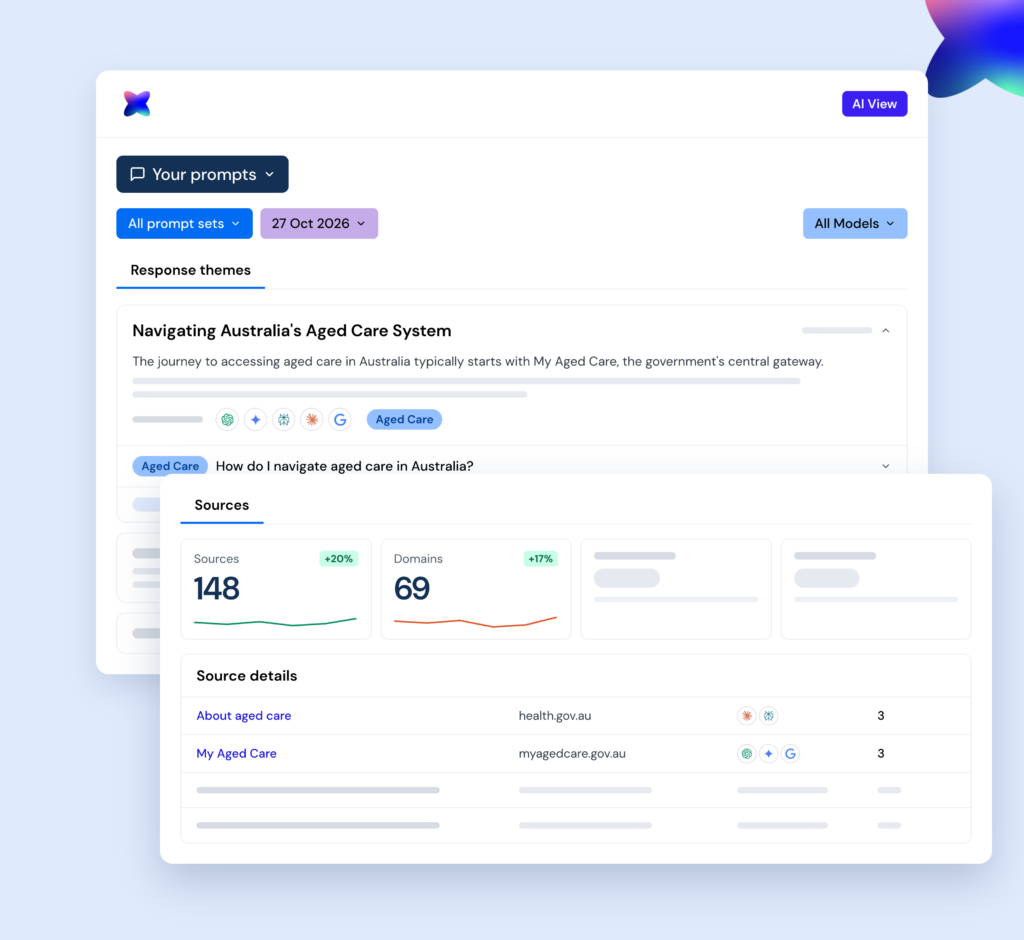
To see how that plays out, we used Your Prompts, a new feature in Isentia's AI View, to track how leading AI models answer these questions. Here's what we found, whose information the models used, how each model goes about sourcing its answers, and what it all means for public-sector communicators.
Starting with the question
Most AI visibility tracking starts with an organisation's name. Your Prompts lets you set your own questions, which gives public-sector teams a much wider view of their reputation. People rarely ask an AI tool about an agency by name; they ask for help with whatever problem is in front of them, whether that's getting a parent into aged care or working out what support is available for a carer. Or they ask something bigger, such as how well the country looks after older people.
We tracked six sets of questions across leading AI models, covering the things people deal with at different stages of life: finding their way around government services, getting older, living with disability and caring for someone, raising a family, staying healthy, and making ends meet. For this article we focused on three of them: access and navigation, aged care, and disability and carers. These are the moments when people depend most directly on the government, which means a wrong or incomplete answer can have real consequences for someone trying to get help, and can colour how they feel about the system as a whole.
We compared answers from ChatGPT, Claude, Gemini, Perplexity and Google AI Overview, looking at what each model said, which sources it cited and which organisations it named. The questions were set up for tracking rather than drawn from a survey of what the public actually asks, and the findings reflect a single point in time, using the latest data from 27 October 2026. Even so, the patterns in how AI finds and presents information about public services were clear and consistent.
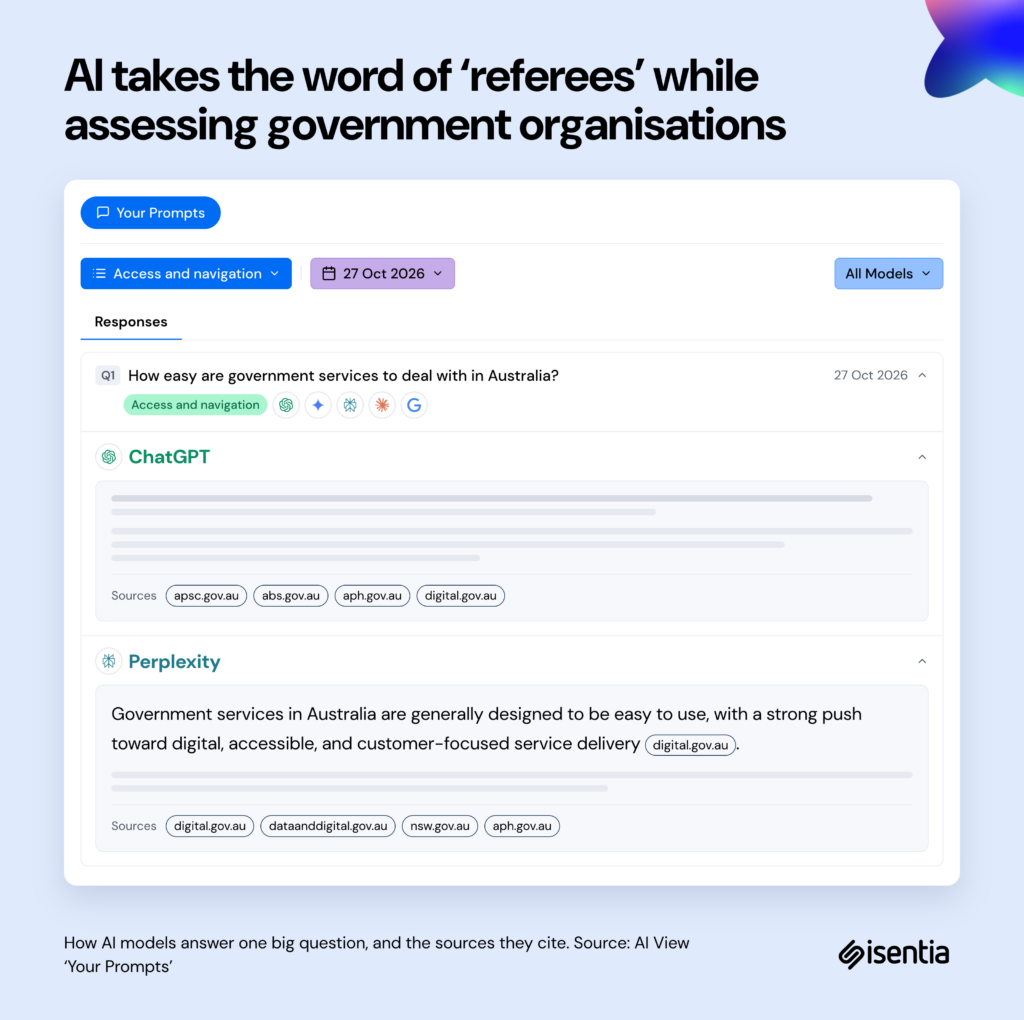
How easy are government services to deal with in Australia?
We asked this alongside a second question: how well government support reaches the people who need it. Most models landed on a similar view: digital services work well for simple tasks, while complex cases, phone contact and people in vulnerable situations are where things get harder. The more interesting part is where that view comes from. The models formed it largely through oversight bodies, with the national audit office's findings carrying particular weight.
Government's own voice only came through when a model cited official pages, as when one model described digital services as a major strength, using a government website as the source. In other words, when AI assesses how the government is performing, it largely takes the word of the ‘referees’. Owned content can earn you a line in the answer, but auditors, commissions and advocates write most of the scorecard. For reputation, that gives an audit finding a second life. Well after the news cycle moves on, it can still be part of the answer people get when they ask how the government is doing. That brings us back to a question we raised in our article on AI visibility for government agencies: is your organisation still seen as the main authority on its own services?
How do I navigate aged care in Australia?
Almost every model named government services as the place to go for financial assessments, payments and in-person help, and the tone was neutral to positive. One model went as far as recommending that people complete a means assessment early so they don't end up paying more than they need to.
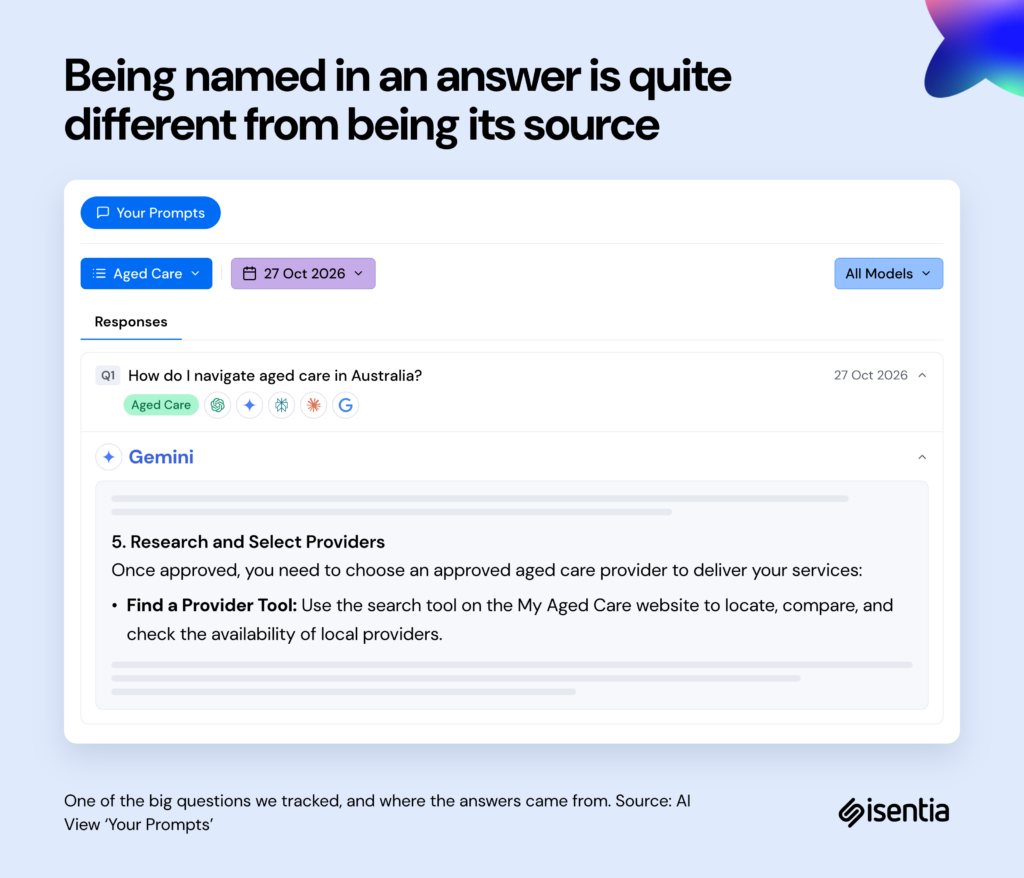
The catch is that the agencies people were being sent to were rarely the source of that information, which mostly came from other government portals and guides written by aged care providers and advocacy groups. In one answer, even an agency's own contact details were taken from a seniors' advocacy group's website. Being named in an answer, then, is quite different from being its source. It builds recognition, but someone else is setting people's expectations of what they'll find when they get there, and if that guide is out of date, it's the service they feel let down by.
Zoom out to the bigger question of how well Australia looks after older people, and the agencies that were the first port of call in the practical answers didn't appear at all. These answers were framed by the Royal Commission into Aged Care Quality and Safety, which concluded in 2021, with most models opening on its findings and some giving them more weight than the reforms that followed. This is the reputational point that's easiest to miss: the practical question tells people where to go, while the big question tells them what kind of system they're dealing with. As we covered in why content freshness matters for AI visibility, old stories have a habit of shaping AI answers long after the facts have moved on.
How well supported are people with disabilities in Australia?
The models discussed income support payments without naming the agency that delivers them, focusing instead on the NDIS and the gaps in support. That said, not every absence is a problem. Some questions genuinely aren't about a particular organisation, so it makes sense for it to sit them out. The useful distinction for communicators is between a relevant absence, where the question simply isn't about you, and a missed opportunity, where your work is being discussed and you aren't getting the credit. Repeated across enough answers, a missed opportunity leaves people with a picture of support that doesn't include the people delivering it.
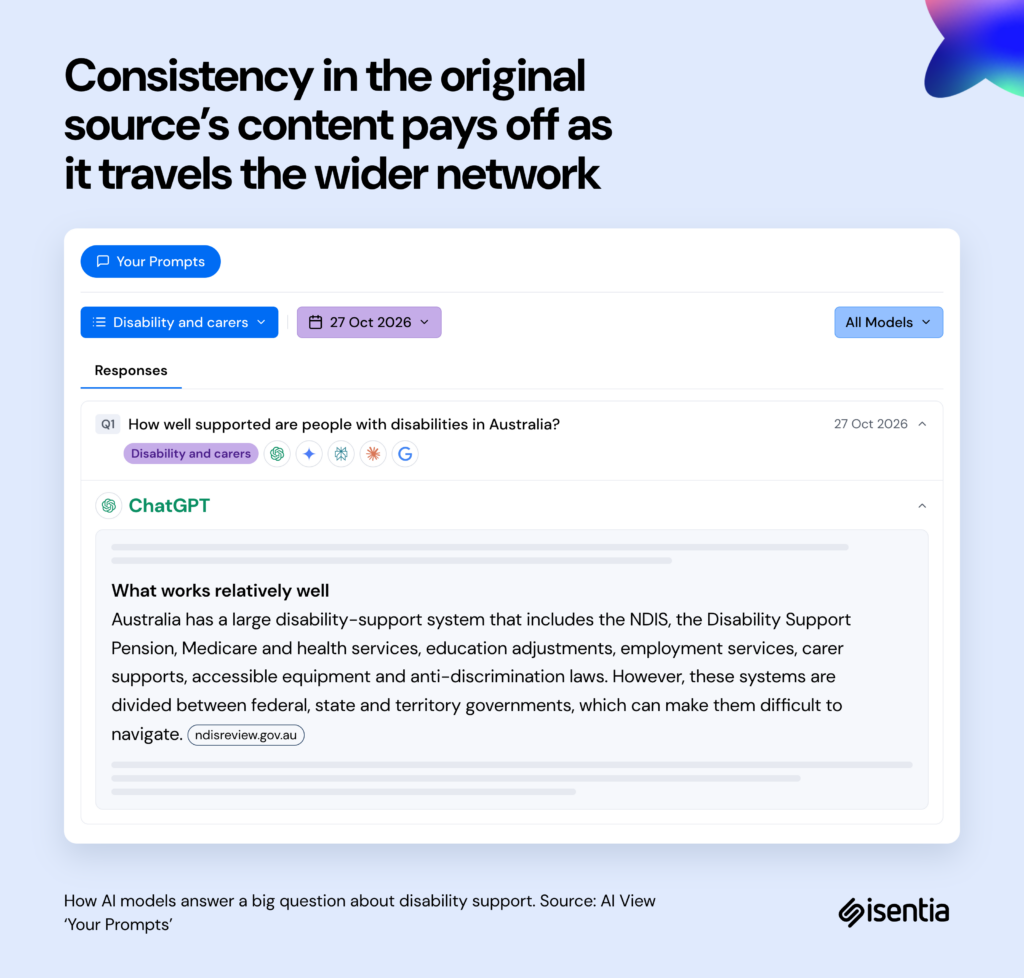
Questions about caring for someone played out differently. Every model gave almost the same answer and pointed people to the same national carer support service. When official information is clear and consistent across agencies, peak bodies and support services, AI repeats it faithfully. There was one notable exception, where a model explained the government's carer payments using a blog from a private company that sells personal medical alarms. The information was mostly accurate, but it shows how far an explanation can travel from its original source. The good news is that consistency across your wider network really does pay off: when the organisations around you describe your services the way you do, AI is more likely to get them right, and that shared story becomes part of your reputation.
Why each model tells the story differently
Across all three categories, each model showed clear habits in the sources it reached for. We can see what each one cites, even if we can't see exactly how it decides, and the patterns are consistent enough to act on. In practice, your reputation can look different depending on the tool someone uses. These habits also build on what we found when we looked at how different LLMs represent your organisation.
Model
Where it gets its information
Example from our research
What it means for communicators
ChatGPT
Official statistics, audit reports and formal reviews. It pairs almost every claim with a figure or finding, much like a policy analyst writing a briefing note.
When asked whether government support reaches people in need, it built its answer around the national audit office’s findings. It was also the model most likely to cite the website of the agency delivering a service.
Oversight reports shape how ChatGPT judges your performance, while your own pages shape how it describes what you do.
Claude
The widest mix of sources, including advocacy groups, provider guides and commentary alongside government material. It tends to explain the reasons behind an issue and present more than one side.
When describing the Royal Commission’s “national disgrace” finding, it relied mostly on second-hand accounts of the report, such as Wikipedia and a private aged care provider’s website.
The organisations that retell your story effectively become your spokespeople.
Gemini
University research and international bodies such as the OECD, drawn from Google’s broad index of academic platforms, video and international sources.
On aged care, it drew on an overseas policy institute’s summary of Australia’s new aged care legislation.
Published research and evaluations carry real weight, as do secondary sources describing your work, wherever in the world they are published.
Perplexity
The most recently updated pages, quoted closely. It is built around live search with visible citations, so it favours recent, easy-to-access pages.
On access to services, it quoted a government corporate plan published only weeks earlier.
This is where keeping your own content current pays off fastest.
Google AI Overview
A small number of sources, summarised briefly, because it is designed to give a quick answer at the top of search results.
On disability support, it relied mainly on the scheme’s own website and summarised criticism in general terms, without naming who made it.
The few sources it chooses carry a lot of weight, so clear, well-structured official pages give you the best chance of being one of them.
One question, several versions
Put together, the same question can produce an audit-style answer, an advocacy-informed analysis, a research summary or a current snapshot, depending on which tool someone happens to open. Two people asking the same question can come away with quite different impressions of the same service. There's no single AI view of an organisation to manage, because each model has its own sources and each needs a slightly different approach.
Zooming out: how these answers add up to reputation
Look at any one of these answers and it can seem like a visibility issue. Put them together and it's a reputation issue. For public-sector organisations, reputation has always been about more than what's said about you by name. It rests on whether people believe the system works, know where to turn and trust what they're told, and those impressions are now forming in AI answers, one question at a time.
Across these questions, four things shaped the impression an answer left:
Who gets named. Whether you appear when your work is being discussed, and get the credit for it.
Who does the explaining. Whether people hear how your services work from you, or from a provider, an advocate or a company blog.
Who acts as referee. Whose assessment of your performance gets repeated as the verdict.
Which story sets the frame. Whether the answer opens on where things stand today, or on a finding from years ago.
None of this shows up if you only ask AI about your organisation by name. You see it when you ask the questions your audience is asking. And it matters, because AI is now one of the main places where people go for information about the things that matter to them.
What this means for public-sector communicators
Government organisations can't control what AI says, but they can do a lot to influence the information it draws on, and with it the reputation that forms around them. Five practical steps came out of this research.
Track the big questions, not just your name. The most useful insights came from questions about services and real-life situations rather than about any one organisation, so start with what your audience is trying to do or understand, and check what AI is telling them.
Work with the bodies that assess your performance. Auditors, commissions and advocates shape how AI judges your work, so respond to their findings publicly and make sure your progress is recorded in the sources they, and AI, rely on. That way an old finding doesn't have to stand alone.
Support the organisations that explain your services. Sister agencies, peak bodies, providers and advocacy groups often explain your services for you, so give them clear, current information to work from. As we found in our analysis of Tier 1 and Tier 2 media in AI answers, specialist and niche sources often matter more to AI than their profile suggests.
Keep practical information clear and up to date. Plain-language pages on eligibility, processes and how to get help are what AI repeats when people ask how to do something. Organisations that deliver services directly rely on this more than most, because outdated information can lead someone to miss out on support they're entitled to.
Check answers across several models regularly. Each model uses different sources, so one model's answer is a poor guide to the others, and because answers shift as new content is published, regular tracking shows whether your updates are reaching the sources AI uses.
Whose information is AI using?
AI is already answering big questions about life in Australia, whether or not the public-sector organisations involved are part of the conversation. This research shows that an organisation can be mentioned often and still have surprisingly little say in how its services are described or how its performance is judged, with other organisations doing much of the explaining and each AI model weighing those voices differently.
For communicators, the job is to understand that wider network of sources and make sure accurate, current information runs through all of it. It's worth asking what AI says about your organisation. It's just as worthwhile asking what AI says when nobody mentions you, and whose information it's using to say it. That's where much of your reputation is now taking shape.
Want to see what AI tells people about the questions that matter to your audience? Get in touch about AI View.
"
["post_title"]=>
string(63) "How do LLMs represent public services to the public they serve?"
["post_excerpt"]=>
string(150) "Learn how AI cites government organisations, whose sources shape its answers on public services, and what public-sector communicators can do about it."
["post_status"]=>
string(7) "publish"
["comment_status"]=>
string(4) "open"
["ping_status"]=>
string(4) "open"
["post_password"]=>
string(0) ""
["post_name"]=>
string(62) "how-do-llms-represent-public-services-to-the-public-they-serve"
["to_ping"]=>
string(0) ""
["pinged"]=>
string(0) ""
["post_modified"]=>
string(19) "2026-11-04 04:47:03"
["post_modified_gmt"]=>
string(19) "2026-11-04 04:47:03"
["post_content_filtered"]=>
string(0) ""
["post_parent"]=>
int(0)
["guid"]=>
string(32) "https://www.isentia.com/?p=50662"
["menu_order"]=>
int(0)
["post_type"]=>
string(4) "post"
["post_mime_type"]=>
string(0) ""
["comment_count"]=>
string(1) "0"
["filter"]=>
string(3) "raw"
}
Blog
How do LLMs represent public services to the public they serve?
Learn how AI cites government organisations, whose sources shape its answers on public services, and what public-sector communicators can do about it.