Blog post
April 15, 2025

Did the leaders debate reignite voter interest or just stoke the culture wars?

As the federal election campaign reaches its midpoint, patterns in media coverage and public attention are beginning to shift. Early social engagement was driven by cost-of-living pressures, energy policy, and political point-scoring, but has waned following the first leaders debate, despite this forum providing leaders the opportunity to set the agenda and strategies of the major parties. So how has coverage focus evolved since the first debate and are audiences still engaging with the campaign or switching off?
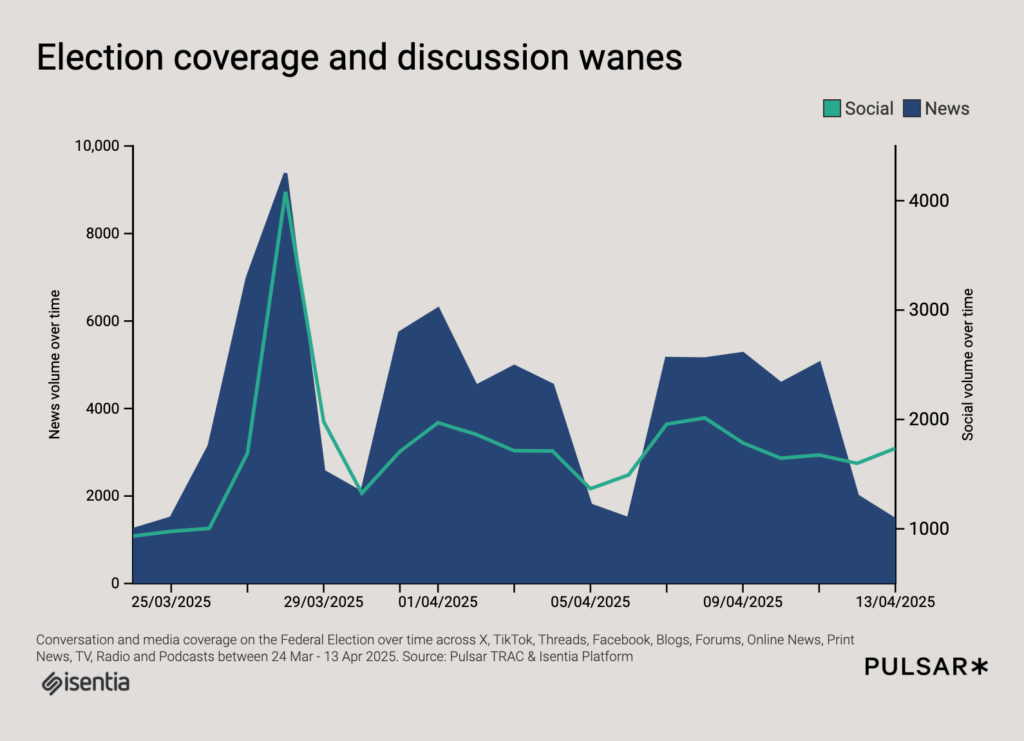
Social media engagement ahead of the federal election has been sharp and personal. It focused less on policy and more on identity and representation. From debates on topics such as  immigration to housing stress and culture, social media has driven a values-first narrative. But while early attention  was strong, both media coverage and social engagement have started to wane in the weeks since the campaign launched. The first leaders debate briefly reignited attention—trust, identity, and media—but coverage patterns suggest a shift away from daily blow-by-blow reporting towards broader social and cultural tensions.
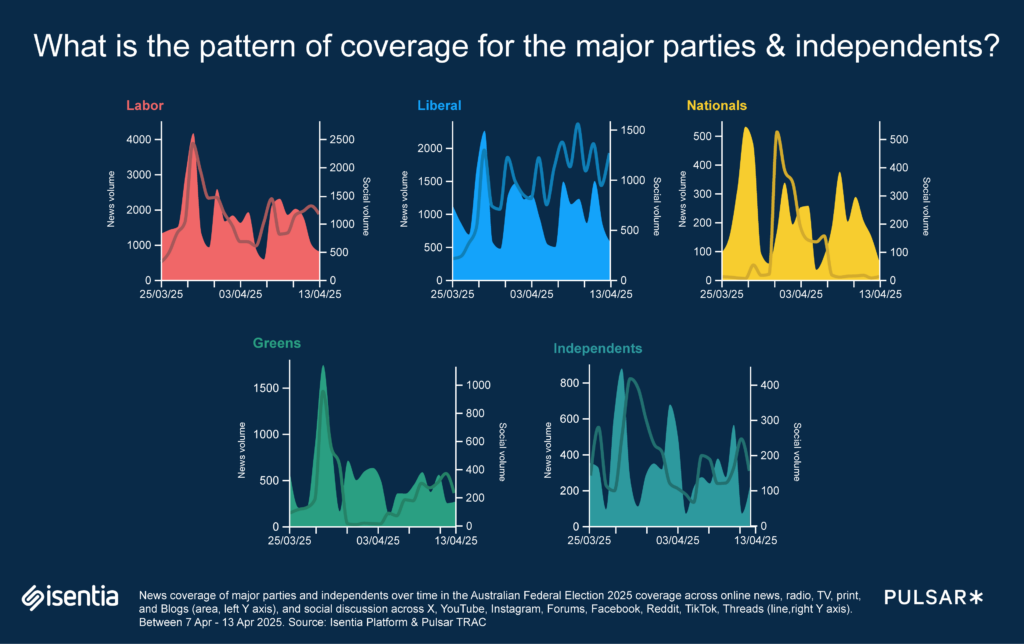
As the federal election campaign nears its halfway mark, last week’s media highlights show a contest still struggling to cut through. Key moments included the first leader’s debate, the Treasurers Debate, the energy showdown at the National Press Club, and Senator Jacinta Price’s Perth appearance with Peter Dutton, which drew attention for its MAGA-style rhetoric.  The first leaders debate was billed as a chance to reset the race—but for many viewers, it reinforced existing divides. Media attention around the debate momentarily lifted visibility for all major parties—but the spike was short-lived. The only party that has seen continued increases in social media engagement is the Liberal Party. The Liberal Party’s sustained rise in social media engagement may be linked to its digital-first strategy, including an AI-generated campaign ad spruiking a fuel excise cut and a meme-style diss track targeting Anthony Albanese—tactics designed to capture online attention and drive shareability.

@abcnewsaus

The Liberal party have released a “diss rap” targeting Prime Minister Anthony Albanese. Reporting by Zac Schroedl. Personalise your news and stay in the know with the ABC NEWS app via the link in our bio. #Liberals #DissTrack #FederalElection #AusVotes #KendrickLamar #Drake #PeterDutton #SussanLey #ElectionCampaign #Rap #AnthonyAlbanese #LiberalParty

♬ original sound – ABC News Australia – ABC News Australia

The Liberals also pitched a $1200 tax cut, Labor attacked their WFH backflip, and the Greens pushed housing and tax reform. Meanwhile, Dutton warned of a Labor-Greens-Teal alliance. Coverage suggests public engagement is driven more by polarising moments and political theatre than detailed policy.
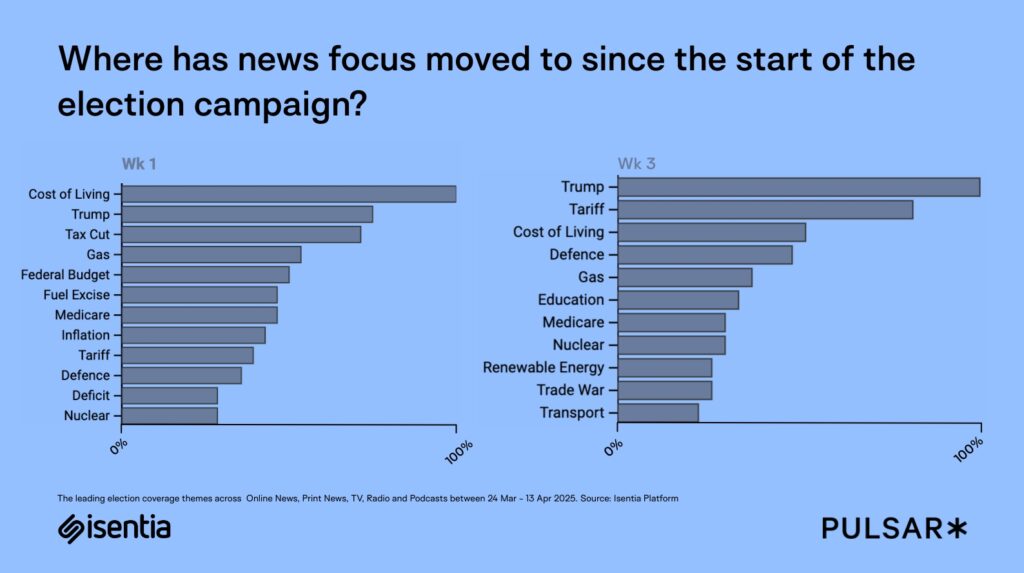
When the election campaign officially kicked off, cost-of-living pressures dominated the news agenda. Fresh off the back of the federal budget, it’s no surprise that affordable healthcare, lower gas and energy prices, and tax cuts were the key messages party leaders wanted to land with voters. But coverage quickly pivoted. In the past week, foreign diplomacy—particularly how each leader would manage Donald Trump—has surged in prominence. While Trump’s role in tariff threats has made headlines, his influence on the broader election narrative goes beyond trade. Media reporting has increasingly centred on Albanese and Dutton’s capacity to navigate a potential Trump presidency, with ideological alignment, national security, and economic fallout all in play. The first leaders’ debate was expected to refocus the campaign on domestic issues. However, it briefly touched on international concerns, with Prime Minister Anthony Albanese addressing the potential economic impact of Trump’s proposed tariffs. Albanese described these tariffs as an “act of economic self-harm” that would dampen global growth, highlighting the intertwining of foreign policy with domestic economic concerns. This suggests that sustained attention is more likely when domestic issues are reframed through the lens of foreign diplomacy, and national identity.
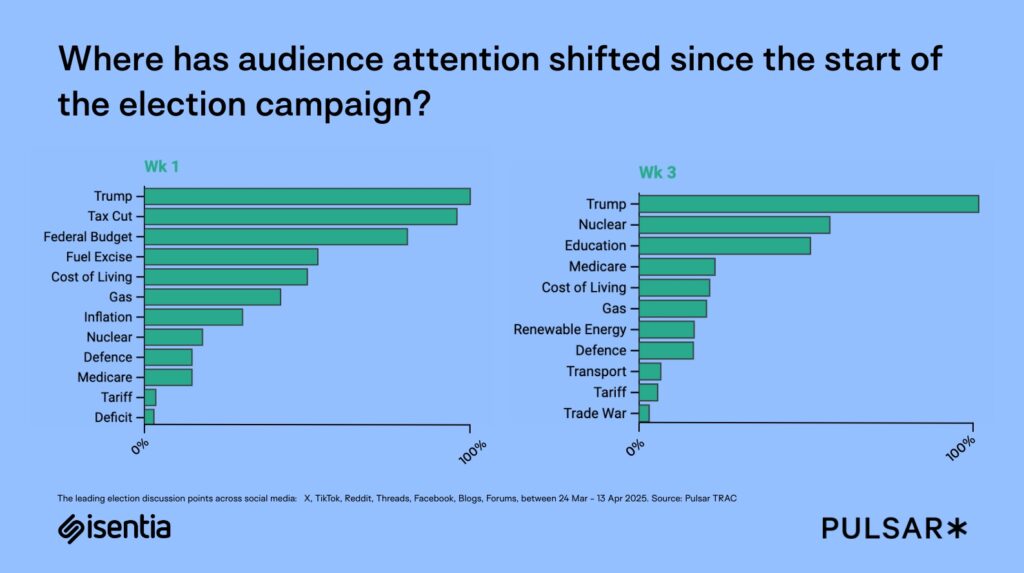
In the social media landscape, Trump was a flashpoint in election-related conversation. His influence—real or perceived—was quickly linked to the Liberal Party, with MAGA-style rhetoric and Trumpian policy cues gaining traction online. These narratives tend to escalate on platforms where ideological alignment and cultural grievance amplify engagement. But it wasn’t all imported culture wars—the federal budget, and the Liberal Party’s fuel excise rebuttal, also drove significant social chatter. In recent weeks, comparisons between major party messaging and Trump-era policy—from international student caps and nuclear energy to debates about school curricula—have continued to dominate discussion.

The first leaders’ debate briefly touched on foreign policy, with Albanese warning Trump’s tariffs could hurt global growth, while Dutton framed it as a test of strong leadership. Domestically, Dutton’s renewed push for nuclear power reignited social media debate—drawing comparisons to Trump-era policies and fuelling discussion about Australia’s energy future. At the same time on social media, promises like HECS cuts, free TAFE, and more funding for public schools sparked genuine engagement, especially among younger voters and education workers, showing that practical, future-focused policies can still cut through. Compared to the start of the campaign, where cost-of-living dominated as a top-line concern, the conversation has expanded: audiences are now weighing both hip-pocket issues and the national values shaping Australia’s future.
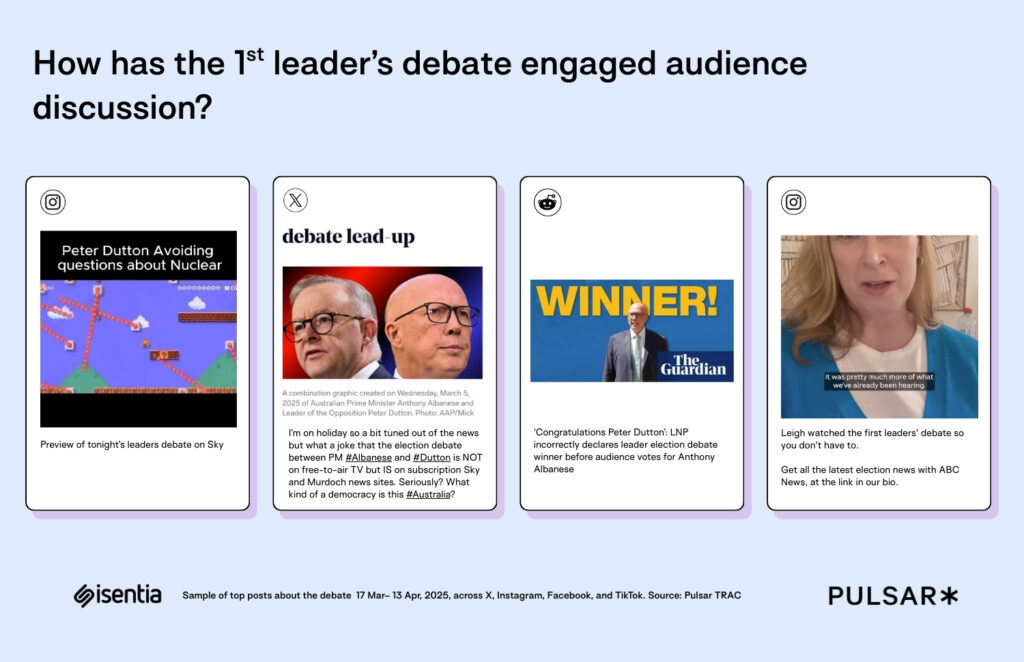
While the debate itself tended to be overshadowed by frustrations about access and media control, a few political undercurrents still surfaced. Anthony Albanese drew some positive mentions, but reactions were far from policy-focused. The Liberal Party’s early claim of victory became a point of humour, with several users likening it to Trump-style misinformation tactics. Disillusionment with the major parties ran deep, with repeated calls to “break the donor-fuelled duopoly” and shift support toward independents or smaller parties. Still, these reactions seem more like a symptom of broader voter cynicism than a sign of energised political engagement, reflecting broader themes around the declining trust.

The leaders’ debate didn’t reset the race—it refracted it, spotlighting how media coverage is now shaped less by policy detail and more by polarising symbols and cultural cues. As election day nears, the contest for attention is revealing just as much about media strategy and voter fatigue as it is about party platforms.

Discover more of our political news services

Share

Similar articles

object(WP_Post)#8646 (24) { ["ID"]=> int(44820) ["post_author"]=> string(2) "75" ["post_date"]=> string(19) "2026-02-20 06:47:39" ["post_date_gmt"]=> string(19) "2026-02-20 06:47:39" ["post_content"]=> string(4605) "

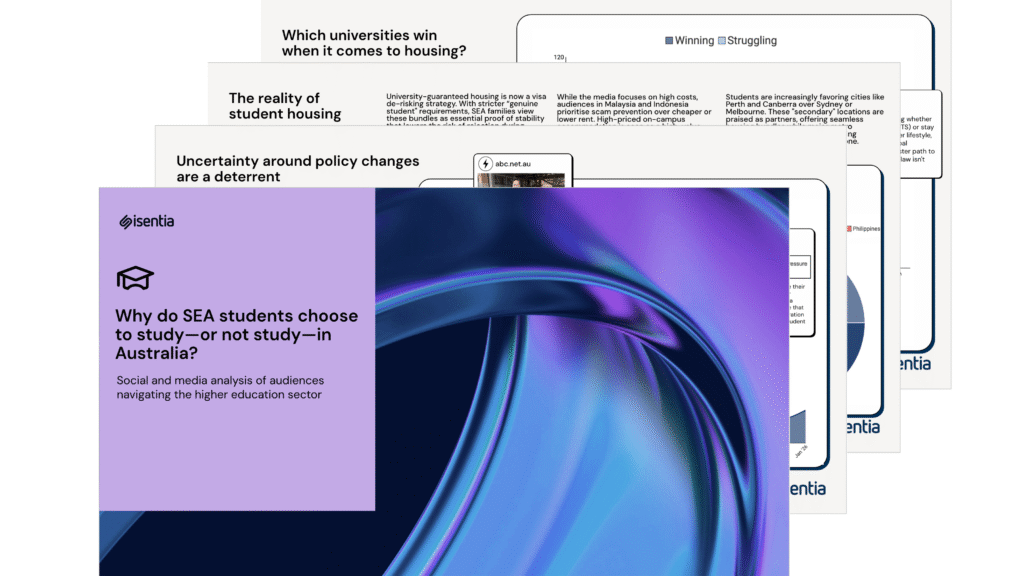
Australia has been a hot destination in higher education for international students, but with recent policy changes and growing anxiety around housing, the student journey has seen a shift, impacting intake into the top Australian universities and making the process a bit unpredictable.

In our analysis we also zoom into the Southeast Asian region, where we uncover what priorities drive students from this region to apply at Australian universities, how housing plays a role and what kind of career outcomes they would expect post-study.

In this report we analyse over 3k posts across social and online media to unpack:

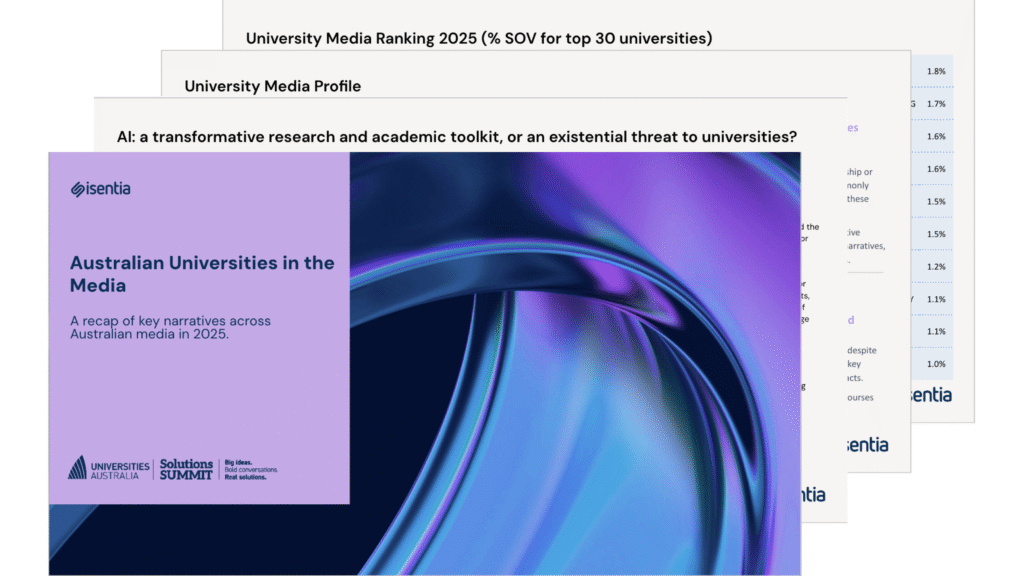
  • How Australian universities are navigating a "crisis of governance" and public trust, with intense media scrutiny on budget deficits, leadership accountability, and long-term financial sustainability.
  • How the rapid integration of AI is seen as both a transformative academic toolkit and an existential threat, forcing institutions to prioritise AI literacy and redesign assessments to combat risks like deep fakes and academic misconduct.
  • How shifting Australian migration policies have made policy safety the primary concern for Southeast Asian students, influencing how they weigh university reputation against visa hurdles and long-term career ambitions.

Reflecting on the media reporting from 2025 provides institutions with the tools to craft communication strategies that address both the domestic demand for accountability and the international student's need for security and value.


Please fill in the forms below and access our reports to get a deeper insight on audience sentiment and behaviour when deciding an education and career in Australia.

Access the SEA insights report here

Access the ANZ insights report here

" ["post_title"]=> string(56) "Analysing Australia's higher education landscape in 2025" ["post_excerpt"]=> string(136) "A deep dive into how global audiences perceive Australian higher education and the university sector with a spotlight on the SEA region." ["post_status"]=> string(7) "publish" ["comment_status"]=> string(4) "open" ["ping_status"]=> string(4) "open" ["post_password"]=> string(0) "" ["post_name"]=> string(77) "analysing-australias-higher-education-landscape-in-2025-amidst-policy-changes" ["to_ping"]=> string(0) "" ["pinged"]=> string(0) "" ["post_modified"]=> string(19) "2026-02-23 08:08:30" ["post_modified_gmt"]=> string(19) "2026-02-23 08:08:30" ["post_content_filtered"]=> string(0) "" ["post_parent"]=> int(0) ["guid"]=> string(32) "https://www.isentia.com/?p=44820" ["menu_order"]=> int(0) ["post_type"]=> string(4) "post" ["post_mime_type"]=> string(0) "" ["comment_count"]=> string(1) "0" ["filter"]=> string(3) "raw" }
Blog
Analysing Australia’s higher education landscape in 2025

A deep dive into how global audiences perceive Australian higher education and the university sector with a spotlight on the SEA region.

object(WP_Post)#11384 (24) { ["ID"]=> int(43742) ["post_author"]=> string(2) "75" ["post_date"]=> string(19) "2025-12-08 17:11:34" ["post_date_gmt"]=> string(19) "2025-12-08 17:11:34" ["post_content"]=> string(9544) "

The media landscape is accelerating. In an era where influence is ephemeral and every angle demands instant comprehension, PR and communications professionals require more than generic technology—they need intelligence engineered for their specific challenges.

Isentia is proud to introduce Lumina, a groundbreaking suite of intelligent AI tools. Lumina has been trained from the ground up on the complex workflows and realities of modern communications and public affairs. It is explicitly designed to shift professionals from passive media monitoring back into the role of strategic leaders and pacesetters. 

“The PR, Comms and Public Affairs sectors have been experimenting with AI, but most tools have not been built with their real challenges in mind.” said Joanna Arnold, CEO of Pulsar Group

“Lumina is different; it is the first intelligence suite designed around how narratives actually form today, combining human credibility signals with machine-level analysis. It helps teams understand how stories evolve, filter out noise and respond with context and confidence to crises and opportunities.”

Setting a new standard for PR intelligence

Lumina is centered on empowering, not replacing, the human element of communications strategy. This suite is purpose-built to help PR, Comms, and Public Affairs professionals significantly improve productivity, enhance message clarity, and facilitate early risk detection.

Lumina enables communicators to:

  • Understand & Interpret: Move beyond basic alerts to strategically map the trajectory and spread of narrative evolution.
  • Focus & Personalise: Achieve the clarity necessary to execute strategic action before critical moments pass.
  • Execute & Monitor: Rapidly deploy strategy firmly rooted in real-time, actionable insight.

Get a demo today: Stories & Perspectives module

We are launching the Lumina suite by making our first module immediately available: Stories & Perspectives.

In the current fragmented, multi-channel media environment, communications professionals need to be able to instantly perceive not just how a story is growing, but also how it is being perceived across different stakeholder groups.

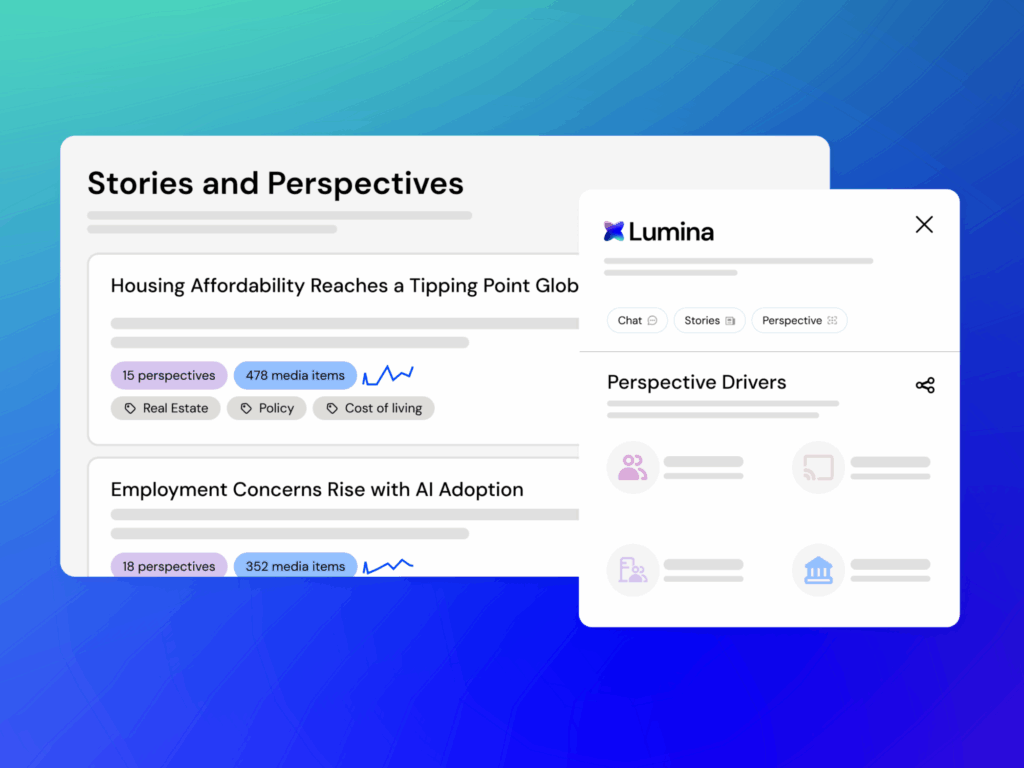
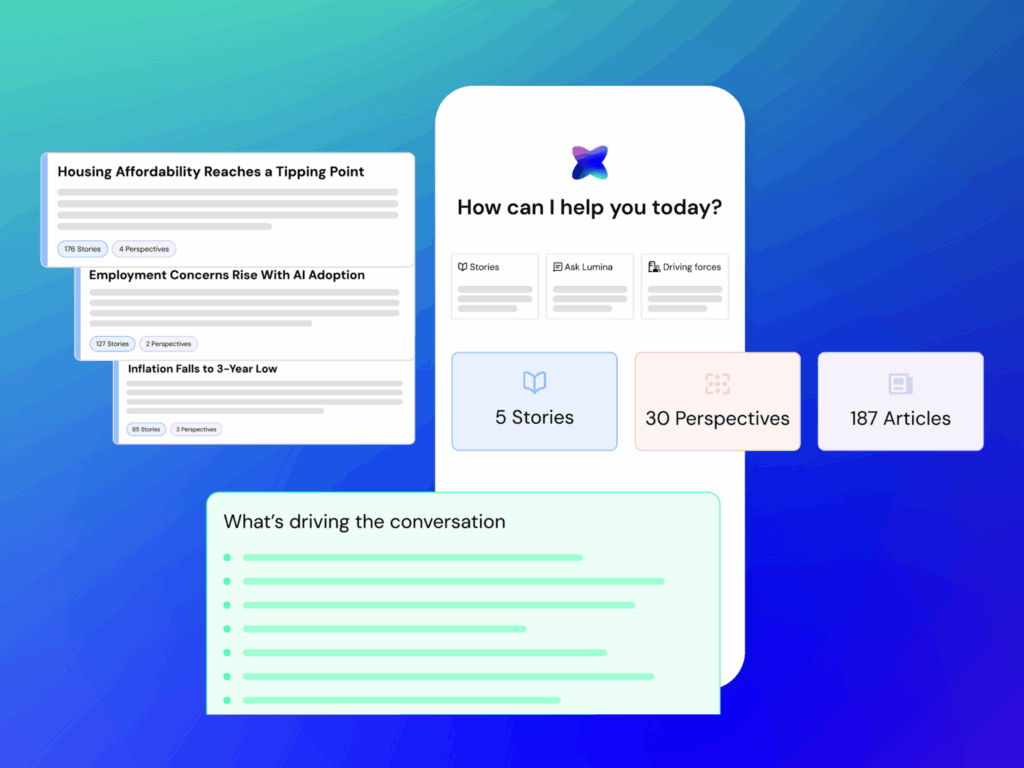
Stories & Perspectives organizes raw media mentions into clustered, cohesive Stories, and the Perspectives that exist within each, reflecting distinct media, audience, and public affairs angles. This unique functionality allows users to:

  • Rise above the noise: Instantly identify which high-level topics are gaining momentum or fading from attention.
  • Get to the detail, fast: Uncover the influential voices, niche communities, and specific channels actively shaping the narrative.
  • Catch the pivot point: Precisely identify the moment a story shifts—from a strategic opportunity to a reputation risk—or when a new key opinion former begins guiding the conversation.

"Media isn’t a stream of mentions," said Kyle Lindsay, Head of Product at Pulsar Group. "But rather a living system of stories shaped by competing perspectives. When you can see those structures clearly, you gain the ability to understand issues as they form, anticipate how they’ll evolve, and act with precision. That’s what we mean when we talk about AI built for communicators, and that's what an off-the-shelf LLM can't give you."

The Lumina Roadmap: AI tools for the future of comms

The launch of Stories & Perspectives is the first release of many. Over the upcoming months, we will systematically roll out the full Lumina roadmap, introducing a comprehensive set of AI tools engineered to handle every phase of the communications lifecycle.

The full Lumina suite will soon incorporate:

  • Curated media summaries: AI-driven daily summaries customized specifically to the priorities of senior leadership, highlighting only the most relevant stories.
  • Reputation analysis: Advanced measurement tracking how critical themes like ethics, innovation, and leadership are statistically shaping corporate perception.
  • Press release & media relations assistant: Tools designed to accelerate content creation and craft hyper-focused, personalized pitches that reach the precise contacts faster.
  • Predictive intelligence layer: Technology engineered to track and anticipate story momentum and strategic change before the window of opportunity closes.
  • Intelligent agents: Background agents continuously scanning all media channels for emerging key spokespeople and previously undetected reputation risks.
  • Enhanced audio, broadcast & crisis detection: Complete, real-time oversight of all channels—including audio and broadcast—enabling rapid context building and optimal crisis response delivery.


Want to harness the power of Lumina AI for your PR, Comms, or Public Affairs team? .

Complete the form below to register your interest.

" ["post_title"]=> string(79) "Announcing Lumina: The purpose-built AI suite for PR, Comms, and Public Affairs" ["post_excerpt"]=> string(129) "An intelligent suite of AI tools trained on the language, workflows, and realities of modern public relations and communications." ["post_status"]=> string(7) "publish" ["comment_status"]=> string(4) "open" ["ping_status"]=> string(4) "open" ["post_password"]=> string(0) "" ["post_name"]=> string(76) "announcing-lumina-the-purpose-built-ai-suite-for-pr-comms-and-public-affairs" ["to_ping"]=> string(0) "" ["pinged"]=> string(0) "" ["post_modified"]=> string(19) "2025-12-09 09:39:52" ["post_modified_gmt"]=> string(19) "2025-12-09 09:39:52" ["post_content_filtered"]=> string(0) "" ["post_parent"]=> int(0) ["guid"]=> string(32) "https://www.isentia.com/?p=43742" ["menu_order"]=> int(0) ["post_type"]=> string(4) "post" ["post_mime_type"]=> string(0) "" ["comment_count"]=> string(1) "0" ["filter"]=> string(3) "raw" }
Blog
Announcing Lumina: The purpose-built AI suite for PR, Comms, and Public Affairs

An intelligent suite of AI tools trained on the language, workflows, and realities of modern public relations and communications.

Ready to get started?

Get in touch or request a demo.