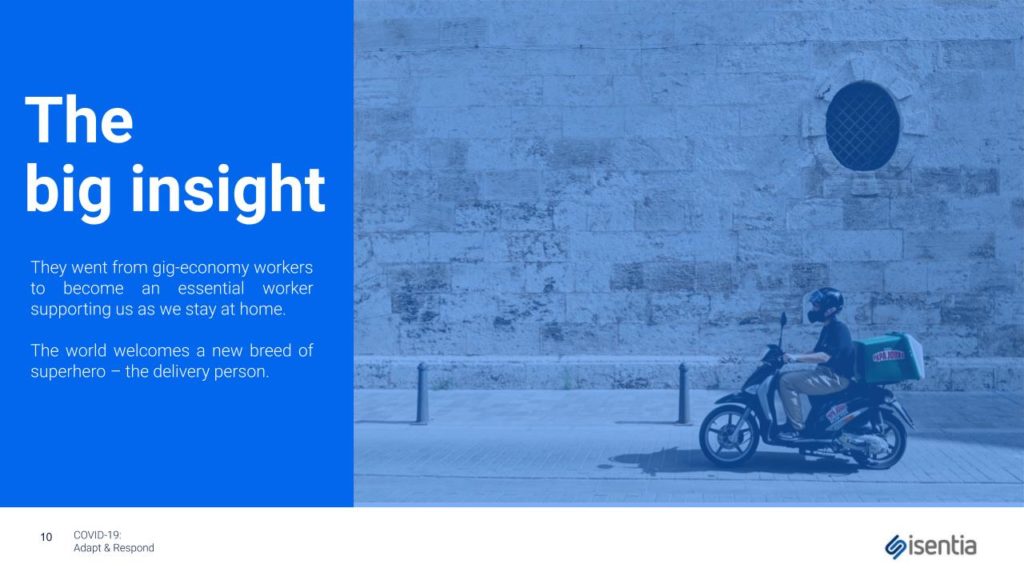
COVID-19 outbreak is evolving around the world and brands have to move quickly. Isentia is here to help with insights on how consumer trends in delivery services and e-commerce are shifting for brands to adapt and respond.
This is the “wpengine” admin user that our staff uses to gain access to your admin area to provide support and troubleshooting. It can only be accessed by a button in our secure log that auto generates a password and dumps that password after the staff member has logged in. We have taken extreme measures to ensure that our own user is not going to be misused to harm any of our clients sites.
Audiences are no longer finding information through traditional search engines that favour established news outlets. AI models now highlight highly relevant and contextual information to audiences to often include niche and regional publications alongside major news media. This change challenges the old media hierarchy around tiered publications and pushes organisations to reconsider how and where they need to show up to stay visible in an AI-first world.
Yes, organisations must focus on optimising their own content for LLMs, but will that always drastically increase the chances of AI models picking up your page? Probably not always. Smart strategy means targeting the specific publications your actual target audience reads — because those are the sources AI models retrieve when answering niche questions.
It’s closer to digital PR than SEO
Generative Engine Optimization (GEO) is changing how brands approach online visibility. For years, traditional SEO meant focusing on your own site—optimising keywords, building backlinks, and improving on-page content. But AI models work differently. Instead of just using your website, these AI engines rely on trusted third-party sources to answer questions. This shift is taking place gradually, of course. LLMs increasingly source from earned media (where it is accessible) and even offsite links from trusted sites. Owned media is still where the organisation has maximum control of how it’s own content travels, but a pivotal strategy shift is needed to match what AI models are picking up and citing.
To succeed with AI search, comms professionals need to think more like a digital PR strategist than a SEO expert. The best way to stand out is by earning mentions, quotes, and citations in the external publications your audience—and the AI systems they use—trust most. This does not make a distinction between Tier 1 or Tier 2 media. If AI models are crawling sites that mention an organisation, but the organisation does not acknowledge or even know those sites are being prioritised by LLMs, they risk falling behind in being the right kind of visible.
To make this strategy work, looking beyond common metrics like traffic to the site or domain authority is not enough. Even a respected industry site will probably not influence AI answers as much if its content is behind a paywall or blocked from search engines. For AI visibility, accessibility to the site or page, structured data that can be crawled, and strong audience alignment are important. Since AI systems use both slow training cycles and fast real-time web searches (RAG), being featured on accessible, relevant niche sites helps an organisation show up accurately when models learn and when they search the web in real time.
Why is Tier 2 media punching at Tier 1 weight?
According to Isentia's report How AI is destabilising trust and reputation amongst audiences, LLMs cite industry and trade publications about twice as often as traditional news sources. Company content and industry press make up over 60% of the share of voice LLMs use, while traditional news is twice as likely to generate negative sentiment. Thus, tier 1 outlets no longer automatically dominate AI-generated responses and may sometimes have the opposite effect.
Two main factors are driving this shift in which media is picked up by LLMs:
The paywalled problem was further expanded on by Dr Momoko Fujita during the Digital News Report: Australia webinar that news organisations must figure out how to make paywalled content easily readable by LLMs. By bridging this gap, these organisations can ensure that AI tools deliver accurate, high-quality reporting rather than missing out on premium content. If not, high-quality coverage may never reach the model. Isentia’s Prashant Saxena, VP of Revenue and Insights, SEA, during a recent partner event with IABC APAC on Why AI Visibility is the next reputation frontier illustrated a paywalled Bloomberg story, for example, that was accurately summarised details it could read at the top level, but fabricated details about raised guidance, even though guidance had been cut. This is because it could not read the rest of the article and tried its best to assume what it can with the information that’s accessible.
Specificity outweighs prestige. Tier 2, trade, and specialist publications are often more accessible, focused, and likely to provide the concrete, citable facts models need. Amy Chappell, Vuelio's Head of Insights Strategy, found a similar trend across sectors in her report on the visibility of supermarkets in the UK “ The role of AI, LLMs, and earned media in shaping reputation” and noted that supermarkets were most often cited by trade publications like The Grocer and Grocery Gazette, not national newspapers. Trade press stories, being more focused and well-sourced, provide models with clearer, more citable facts than broader national articles. This doesn’t mean that Tier 1 coverage does not matter — CEOs value front-page exposure because it remains highly influential. However, relying only on tier 1 hits now means missing significant AI visibility opportunities.
Cited vs consulted: LLMs read a hundred sources, but cite only a few
Which type of media gets cited relies upon how AI models scan different pages. If these models are citing much more niche media outlets, we can assume that a lot of these pages that are consulted could be a part of very relevant Tier 2 media that ends up actually getting cited, and that we’re seeing more and more examples of in AI answers. At the IABC APAC and Isentia webinar on measuring brand visibility in AI answers, Prashant Saxena, Isentia's VP of Revenue and Insights for SEA, stated that in the search era "we would get sources on our page one, page two, mostly page one", and people would click through to form their own opinions. The combined click-through rate in that era was 35 to 40 per cent. Nowadays, he says, "it's just four to five per cent" — since LLMs provide a smooth, ready-made answer and "most of us aren't really checking the citations".
Communications teams now face a new consideration: the distinction between sources that are consulted and those that are cited. At the IABC APAC and Isentia webinar, Takeo Apitzsch, Hoffman Agency’s Chief Digital and AI Officer, explained that AI models scan hundreds of pages to generate an answer but cite only a select few to users. This means that the audience sees only a small, curated portion of the sources that actually influenced the AI's response and a lot of what actually shapes the AI answer doesn’t get visible credit. Therefore, organisations need to make sure they reach out to those publications that AI models can actually crawl and audiences trust the most.
What does this mean for communications professionals?
We are seeing four practical shifts:
Rebuild your tier list based on what LLMs actually cite, not on internal assumptions. A so-called “low-priority” trade publication or niche forum may contribute more to your AI visibility than a national outlet you have long targeted.
Keep your reshuffled tier list fresh, not just correctly ranked. InWhy is content freshness the new currency for AI visibility? we discuss that a page that hasn't been updated in eighteen months is far more likely to drop out of AI answers altogether, no matter how well it once performed. Getting the right tier 2 outlets on side is only half the job done. Feeding them (and your own owned channels) on an ongoing basis is the other half.
Treat consistency as an essential. The largest gap between an organisation’s claims and what an LLM will confidently state is often due to inconsistencies between owned content and third-party coverage. When this occurs, the model may stop providing factual answers altogether.
Shift your focus from share of voice to share of mind. It is now less about how much you are discussed and more about whether the systems mediating the most have got the correct information about your organisation.If the system holds the wrong version, your audience may never access the right one.
Structurally, as Ashley Knapp, Head of Brand and Corporate Affairs, East Asia at Schneider Electric noted during the webinar, these efforts can no longer remain siloed. Owned, earned, shared, and paid media have traditionally been managed by separate teams. Now, because of AI visibility, this required a unified approach, as models do not distinguish between departments but are first to detect inconsistencies.
This also means reconsidering the PESO (paid, earned, shared and owned) strategy deployed by organisations since the way that LLMs access and prioritise them has changed. They prioritise brevity in content due to the high costs of GPUs and data centres. As a result, the shortest, clearest, and most trusted answers are favoured which benefits brands with strong reputations. Earned media remains important, but its influence now depends more on the credibility of the analyst than the platform. Shared content amplifies messages more than ever but is also where misinformation spreads fastest. Paid media is becoming more prominent in some models, though brands are still learning how this impacts visibility.
Media monitoring companies are becoming strategic AI visibility consultants
This shift requires media monitoring companies to evolve. Tracking mentions and sentiment across media channels has been central to media intelligence, but AI visibility has added a new dimension to this. This means monitoring not only what is said about an organisation, but also which sources AI models use when answering questions about that organisation, and assessing how current, authoritative, and consistent those sources are. This gives media monitoring organisations an opportunity to own what they’ve developed and also be thought leaders in this space. Stakeholders value the “so what” advice much more than just knowing “this is what is being said about you in the media”.
Lumina AI View addresses this by tracking which sources ChatGPT, Gemini, Claude, and other models cite when representing an organisation, benchmarks citations against competitors, identifies narrative shifts before they reach stakeholders, and regularly scores AI visibility against four reputation pillars: Direction, Performance, Integrity, and Innovation, These pillars have always supported reputation management, now applied to a largely unseen audience.
If you're weighing up where a tool like this sits alongside the rest of your stack, our own comparison,Best AI Tools for PR & Comms Teams (2026), breaks down how AI-assisted coverage, measurement, crisis response and reporting tools stack up, Lumina included.
Because that’s really the mindset shift comms teams, and the firms advising them both need to make. As Takeo put it on the IABC APAC and Isentia webinar: “I fear that this is the mindset shift communications teams and their advisors must adopt. I fear that AIs will be your secondary, and if not, at least equal… audience in the future.” Beyond human visibility, reputation is about being accurately represented by the systems that mediate access to your audience, which is an additional layer that cannot be trivialised anymore.
"
["post_title"]=>
string(97) "How relevant is Tier 1 and Tier 2 media hierarchy in impacting how organisations show up in LLMs?"
["post_excerpt"]=>
string(243) "The hierarchy that exists between Tier 1 & 2 publications today is being challenged. AI models are the new way audiences discover information requiring organisations to rethink how they show up to remain visible in an AI-mediated environment. "
["post_status"]=>
string(7) "publish"
["comment_status"]=>
string(4) "open"
["ping_status"]=>
string(4) "open"
["post_password"]=>
string(0) ""
["post_name"]=>
string(96) "how-relevant-is-tier-1-and-tier-2-media-hierarchy-in-impacting-how-organisations-show-up-in-llms"
["to_ping"]=>
string(0) ""
["pinged"]=>
string(0) ""
["post_modified"]=>
string(19) "2026-09-09 02:24:17"
["post_modified_gmt"]=>
string(19) "2026-09-09 02:24:17"
["post_content_filtered"]=>
string(0) ""
["post_parent"]=>
int(0)
["guid"]=>
string(32) "https://www.isentia.com/?p=49871"
["menu_order"]=>
int(0)
["post_type"]=>
string(4) "post"
["post_mime_type"]=>
string(0) ""
["comment_count"]=>
string(1) "0"
["filter"]=>
string(3) "raw"
}
Blog
How relevant is Tier 1 and Tier 2 media hierarchy in impacting how organisations show up in LLMs?
The hierarchy that exists between Tier 1 & 2 publications today is being challenged. AI models are the new way audiences discover information requiring organisations to rethink how they show up to remain visible in an AI-mediated environment.
Would you trust a brand more if an AI model recommended it? For many, the answer is yes – and it’s changing the very nature of PR & Comms.
Our latest report digs into the changing nature of trust, as audiences turn to AI models for quick answers instead of going to organisations or media outlets directly, with AI fast becoming the final stop in the comms cycle.
This report unpacks:
Why trust has shifted, and where audiences are having these conversations
Why AI has become the last stop in the comms cycle
Methods for staying on top of your brand trust and reputation
To access the full report, fill in the form below:
If you ask ChatGPT or Gemini about your organisation today, the answer won't come straight from your website. Instead, it uses sources the model already trusts, which are often months or years old. So if your last big mention was a crisis or a controversy from 2023, that's probably still how AI describes you.
This is the tough reality for anyone working in PR and communications today. More people are getting their first—and sometimes only—impression of your organisation from an AI-generated summary, not from search results or the homepage. And these summaries often rely on outdated information.
What does freshness actually mean?
Content freshness refers to how recent the sources are that an AI model uses when it talks about you. It might seem like a minor technical point, but it's actually very important.
Search engines have always valued fresh content, and they let you update information quickly. If you change a page, Google recrawls it, and rankings can shift in days. Large language models don't work like this. As Lisa Main, Director at Main Bureau, said on Isentia's "AI as a Stakeholder" panel, "large language models are not databases of verified facts." These models are trained on a snapshot of the internet, updated only from time to time, and they rely on sources that were already prominent when they were trained. This means a past crisis or a controversy that is already resolved can keep showing up in AI answers long after it's no longer relevant.
She shared the example of how a day and a half after a notorious terror attack, she asked ChatGPT if the area had ever experienced a tragedy of that type. It replied that it had not." The model wasn't being careless, but it just hadn't updated to include the latest news. This gap between what reality is and what AI still believes is true sums up the content freshness problem.
Dr Nici Sweaney, founder of AI Her Way, explained on the same panel why this gap matters. She calls AI "an accidental narrator" — it shapes what people believe about your organisation just by repeating the latest information it received. The system simply uses what's available and is not trying to be harmful, so it's important to make sure that information is up to date.
How does this change the way organisations show up?
For PR and communications teams, this changes what "reputation management" means. Put simply, messaging that an LLM cites will remain relevant, no matter when it dates from. Messaging that has not been factored into the LLM’s answers, meanwhile, will have no discernible impact on an increasingly vital - even central - channel, regardless of how many other metrics it might win out on.
This leads to two important things to consider:
First, the conditions that surround recent earned media, statements, and announcements determine whether an AI model updates its picture of the brand, or keeps running on an outdated one. Catherine Arrow of the PR Knowledge Hub made a related point on the "Inside the AI Shift" webinar: LLMs and the agents built on them are "often forbidden from going behind paywalls, from scraping particular sites," which she said creates a kind of "news vacuum." The same logic applies to the brand’s own newsroom or press page. If it isn't feeding the model something current, the model has nothing current to draw from.
Second, owned content—like blog posts, media releases, and website pages — are strategically important because they’re something the organisation in question can control , but only if they are updated. If a page hasn't changed in eighteen months, it's much more likely to disappear from AI results, making any reputation built on it unstable. If something is published once and not updated, the brand risks letting older, less positive stories take its place.
For public sector and government communicators, the stakes are more immediate again. When a government agency's guidance changes, whether that's eligibility criteria, compliance requirements, or a service update, and the fresh version doesn't make it into what AI models are citing, people will still get fed old information, with potentially devastating real-world implications.
The evidence is already there
This is not just in theory. It's playing out in global research and in the day-to-day data right now.
AI is quietly replacing the front door to your content
The Reuters Institute's Digital News Report Australia 2026 confirms that many PR teams have noticed that Google organic search traffic to news sites dropped by a third worldwide between November 2024 and November 2025, and by 38% in the US, as AI Overviews and AI Mode launched. Publishers expect this traffic to nearly halve again in the next three years. Some now call this trend a move towards "Google Zero." For communications teams, this means people are increasingly less likely to click through to your website to check if information is current. More often, they're trusting what the AI says: hence why it’s so important to monitor content freshness.
AI models are now web-enabled and they might not actually guarantee source accuracy
One challenge is that most major chatbots are now web-enabled. For example, ChatGPT can browse the internet, Gemini uses Google Search, and Perplexity has its own live index. This makes it easy to assume that AI always knows the latest information. However, this does not mean that they are always accurate when it comes to citations. A study from Columbia's Tow Center for Digital Journalism tested eight AI search tools with 1,600 queries. They found that these tools failed to correctly identify or cite the source article more than 60% of the time. Some tools were wrong on most tests and rarely showed any uncertainty. New information has not had time to be checked or confirmed like older stories have. This is the real risk of relying on the newest updates — a story that is fast moving and poorly sourced about your organisation might end up in an AI answer before it’s even verified or fact-checked.
People are turning to AI chatbots specifically for what's new
The same report found that 35% of people who use AI chatbots for news do so to get the latest media updates. Dr Sora Park from the University of Canberra's News and Media Research Centre explained on the "Digital News Report Australia 2026" webinar that the main reason people use AI chatbots for news is that "AI collates stories from different news sources into a single response." People expect these tools to provide current information. If your organisation's newest content isn't included (and you have something current or novel to communicate) you miss the chance to reach audiences when they're most interested.
Fresh content doesn’t always equate to ‘new’ content
A notable example of creating freshness that LLMs reward and prioritise comes from updating existing pages, rather from creating brand-new content. Republishing and refreshing current material is more effective than many communications teams realise, as long as one actually updates the content, not just the date.
Evergreen pages are the first casualties when AI overviews roll in
The DNR Australia 2026 report also notes that once someone is inside an AI chatbot conversation, they rarely leave it to check the source — only 4% of AI chatbot users say they always or often click through to the original article, compared with 19% for search and 17% for social media. The pages that used to earn traffic just by sitting there, permanent and useful, are now the ones most likely to lose visibility, because AI models favour what's recent over what's merely correct.
One fresh statement doesn't automatically undo a stale narrative
If an executive online, especially one who has a lot of weight to what they post online, says something controversial and it quickly spreads across media articles, social media and search — it will definitely be picked up by AI as well. There is a golden window of opportunity that they need to capitalise on to clarify what they said. If they don’t, the negative story that was already built into the data AI models use, will not be affected much by the executive’s clarification statement, which wasn’t that timely anyway. As Catherine Arrow of the PR Knowledge Hub said on the "Inside the AI Shift" webinar: "public relations and media relations are not the same thing," and relying on a single release misses the point. The real lesson is not to publish faster after a crisis, but to build a strong, up-to-date presence before you need it. In our latest report, “How can leaders communicate in an age of scrutiny”, we’ve outlined exactly how comms leaders can communicate by adapting their content to audiences exposed to the “AI way” of news dissemination.
What PR & Comms teams should actually do?
The challenge is that organisations can't make an AI model update its answers whenever they want. What they can do is track whether recent work is actually being noticed, which is what Lumina AI View can help with.
Lumina AI View monitors which sources AI models use when talking about your organisation, how strong and recent those sources are, and how you compare to competitors. Freshness is one of five key factors in the overall score. If your freshness score drops, it's an early warning that your latest campaign or announcement hasn't reached the AI ecosystem yet, and older stories are still dominating.
What’s important to note is that the tool provides a list of source citations, paired with reputation pillars like direction, integrity, performance and innovation — giving a comms professional a fully-rounded understanding of what they need to do. It’s not just the case of knowing source citations, but also of understanding your own AI perception and performance to make informed decisions — whether that’s for a brand,a government agency, a NFP or elsewhere.
This kind of tracking is even more important because it shifts by industry and by market, so "AI visibility" doesn't mean the same monitoring job for every organisation. AI answers for healthcare might draw from the smallest, highest-trust pool of sources (mostly clinical and government), but SaaS and fintech answers lean heavily on editorial reviews and comparison sites. Ngaire Crawford made a similar point regionally on the "AI as a Stakeholder" panel. For the APAC region specifically, she pushed back on the assumption that editorial media dominates AI citations — "there are a lot of really massive claims about the impact of editorial media... some as high as 85, 88%. That's not what we're seeing." Instead, she found "a fairly even split between (editorial media) and company content," alongside a real presence for review sites, forums, and academic sources. For a comms team, that means the freshness strategy that works for a media-heavy consumer brand might not work for a government agency whose AI visibility is really riding on review sites, .gov pages, or industry forums instead.
By tracking regularly — weekly or as a routine check— you turn the vague concern of "what is AI saying about us" into something that is super clear. You can see if recent coverage changed your list of citations, or if your owned content is still being found, or where there are gaps that need to be filled because old stories still exist and are causing problems.
The opportunity in staying current
There's a real advantage here too. If old content keeps you tied to an outdated story, fresh content is a direct way for PR and communications teams to influence how AI presents them. Publishing regularly, keeping your own pages updated, and getting recent, credible coverage is not just for human audiences. It's how PR professionals can make sure the systems shaping first impressions have the right information.
Teams that make it an ongoing habit of checking in regularly, watching for changes, and keeping fresh, credible content flowing, will have more control over how AI describes their organisation.
If you would like to know more about our Lumina suite, please reach out here and our team will get in touch with for you a quick demo.
"
["post_title"]=>
string(60) "Why is content freshness the new currency for AI visibility?"
["post_excerpt"]=>
string(172) "AI summaries are replacing websites as your organisation's first impression. Here’s why content freshness—and the sources feeding these models—matters more than ever."
["post_status"]=>
string(7) "publish"
["comment_status"]=>
string(4) "open"
["ping_status"]=>
string(4) "open"
["post_password"]=>
string(0) ""
["post_name"]=>
string(59) "why-is-content-freshness-the-new-currency-for-ai-visibility"
["to_ping"]=>
string(0) ""
["pinged"]=>
string(0) ""
["post_modified"]=>
string(19) "2026-08-20 02:44:18"
["post_modified_gmt"]=>
string(19) "2026-08-20 02:44:18"
["post_content_filtered"]=>
string(0) ""
["post_parent"]=>
int(0)
["guid"]=>
string(32) "https://www.isentia.com/?p=49408"
["menu_order"]=>
int(0)
["post_type"]=>
string(4) "post"
["post_mime_type"]=>
string(0) ""
["comment_count"]=>
string(1) "0"
["filter"]=>
string(3) "raw"
}
Blog
Why is content freshness the new currency for AI visibility?
AI summaries are replacing websites as your organisation’s first impression. Here’s why content freshness—and the sources feeding these models—matters more than ever.