We’re all trying to achieve more, with less, all while trying to be better than anyone else. Sometimes you can’t do it alone, and there’s a good chance you need systems or smarter technology to do some of the heavy lifting for you.
It’s at this interval where many stumble – striving for consensus where, really, buy-in is the goal.
For any Marketing or Communications professional, the art of selling a dream or pitching an idea is second nature. However, that art is so often forgotten when trying to get things like new technology, new processes, new approaches, or even new ways of looking at data across the line.
We typically default to aiming for consensus, which by our very nature as people (and roles within organisations) is the wrong metric. Differing perspectives foster innovation, inspiration and fresh thinking – which is great for business, but not great for decision making. By aiming for consensus, we fail to create action. Instead, we create unnecessary stress, and push timelines to the point where we start to see decisions as rare shooting stars – beautiful, yet unattainable.
What we really need to strive for is buy-in. As a concept, buy-in is nothing new – but it’s something that we blur with consensus. It’s not about 100% agreement, it’s about getting enough people to believe in your argument.
Not to sound cliché, but it’s a little like story-telling. Not everyone will read to the end and it may not be their favourite story, but they can certainly see the path, recognize the markers, and believe the characters. The key here is to reach a majority buy-in to keep decisions moving forward.
When you fail to make decisions, the price paid is to the bottom line. Focus on quality, focus on getting the systems you need to free up time for more important things, and focus on putting your best case forward.
Loren is an experienced marketing professional who translates data and insights using Isentia solutions into trends and research, bringing clients closer to the benefits of audience intelligence. Loren thrives on introducing the groundbreaking ways in which data and insights can help a brand or organisation, enabling them to exceed their strategic objectives and goals.
The Australian public’s reaction to government reforms and leaders was especially eventful. Debates about campus safety by the Royal Commission, a tax deal between Labor and the Greens unsettling the finance and property sectors, and a speech on “monoculture” by Pauline Hanson shifting opinion polls in an unexpected way; were three complex stories that saw audiences taking different sides, leading to many perspectives and angles.
We used Isentia's Lumina to track the different viewpoints, key people, and stories with the largest volume and audience. Over four weeks (22 June to 17 July), we found 62 unique perspectives and nearly 900 media items across these three stories.
Key Stories, Key Drivers
Here’s a quick overview:
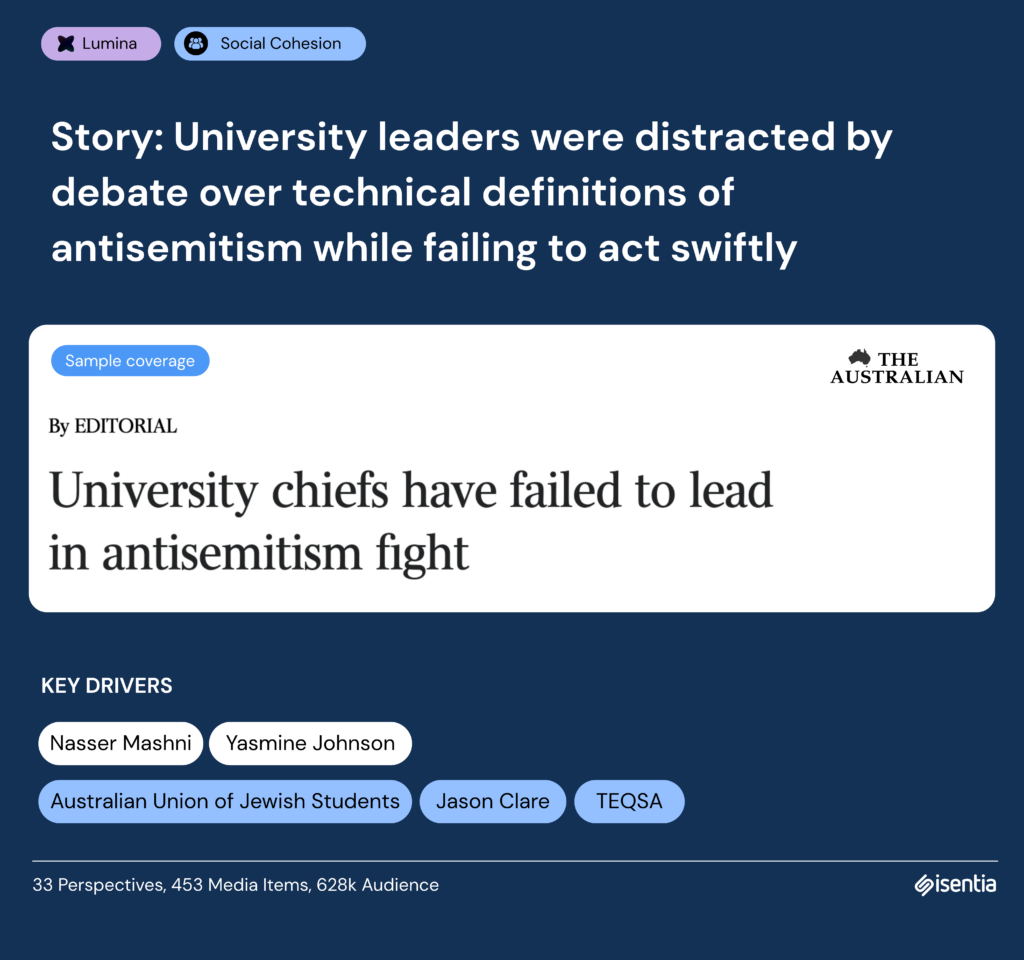
▸ Campus Antisemitism at the Royal Commission — Pro-Palestinian groups, Jewish advocacy groups, and the federal government each put a different framing on the same hearings. Key drivers: Nasser Mashni, Yasmine Johnson, the Australian Union of Jewish Students, Jason Clare, TEQSA.
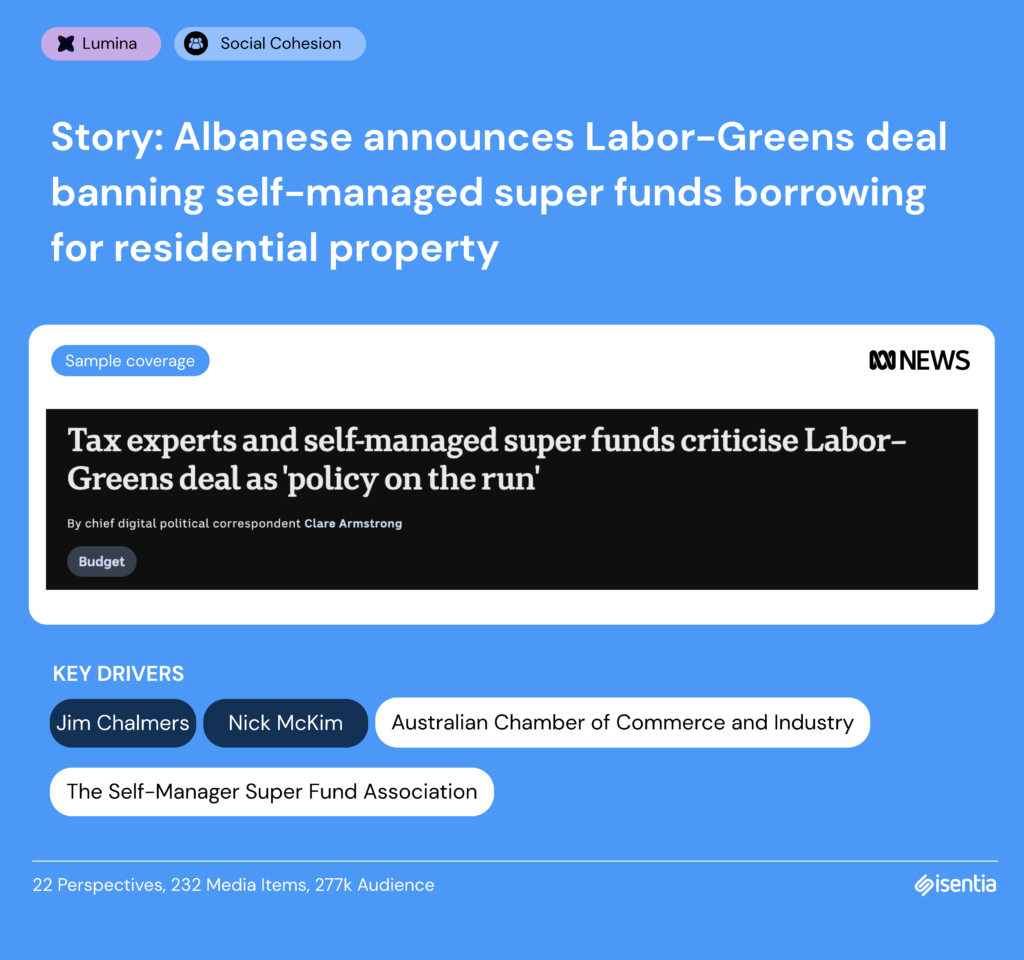
▸ The Labor–Greens Tax Deal — Government and Greens call it fairness for first-home buyers; finance and business groups call it policy on the run. Key drivers: Jim Chalmers, Nick McKim, the Self-Managed Super Fund Association, the Australian Chamber of Commerce and Industry.
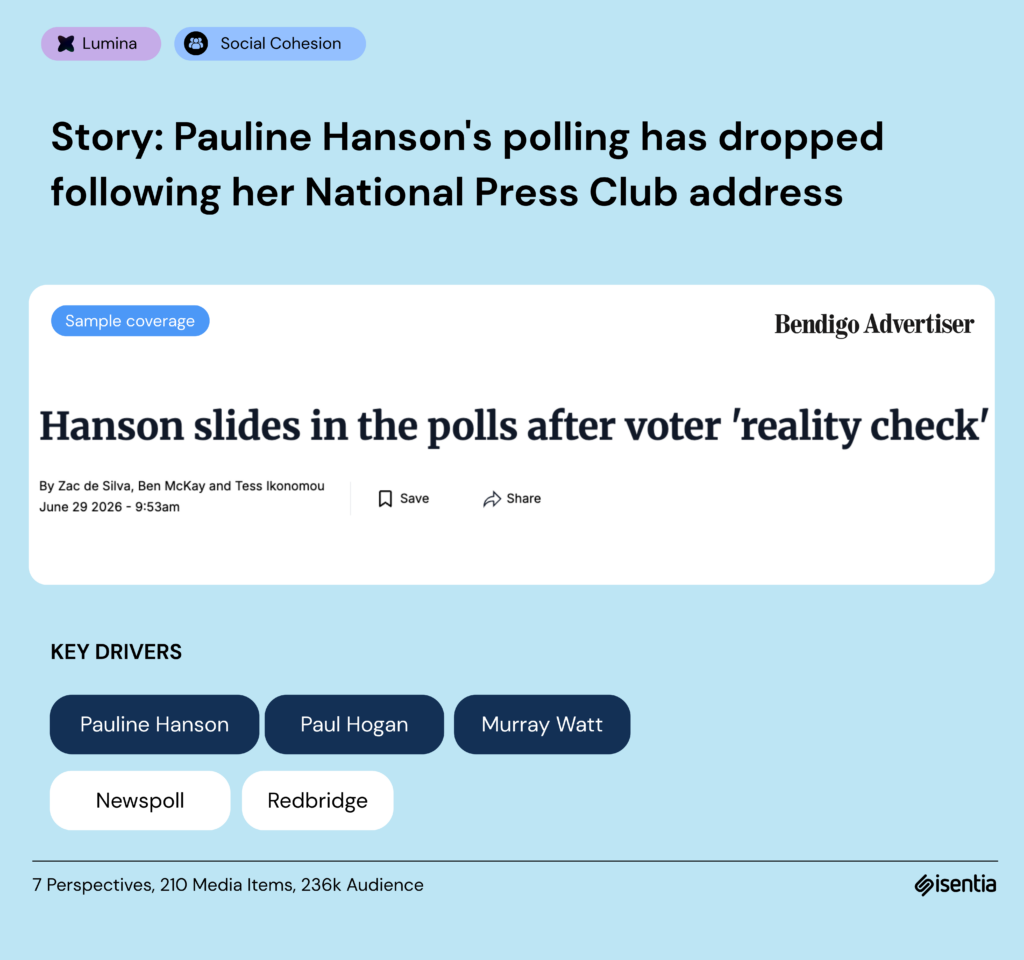
▸ Pauline Hanson's Monoculture Speech — A push for cultural unity that critics called divisive, followed by a real slide in the polls. Key drivers: Pauline Hanson, Paul Hogan, Murray Watt, Newspoll, Redbridge.
The Royal Commission on campus anti-semitism
The Royal Commission on Antisemitism and Social Cohesion’s hearings on university campuses was the biggest story by far. In less than a week, it drew 33 perspectives and 453 media items, reaching over 628k audiences. The story’s size came from the many institutions involved—student groups, representative bodies, and the federal government—each offering their own view on the same testimony.
Pro-Palestinian advocacy groups had the widest reach, making up about a third of all coverage. Spokespeople like Yasmine Johnson from Students for Palestine and Nasser Mashni from the Australia Palestine Advocacy Network told the commission their campus protests are a legitimate justice movement. They also raised concerns that criticism of government policy is being confused with antisemitism, which they say limits open debate.
Jewish student and staff groups also received significant coverage, making up about a fifth of the total. The Australian Union of Jewish Students described campuses where some students feel hesitant to attend and highlighted gaps in how universities handle complaints and support those affected. Most of this coverage came from wire services and was widely shared across news outlets like The Australian or the Midwest Times.
The federal government provided a third perspective, with similar coverage. Education Minister Jason Clare said universities had been slow to act and announced plans to tighten governance standards. This includes clearer anti-racism policies covering both antisemitism and Islamophobia. Reports also noted that TEQSA, the regulator, warned universities about outside groups joining campus protests, and the government’s antisemitism envoy suggested universities could face funding cuts if they do not do enough.
The Labor-Greens Tax Deal
The second-biggest story was more focused but still managed to stir strong reactions. Labor’s deal with the Greens to close a borrowing loophole for self-managed super funds, in return for Greens support on capital gains tax and negative gearing changes, led to 22 perspectives and 232 media items, reaching nearly 177k audiences.
The government, supported by the Greens, presented the deal simply — it closed a loophole that allowed wealthy investors to use their super funds to compete with first-home buyers at auctions. Treasurer Jim Chalmers cited a 2014 recommendation to support the change, and Greens treasury spokesman Nick McKim called it a win against "wealthy property investors."
The Greens, however, took a tougher stance and received similar coverage for saying the deal was only a partial win. They argued that allowing existing arrangements to continue would let Labour protect wealthy investors rather than renters, and said the housing crisis would now be "squarely of Labor's design." This shows that support from a governing partner does not always mean they are satisfied, as Country News highlighted.
Finance and business groups pushed back with nearly as much coverage. The Self-Managed Super Fund Association and the Australian Finance Industry Association said the borrowing rules did not pose a systemic risk and argued that regulators should focus on "aggressive marketing" and property spruiking, not legitimate investors. The Australian Chamber of Commerce and Industry warned that the wider capital gains tax changes could hurt business investment. ABC News gave the most detailed account of this perspective, noting the sector was "surprised" by how the deal was made.
Pauline Hanson’s monoculture speech
This story had the fewest perspectives (just seven) but still reached nearly 236k people through 210 media items. That’s a bigger audience than the tax story, which had three times as many viewpoints.
The story began when Pauline Hanson used a National Press Club speech to argue that Australia should replace multiculturalism with a single "monoculture." She cited Paul Hogan and the Socceroos as examples. The backlash was quick and unexpected and Hogan himself called her a "pelican" and said her views were racist. His response ended up shaping the story more than her monoculture speech.
What makes this story notable is what happened afterward. Two polls, Newspoll and Redbridge, showed One Nation’s primary vote dropping by about two points (Dairy News Australia) and Hanson’s personal approval falling ten points into negative territory. Labor regained a narrow lead and Labor minister Murray Watt quickly described the numbers as a "reality check,". This framing spread almost as widely as the original speech, as the Bendigo Advertiser reported.
The speech and the poll results are really one story seen from three sides — Hanson’s message, her critics’ reactions, and Labor’s use of the polling. Each angle received similar coverage, showing that the speech missed its mark and gave the government a useful talking point.
How does this inform PR & Comms Strategy?
First, the number of perspectives in a story is important. A story with many viewpoints, like the antisemitism hearings, needs a different monitoring approach than one with just a few, because the loudest voices might not always be the most important.
Second, pay attention when several perspectives are about the same size, as in the tax deal. If no single viewpoint stands out, the issue is likely still being debated. It’s a good idea to check back after some time instead of treating the first coverage as the final answer.
Third, compare any polarising message to the Hanson example before recommending it to a client. The numbers show that a divisive message can get attention but still turn public opinion against the speaker.
Conclusion
What links these stories is how much is lost when they are reduced to just two sides. The antisemitism hearings, the tax deal, and Hanson’s polling drop were all more complex than their main headlines suggested.
That’s why it’s valuable to track a story by its different perspectives and key drivers. See what Lumina can reveal for your industry or clients, and check out more analysis like this on the Isentia blog.
"
["post_title"]=>
string(61) "Who really shaped Australia's latest social cohesion debates?"
["post_excerpt"]=>
string(170) "See how Isentia's Lumina tracked 62 perspectives across 3 major Australian stories, revealing how media coverage really spreads and who ends up controlling the narrative."
["post_status"]=>
string(7) "publish"
["comment_status"]=>
string(4) "open"
["ping_status"]=>
string(4) "open"
["post_password"]=>
string(0) ""
["post_name"]=>
string(59) "who-really-shaped-australias-latest-social-cohesion-debates"
["to_ping"]=>
string(0) ""
["pinged"]=>
string(0) ""
["post_modified"]=>
string(19) "2026-07-23 02:35:20"
["post_modified_gmt"]=>
string(19) "2026-07-23 02:35:20"
["post_content_filtered"]=>
string(0) ""
["post_parent"]=>
int(0)
["guid"]=>
string(32) "https://www.isentia.com/?p=48739"
["menu_order"]=>
int(0)
["post_type"]=>
string(4) "post"
["post_mime_type"]=>
string(0) ""
["comment_count"]=>
string(1) "0"
["filter"]=>
string(3) "raw"
}
Blog
Who really shaped Australia’s latest social cohesion debates?
See how Isentia’s Lumina tracked 62 perspectives across 3 major Australian stories, revealing how media coverage really spreads and who ends up controlling the narrative.
Audiences have quietly moved from giving leaders — CEOs and operational leaders — the benefit of the doubt to actively scrutinising them. Smarter communication leaders have realised that content with proof and evidence, over anything performative, is much more valued by audiences.
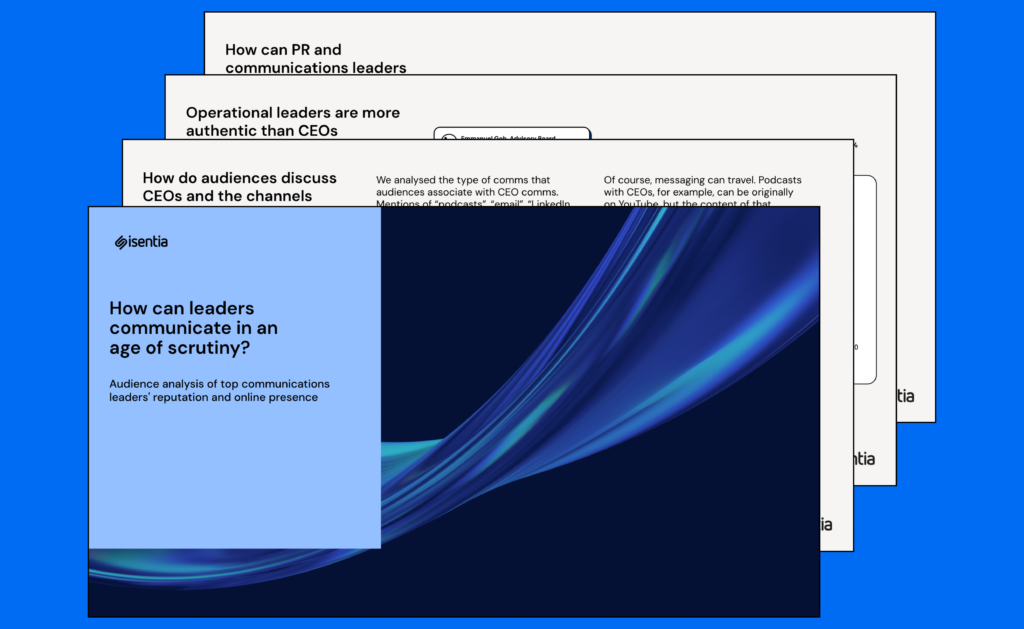
Our latest report analyses how top communications leaders are discussed by audiences online and reveals what actually earns trust and reputation in an age of scrutiny.
In the report, we unpack how:
Comms leaders' online presence is affected because of increased audience scrutiny
Operational leaders out-communicate CEOs and audiences read them as more authentic
Proof, people, and place are prioritised in comms leaders' posts — that in turn deepens trust the most
Isentia’s AI-built suite of tools can help uncover the right story for the comms leader of today
To access the full report, fill in the form below:
"
["post_title"]=>
string(50) "How can leaders communicate in an age of scrutiny?"
["post_excerpt"]=>
string(177) "This report analyses how comms leaders are constantly adapting their content online as a result of increased audience scrutiny - in order to earn trust and maintain reputation. "
["post_status"]=>
string(7) "publish"
["comment_status"]=>
string(4) "open"
["ping_status"]=>
string(4) "open"
["post_password"]=>
string(0) ""
["post_name"]=>
string(49) "how-can-leaders-communicate-in-an-age-of-scrutiny"
["to_ping"]=>
string(0) ""
["pinged"]=>
string(0) ""
["post_modified"]=>
string(19) "2026-07-15 03:14:40"
["post_modified_gmt"]=>
string(19) "2026-07-15 03:14:40"
["post_content_filtered"]=>
string(0) ""
["post_parent"]=>
int(0)
["guid"]=>
string(32) "https://www.isentia.com/?p=48566"
["menu_order"]=>
int(0)
["post_type"]=>
string(4) "post"
["post_mime_type"]=>
string(0) ""
["comment_count"]=>
string(1) "0"
["filter"]=>
string(3) "raw"
}
Blog
How can leaders communicate in an age of scrutiny?
This report analyses how comms leaders are constantly adapting their content online as a result of increased audience scrutiny – in order to earn trust and maintain reputation.
There is a new frontier where public perception is shaped: Large Language Models. Right now, LLMs are answering critical questions about your organisation. What are they saying? And more importantly, which sources are shaping those answers?
To navigate this landscape, public relations professionals don't need generic tools, but rather technology that speaks their language, and addresses the realities of a changed media and informational landscape.
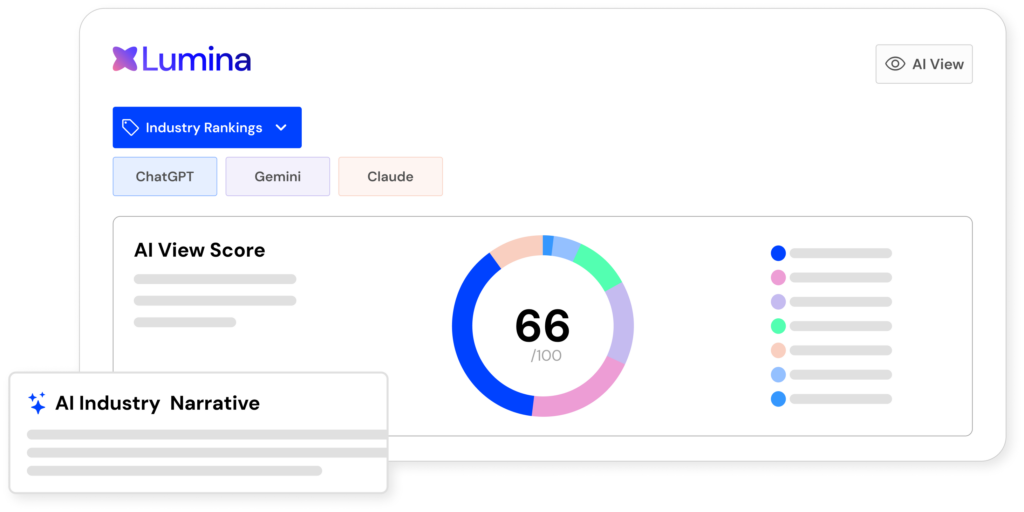
That is why we're unveiling Lumina AI View, the latest addition to our intelligent suite of AI tools from Isentia. Trained specifically on the workflows and challenges of modern PR & communications, Lumina AI View helps you understand exactly what AI knows about you, and how it learned it.
A new standard for AI visibility
AI View tracks your citation strength and source quality alongside those of your competitors, giving you a clear view of where you hold authority and where you have gaps.
Lumina AI View maps your AI reputation from the ground up, allowing you to:
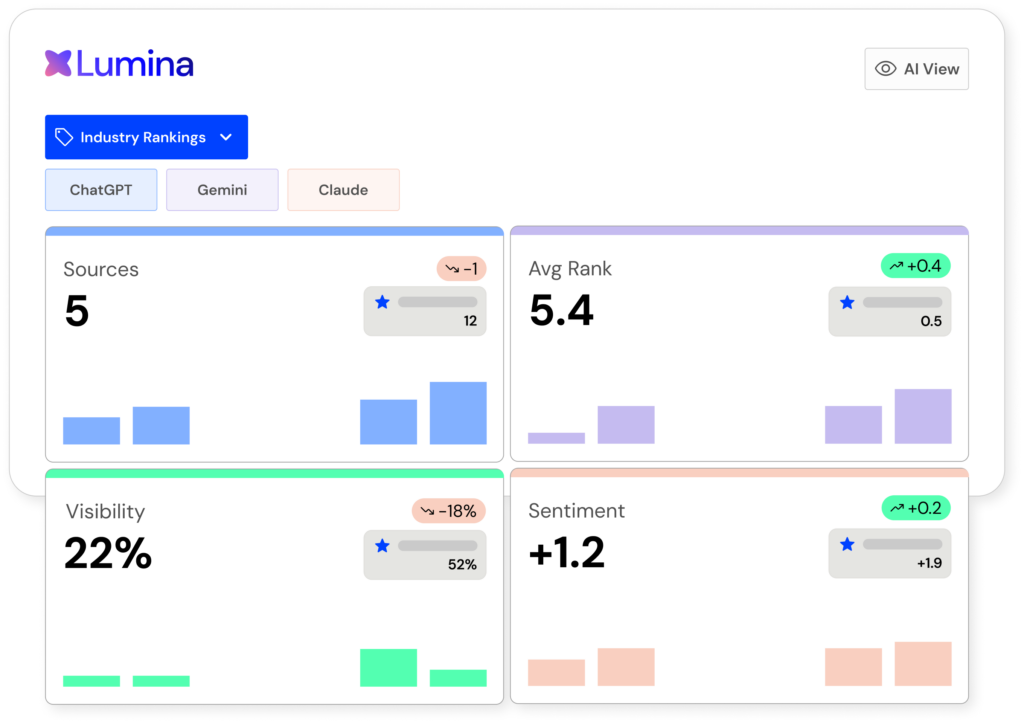
See which sources matter: When tools such as ChatGPT or Gemini discuss your organisation, which outlets do they cite? Track your source footprint over time and view the impact of key target media on how you’re discussed. We measure your citation strength and source quality alongside those of competitors, giving you a clear view of where you have authority and where you have gaps.
Gain industry-specific insight: Your competitors get cited from Financial Times and Bloomberg. You get cited on Reddit. Each brings opportunity – and risk. Discover how you measure up against industry standards, and target the sources that actually influence how AI represents you.
Catch narrative shifts early: AI responses change when new sources appear, sentiment shifts, or old controversies resurface. Get alerts when citation patterns change suddenly, before they impact the way you’re perceived by stakeholders.
Measure your progress: From media monitoring to full media intelligence
Lumina AI View is built on the principle that insights get stronger with repeated measurement. To help you maintain a clear view of your reputation, our proprietary scoring system provides regular updates that show you:
Evolving trends in how sources cite your organisation
Competitive standing and benchmark metrics
Where models differ in information presented, and sources cited
Whether you run it weekly, on-demand, or whenever you need a check-in, patterns will emerge, trends will become clear, and you will build a baseline that makes any sudden narrative changes both comprehensible and the prerequisite to action.
Lumina AI View is part of Lumina AI, a comprehensive suite of AI tools built specifically for communicators. Our Lumina suite evolves traditional media monitoring into narrative intelligence, enabling you to truly understand how perceptions form, evolve, and impact your reputation.
Get in touch to register your interest and see what Lumina AI View can do for you.
"
["post_title"]=>
string(66) "Introducing Lumina AI View: AI Visibility Built for PR & Comms"
["post_excerpt"]=>
string(158) "Lumina AI View, the latest in Isentia's AI suite, is trained on PR & comms workflows to help you understand what AI knows about you — and how it learned it."
["post_status"]=>
string(7) "publish"
["comment_status"]=>
string(4) "open"
["ping_status"]=>
string(4) "open"
["post_password"]=>
string(0) ""
["post_name"]=>
string(59) "introducing-lumina-ai-view-ai-visibility-built-for-pr-comms"
["to_ping"]=>
string(0) ""
["pinged"]=>
string(0) ""
["post_modified"]=>
string(19) "2026-07-15 03:12:57"
["post_modified_gmt"]=>
string(19) "2026-07-15 03:12:57"
["post_content_filtered"]=>
string(0) ""
["post_parent"]=>
int(0)
["guid"]=>
string(32) "https://www.isentia.com/?p=47963"
["menu_order"]=>
int(0)
["post_type"]=>
string(4) "post"
["post_mime_type"]=>
string(0) ""
["comment_count"]=>
string(1) "0"
["filter"]=>
string(3) "raw"
}
Blog
Introducing Lumina AI View: AI Visibility Built for PR & Comms
Lumina AI View, the latest in Isentia’s AI suite, is trained on PR & comms workflows to help you understand what AI knows about you — and how it learned it.