Blog
How AI is destabilising trust and reputation amongst audiences?
Learn how LLMs reshape brand perception and actionable steps organisations can take to maintain trust and reputation in the new information era.
Audiences are no longer finding information through traditional search engines that favour established news outlets. AI models now highlight highly relevant and contextual information to audiences to often include niche and regional publications alongside major news media. This change challenges the old media hierarchy around tiered publications and pushes organisations to reconsider how and where they need to show up to stay visible in an AI-first world.
Yes, organisations must focus on optimising their own content for LLMs, but will that always drastically increase the chances of AI models picking up your page? Probably not always. Smart strategy means targeting the specific publications your actual target audience reads — because those are the sources AI models retrieve when answering niche questions.
Generative Engine Optimization (GEO) is changing how brands approach online visibility. For years, traditional SEO meant focusing on your own site—optimising keywords, building backlinks, and improving on-page content. But AI models work differently. Instead of just using your website, these AI engines rely on trusted third-party sources to answer questions. This shift is taking place gradually, of course. LLMs increasingly source from earned media (where it is accessible) and even offsite links from trusted sites. Owned media is still where the organisation has maximum control of how it’s own content travels, but a pivotal strategy shift is needed to match what AI models are picking up and citing.
To succeed with AI search, comms professionals need to think more like a digital PR strategist than a SEO expert. The best way to stand out is by earning mentions, quotes, and citations in the external publications your audience—and the AI systems they use—trust most. This does not make a distinction between Tier 1 or Tier 2 media. If AI models are crawling sites that mention an organisation, but the organisation does not acknowledge or even know those sites are being prioritised by LLMs, they risk falling behind in being the right kind of visible.
To make this strategy work, looking beyond common metrics like traffic to the site or domain authority is not enough. Even a respected industry site will probably not influence AI answers as much if its content is behind a paywall or blocked from search engines. For AI visibility, accessibility to the site or page, structured data that can be crawled, and strong audience alignment are important. Since AI systems use both slow training cycles and fast real-time web searches (RAG), being featured on accessible, relevant niche sites helps an organisation show up accurately when models learn and when they search the web in real time.
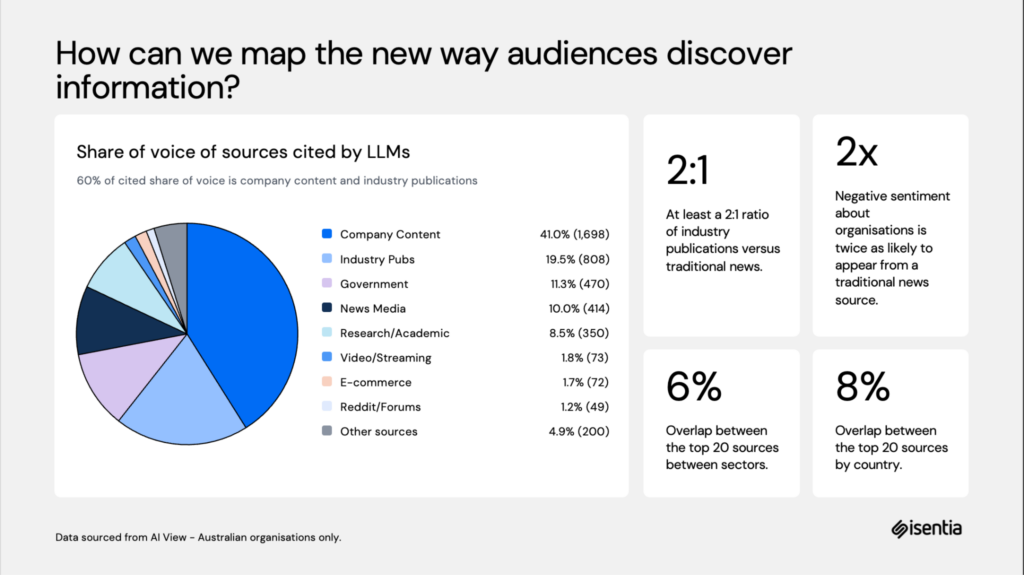
According to Isentia’s report How AI is destabilising trust and reputation amongst audiences, LLMs cite industry and trade publications about twice as often as traditional news sources. Company content and industry press make up over 60% of the share of voice LLMs use, while traditional news is twice as likely to generate negative sentiment. Thus, tier 1 outlets no longer automatically dominate AI-generated responses and may sometimes have the opposite effect.
Two main factors are driving this shift in which media is picked up by LLMs:
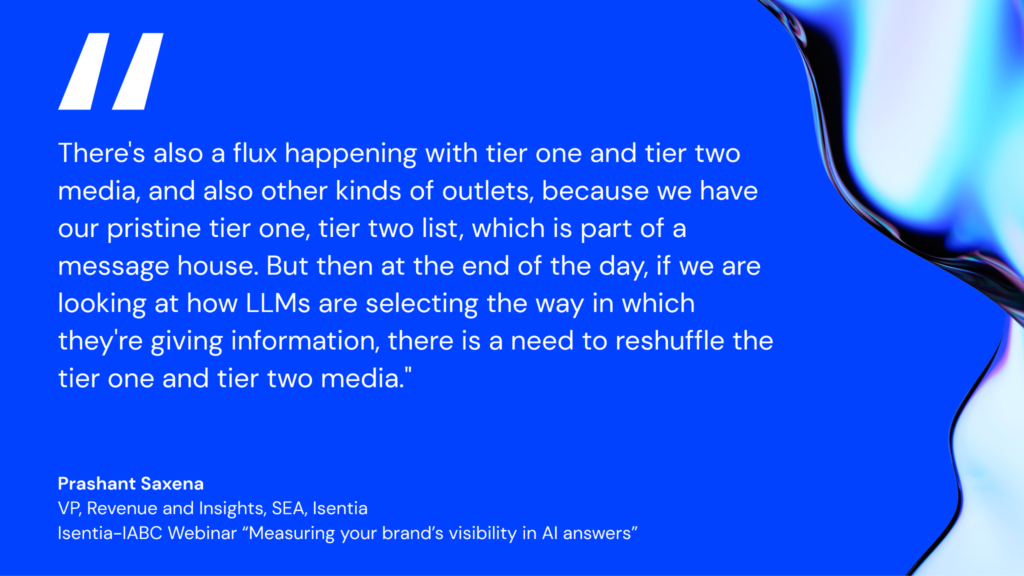
Which type of media gets cited relies upon how AI models scan different pages. If these models are citing much more niche media outlets, we can assume that a lot of these pages that are consulted could be a part of very relevant Tier 2 media that ends up actually getting cited, and that we’re seeing more and more examples of in AI answers. At the IABC APAC and Isentia webinar on measuring brand visibility in AI answers, Prashant Saxena, Isentia’s VP of Revenue and Insights for SEA, stated that in the search era “we would get sources on our page one, page two, mostly page one”, and people would click through to form their own opinions. The combined click-through rate in that era was 35 to 40 per cent. Nowadays, he says, “it’s just four to five per cent” — since LLMs provide a smooth, ready-made answer and “most of us aren’t really checking the citations”.
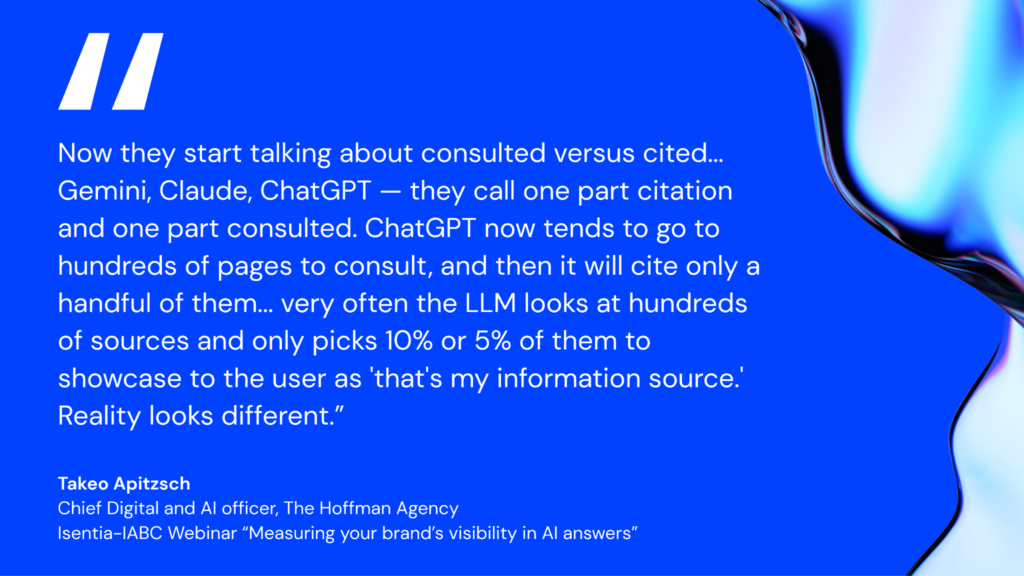
Communications teams now face a new consideration: the distinction between sources that are consulted and those that are cited. At the IABC APAC and Isentia webinar, Takeo Apitzsch, Hoffman Agency’s Chief Digital and AI Officer, explained that AI models scan hundreds of pages to generate an answer but cite only a select few to users. This means that the audience sees only a small, curated portion of the sources that actually influenced the AI’s response and a lot of what actually shapes the AI answer doesn’t get visible credit. Therefore, organisations need to make sure they reach out to those publications that AI models can actually crawl and audiences trust the most.
We are seeing four practical shifts:
Structurally, as Ashley Knapp, Head of Brand and Corporate Affairs, East Asia at Schneider Electric noted during the webinar, these efforts can no longer remain siloed. Owned, earned, shared, and paid media have traditionally been managed by separate teams. Now, because of AI visibility, this required a unified approach, as models do not distinguish between departments but are first to detect inconsistencies.
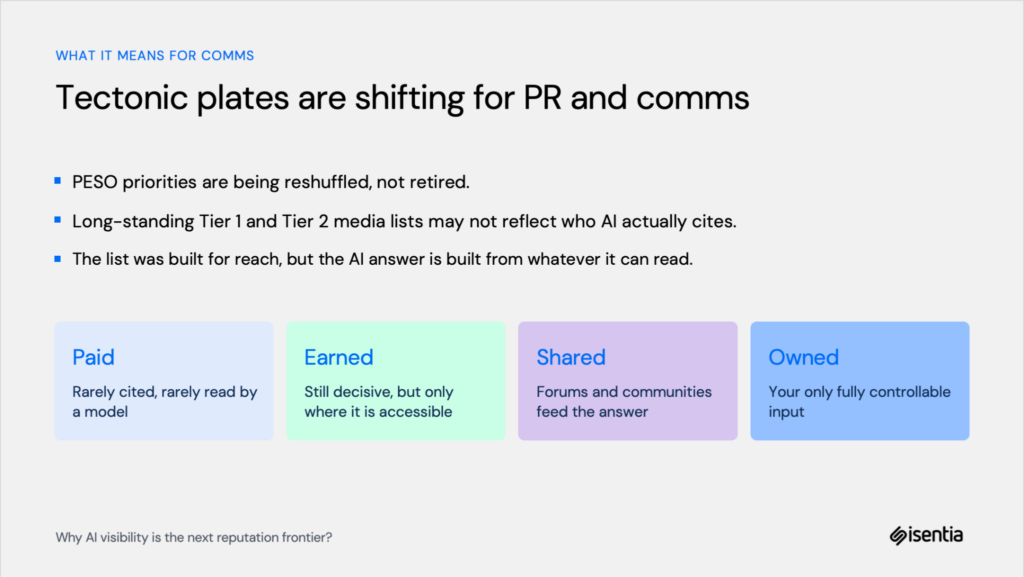
This also means reconsidering the PESO (paid, earned, shared and owned) strategy deployed by organisations since the way that LLMs access and prioritise them has changed. They prioritise brevity in content due to the high costs of GPUs and data centres. As a result, the shortest, clearest, and most trusted answers are favoured which benefits brands with strong reputations. Earned media remains important, but its influence now depends more on the credibility of the analyst than the platform. Shared content amplifies messages more than ever but is also where misinformation spreads fastest. Paid media is becoming more prominent in some models, though brands are still learning how this impacts visibility.
This shift requires media monitoring companies to evolve. Tracking mentions and sentiment across media channels has been central to media intelligence, but AI visibility has added a new dimension to this. This means monitoring not only what is said about an organisation, but also which sources AI models use when answering questions about that organisation, and assessing how current, authoritative, and consistent those sources are. This gives media monitoring organisations an opportunity to own what they’ve developed and also be thought leaders in this space. Stakeholders value the “so what” advice much more than just knowing “this is what is being said about you in the media”.
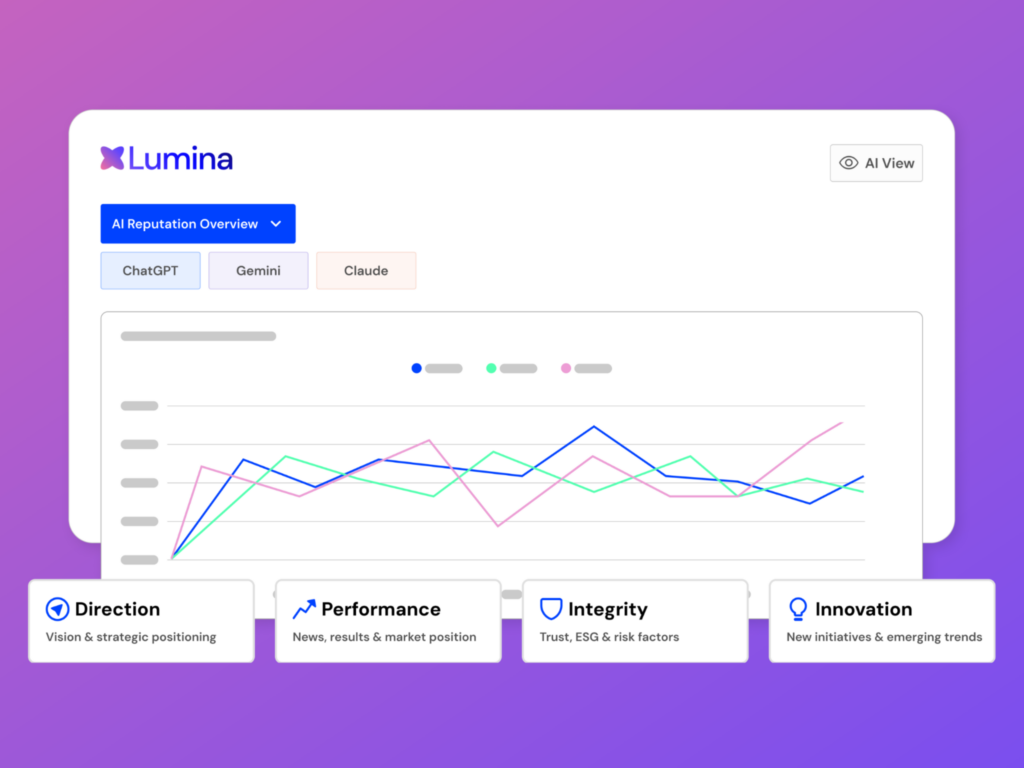
Lumina AI View addresses this by tracking which sources ChatGPT, Gemini, Claude, and other models cite when representing an organisation, benchmarks citations against competitors, identifies narrative shifts before they reach stakeholders, and regularly scores AI visibility against four reputation pillars: Direction, Performance, Integrity, and Innovation, These pillars have always supported reputation management, now applied to a largely unseen audience.
If you’re weighing up where a tool like this sits alongside the rest of your stack, our own comparison, Best AI Tools for PR & Comms Teams (2026), breaks down how AI-assisted coverage, measurement, crisis response and reporting tools stack up, Lumina included.
Because that’s really the mindset shift comms teams, and the firms advising them both need to make. As Takeo put it on the IABC APAC and Isentia webinar: “I fear that this is the mindset shift communications teams and their advisors must adopt. I fear that AIs will be your secondary, and if not, at least equal… audience in the future.” Beyond human visibility, reputation is about being accurately represented by the systems that mediate access to your audience, which is an additional layer that cannot be trivialised anymore.
Want to see which sources are shaping how AI describes your organisation? Get in touch about Lumina AI View.

Content Marketing Executive, APAC
Nikita Gundala manages brand marketing and thought leadership for Pulsar Group across the SEA and ANZ markets. With over three years of first-hand experience in the influencer marketing and PR industries, she specializes in translating real-time insights and audience intelligence into actionable content. Nikita holds a master’s in Marketing and Digital from ESSEC Business School, Singapore. She has contributed to the wider industry conversation by co-authoring articles and reports for The Business Times Marketing Interactive.
Get in touch or request a demo.