
Blog post
December 20, 2025

How social listening tools assist influencer ROI measurement in the Philippines

The Philippines has the world’s highest rate of influencer followership. According to DataReportal’s Digital 2025 report, 44.9 percent of Filipino internet users follow influencers — the highest rate globally. Combined with 8.36 platforms used per month and nearly five hours of daily social media time (Meltwater, 2026), the Philippines represents an influencer marketing ecosystem of unmatched intensity. But measuring the return on influencer investment remains a persistent challenge. Reach and engagement metrics tell you how many people saw the content. They do not tell you whether it changed purchase behaviour, shifted brand perception, or drove meaningful business outcomes.

Why Standard Influencer Metrics Fail in the Philippines

The conventional influencer measurement stack — reach, impressions, engagement rate, cost per engagement — was designed for markets where influencer content operates within a single platform ecosystem. The Philippines does not work that way.

A Filipino influencer’s TikTok video about a skincare product generates views and likes on TikTok. But the real impact unfolds across platforms: viewers share the video to Facebook Messenger — used by over 90 percent of Filipino internet users (Meltwater, 2026) — in groups discussing beauty products. They discuss it in Viber communities. They search for the product on Shopee and Lazada. They share purchase experiences through WhatsApp and text messaging.

The influencer’s content acts as a catalyst for cross-platform conversation that standard metrics cannot track. An influencer with moderate TikTok engagement may drive significant Messenger sharing and e-commerce conversion that never appears in their platform analytics.

48.3 percent of Filipino internet users watch vlogs weekly — the highest rate in the region. This creates a long-tail content dynamic where influencer videos continue driving purchase decisions weeks after posting, through saves, shares, and algorithmic resurfacing. Standard campaign measurement that stops counting at the campaign end date misses this extended impact.

Beyond Reach: A Social Listening Approach to Influencer ROI

Social listening tools offer a fundamentally different approach to influencer measurement. Rather than measuring what the influencer’s content achieved on a single platform, social listening measures the total conversation impact across all platforms.

The methodology involves three measurement layers.

  • First, conversation lift — measuring the increase in brand mentions, search volume, and discussion across all monitored platforms during and after influencer campaigns. This captures the cross-platform amplification that standard metrics miss.
  • Second, sentiment shift — tracking whether influencer content moved brand sentiment in a positive direction among the target audience. A high-reach campaign that does not shift sentiment has generated awareness without influence.
  • Third, narrative adoption — measuring whether the influencer’s key messages appear in organic consumer conversations. If an influencer positions a product as “affordable luxury” and subsequent consumer discussions adopt that framing, the narrative has been successfully planted.

Isentia’s Influencer Measurement Capabilities

Isentia’s sister company Pulsar applies influencer ROI measurement through its audience intelligence and social listening capabilities. Pulsar TRAC identifies the audiences engaging with any tracked conversation — their demographics, interests, other brands they discuss, and platform behaviour patterns. When applied to influencer campaigns, this audience-level analysis reveals whether the campaign reached the intended target or missed the mark.

Pulsar’s Narratives AI tracks how influencer-originated messages flow through public conversation, showing whether key messages are adopted, modified, or rejected by the broader audience. For brands investing significant budgets in Filipino influencer partnerships, this narrative tracking provides evidence of actual influence rather than assumed impact.

Isentia’s cross-channel monitoring covers the platforms where Filipino consumers discuss products — not just Instagram and TikTok, but also Forums (32.4 percent monthly active according to GWI), Facebook groups, and online forums. The Manila-based analyst team verifies sentiment accuracy in Filipino English and Taglish (Tagalog-English code-switching).

Building an Influencer Measurement Framework

For Philippine market teams, the recommended framework ties influencer measurement to business objectives rather than vanity metrics.

Define pre-campaign baselines for brand mention volume, sentiment, share of voice, and narrative positioning across all monitored platforms. Run the influencer campaign. Measure post-campaign changes against baselines. Attribute the delta to influencer activity after controlling for other marketing variables.

The measurement period should extend at least 2-4 weeks beyond the campaign end to capture the long-tail effect of content sharing and algorithmic resurfacing that characterises Filipino social media consumption.

Frequently Asked Questions

Q1. Why is the Philippines the most important market for influencer measurement?

According to DataReportal, 44.9 percent of Filipinos follow influencers — the highest rate globally. Combined with 8.36 platforms per month and nearly five hours of daily social media use, the Philippines represents unmatched influencer engagement intensity.

Q2. How does social listening improve influencer ROI measurement?

Social listening captures cross-platform conversation impact that single-platform metrics miss. It measures conversation lift, sentiment shift, and narrative adoption — outcomes that reflect actual influence rather than content exposure.

Q3. What platforms should be included in Filipino influencer measurement?

TikTok, Instagram, Facebook, Messenger groups, YouTube, and e-commerce platforms (Shopee, Lazada). Messenger, used by over 90 percent of Filipino internet users, is a critical dark social channel for content sharing.


Learn More

Get to Know Pulsar — Isentia’s sister company Pulsar is an audience intelligence and social listening platform.

Isentia Social Listening for Philippines — Cross-platform Filipino coverage.

Isentia Media Monitoring Solutions — Multi-channel monitoring.

DataReportal Digital 2025 Philippines — Influencer engagement data.

About Isentia — Manila analyst team.

Book a Demo with Isentia — Discuss influencer measurement.

Share

Similar articles

object(WP_Post)#11900 (24) { ["ID"]=> int(47963) ["post_author"]=> string(2) "75" ["post_date"]=> string(19) "2026-06-03 02:01:58" ["post_date_gmt"]=> string(19) "2026-06-03 02:01:58" ["post_content"]=> string(5651) "

There is a new frontier where public perception is shaped: Large Language Models. Right now, LLMs are answering critical questions about your organisation. What are they saying? And more importantly, which sources are shaping those answers?

To navigate this landscape, public relations professionals don't need generic tools, but rather technology that speaks their language, and addresses the realities of a changed media and informational landscape.

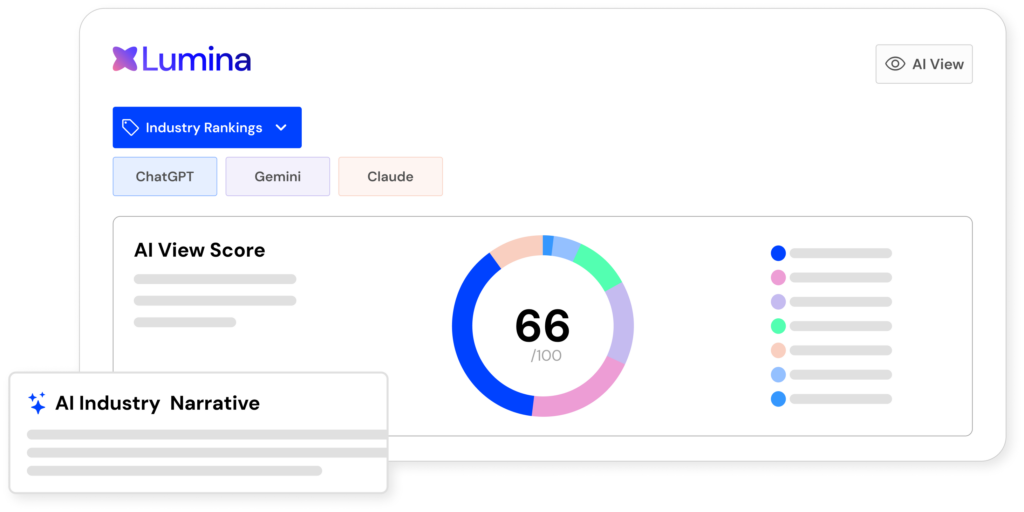
That is why we're unveiling Lumina AI View, the latest addition to our intelligent suite of AI tools from Isentia. Trained specifically on the workflows and challenges of modern PR & communications, Lumina AI View helps you understand exactly what AI knows about you, and how it learned it.

A new standard for AI visibility

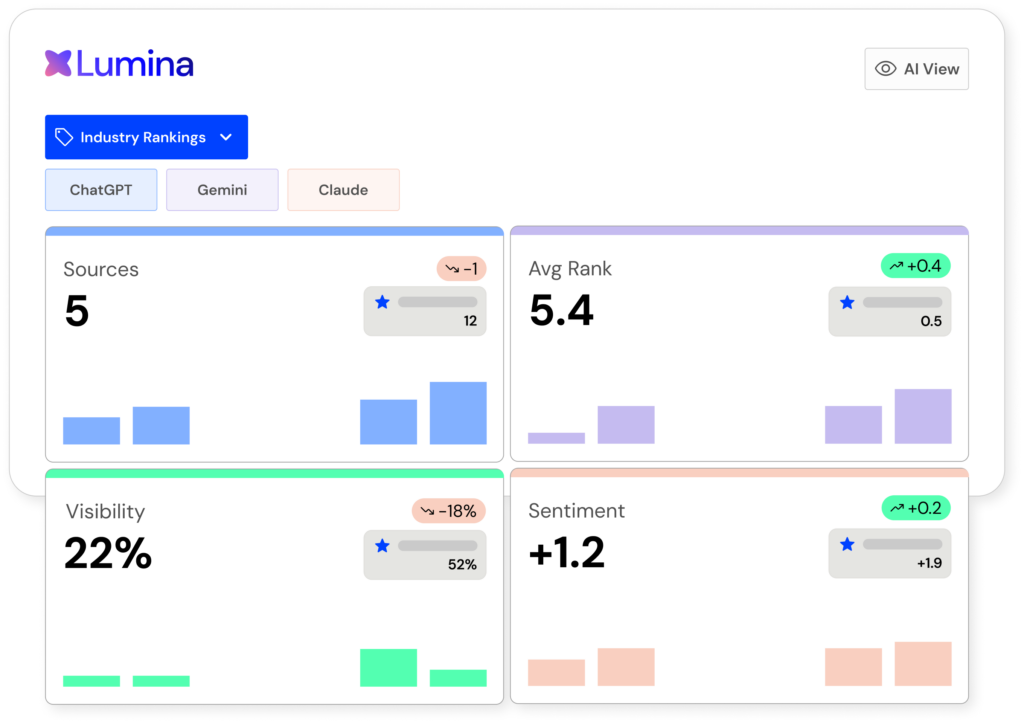
AI View tracks your citation strength and source quality alongside those of your competitors, giving you a clear view of where you hold authority and where you have gaps.

Lumina AI View maps your AI reputation from the ground up, allowing you to:

  • See which sources matter: When tools such as ChatGPT or Gemini discuss your organisation, which outlets do they cite? Track your source footprint over time and view the impact of key target media on how you’re discussed. We measure your citation strength and source quality alongside those of competitors, giving you a clear view of where you have authority and where you have gaps.
  • Gain industry-specific insight: Your competitors get cited from Financial Times and Bloomberg. You get cited on Reddit. Each brings opportunity – and risk. Discover how you measure up against industry standards, and target the sources that actually influence how AI represents you.
  • Catch narrative shifts early: AI responses change when new sources appear, sentiment shifts, or old controversies resurface. Get alerts when citation patterns change suddenly, before they impact the way you’re perceived by stakeholders.

Measure your progress: From media monitoring to full media intelligence

Lumina AI View is built on the principle that insights get stronger with repeated measurement. To help you maintain a clear view of your reputation, our proprietary scoring system provides regular updates that show you:

  • Evolving trends in how sources cite your organisation
  • Competitive standing and benchmark metrics
  • Where models differ in information presented, and sources cited 

Whether you run it weekly, on-demand, or whenever you need a check-in, patterns will emerge, trends will become clear, and you will build a baseline that makes any sudden narrative changes both comprehensible and the prerequisite to action.

Lumina AI View is part of Lumina AI, a comprehensive suite of AI tools built specifically for communicators. Our Lumina suite evolves traditional media monitoring into narrative intelligence, enabling you to truly understand how perceptions form, evolve, and impact your reputation.


Get in touch to register your interest and see what Lumina AI View can do for you.

" ["post_title"]=> string(66) "Introducing Lumina AI View: AI Visibility Built for PR & Comms" ["post_excerpt"]=> string(158) "Lumina AI View, the latest in Isentia's AI suite, is trained on PR & comms workflows to help you understand what AI knows about you — and how it learned it." ["post_status"]=> string(7) "publish" ["comment_status"]=> string(4) "open" ["ping_status"]=> string(4) "open" ["post_password"]=> string(0) "" ["post_name"]=> string(59) "introducing-lumina-ai-view-ai-visibility-built-for-pr-comms" ["to_ping"]=> string(0) "" ["pinged"]=> string(0) "" ["post_modified"]=> string(19) "2026-06-04 04:13:37" ["post_modified_gmt"]=> string(19) "2026-06-04 04:13:37" ["post_content_filtered"]=> string(0) "" ["post_parent"]=> int(0) ["guid"]=> string(32) "https://www.isentia.com/?p=47963" ["menu_order"]=> int(0) ["post_type"]=> string(4) "post" ["post_mime_type"]=> string(0) "" ["comment_count"]=> string(1) "0" ["filter"]=> string(3) "raw" }
Blog
Introducing Lumina AI View: AI Visibility Built for PR & Comms

Lumina AI View, the latest in Isentia’s AI suite, is trained on PR & comms workflows to help you understand what AI knows about you — and how it learned it.

object(WP_Post)#8871 (24) { ["ID"]=> int(47943) ["post_author"]=> string(2) "75" ["post_date"]=> string(19) "2026-05-20 04:07:51" ["post_date_gmt"]=> string(19) "2026-05-20 04:07:51" ["post_content"]=> string(13873) "

Why PR and comms teams need to take LLM visibility seriously — and what to do about it

The next time a journalist, investor or potential customer wants to know about your organisation, it’s now increasingly likely they won’t Google you. They'll ask an AI.

They'll type a question into ChatGPT, Claude or Gemini, something like "Who are the leading renewable energy companies in Australia?" or "What's the best PR agency for healthcare in Singapore?" and the AI will give them an answer. The question is whether your own organisation shows up in that answer.

The implications are significant for communications professionals, whether they’re in the agency-side working with clients or in-house managing a brand. The rules of reputation and discovery are being rewritten, and there’s a new kind of playbook that we all need to adapt to. That’s what’s going to take us forward.

The shift no one saw coming, but perhaps should have

For decades, earned media has been the backbone of credibility. A strong piece in a respected outlet signalled trust, authority and relevance. This hasn't particularly changed, but the way that coverage gets used has.

Large language models (LLMs) are trained on vast amounts of publicly available content - news articles, company websites, industry reports, social media, expert commentary. When someone asks an AI a question, it synthesises all of that material into a single answer. If an organisation has a strong, consistent, well-sourced presence across those channels, it is more likely to show up. If it doesn't, it becomes invisible and is absent from the conversation entirely.

Gartner's latest predictions for Chief Communications Officers underline how serious this shift is. They forecast that as LLMs increasingly replace traditional search, PR and earned media budgets will double by 2027. What they say is that this is a communications challenge, one that requires PR expertise to build trust, secure quality coverage, and maintain consistent messaging across stakeholders.

Their research also predicts that by 2029, 45% of CCOs will be using narrative intelligence technologies to monitor reputation amid rising disinformation, a recognition that the old keyword-based approach to media monitoring simply can't keep up with the way stories now form, spread and multiply. 

The AI-generated content loop and why it matters

One of the less obvious risks in this new landscape is what happens when AI starts feeding on itself.

Catherine Arrow, Executive Director of the PR Knowledge Hub, raised this point during Isentia's recent Inside the AI Shift webinar. As she explained, "AI can identify and interpret some publicly available commentary. The difficulty is that we have to be careful about what it is actually reading. You can already see this in AI overviews where the system may refer to online discussion without digging deeply enough into whether the original sources are genuine, reliable or themselves AI-generated. So we end up with AI nested inside AI, nested inside AI."

That creates a real problem for anyone in communications. If the content landscape is increasingly populated by AI-generated material which is optimised to be found by algorithms rather than to inform real people, then the signals that LLMs rely on to build their answers become less trustworthy. Human judgement, original thinking and genuine expertise become harder for these systems to find, precisely because they're being drowned out by content that was designed to game them.

Catherine puts it simply, "People can become immune to this kind of content because it does not sound like the way we speak to each other, nor does it reflect the way genuine relationships are built. Then, when conflict or outrage is layered on top, the environment becomes even harder to interpret."

For PR and comms teams, it's not enough to produce more content. The right content needs to be produced, one that is original, expert-led, and well-placed in the channels and formats that LLMs are most likely to surface.

What this means in practice

So what does it actually look like to build LLM visibility into your communications strategy? It starts with the fundamentals, but applied with new intent:

  • Expert commentary placed in credible publications. 
  • Thought leadership that's genuinely distinctive, not a rehash of what everyone else is saying. 
  • Consistent messaging across channels. 
  • Media coverage that's authoritative enough for an AI system to treat it as a reliable source.

This is where the gap between media monitoring and media intelligence becomes critical. Monitoring tells you what's been said. Intelligence tells you how stories are forming, which perspectives are shaping them, and where your organisation sits within those narratives — including how AI systems are representing you.

Dr Nici Sweaney, Founder and Director of AI Her Way, made this distinction sharply during Isentia's AI as a New Stakeholder webinar. "What will set people apart, and what AI cannot replicate is the human lens. The judgment, the relationships, the institutional knowledge, the strategic read of a room. The organisations that lean into supporting their people to harness these tools, rather than just deploying the tools, will be the ones best placed.”

That's an important framing. The answer to AI disruption is to get clear on what only humans can do and then make sure the tools we’re using actually support that.

Staying credible when the noise is deafening

There's a temptation, when faced with a challenge like this, to throw more content at the problem – more posts, more articles, more releases. But Catherine Arrow points out the risks of that approach.

"Maintaining credibility and authenticity means being yourself and not allowing AI to suffocate your identity. That will become harder to do as digital twins, synthetic voices and other tools make it easier for organisations to use it as a mask. The real challenge is not so much maintaining credibility. It is about maintaining humanity, empathy, kindness and a genuine wish to connect with others beyond the AI-intermediated space.”

That advice matters just as much for organisations as it does for individuals. Brands that let AI do their thinking, generating bland, interchangeable content at scale, will find themselves blending into the noise rather than cutting through it. The brands that show up in LLM answers will be the ones with a clear, consistent, well-evidenced point of view.

Dr Nici Sweaney reinforced this from the operational side. "Ethical use is not about not using AI. It’s about using it with intention, honesty, and a clear sense of what good looks like on the other side.”
She was also direct about the risks of rushing in, "Don’t add new shiny AI projects on top of already overloaded teams. That creates resentment, not buy-in. Start by solving the problems people already have."

The cultural dimension

There's another layer to this that often gets overlooked and that’s the cultural one.

Catherine Arrow raised important concerns about how different AI systems can distort or flatten cultural context. Many of the most widely used models are shaped by US language, commercial assumptions and social norms. Chinese models operate within a different political and cultural framework. For organisations working across the Asia-Pacific region, it directly affects how the brand, messaging and the market are understood and represented by AI.

"Different AI systems may distort cultural context by privileging dominant languages, simplifying complex meanings, mistranslating concepts, omitting local histories or reproducing the worldview of their developers and training environments. They may flatten culture by making everything sound the same.”

For communicators operating across diverse markets, this means paying close attention to where content sits, who produced it, and whether the AI systems the audiences are using can actually interpret it with the nuance it deserves.

Where Isentia's platform fits with its new toolkit for AI visibility

This is precisely the challenge that Isentia's Lumina suite was built to address. Lumina is an intelligent suite of AI tools trained on the language, workflows and realities of modern public relations and communications, designed to empower, not replace, the human element of communications strategy.

Isentia's Lumina AI View feature will allow organisations to track how their brand, competitors and key topics are described by leading LLMs, with auditable claims, citations and transparency with regards to the sources. It's the difference between wondering whether AI is getting your story right and actually being able to see for yourself. These aren't generic AI features bolted onto a monitoring tool. They're intelligence systems built for the way communicators actually work.

The bottom line

The communications landscape has shifted. AI isn't just a tool the team might use, it's a stakeholder in its own right, actively shaping how an organisation is discovered, understood and evaluated.

For PR and comms professionals, the priorities are to ensure experts, commentary and evidence are placed widely enough for LLMs to find them and include them in their answers. Intelligence is imperative and required to how narratives are forming across both traditional media and AI platforms. All of this needs to be done without losing the human credibility that makes communications worth paying attention to in the first place.

As Dr Nici Sweaney put it, "The people who get the most from AI aren’t the ones who use the most tools, they’re the ones who understand their work deeply enough to know exactly where AI can add the most leverage."

That's the opportunity. The question is whether we’re set up to take it.


To explore how Isentia's Lumina suite can help your team navigate AI visibility, get in touch or discover Lumina.

" ["post_title"]=> string(51) "If AI can't find you, neither can your stakeholders" ["post_excerpt"]=> string(140) "We explore why LLM visibility should be a priority for PR and comms teams — and why harnessing AI, not just deploying it, is what matters." ["post_status"]=> string(7) "publish" ["comment_status"]=> string(4) "open" ["ping_status"]=> string(4) "open" ["post_password"]=> string(0) "" ["post_name"]=> string(49) "if-ai-cant-find-you-neither-can-your-stakeholders" ["to_ping"]=> string(0) "" ["pinged"]=> string(0) "" ["post_modified"]=> string(19) "2026-05-20 04:07:57" ["post_modified_gmt"]=> string(19) "2026-05-20 04:07:57" ["post_content_filtered"]=> string(0) "" ["post_parent"]=> int(0) ["guid"]=> string(32) "https://www.isentia.com/?p=47943" ["menu_order"]=> int(0) ["post_type"]=> string(4) "post" ["post_mime_type"]=> string(0) "" ["comment_count"]=> string(1) "0" ["filter"]=> string(3) "raw" }
Blog
If AI can’t find you, neither can your stakeholders

We explore why LLM visibility should be a priority for PR and comms teams — and why harnessing AI, not just deploying it, is what matters.

Ready to get started?

Get in touch or request a demo.