Australia’s Infrastructure: Making Cities Resilient
Australia’s infrastructure and population are constantly growing and as well as being a resilient economy, the expectations of quality infrastructure and connectivity for a better quality of life are increasing. Infrastructure also provides the opportunity for leading companies to finance, construct, own and operate infrastructure assets.
The issue in Australia – most of the infrastructure required to be built are in complex cities and are in highly urbanised environments and with this comes significant environmental issues, planning issues and community issues. It also means that solutions to these problems are expensive and developers and governments are finding it difficult to fund the expensive infrastructure projects. The rise in discussions around future cities has increased by 175 per cent with conversations being had around the Australian government improving productivity and liveability of the nation’s largest cities as they grow over the next 30 years.
In this whitepaper we explore the various infrastructures within Australia including transport, water, energy and telecommunications to understand their current status, the effects each sector is having on the environment and analyse the role media plays.
Loren is an experienced marketing professional who translates data and insights using Isentia solutions into trends and research, bringing clients closer to the benefits of audience intelligence. Loren thrives on introducing the groundbreaking ways in which data and insights can help a brand or organisation, enabling them to exceed their strategic objectives and goals.
The early start of the bushfire season is being raised by the fire authorities as a serious concern. With another summer of record high temperatures still to come and no sign of the drought breaking, the bushfires have sparked the use of terms such as crisis, emergency, unprecedented and historic in the media. But bushfires in Queensland are not unusual and the subject of climate change being a contributor is also a hot topic.
In this blog, we delve deeper into these topics by analysing the media coverage around the Queensland bushfires and climate change.
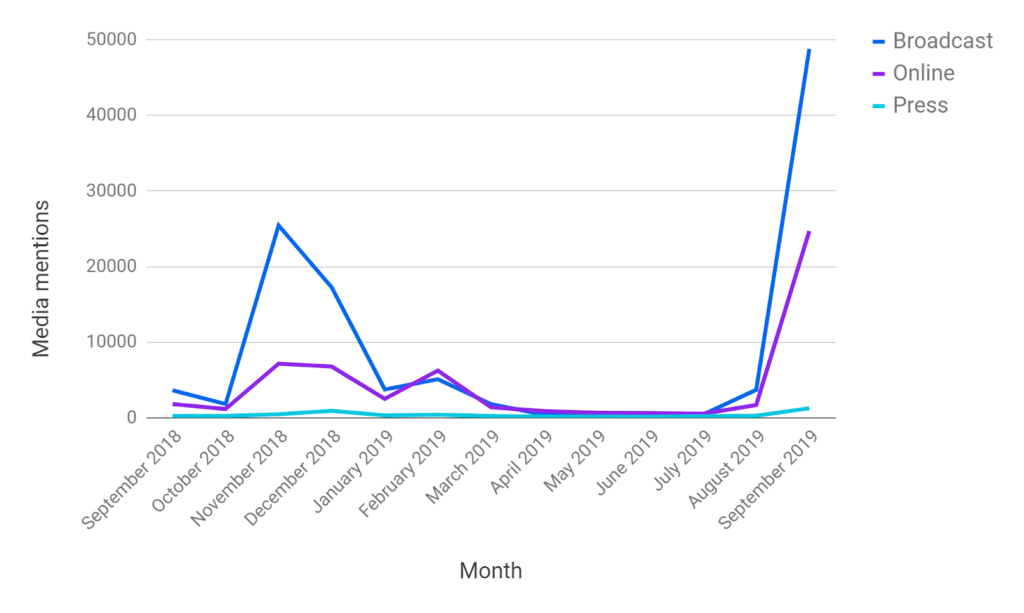
In the past year, “bushfire,” “Queensland” and related keywords returned close to 174,000 mentions.
Throughout November and December 2018, we saw a spike in mentions predominantly across Broadcast. During this time, the media communicated great concern over an early start to the fire season and the lack of rain that was expected in the coming weeks and months.
Interestingly, the number of mentions from these months combined equates to less than the number of mentions that have happened in September 2019. These figures tell a story with emphasis being placed on the severity of the bushfires, the surrounding issues around climate change and the government’s response.
Media mentions for “bushfires," Queensland” and related terms from September 2018 to September 2019
The current landscape
Queensland has been facing it’s most catastrophic bushfire season in recorded history - with more than fifty bushfires burning at one time. The Bureau of Meteorology’s data on climate change shows that rising temperatures have been evident since the beginning of the 20th century and have been gaining momentum with rising carbon emissions year on year.
This year, a warming climate has contributed to the early fire season. With an unusually dry winter, very little rainfall and above average temperatures, weather conditions like these have not been seen so early in Spring. Vegetation such as rainforests are now flammable thanks to a drier and hotter climate. These conditions are also putting more people at risk with health issues as well as fires threatening people's homes.
The drought that’s now across much of the eastern seaboard has set the scene for more frequent and intense fires this summer. Currently, approximately 98 per cent of New South Wales and 65 per cent of Queensland are drought affected. Many towns in regional New South Wales and southern Queensland are having to get water supplies transported to them to avoid water shortages.
The warming climate has also increased the possibility of bushfires burning in different states simultaneously. Due to this, the paradigm to a strategic firefighting plan is required whereby states will need to resource their own fires as the resources aren’t available to lend a helping hand.
The economic effects
Despite the numerous bushfires that have happened in recent weeks, politicians have been insisting that climate change isn’t relevant to this year’s fire season.
Climate scientists advise this is a dangerous approach and Queensland's summer of disasters is evidence that climate change will take an economic toll on taxpayers.
Bushfires and floods have been ravaging Queensland over the past three months and if natural disasters continue, the State Budget is estimated to take a hit of at least $1.5b.
The government has made disaster recovery payments available for eligible residents, where up to 13 weeks of income assistance can be claimed for those affected by natural disasters.
Global climate strike
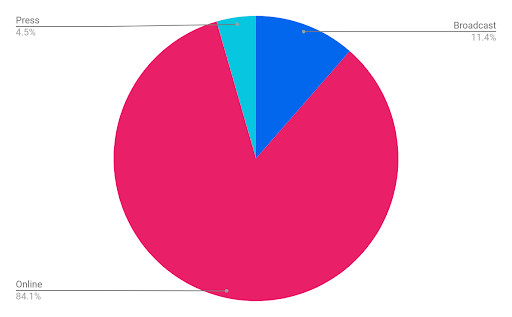
Strikes for climate change have been prominent on a global scale with ‘Strike for Climate’ rallies that have taken place in multiple cities around the world. The first rallies took place Friday 20th September 2019 and continued until Friday 27th September. During the week period, there were over 16,000 media mentions on the subject with 84 per cent of these mentions made online. These numbers depict just how prominent the subject of climate change is in the media.
In the below, we see the dispersion of mentions about the climate change strikes across Broadcast, Print and Online news.
Media mentions for “Global Climate Strike” and related terms from September 20 - September 27 2019
These strikes were brought on after Swedish teenage activist, Greta Thunberg started to raise global awareness of the risks posed by climate change. She wanted to put pressure on politicians to be held accountable for their lack of action on the climate crisis.
Within Australia, hundreds of thousands of school students walked out of classrooms and rallied for action to be taken. The September strikes followed strikes that were held in March this year where over 150,000 people marched in Australia and 1.5million world wide.
Australia was one of the first countries in the world to join the global climate strike protests, with hundreds of thousands rallying in countries around the world. In capital cities around Australia, people prepared signs and chanted slogans in favour of swift climate action.
In Australia protesters want the Federal Government to commit to:
No new coal, oil or gas projects
100 per cent renewable energy generation and exports by 2030
Funding for "a just transition and job creation for all fossil-fuel industry workers and communities"
Looking to the future, it will be interesting to see how government bodies around the world respond to the rallies, to the changing climate and the effect they are having on the environment and community.
If you would like to learn more about the media coverage about this topic or anything media intelligence related, get in touch with us today.
"
["post_title"]=>
string(48) "The burning issues: bushfires and climate change"
["post_excerpt"]=>
string(313) "The early start of the bushfire season is being raised by fire authorities as a serious concern. Predicted to be another summer of record high temperatures with no sign of the drought breaking, their presence have sparked concern within the media and ignited debates over the role climate change plays with fires."
["post_status"]=>
string(7) "publish"
["comment_status"]=>
string(4) "open"
["ping_status"]=>
string(4) "open"
["post_password"]=>
string(0) ""
["post_name"]=>
string(46) "the-burning-issue-bushfires-and-climate-change"
["to_ping"]=>
string(0) ""
["pinged"]=>
string(0) ""
["post_modified"]=>
string(19) "2020-01-23 06:14:45"
["post_modified_gmt"]=>
string(19) "2020-01-23 06:14:45"
["post_content_filtered"]=>
string(0) ""
["post_parent"]=>
int(0)
["guid"]=>
string(31) "https://www.isentia.com/?p=3800"
["menu_order"]=>
int(0)
["post_type"]=>
string(4) "post"
["post_mime_type"]=>
string(0) ""
["comment_count"]=>
string(1) "0"
["filter"]=>
string(3) "raw"
}
Blog
The burning issues: bushfires and climate change
The early start of the bushfire season is being raised by fire authorities as a serious concern. Predicted to be another summer of record high temperatures with no sign of the drought breaking, their presence have sparked concern within the media and ignited debates over the role climate change plays with fires.
Audiences have quietly moved from giving leaders — CEOs and operational leaders — the benefit of the doubt to actively scrutinising them. Smarter communication leaders have realised that content with proof and evidence, over anything performative, is much more valued by audiences.
Our latest report analyses how top communications leaders are discussed by audiences online and reveals what actually earns trust and reputation in an age of scrutiny.
In the report, we unpack how:
Comms leaders' online presence is affected because of increased audience scrutiny
Operational leaders out-communicate CEOs and audiences read them as more authentic
Proof, people, and place are prioritised in comms leaders' posts — that in turn deepens trust the most
Isentia’s AI-built suite of tools can help uncover the right story for the comms leader of today
To access the full report, fill in the form below:
"
["post_title"]=>
string(50) "How can leaders communicate in an age of scrutiny?"
["post_excerpt"]=>
string(177) "This report analyses how comms leaders are constantly adapting their content online as a result of increased audience scrutiny - in order to earn trust and maintain reputation. "
["post_status"]=>
string(7) "publish"
["comment_status"]=>
string(4) "open"
["ping_status"]=>
string(4) "open"
["post_password"]=>
string(0) ""
["post_name"]=>
string(49) "how-can-leaders-communicate-in-an-age-of-scrutiny"
["to_ping"]=>
string(0) ""
["pinged"]=>
string(0) ""
["post_modified"]=>
string(19) "2026-07-15 03:14:40"
["post_modified_gmt"]=>
string(19) "2026-07-15 03:14:40"
["post_content_filtered"]=>
string(0) ""
["post_parent"]=>
int(0)
["guid"]=>
string(32) "https://www.isentia.com/?p=48566"
["menu_order"]=>
int(0)
["post_type"]=>
string(4) "post"
["post_mime_type"]=>
string(0) ""
["comment_count"]=>
string(1) "0"
["filter"]=>
string(3) "raw"
}
Blog
How can leaders communicate in an age of scrutiny?
This report analyses how comms leaders are constantly adapting their content online as a result of increased audience scrutiny – in order to earn trust and maintain reputation.
There is a new frontier where public perception is shaped: Large Language Models. Right now, LLMs are answering critical questions about your organisation. What are they saying? And more importantly, which sources are shaping those answers?
To navigate this landscape, public relations professionals don't need generic tools, but rather technology that speaks their language, and addresses the realities of a changed media and informational landscape.
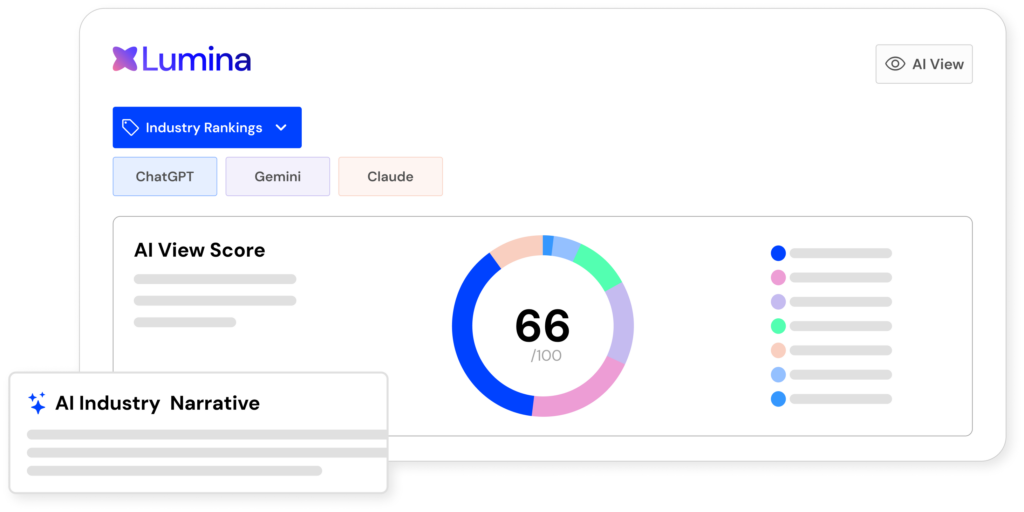
That is why we're unveiling Lumina AI View, the latest addition to our intelligent suite of AI tools from Isentia. Trained specifically on the workflows and challenges of modern PR & communications, Lumina AI View helps you understand exactly what AI knows about you, and how it learned it.
A new standard for AI visibility
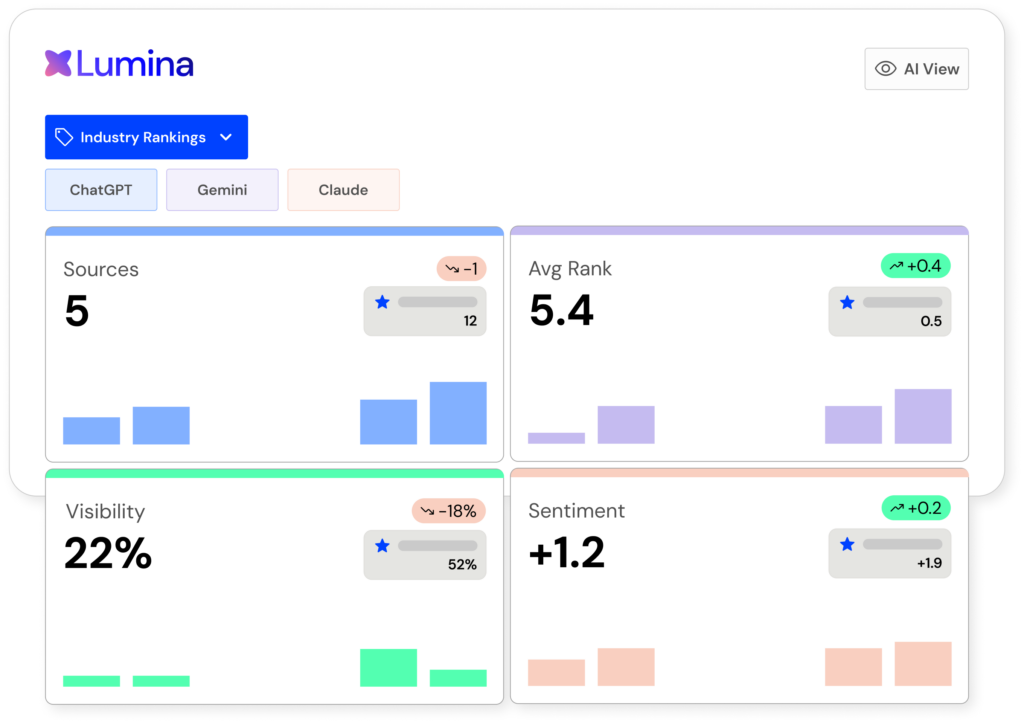
AI View tracks your citation strength and source quality alongside those of your competitors, giving you a clear view of where you hold authority and where you have gaps.
Lumina AI View maps your AI reputation from the ground up, allowing you to:
See which sources matter: When tools such as ChatGPT or Gemini discuss your organisation, which outlets do they cite? Track your source footprint over time and view the impact of key target media on how you’re discussed. We measure your citation strength and source quality alongside those of competitors, giving you a clear view of where you have authority and where you have gaps.
Gain industry-specific insight: Your competitors get cited from Financial Times and Bloomberg. You get cited on Reddit. Each brings opportunity – and risk. Discover how you measure up against industry standards, and target the sources that actually influence how AI represents you.
Catch narrative shifts early: AI responses change when new sources appear, sentiment shifts, or old controversies resurface. Get alerts when citation patterns change suddenly, before they impact the way you’re perceived by stakeholders.
Measure your progress: From media monitoring to full media intelligence
Lumina AI View is built on the principle that insights get stronger with repeated measurement. To help you maintain a clear view of your reputation, our proprietary scoring system provides regular updates that show you:
Evolving trends in how sources cite your organisation
Competitive standing and benchmark metrics
Where models differ in information presented, and sources cited
Whether you run it weekly, on-demand, or whenever you need a check-in, patterns will emerge, trends will become clear, and you will build a baseline that makes any sudden narrative changes both comprehensible and the prerequisite to action.
Lumina AI View is part of Lumina AI, a comprehensive suite of AI tools built specifically for communicators. Our Lumina suite evolves traditional media monitoring into narrative intelligence, enabling you to truly understand how perceptions form, evolve, and impact your reputation.
Get in touch to register your interest and see what Lumina AI View can do for you.
"
["post_title"]=>
string(66) "Introducing Lumina AI View: AI Visibility Built for PR & Comms"
["post_excerpt"]=>
string(158) "Lumina AI View, the latest in Isentia's AI suite, is trained on PR & comms workflows to help you understand what AI knows about you — and how it learned it."
["post_status"]=>
string(7) "publish"
["comment_status"]=>
string(4) "open"
["ping_status"]=>
string(4) "open"
["post_password"]=>
string(0) ""
["post_name"]=>
string(59) "introducing-lumina-ai-view-ai-visibility-built-for-pr-comms"
["to_ping"]=>
string(0) ""
["pinged"]=>
string(0) ""
["post_modified"]=>
string(19) "2026-07-15 03:12:57"
["post_modified_gmt"]=>
string(19) "2026-07-15 03:12:57"
["post_content_filtered"]=>
string(0) ""
["post_parent"]=>
int(0)
["guid"]=>
string(32) "https://www.isentia.com/?p=47963"
["menu_order"]=>
int(0)
["post_type"]=>
string(4) "post"
["post_mime_type"]=>
string(0) ""
["comment_count"]=>
string(1) "0"
["filter"]=>
string(3) "raw"
}
Blog
Introducing Lumina AI View: AI Visibility Built for PR & Comms
Lumina AI View, the latest in Isentia’s AI suite, is trained on PR & comms workflows to help you understand what AI knows about you — and how it learned it.