Blog
My experience as an Isentia Intern, Nicole
Interning at Isentia was enriching and fulfilling
Worry, fear and second guessing are everywhere. It’s hard to say if it’s at an all-time high or if it just feels like it with the rise of fake news, social media amplification and the proliferation of stories that keep our minds hunting for the truth. Whatever the reason, we seem to be entering an age where there are no breaks or breathers for our consciousness to just stop and focus on what we can discern as truth, or measure with certainty. We are knee-deep in thoughts and worry, not just between 9-5pm, but now 24/7 and 365 days a year – there is noise all around us.
Of course, there is the other side of the coin that says all this complexity has only made us clearer about our collective want for simplicity. We crave confidence, feelings of clarity, the ability to see a path, and to pinpoint the underlying message before we try to forecast the future. With books like ‘It’s Even Worse Than You Think: What the Trump Administration Is Doing to America’ by David Cay Johnston on one side and ‘The Subtle Art of Not Giving a F*ck’ by Mark Manson on the other, it’s easy to agree that 2017 may have been a little overwhelming.
However, if we spend too much time worrying, we leave no room for imagination. We waste energy on what might be, and not on what could be. Yes, the line is very similar, but it has a distinct difference. Imagination chooses to see possibilities – it’s best friends with innovation, and in a business context it can help you regain focus on your desired end goal.
This isn’t to say that you never think beyond the first step when developing your communication strategy, influence program or press release. This is crucial to ensure you’ve thought everything through thoroughly, but also should include things like risk register that will help you minimize risk, accept the things you can’t control, and make the decision to go ahead with the knowledge that you have done what you can to avoid late night worries.
Once you’re off it’s about having the tools in place to reduce worry and creating time for imagination or innovation. We like to fight worry with confidence. Our clients often use our Mediaportal Alerts or the Isentia App to alert them to news that needs attention, giving them peace of mind that someone else is on the case and the freedom to use their mind elsewhere. Or in some cases, it’s going to bed knowing that they will get an early morning daily brief of news coverage so that they can start the day with a clearer picture of what to priorities. Whatever’s going to give you back some confidence to let your mind refocus on producing more amazingness, do it.

Loren is an experienced marketing professional who translates data and insights using Isentia solutions into trends and research, bringing clients closer to the benefits of audience intelligence. Loren thrives on introducing the groundbreaking ways in which data and insights can help a brand or organisation, enabling them to exceed their strategic objectives and goals.
I had the pleasure of interning at Isentia, and my experience was nothing short of wonderful.
Having only just graduated from university, I could not help but feel slightly apprehensive starting my internship. However, from my very first day, I was greeted with friendly faces all around the office. Before I knew it, I was having morning coffees with my team mates, and soon my colleagues became familiar friends. I was pleasantly surprised by how inclusive and positive the culture proved to be.
My leader and colleagues from the marketing team were patient when it came to sharing knowledge and took the time to give me tasks that enhanced my learning experience.
During my internship I gained a deeper understanding how to execute a social media campaign. The planning that goes behind each campaign was so extensive and detailed, which I found intimidating initially, but nevertheless proved to be a great learning experience. For example, I was introduced to the concept of publishing paid advertisements, SEO and content creation. I was even given the chance to write blogs, a responsibility I took on-board with great enthusiasm.
My experience was not limited to marketing, I was fortunate enough to get involved with the client experience team, where I learnt more about Mediaportal and the amazing insight services Isentia provides. Time flew by quickly and I am very grateful to have had the opportunity to learn and grow.
Isentia isn’t all about working hard; it provides a holistic experience with various social activities and events so everyone has a chance to get to know each other better and learn about the different roles that help to make everything happen.
I am a strong believer in an enriching environment and Isentia has exceeded my expectations as a company, which teaches and places value in those who work there. The knowledge I have gained is invaluable, and I am thankful for the friendships I have made along the way.
I highly recommend working at Isentia and leave the team feeling much more confident of the future ahead - a big thanks to everyone who added to my experience.
Nicole C.
Sydney University, Marketing Graduate
Hi, my name is Allan. I am currently an undergraduate Mechanical Engineering and Business Management student studying at the University of Technology, Sydney – and have recently completed an internship with Isentia’s HR department.
First of all, you might be wondering what an Engineer is doing as a HR Intern – they don’t exactly fit together, do they? It was for this reason that I was initially hesitant in applying for the role as I didn’t know whether it would align with what I wanted out of my future, or whether I would be a good fit.
However, I soon learnt that being an intern with Isentia was a rewarding and interesting role, not to mention the fact that I was also surrounded by a group of incredibly supportive and knowledgeable people.
Having put myself forward as a mentee for the Australian Human Resources Institute’s mentoring program, I was inspired to learn more – an interest that ultimately led me to this exciting role.
Being an HR intern at Isentia wasn’t just any job – I took on this role because of the challenges it would provide to explore a different area of expertise. And yes, there were definitely new and interesting projects waiting to test my capabilities!
I do have to admit, I always seemed to find myself applying a bit of my engineering experience to the way I undertook each task, but I think this was an approach that helped bring a new and alternative perspective to the team. Who knows, maybe I taught them something new too?!
Along with the day-to-day operations of a HR department, I also gained skills across areas such as policy development, the intricacies of an intranet, and how a strategic HR function operates within a large business.
I would highly recommend Isentia for all future interns wishing to challenge themselves with something new and exciting – I certainly loved my time there and will carry that experience with me throughout my career!
Allan Soo
Student from the University of Technology, Sydney NSW
Combined Degree in Business Management (Hons) and Mechanical Engineering (Hons)
How would I sum up my experience as an intern for Isentia? Interesting, rewarding, challenging, and engaging.
Customers now have a powerful voice in sharing their experiences and with it, comes an expectation for actions to take place as a result of their feedback. In our digital world, customer data is nearly limitless – but people are much more than data. Their lives are defined by driving wants, needs and desires with an endless amount of choice and more often than not, brands believe they are delivering a better experience to these people than they actually are.
For those brands or organisations that choose to close the experience gap and embrace maximising the customer experience (CX), are finding themselves in a race to the top. By understanding what drives your customers’ decisions and the other influences that are out there, you can improve overall business growth and success over your competitors by making decisions based on customer intelligence.
Optimising the customer experience
A customer’s feedback has the power to transform your organisation through innovation and by improving their overall experience it can reduce customer churn. No matter where your organisation is in terms of CX maturity or customer feedback management, it is important to have access to customer insights in order to implement strategies to retain them.
Here are 3 steps to maximising the customer experience:
1. Illustrate the customer journey
The customer experience is made up of many customer journeys – the path customers take to solve a problem or need. The better experience your customers have with your brand or service, the more engaged they become, and the more opportunities become available. Having a great customer experience can also promote customer loyalty and as long you continuously optimise every element along their journey you will have satisfied customers.
Understanding the steps of your customers journey through various touchpoints, engagements and interactions with your brand will help to properly target your customers and understand their requirements and their pain points. Divide the customer journey into phases and pay close attention to each component by measuring the outcomes, collecting feedback and applying this feedback where possible. This will maximise customer success.
2. Drive value from experience data
Looking at both quantitative and qualitative approaches across various facets of your business must be considered to give a complete picture of your customer data. Looking at one source will only give an incomplete representation.
Customer experience is more than sending surveys and collecting feedback – having this information is important but it’s also about enriching and humanising the experience and using these unique experiences to create a positive customer centric culture. Sharing insights and developing processes to improve the customer experience and create business value allows the best experience possible. It also generates the maximum return on your efforts. Obtaining this information can be done through swapping knowledge between cross functional groups by identifying where there are gaps as well as what's working well. A team dashboard can also be created that specifically looks at different touchpoints and their success. Whatever data you do gather, turn it into actionable insights that directly improve your customers 'experience.
3. Learn from churn when it happens
Reducing customer churn is always sought after, however is quite difficult to achieve. Churn happens from poor experiences (both operational and strategic) and can have a drastic effect on your bottom line but it can also be helpful and insightful for your brand to learn and improve. For the customers you’re not able to prevent from churning, be sure to find out why they decided to move on. Conduct a short exit interview with the customer to understand their experiences and their pain points and take this knowledge to make improvements.
Fundamentally, it’s important to ensure a positive customer experience to encourage your customers to build brand loyalty. Customers hold the power in today’s business landscape which is why seeking feedback on their experiences is valuable to your brand or organisations' performance and reputation.
Happy customer, happy life.
" ["post_title"]=> string(39) "Experiences are the new differentiators" ["post_excerpt"]=> string(109) "Optimise your customers' journey across all touchpoints to achieve a holistic and customer-centric experience" ["post_status"]=> string(7) "publish" ["comment_status"]=> string(4) "open" ["ping_status"]=> string(4) "open" ["post_password"]=> string(0) "" ["post_name"]=> string(39) "experiences-are-the-new-differentiators" ["to_ping"]=> string(0) "" ["pinged"]=> string(0) "" ["post_modified"]=> string(19) "2019-07-25 01:11:07" ["post_modified_gmt"]=> string(19) "2019-07-25 01:11:07" ["post_content_filtered"]=> string(0) "" ["post_parent"]=> int(0) ["guid"]=> string(36) "https://isentia.wpengine.com/?p=1773" ["menu_order"]=> int(0) ["post_type"]=> string(4) "post" ["post_mime_type"]=> string(0) "" ["comment_count"]=> string(1) "0" ["filter"]=> string(3) "raw" }Optimise your customers’ journey across all touchpoints to achieve a holistic and customer-centric experience
Audiences are no longer finding information through traditional search engines that favour established news outlets. AI models now highlight highly relevant and contextual information to audiences to often include niche and regional publications alongside major news media. This change challenges the old media hierarchy around tiered publications and pushes organisations to reconsider how and where they need to show up to stay visible in an AI-first world.
Yes, organisations must focus on optimising their own content for LLMs, but will that always drastically increase the chances of AI models picking up your page? Probably not always. Smart strategy means targeting the specific publications your actual target audience reads — because those are the sources AI models retrieve when answering niche questions.
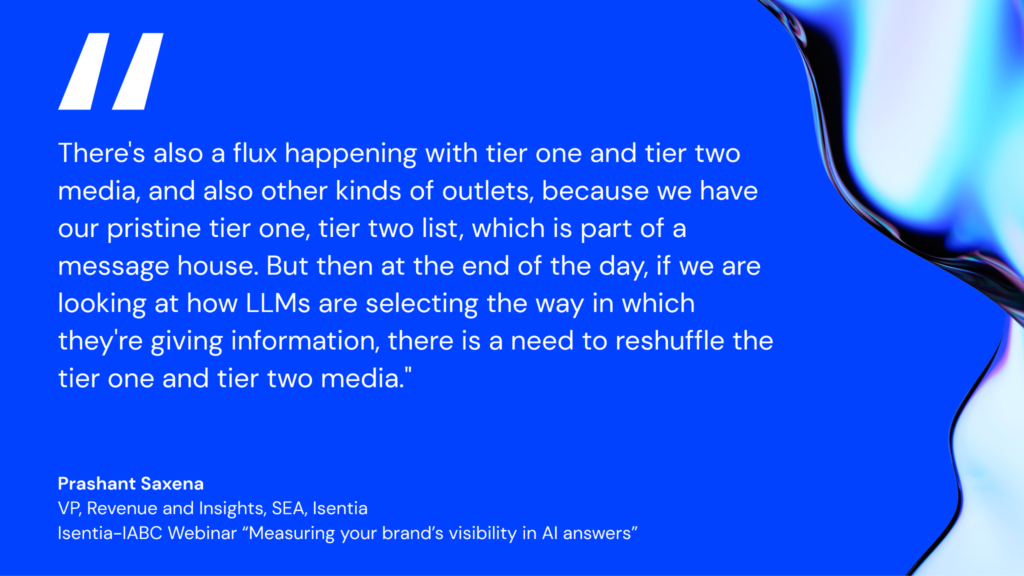
Generative Engine Optimization (GEO) is changing how brands approach online visibility. For years, traditional SEO meant focusing on your own site—optimising keywords, building backlinks, and improving on-page content. But AI models work differently. Instead of just using your website, these AI engines rely on trusted third-party sources to answer questions. This shift is taking place gradually, of course. LLMs increasingly source from earned media (where it is accessible) and even offsite links from trusted sites. Owned media is still where the organisation has maximum control of how it’s own content travels, but a pivotal strategy shift is needed to match what AI models are picking up and citing.
To succeed with AI search, comms professionals need to think more like a digital PR strategist than a SEO expert. The best way to stand out is by earning mentions, quotes, and citations in the external publications your audience—and the AI systems they use—trust most. This does not make a distinction between Tier 1 or Tier 2 media. If AI models are crawling sites that mention an organisation, but the organisation does not acknowledge or even know those sites are being prioritised by LLMs, they risk falling behind in being the right kind of visible.
To make this strategy work, looking beyond common metrics like traffic to the site or domain authority is not enough. Even a respected industry site will probably not influence AI answers as much if its content is behind a paywall or blocked from search engines. For AI visibility, accessibility to the site or page, structured data that can be crawled, and strong audience alignment are important. Since AI systems use both slow training cycles and fast real-time web searches (RAG), being featured on accessible, relevant niche sites helps an organisation show up accurately when models learn and when they search the web in real time.
According to Isentia's report How AI is destabilising trust and reputation amongst audiences, LLMs cite industry and trade publications about twice as often as traditional news sources. Company content and industry press make up over 60% of the share of voice LLMs use, while traditional news is twice as likely to generate negative sentiment. Thus, tier 1 outlets no longer automatically dominate AI-generated responses and may sometimes have the opposite effect.
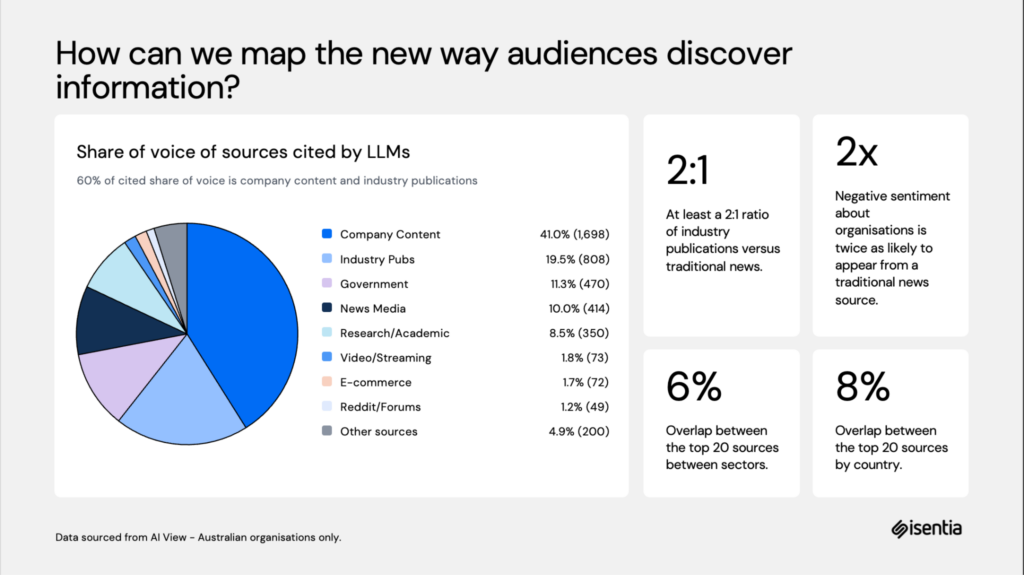
Two main factors are driving this shift in which media is picked up by LLMs:
Which type of media gets cited relies upon how AI models scan different pages. If these models are citing much more niche media outlets, we can assume that a lot of these pages that are consulted could be a part of very relevant Tier 2 media that ends up actually getting cited, and that we’re seeing more and more examples of in AI answers. At the IABC APAC and Isentia webinar on measuring brand visibility in AI answers, Prashant Saxena, Isentia's VP of Revenue and Insights for SEA, stated that in the search era "we would get sources on our page one, page two, mostly page one", and people would click through to form their own opinions. The combined click-through rate in that era was 35 to 40 per cent. Nowadays, he says, "it's just four to five per cent" — since LLMs provide a smooth, ready-made answer and "most of us aren't really checking the citations".
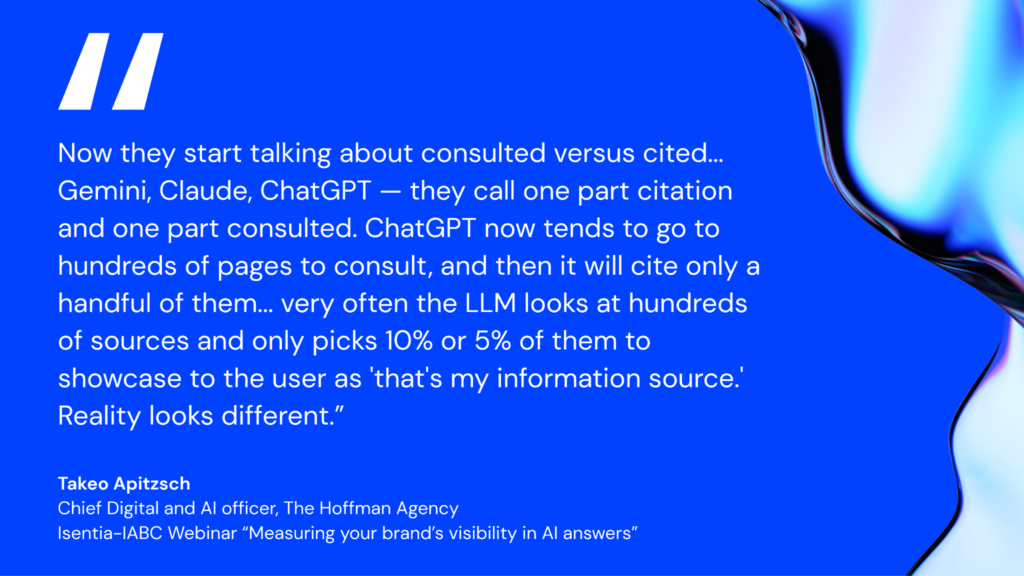
Communications teams now face a new consideration: the distinction between sources that are consulted and those that are cited. At the IABC APAC and Isentia webinar, Takeo Apitzsch, Hoffman Agency’s Chief Digital and AI Officer, explained that AI models scan hundreds of pages to generate an answer but cite only a select few to users. This means that the audience sees only a small, curated portion of the sources that actually influenced the AI's response and a lot of what actually shapes the AI answer doesn’t get visible credit. Therefore, organisations need to make sure they reach out to those publications that AI models can actually crawl and audiences trust the most.
We are seeing four practical shifts:
Structurally, as Ashley Knapp, Head of Brand and Corporate Affairs, East Asia at Schneider Electric noted during the webinar, these efforts can no longer remain siloed. Owned, earned, shared, and paid media have traditionally been managed by separate teams. Now, because of AI visibility, this required a unified approach, as models do not distinguish between departments but are first to detect inconsistencies.
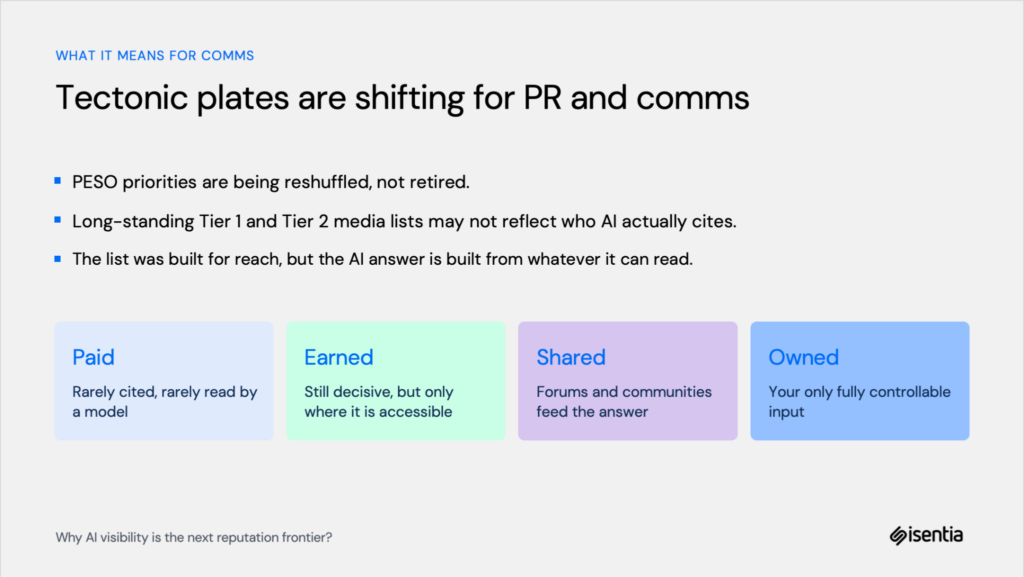
This also means reconsidering the PESO (paid, earned, shared and owned) strategy deployed by organisations since the way that LLMs access and prioritise them has changed. They prioritise brevity in content due to the high costs of GPUs and data centres. As a result, the shortest, clearest, and most trusted answers are favoured which benefits brands with strong reputations. Earned media remains important, but its influence now depends more on the credibility of the analyst than the platform. Shared content amplifies messages more than ever but is also where misinformation spreads fastest. Paid media is becoming more prominent in some models, though brands are still learning how this impacts visibility.
This shift requires media monitoring companies to evolve. Tracking mentions and sentiment across media channels has been central to media intelligence, but AI visibility has added a new dimension to this. This means monitoring not only what is said about an organisation, but also which sources AI models use when answering questions about that organisation, and assessing how current, authoritative, and consistent those sources are. This gives media monitoring organisations an opportunity to own what they’ve developed and also be thought leaders in this space. Stakeholders value the “so what” advice much more than just knowing “this is what is being said about you in the media”.
Lumina AI View addresses this by tracking which sources ChatGPT, Gemini, Claude, and other models cite when representing an organisation, benchmarks citations against competitors, identifies narrative shifts before they reach stakeholders, and regularly scores AI visibility against four reputation pillars: Direction, Performance, Integrity, and Innovation, These pillars have always supported reputation management, now applied to a largely unseen audience.
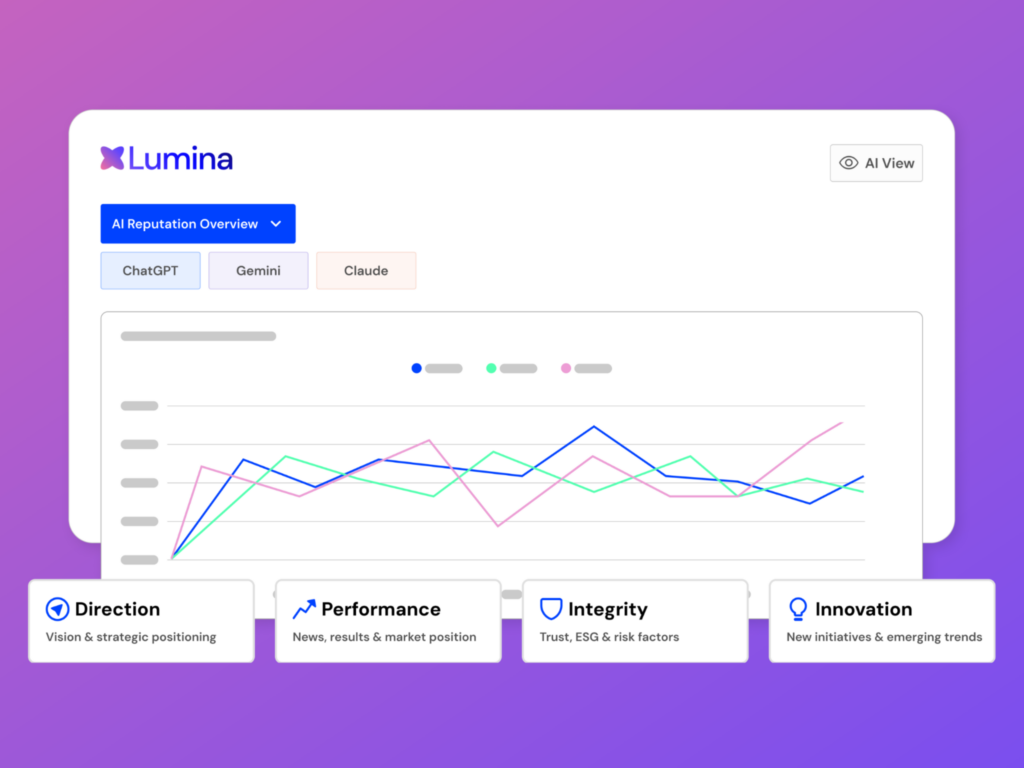
If you're weighing up where a tool like this sits alongside the rest of your stack, our own comparison, Best AI Tools for PR & Comms Teams (2026), breaks down how AI-assisted coverage, measurement, crisis response and reporting tools stack up, Lumina included.
Because that’s really the mindset shift comms teams, and the firms advising them both need to make. As Takeo put it on the IABC APAC and Isentia webinar: “I fear that this is the mindset shift communications teams and their advisors must adopt. I fear that AIs will be your secondary, and if not, at least equal… audience in the future.” Beyond human visibility, reputation is about being accurately represented by the systems that mediate access to your audience, which is an additional layer that cannot be trivialised anymore.
Want to see which sources are shaping how AI describes your organisation? Get in touch about Lumina AI View.
" ["post_title"]=> string(97) "How relevant is Tier 1 and Tier 2 media hierarchy in impacting how organisations show up in LLMs?" ["post_excerpt"]=> string(243) "The hierarchy that exists between Tier 1 & 2 publications today is being challenged. AI models are the new way audiences discover information requiring organisations to rethink how they show up to remain visible in an AI-mediated environment. " ["post_status"]=> string(7) "publish" ["comment_status"]=> string(4) "open" ["ping_status"]=> string(4) "open" ["post_password"]=> string(0) "" ["post_name"]=> string(96) "how-relevant-is-tier-1-and-tier-2-media-hierarchy-in-impacting-how-organisations-show-up-in-llms" ["to_ping"]=> string(0) "" ["pinged"]=> string(0) "" ["post_modified"]=> string(19) "2026-09-09 02:24:17" ["post_modified_gmt"]=> string(19) "2026-09-09 02:24:17" ["post_content_filtered"]=> string(0) "" ["post_parent"]=> int(0) ["guid"]=> string(32) "https://www.isentia.com/?p=49871" ["menu_order"]=> int(0) ["post_type"]=> string(4) "post" ["post_mime_type"]=> string(0) "" ["comment_count"]=> string(1) "0" ["filter"]=> string(3) "raw" }The hierarchy that exists between Tier 1 & 2 publications today is being challenged. AI models are the new way audiences discover information requiring organisations to rethink how they show up to remain visible in an AI-mediated environment.
Get in touch or request a demo.