Omni-channel marketing provides a seamless experience, regardless of channel or device. This allows customers to engage with a company in a physical store, a website, mobile app or social media.
With more than 600 million internet users and more than $US899 billion in online spending, China is the world’s biggest online shopping market and one of the most digitised countries. As the e-commerce market continues its meteoric rise, it’s now more important than ever for businesses to implement omni-channel marketing strategies that deliver a consistent experience across online and offline platforms.
Whether it’s insurance or luxury brands, the omni-channel marketing experience is essential for businesses looking to thrive in China.
A look at the e-commerce landscape in China today
A report by EY found that in 2010 only 23 per cent of China’s urban population shopped online. Last year, China’s consumers accounted for 42.8 per cent of the world’s e-commerce sales and this is projected to rise to nearly 60 per cent in 2020 – almost triple what it was a decade prior.
The increase in smartphones in China has contributed to this growth in e-commerce. The same EY report found that in 2014, there were more than 780 million active smartphone users across the nation, and around 25 per cent of customers made purchases through their mobile phone on a weekly basis. Even in rural areas, which have less than 20 per cent internet penetration, more than 60 per cent of consumers are e-commerce users.
Tips on creating a successful omni-channel marketing strategy
Given the prominence of e-commerce in China, it’s essential to have a strategy in place that creates a seamless experience across third-party websites, your own website and any bricks-and-mortar stores you may have.
If you want to implement an omni-channel marketing strategy for your business in China, here are a few tips to help it thrive.
1. Be on third-party websites, but do it well.
China’s top 10 favourite websites are all e-commerce sites – including TMall, JD, 51Buy and Amazon China. In order to reach the maximum number of consumers, it’s important to be on third-party websites. To protect your own brand identity and image, it’s vital to collaborate with third-party providers to make sure your brand’s merchandising, pricing and product descriptions are consistent with your other sales channels.
2. Ensure a consistent customer service experience.
As customers access your business through multiple touchpoints, it’s essential that their experience is the same no matter where they go. Whether a customer orders from TMall, receives their product from a third-party delivery company or complains over the phone, it’s imperative they receive the same level of service to avoid conflicting experiences with your brand. To do this, identify the key touchpoints with customers in your business, and focus on creating processes and controls to ensure these experiences are up to your business’s standard. It doesn’t hurt to try a mystery shopper either, to help you identify any holes.
3. Focus on the data.
Consumers behave differently on third-party websites than they do in stores, over the phone and at an online store. In order to ensure you’re getting the most out of your different sales channels, dive into your data to see which channels are performing best and where further investigation or improvement needs to be made. Key insights to look for include abandoned shopping carts on your own website versus on third-party websites, which products are popular on different channels, satisfaction rates and exchanges or returns on third-party sites versus your own.
Ultimately, China’s growing e-commerce market holds an incredible amount of promise for local and global businesses.
With the right omni-channel strategy and attention to market innovations, businesses stand the best chance of capitalising on the booming online shopping industry.
Loren is an experienced marketing professional who translates data and insights using Isentia solutions into trends and research, bringing clients closer to the benefits of audience intelligence. Loren thrives on introducing the groundbreaking ways in which data and insights can help a brand or organisation, enabling them to exceed their strategic objectives and goals.
Another year draws to a close and 2018 fast approaches, but it's business as usual at Isentia offices across the globe. Mediaportal is now available in Korea and Taiwan, and Asia Pacific continues to be a highlight for Isentia’s Media and Intelligence business.
We spoke with David Liu, Chief Executive, Asia, and Sean Smith, Chief Executive Media & Intelligence, to get their insights on how Isentia will continue their expansion into Asia.
Isentia's growth in Asia Pacific has been positive for the business for some time. With the recent launch of Mediaportal in Korea and the addition of Taiwan to the portfolio, can you share your thoughts on the journey in Asia so far?
David: From my point of view, if any company wants to launch in a new country, the key is a flagship brand, or product. What we would like to see is Isentia moving from more than just a company name but to a strong and recognisable brand. The exciting aspect about our future in Asia now is that we have a product that can really help us to build our presence in the market. The launch of Mediaportal in Korea and Taiwan really marks the beginning of a new chapter in the launch of Isentia in Asia.
Mediaportal is a very powerful tool that provides a lot of clarity to our clients on what our capabilities are. Anybody can say ‘we monitor media’ but with Mediaportal, what we can do means so much more and it’s going to make it easier for us to continue to build the brand in the region.
Especially with the capabilities Mediaportal brings: • Metadata applied to local sources • Multilingual content when it’s available • A user interface in English, Korean and Traditional or simplified Chinese
Having this portal in very unique countries like Korea and Taiwan, where the media landscapes are not in line with any other international market, gives us the insight and confidence to expand our services further and faster. As a business we haven’t actually changed anything that we can do at the core, but it’s much easier for the team to tell the story of what we can help clients achieve.
How have clients received Isentia’s new product offering in Korea and Taiwan?
David: The reception in Korea has been incredibly positive. The fact is, the decision making processes in companies in these markets are typically longer than most countries, so there’s still a lot of opportunity there for us to sign on more clients than we already have. I’m confident it’s going to be a real breakthrough for us.
Taiwan is just as promising! We’ve recently launched and already signed our first round of clients. They’re coming over from competitors after seeing a demo of a prototype. So you can see that there was already a buzz building there. Of course, the client services team are really excited about Mediaportal, too.
Sean: The other key point to add to this is that this is the first time we’re taking a single platform approach to Asia. We’re simplifying what we do by retiring a series of smaller platforms and outputs & providing a superior, whole-of-company approach. In doing this we will give our clients the best media intelligence service and make it more seamless to our clients to go get regional or global servicing.
The important thing to emphasise again is that we’re delivering a Mediaportal experience which has been adapted to the client needs of each market. Mediaportal will have a multilingual UI and be able to receive content and data from any Asian language.
Sean, I know you’re heading over to Hong Kong and China really soon, can you tell us a bit more about what that trip will entail?
Sean: My time in Hong Kong and China will focus on getting both these markets ready for Mediaportal. There’s a big change management process that David and I need to work through in order to enable our teams and ensure a successful release of Mediaportal.
Launching in Korea and Taiwan was exciting because both were new markets, and there was no legacy to contend with. This isn’t the case when we go live in Hong Kong and China. We’ll introduce a new platform, and a key challenge will be enabling our people and clients so that Mediaportal is easy for them and improves the service. We already deliver the market leading media intelligence service in Korea, Taiwan, Australia and New Zealand. We now want this to be the reality in Hong Kong and China.
So we are coming together to build the internal culture and knowledge. What David brings is the skills, expertise and leadership in doing business in Asia, while I bring my experience in Media and Intelligence – we meet in the middle and will work towards a shared goal of releasing Mediaportal in Hong Kong and China and all other markets. Isn’t that the plan David?
David: [laughter] We’re really happy with the way we have structured this because what we have is someone who really understands Mediaportal through his experience and leadership in Media and Intelligence. The support in implementation, positioning and communicating the value of Mediaportal is fantastic and will really help our teams to expand their knowledge.
David: Well as you you’ve already pointed out, the landscape has been rapidly changing and becoming more digitized. I think the difference in Asia is that the capturing of data is actually easier than before because there is less print (print media requires more complexity to capture and costly) and maybe less in broadcast. A notable change in the media landscape is that there is more online news and social –with the digital growth, everything is moving on to the cloud. If you’re not using a platform with the power of the cloud, how will you contain all the data?
Another key point, as well as fast paced growth, is the demographics across the Asian population. For the most part, it is a younger subset. For example the median age of the Vietnamese population was 30.4 years in 2015. This has a big impact on the adoption curve to digital and how media is consumed now and into the future.
What does it take to succeed? And what can we do to bring all that together?
Sean: We know Mediaportal is a great product and that our clients in other markets use it successfully every day to help manage the media and stay informed. Getting the change process right will be critical. We need to make sure our people become experts at using Mediaportal and understand how to show case to our clients so that they can see the benefits it will bring to them as professional communicators.
Secondly the media market is very different in Asia, not just as a region, even as we look country to country. As David has pointed out it is more digitally driven – so online news and social media will be key. Isentia has always had depth of content and data and in Asia this will be no different. In addressing this, we have got to be smarter – the volumes of data in Asia are infinitely bigger. Managing volume and noise for our clients is that we do, by getting the relevant sources to our clients at the right time.
Can you outline what each of you view to be the key competitive advantages that Isentia have over other key players in market?
Sean: We have the greatest reach and can provide our clients with the relevant content and data that they need to stay informed. We do this through a single platform (Mediaprotal) and clients can access this through the web, mobile apps or any device. Importantly Isentia monitors any media type - whether it is print, broadcast, radio or online news - we cover it all. Our clients will have the confidence that they are fully informed. This is unique, as what I see of most other players in the market is they only cover one or two media types.
Another key difference is what Isentia does with all that content and data, through our relevance engines. We make sure that we get the right information to our clients at the right time. We shield them from the noise!
Lastly, it is the strength of our people, we are local and operate in every country. Our teams will understand the media landscape and clients in each country individually.
How do you both collaborate and come together to bring some of Isentia’s strategic objectives to life?
Sean: We talk all the time! We have regular meetings and when needed I spend time in Asia. We stay connected and touch base on all the important points and have very open and robust conversations about what we need to do.
Again, we both bring different strengths to this partnership. David has the Asian knowledge, like people and sales, whereas I bring a range of experience across media intelligence, and that’s how we build a better business.
David: I think we have only one goal and is to make sure that we deliver the best client experience – that is how we really grow Isentia. We understand the client needs locally and I think Sean and his team contribute different industry knowledge and product insights so that our teams can deliver.
“Powered by Technology. Inspired by people” – What does this mean to you?
David: We’re in the business to help clients solve problems. We need our people to understand the client problem and the approaches we can take to help them solve it. But when it comes to implementation, we need technology to help with the complex media landscape world. I doubt any company successfully performs without technology and people going hand in hand.
Sean: I think it’s getting the best out of both. Our service is powered by technology, especially when you talk about the scale and volumes we now encounter. Our people help guide our clients through that busy 24/7 media landscape, and add value to what technology cannot already do.
"
["post_title"]=>
string(41) "Breaking Boundaries In Media Intelligence"
["post_excerpt"]=>
string(264) "Another year draws to a close and 2018 fast approaches, but it's business as usual at Isentia offices across the globe. Mediaportal is now available in Korea and Taiwan, and Asia Pacific continues to be a highlight for Isentia’s Media and Intelligence business. "
["post_status"]=>
string(7) "publish"
["comment_status"]=>
string(4) "open"
["ping_status"]=>
string(4) "open"
["post_password"]=>
string(0) ""
["post_name"]=>
string(41) "breaking-boundaries-in-media-intelligence"
["to_ping"]=>
string(0) ""
["pinged"]=>
string(0) ""
["post_modified"]=>
string(19) "2019-09-24 08:11:09"
["post_modified_gmt"]=>
string(19) "2019-09-24 08:11:09"
["post_content_filtered"]=>
string(0) ""
["post_parent"]=>
int(0)
["guid"]=>
string(43) "https://isentiastaging.wpengine.com/?p=1881"
["menu_order"]=>
int(0)
["post_type"]=>
string(4) "post"
["post_mime_type"]=>
string(0) ""
["comment_count"]=>
string(1) "0"
["filter"]=>
string(3) "raw"
}
Blog
Breaking Boundaries In Media Intelligence
Another year draws to a close and 2018 fast approaches, but it’s business as usual at Isentia offices across the globe. Mediaportal is now available in Korea and Taiwan, and Asia Pacific continues to be a highlight for Isentia’s Media and Intelligence business.
Earlier this year, Kris Wu, 27, a Chinese singer and actor made history by becoming the first artist from mainland China to perform at the Super Bowl. The NFL also named him official Super Bowl LII ambassador for China. As one of the most influential young celebrities in China, Kris is also the first non-British brand ambassador for Burberry, and ambassador for the 2017 NBA All-Star Game in New Orleans.
To target the world’s most populated market and to be better engage with over 200 million millennials in China, more and more multinational brands are collaborating with young Chinese celebrities. Especially those with high commercial value and significant social media influence. For example; Michael Kors partnered with Yang Mi, while Bally is working with Tang Yan, and Lancôme choose Zhou Dongyu as a brand ambassador.
Isentia’s recent social media analysis report “The hottest young Chinese celebrities that luxury brands should be following” reveals some of China’s young rising stars that may be next on the brand collaboration watch list, given their commercial value, reputation and highly visible lifestyle.
Download the full report now or read on for a sneak peek!
Case study:
SK-II partner with Leah Dou (窦靖童)
Leah Dou, born in 1997, is the youngest brand spokesperson for SK-II. Known for her rebellious, edgy but also cool attitude, including a distinctive chin tattoo, Leah is somewhat of a departure from the Japanese skincare brands traditional brand representatives.
As the daughter of China’s famous musician Faye Wong and Dou Wei, Leah is a unique Chinese celebrity and according to Isentia’s analysis, after a month from the launch of the “Your statement, your bottle” SK-II campaign, it contributed to 21% of SK-II’s social buzz.
In the past two years, SK-II has increased its marketing efforts in China by leveraging e-commerce and social media tactics crafted for the local market. SK-II’s Changing Destiney campaign has successfully aroused resonance among the Chinese consumers, and sales roared 50% in 2016 from April to December.
Tinna Nien , SK-II’s senior PR manager said in a media interview that to quickly adapt to the China market demand and tap into the millennial consumers, SK-II works with Leah to create diverse brand images, as she is not just represents young consumers but also symbolizes independent values.
However, the collaboration didn’t work for everyone. According to Isentia’s social media analysis, netizens expressed an ambivalent view on choosing Leah Dou as a brand ambassador as they felt she wasn’t a ‘right match’ with the brand. Sentiment then hit bottom and also triggered discussion around the push to be ‘younger’ and label those over 25, unmarried to be ‘leftover women’. Large amounts of Key Opinion Leaders (KOLs) however continued to blast positive articles and posts towards the SK-II x Leah Dou collaboration and KOLs followers expressed supportive opinions. The sentiment peaked and lasted around 10 days. Over 114 KOLs leveraged for promoting #‘生而由我,从心所欲BE THE PERSON YOU DECIDE TO BE #, SK-II seamlessly leveraged the KOLs to promote Tmall, Duty free and offline promotions.
China’s top rising stars:
So who are the ones to watch?
The raising social media e-commerce and fan economy creates a new direct-to-consumer model that enable brands efficiently convert the leads. In Chinese, people call the celebrities who are good at promoting and selling products via social media to their fans ‘Dai Huo Huang Di or Huang Hou’ (King or Queen of product sales). According to Isentia social media analysis, the brand or event co-mentions ratio of King or Queen of product sales could up to 20% to 40%.
Using our powerful media listening tool, along with bespoke framework and extensive keyword iteration list, Isentia’s award winning media analysis team identified the latest popular influencers based on real data and their ability to impact sales through brands collaborations.
Celebrities born after the 1990s have become popular on Weibo since they garnered high buzz volumes thanks to TV dramas and shows. “孟子坤 Meng Zikun”, “周震南Zhou zhennan”, “马伯骞 Ma bosai” and “赵天宇Zhao tianyu”, were all known thanks to the TV show “The coming one” (明日之子.
To view the full celebrity rank and download the full report, please visit:
If there’s one topic Australians never tire of debating, it’s housing. Whether it’s at the pub, around the dinner table, or dominating headlines, property prices, rent hikes and the “can I ever afford a home?” questions are constant fixtures of the national conversation.
But let’s be honest—rising house prices aren’t new. What is changing is how the conversation is evolving, who’s shaping it, and which narratives are starting to stick.
Using Lumina’s Stories and Perspectives, we analysed 19 stories and over 50 perspectives across a 30-day period from 15 March to 14 April 2026 to understand what’s actually driving the housing narrative in Australia right now—and why it matters.
Which are the stories shaping conversation and who's driving it?
▸Housing Supply and Affordability Divide — Analysts and economists link supply shortages directly to soaring prices. Cities that built more homes saw far less price growth.
Key drivers: Gerard Burg (Cotality), Peter Tulip (Centre for Independent Studies), Australian Associated Press
▸Tax Reform Debates Heat Up Ahead of Budget — 14 competing perspectives. Advocates say reforms are essential for fairness; the property industry warns they’ll push rents up 30%.
Key drivers: Anthony Albanese, Jim Chalmers, Angus Taylor, Housing Industry Association, Saul Eslake
▸Grattan Institute Connects Housing to Democratic Trust — A major report argues that the housing crisis is eroding public confidence in democracy itself.
Key drivers: Aruna Sathanapally, Grattan Institute
Australians make housing supply the biggest story
This perspective was 100% of the coverage of this story and generated 85 media items, making it the most widely covered story of the entire period. The main insight is the public drawing a direct line between housing supply levels and property prices across Australia’s capital cities.
Perth and Brisbane, where home construction has lagged well behind population growth since the pandemic, have seen property values surge massively. Meanwhile, Victoria — which built a proportionally higher number of new homes — saw less growth, compared to the national average.
It ran everywhere from PerthNow to regional papers across NSW and Victoria. The fact that the Australian Associated Press syndicated the data meant it hit dozens of outlets simultaneously.
The key drivers are property analysts Gerard Burg from Cotality and Peter Tulip from the Centre for Independent Studies. Both are pushing the same message. If you want to fix affordability, you have to fix supply. Their proposed solution is liberalising zoning laws, particularly in NSW and Victoria, to allow more homes to be built faster.
Why does this matter for communicators?
This story had the widest media footprint of the entire period, reaching outlets from The West Australian to regional mastheads across the country. If your organisation operates in housing, property, or urban planning, the “supply-equals-affordability” narrative is now firmly established in public discourse, and therefore, your messaging needs to account for it. Audiences know of the supply argument before, and with experts aligned on the issue, it’s harder for policymakers to dismiss it easily.
It’s also worth noting how the analysis around who the key drivers are adds a layer traditional media monitoring might miss. The AAP’s role as the primary distribution channel meant this story reached dozens of the bigger mastheads like PerthNow and The West Australian and hyperlocal outlets like the Cobram Courier and Benalla Ensign, simultaneously. For communicators, this distribution pattern indicates that a story has penetrated both metropolitan and regional audiences, making it impossible to dismiss as just a capital-city concern.
Tax reform rebates are the most contested story of the month
The housing tax reform debate was the most contested generating 14 distinct perspectives across 23 media items becoming by far the most multi-sided story of the month. However, the top three perspectives were the most interesting to look at considering how disputed the opinions of either side are and sit at the highest level in the government.
At the centre of it is the Albanese Government’s consideration of reducing the capital gains tax discount and limiting negative gearing ahead of the May budget. The country is essentially split down the middle on this one.
Perspective 1: This made up for 34.8% of the story coverage. Prime Minister Anthony Albanese, Treasurer Jim Chalmers, and housing advocacy group Everybody’s Home are arguing that the current system unfairly benefits wealthy investors while locking out first-home buyers. Economist Saul Eslake backs this view. Together, they account for about a third of the story’s total coverage.
Perspective 2: This had an equal share in coverage at 34.8% of the story. Opposition figures Angus Taylor, the Housing Industry Association, and Victorian Libertarian Party Leader David Limbrick are warning that scrapping these tax incentives will scare off investors, shrink rental supply, and push rents up by as much as 30%. They command an equal share of the conversation (Herald Sun).
What’s interesting is what sits beneath these two dominant perspectives. A third angle that was 17.4% of the story coverage was driven by Chalmers and Greens Senator Nick McKim, frames the whole debate as a question of intergenerational fairness. And then there are the young “rentvestors” who rent where they live but own an investment property elsewhere. They’re worried about getting caught in the crossfire of changes that weren’t designed with them in mind (Australian Financial Review).
Trust is eroding in the Australian democracy — and housing is the problem
The Grattan Institute released a report warning that trust in Australian democracy is under pressure, and housing is one of the reasons why. This soon became the second biggest story, generating 58 media items.
Led by Grattan CEO Aruna Sathanapally, the report argues that persistent inequality, including the housing affordability gap, is eroding the social contract between citizens and government. The report explicitly names the housing crisis as one of the major unresolved challenges fuelling public disillusionment. Sathanapally is the key driver of this story, commanding over 93% of its coverage. Her influence matters because she’s reframing housing as something bigger than an economic problem. She’s positioning it as a threat to democratic stability. That’s a powerful narrative shift, and one that gives housing advocates a new way to make their case.
For anyone in public affairs or government communications, this connection between housing and democratic trust is worth watching. It’s the kind of framing that can reshape how policymakers prioritise the issue.
Know which side of the debate your audience sits on: The tax reform story alone has 14 perspectives. If you’re crafting messaging around housing policy, understand which perspective your stakeholders identify with and who they consider a credible voice. A one-size-fits all approach might not work.
Follow the key drivers, not just the headlines: The unexpected pairing of Greens Senator Nick McKim with Treasurer Chalmers on intergenerational fairness suggests this issue is cutting across traditional party lines in ways that could reshape coalition dynamics. Meanwhile, the "rentvestor" audience represents a politically orphaned group that neither side of the debate is referencing or considering, making them a potential swing audience whose concerns could quietly shape how any reform actually lands.
Watch the emerging narratives: One Nation’s growing support, the “rentvestor” demographic, and the connection between housing and democratic trust are all stories that could become dominant in the months ahead.
What does this tell us about the Australian housing conversation?
It’s not a new crisis anymore. It’s a nationally entrenched issue that is now being addressed by the public by way of debates along with policymakers and experts at the highest government level. These debates are on solutions, trade-offs and fairness. The conversation is much more sophisticated where audiences are not just talking about “prices being too high”, but discussing supply, investments, short term relief vs long term reform. What’s also essential is to look at the key drivers or the key voices driving the top narratives. From economists to policymakers to advocacy groups, the voices gaining traction are influencing how the issue is understood and what solutions feel viable. Understanding not just what’s being said, but who is driving the conversation and why it’s resonating, is becoming critical for organisations looking to engage credibly. That’s where Lumina’s Stories and Perspectives comes in, helping you move beyond headlines to uncover the narratives and voices shaping the issues that matter most.
[/et_pb_text][et_pb_sidebar _builder_version="4.27.4" _module_preset="default" global_colors_info="{}"][/et_pb_sidebar][/et_pb_column][/et_pb_row][/et_pb_section][et_pb_section fb_built="1" _builder_version="4.27.4" _module_preset="default" global_colors_info="{}"][/et_pb_section]"
["post_title"]=>
string(65) "What's really driving Australia's housing conversation right now?"
["post_excerpt"]=>
string(155) "Explore how housing in Australia has become a nationally entrenched issue where audiences participate in shaping conversation as much as the policymakers. "
["post_status"]=>
string(7) "publish"
["comment_status"]=>
string(4) "open"
["ping_status"]=>
string(4) "open"
["post_password"]=>
string(0) ""
["post_name"]=>
string(62) "whats-really-driving-australias-housing-conversation-right-now"
["to_ping"]=>
string(0) ""
["pinged"]=>
string(0) ""
["post_modified"]=>
string(19) "2026-04-29 06:09:55"
["post_modified_gmt"]=>
string(19) "2026-04-29 06:09:55"
["post_content_filtered"]=>
string(0) ""
["post_parent"]=>
int(0)
["guid"]=>
string(32) "https://www.isentia.com/?p=45983"
["menu_order"]=>
int(0)
["post_type"]=>
string(4) "post"
["post_mime_type"]=>
string(0) ""
["comment_count"]=>
string(1) "0"
["filter"]=>
string(3) "raw"
}
Blog
What’s really driving Australia’s housing conversation right now?
Explore how housing in Australia has become a nationally entrenched issue where audiences participate in shaping conversation as much as the policymakers.
The media landscape is accelerating. In an era where influence is ephemeral and every angle demands instant comprehension, PR and communications professionals require more than generic technology—they need intelligence engineered for their specific challenges.
Isentia is proud to introduce Lumina, a groundbreaking suite of intelligent AI tools. Lumina has been trained from the ground up on the complex workflows and realities of modern communications and public affairs. It is explicitly designed to shift professionals from passive media monitoring back into the role of strategic leaders and pacesetters.
“The PR, Comms and Public Affairs sectors have been experimenting with AI, but most tools have not been built with their real challenges in mind.” said Joanna Arnold, CEO of Pulsar Group.
“Lumina is different; it is the first intelligence suite designed around how narratives actually form today, combining human credibility signals with machine-level analysis. It helps teams understand how stories evolve, filter out noise and respond with context and confidence to crises and opportunities.”
Setting a new standard for PR intelligence
Lumina is centered on empowering, not replacing, the human element of communications strategy. This suite is purpose-built to help PR, Comms, and Public Affairs professionals significantly improve productivity, enhance message clarity, and facilitate early risk detection.
Lumina enables communicators to:
Understand & Interpret: Move beyond basic alerts to strategically map the trajectory and spread of narrative evolution.
Focus & Personalise: Achieve the clarity necessary to execute strategic action before critical moments pass.
We are launching the Lumina suite by making our first module immediately available: Stories & Perspectives.
In the current fragmented, multi-channel media environment, communications professionals need to be able to instantly perceive not just how a story is growing, but also how it is being perceived across different stakeholder groups.
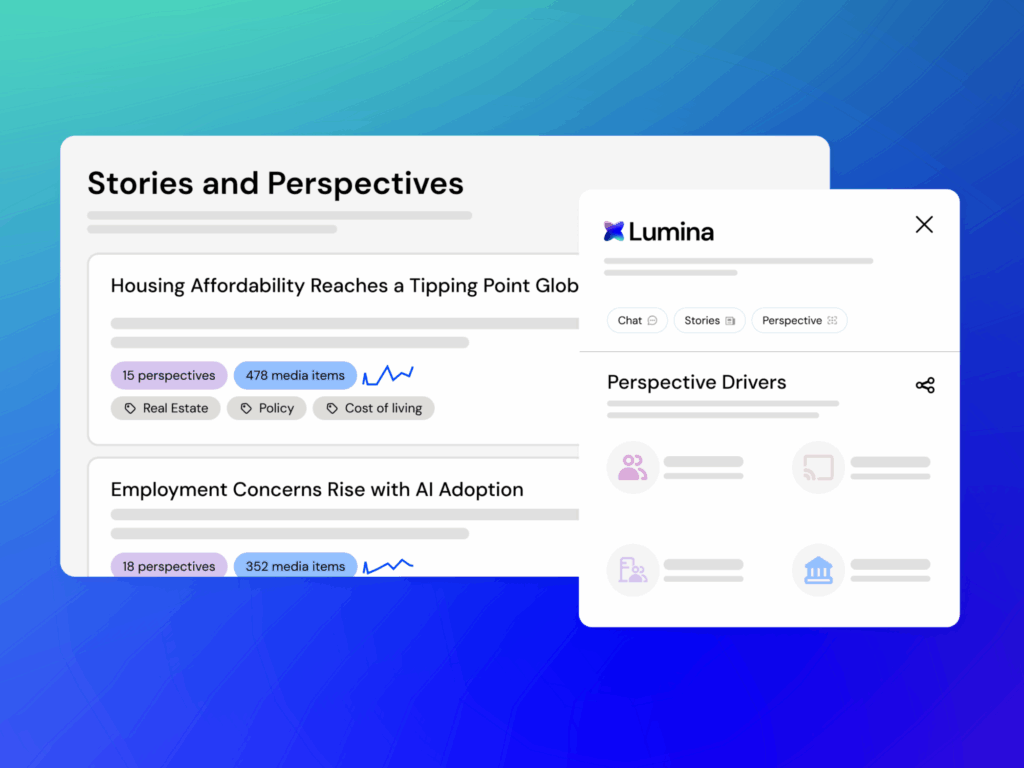
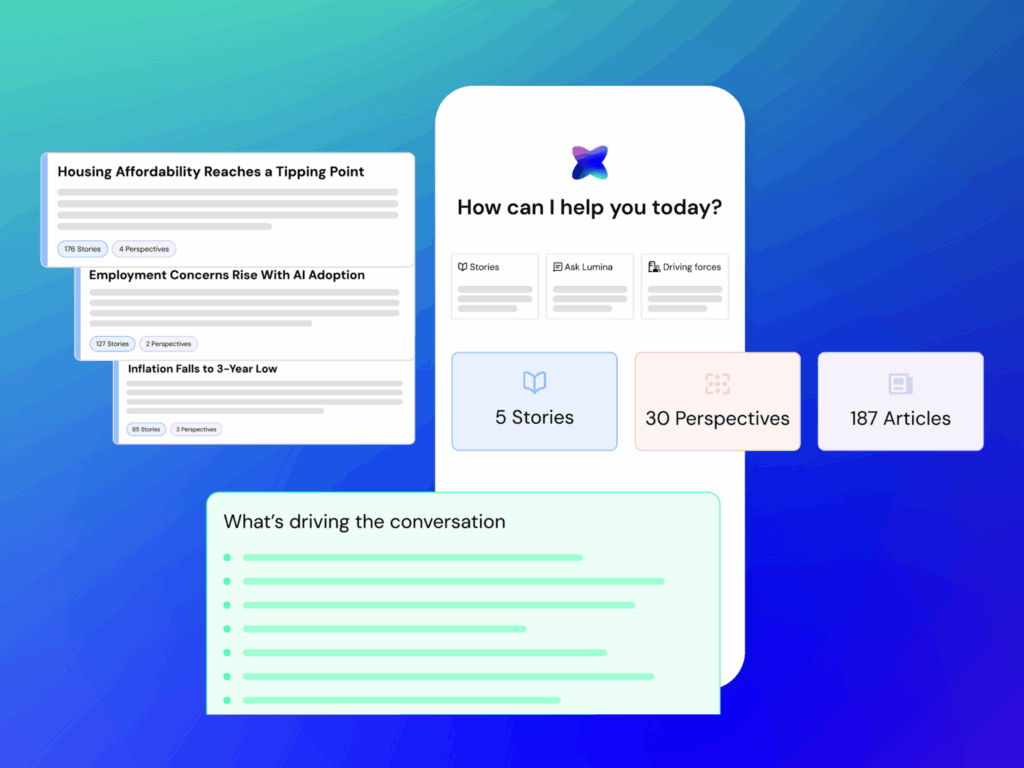
Stories & Perspectives organizes raw media mentions into clustered, cohesive Stories, and the Perspectives that exist within each, reflecting distinct media, audience, and public affairs angles. This unique functionality allows users to:
Rise above the noise: Instantly identify which high-level topics are gaining momentum or fading from attention.
Get to the detail, fast: Uncover the influential voices, niche communities, and specific channels actively shaping the narrative.
Catch the pivot point: Precisely identify the moment a story shifts—from a strategic opportunity to a reputation risk—or when a new key opinion former begins guiding the conversation.
"Media isn’t a stream of mentions," said Kyle Lindsay, Head of Product at Pulsar Group. "But rather a living system of stories shaped by competing perspectives. When you can see those structures clearly, you gain the ability to understand issues as they form, anticipate how they’ll evolve, and act with precision. That’s what we mean when we talk about AI built for communicators, and that's what an off-the-shelf LLM can't give you."
The Lumina Roadmap: AI tools for the future of comms
The launch of Stories & Perspectives is the first release of many. Over the upcoming months, we will systematically roll out the full Lumina roadmap, introducing a comprehensive set of AI tools engineered to handle every phase of the communications lifecycle.
The full Lumina suite will soon incorporate:
Curated media summaries: AI-driven daily summaries customized specifically to the priorities of senior leadership, highlighting only the most relevant stories.
Reputation analysis: Advanced measurement tracking how critical themes like ethics, innovation, and leadership are statistically shaping corporate perception.
Press release & media relations assistant: Tools designed to accelerate content creation and craft hyper-focused, personalized pitches that reach the precise contacts faster.
Predictive intelligence layer: Technology engineered to track and anticipate story momentum and strategic change before the window of opportunity closes.
Intelligent agents: Background agents continuously scanning all media channels for emerging key spokespeople and previously undetected reputation risks.
Enhanced audio, broadcast & crisis detection: Complete, real-time oversight of all channels—including audio and broadcast—enabling rapid context building and optimal crisis response delivery.
Want to harness the power of Lumina AI for your PR, Comms, or Public Affairs team? .
Complete the form below to register your interest.
"
["post_title"]=>
string(79) "Announcing Lumina: The purpose-built AI suite for PR, Comms, and Public Affairs"
["post_excerpt"]=>
string(129) "An intelligent suite of AI tools trained on the language, workflows, and realities of modern public relations and communications."
["post_status"]=>
string(7) "publish"
["comment_status"]=>
string(4) "open"
["ping_status"]=>
string(4) "open"
["post_password"]=>
string(0) ""
["post_name"]=>
string(76) "announcing-lumina-the-purpose-built-ai-suite-for-pr-comms-and-public-affairs"
["to_ping"]=>
string(0) ""
["pinged"]=>
string(0) ""
["post_modified"]=>
string(19) "2026-04-29 06:04:22"
["post_modified_gmt"]=>
string(19) "2026-04-29 06:04:22"
["post_content_filtered"]=>
string(0) ""
["post_parent"]=>
int(0)
["guid"]=>
string(32) "https://www.isentia.com/?p=43742"
["menu_order"]=>
int(0)
["post_type"]=>
string(4) "post"
["post_mime_type"]=>
string(0) ""
["comment_count"]=>
string(1) "0"
["filter"]=>
string(3) "raw"
}
Blog
Announcing Lumina: The purpose-built AI suite for PR, Comms, and Public Affairs
An intelligent suite of AI tools trained on the language, workflows, and realities of modern public relations and communications.